


Step-by-step STI testing guide for home use
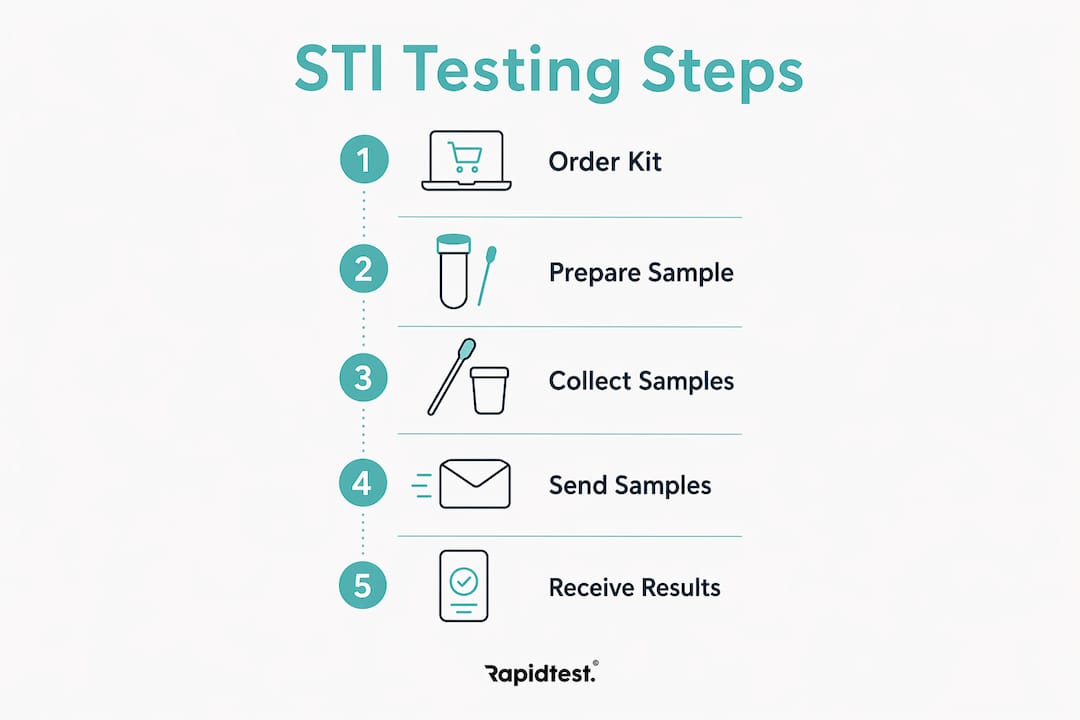
Yes, you can reliably screen for the most common STIs at home. Whether you use a mail-back self-sampling kit or a rapid point-of-care device like Rapidtest (which gives you results in about ten to fifteen minutes), the process is straightforward when you follow the right steps. Here is your immediate checklist:
- Choose the right kit based on the sexual activity you have had (oral, anal, vaginal) and the infections you want to screen for.
- Prepare correctly — avoid douching, vaginal creams, or sexual intercourse shortly before sampling where your kit instructs.
- Wait the window period for the infection you are testing for before you collect samples.
- Collect every sample exactly as instructed — swab technique and urine catch method matter more than most people realise.
- Return samples or read rapid results promptly and follow the kit’s guidance.
- Seek clinic follow-up for any positive result, or visit a sexual health service immediately if you have symptoms such as sores, discharge, or pain.
Pro Tip: If you have symptoms right now, do not wait for a home kit result. Book an appointment with a sexual health clinic or your GP today — home testing is designed for asymptomatic screening, not clinical diagnosis.
Table of Contents
- What is at-home STI self-sampling and who is it for?
- What to do before you test: timing, window periods and preparation
- How to get an at-home STI test kit in the UK
- How to collect each sample type: step-by-step
- What to do after collecting your samples
- How to understand your results and what to do next
- How accurate is home testing and when should you go to a clinic?
- Practical tips that actually improve your results
- Key takeaways
- Why at-home testing deserves more credit than it gets
- Rapidtest makes private STI screening straightforward
- Useful sources
- FAQ
What is at-home STI self-sampling and who is it for?
Self-sampling means you collect your own specimens at home: a urine sample, a swab from the vagina, throat, or rectum, or a finger-prick blood sample. You then either send those samples to a laboratory by post or process them with a rapid device that gives you a result on the spot.
Self-sampling is highly effective for routine screening in people without symptoms. If you have symptoms, a clinic can examine you physically, which a home kit simply cannot do.
Who it suits:
- Sexually active adults who want private, convenient routine screening.
- People who have had a new partner or unprotected sex and want to check in.
- Those who find clinic appointments difficult to access or prefer discretion.
- Couples who want to test together before stopping barrier contraception.
When it is not enough on its own:
- You have visible sores, unusual discharge, pain, or bleeding.
- You need a cervical examination or visual inspection of the genitals.
- A previous home test came back positive and needs clinical confirmation.
One thing worth knowing: STI testing is not automatically included in routine GP or gynaecological check-ups. You usually need to ask for it specifically, which is exactly why home testing has become such a practical option for proactive screening.
What to do before you test: timing, window periods and preparation
Getting the timing right is probably the single most important thing you can do before you even open the kit. Testing too early after exposure can produce a false negative because the infection has not yet reached detectable levels.
Window periods to know
Window periods vary depending on the infection, generally ranging from a few days to several weeks for most common STIs.
Always check your specific kit’s instructions for the window period it recommends, as testing too early after exposure can produce false negatives. When in doubt, consult a clinician.
Before you test, avoid:
- Douching or using vaginal creams for at least 24 hours before a urine or swab test, as these can interfere with accuracy.
- Sexual intercourse in the hours before a swab or urine sample where your kit advises against it.
- Urinating for at least one hour before a urine sample (to ensure first-catch concentration).
- Eating, drinking, or smoking for 30 minutes before a throat swab.
Test-day checklist:
- Read all instructions fully before opening any packaging.
- Prepare a clean, flat surface with good lighting.
- Have tissues, a timer, and a pen ready.
- Check the freepost envelope is included (mail-back kits) or that your rapid device has fresh batteries or is charged.
- Confirm your contact details match the form if you are mailing samples to a lab.
Pro Tip: Take a photo of your kit barcode before you post anything. If a sample goes missing in transit, you will need that reference number to request a replacement.
How to get an at-home STI test kit in the UK
You have a few routes, and the right one depends on what you need tested and how quickly you want results.
Your options:
- NHS sexual health services — some local services offer free self-sampling kits by post. Availability varies by area; search via the NHS website or Sexual Health London (SH:24) if you are in London.
- Sexual health charities — organisations such as Sexual Health London provide free postal kits for eligible residents.
- Private providers like Rapidtest — order online for discreet delivery, with rapid at-home STI kits that give results in about ten to fifteen minutes without lab returns for supported tests.
How to choose the right panel:
- Think about the sexual acts you have had: oral, anal, and vaginal sex each carry different infection risks and require different sample sites.
- Choose throat or rectal swabs when oral or anal sex has occurred, because a urine test alone will miss infections at those sites.
- Decide whether you need rapid results (Rapidtest devices) or are happy to wait a few days for a lab-processed result.
- Check which infections the kit covers: common panels include chlamydia, gonorrhoea, syphilis, HIV, hepatitis B, hepatitis C, HSV-2, and HPV.
Before you confirm your order, check:
- Which sample types are included (urine, swabs, blood).
- Turnaround time: rapid device (about ten to fifteen minutes) versus mail-back lab (a few days to a week).
- Whether freepost return is included.
- The provider’s privacy and data protection policy, and whether packaging is discreet.
How to collect each sample type: step-by-step
At-home kits can include urine, finger-prick blood, and throat, anal, or vaginal swabs depending on the sexual practices you report when ordering. Here is exactly how to collect each one.
Urine (first-catch technique)
- Do not urinate for at least one hour beforehand.
- Open the collection cup without touching the inside.
- Begin urinating and collect the first 20–30 ml of the stream directly into the cup. Do not use midstream urine for this test.
- Seal the cup immediately and transfer to the provided tube if required.
- Label the sample and place it in the biohazard bag.
For more detail on discreet urine collection, Rapidtest has a dedicated guide.
Vaginal swab
- Wash your hands thoroughly.
- Remove the swab from its packaging without touching the tip.
- Insert the swab about 5 cm into the vaginal opening.
- Rotate gently for 15–30 seconds, applying light but consistent pressure against the vaginal wall.
- Withdraw carefully, place in the transport tube, and seal.
Throat swab
- Stand in front of a mirror with good light.
- Say “ahh” to lower your tongue and open the throat.
- Swab the back of the throat and both tonsil areas firmly, avoiding the tongue and teeth.
- Rotate for 5–10 seconds with moderate pressure.
- Place in the transport tube immediately.
Rectal swab
- Relax and find a comfortable position.
- Insert the swab approximately 2–3 cm into the rectum.
- Rotate for 10–15 seconds with gentle but firm pressure against the rectal wall.
- Withdraw and place in the transport tube.
Finger-prick blood sample
- Warm your hand by rubbing it or running it under warm water for two minutes.
- Clean the fingertip with the alcohol wipe provided and allow it to dry fully.
- Use the lancet on the side of the fingertip (less painful than the pad).
- Wipe away the first drop of blood with a clean tissue.
- Gently squeeze from the base of the finger toward the tip to encourage blood flow, and collect drops onto the collection card or into the tube as instructed.
- Apply the plaster provided once collection is complete.
Pro Tip: Never touch the swab tip with your fingers at any point. Even brief contact can contaminate the sample and cause an invalid result.
Swab quality is the most common cause of invalid or false-negative home samples. Insufficient rotation, light pressure, or touching the swab tip all reduce the yield. Take your time with each swab.
Common errors to avoid:
- Using midstream rather than first-catch urine.
- Swabbing only the entrance of the vagina rather than inserting fully.
- Skipping the throat or rectum because it feels awkward — these sites matter if you have had oral or anal sex.
- Letting a blood sample dry on the finger before collecting it.
What to do after collecting your samples
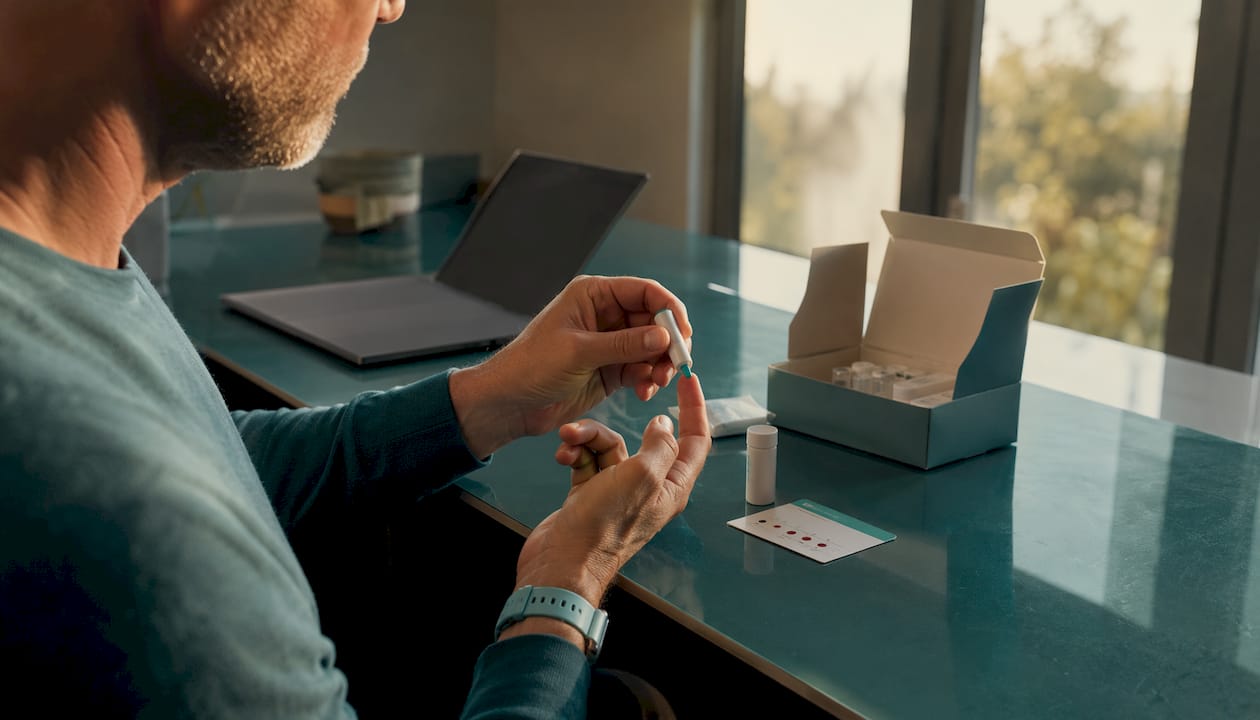
Once you have collected everything, the next few steps are just as important as the sampling itself.
Packaging checklist:
- Seal each swab transport tube tightly and check for leaks.
- Place all samples in the biohazard bag provided.
- Complete the request form fully (name, date of birth, date of collection, sample types).
- Seal the freepost envelope and post it the same day if possible. Avoid posting on a Friday if your kit advises against weekend transit.
- Keep samples at room temperature until posted; do not refrigerate unless the kit specifically instructs it.
Timelines:
- Mail-back kits — lab processing usually takes a few days, with results sent by text, email, or app notification.
- Rapidtest rapid devices — results appear in about ten to fifteen minutes at home, with no lab return needed for supported tests.
While you wait:
- Avoid new sexual partners or use barrier protection until you have your results.
- Note any new symptoms and contact a clinic promptly if they develop.
- Follow any urgent guidance from your provider if they contact you before results are ready.
How to understand your results and what to do next
Negative results
A negative result is reassuring, but it does not always rule out a recent exposure. A negative home test may not exclude recent infection if you tested within the window period. If your exposure was recent, follow your kit’s guidance on repeat testing at the appropriate interval.
Positive results
A positive result needs clinical follow-up. Contact your GP or a sexual health clinic to arrange confirmatory testing and, where appropriate, treatment. Most bacterial STIs (chlamydia, gonorrhoea, syphilis) are treatable with antibiotics. Partner notification is important: your sexual health service can help with this confidentially, or you can tell partners directly. You can also book a telehealth appointment quickly if you want to discuss your result with a clinician before attending in person.
Pro Tip: A positive rapid result from a home device is a strong indicator, not a final diagnosis. Always seek clinical confirmation before starting any treatment.
Inconclusive or invalid results
These happen when a sample is insufficient, the swab was contaminated, or postal delays affected sample quality. Contact your provider to request a replacement kit. If you receive a second inconclusive result, visit a sexual health clinic for professionally collected samples.
For a clear walkthrough of reading your STI test results, Rapidtest’s guide covers both rapid device and mail-back kit interpretation.
How accurate is home testing and when should you go to a clinic?
Home self-sampling is accurate for routine screening when samples are collected correctly and at the right time. The main factors that affect accuracy are sample quality, timing after exposure, and whether you have tested the right anatomical sites.
Common causes of false negatives:
- Testing within the window period.
- Poor swab technique (insufficient rotation or pressure).
- Relying on urine alone when throat or rectal infections are possible.
- Postal delays degrading sample quality.
Site limitations: urine tests detect chlamydia and gonorrhoea in the urethra but will miss the same infections in the throat or rectum. Sexual history should drive which samples you collect — if you have had oral or anal sex, include the relevant swabs.
When to attend a clinic instead of testing at home: Go to a sexual health service if you have active symptoms (sores, heavy discharge, severe pain, or bleeding), if a rapid test is positive and needs clinical confirmation, if you have had a high-risk exposure and need post-exposure prophylaxis (PEP), or if you have received two inconclusive home results in a row.
Practical tips that actually improve your results
Most invalid home samples come down to one thing: swab technique. People consistently underestimate how much rotation and pressure is needed. Watch the video guide included with your kit, or find one on the provider’s website, before you start.
Timing and window periods:
- Do not test the morning after a risk event. Wait the full window period for the infection you are most concerned about.
- If you are unsure which window period applies, the CDC’s testing guidance and your kit’s instructions are the two best references.
Privacy and recordkeeping:
- Note the date and time of each sample collection on the form and in your phone.
- Keep a photo of the kit barcode until results arrive.
- Track your postage confirmation or app notification so you know the sample reached the lab.
Pro Tip: If you are testing for multiple infections, collect swabs in this order: throat first, then vaginal or rectal. This avoids cross-contamination between sites and keeps each sample as clean as possible.
- Use safe and accurate home testing practices every time, not just the first time.
- If you test regularly (every three to six months is common for sexually active adults with multiple partners), keep a simple log so you can spot any gaps.
Key takeaways
Home STI self-sampling is reliable for asymptomatic screening when you choose the correct sample sites, follow pre-test preparation, collect samples with proper technique, and act promptly on any positive result.
| Point | Details |
|---|---|
| Choose the right sample sites | Base your kit selection on your sexual history — include throat and rectal swabs if you have had oral or anal sex. |
| Respect window periods | Testing too early risks a false negative; check your kit instructions for the specific detection window. |
| Swab technique is critical | Rotate with firm, consistent pressure for the full recommended duration — this is the most common failure point. |
| Act on positive results | Arrange clinical confirmation and treatment through your GP or a sexual health service; notify partners. |
| Rapidtest for rapid results | Rapidtest’s at-home rapid kits give results in about ten to fifteen minutes with no lab return needed for supported tests. |
Why at-home testing deserves more credit than it gets
There is a tendency to treat home STI testing as a second-best option, something you do when you cannot get a clinic appointment. That framing undersells what self-sampling actually does well.
For asymptomatic screening, which is the majority of STI testing that needs to happen, a well-collected home sample processed by a quality laboratory is clinically equivalent to a clinic-collected one. The weak link is not the test itself. It is the human collecting the sample. That is why technique guidance matters so much, and why providers who include clear video instructions produce better results than those who rely on a folded leaflet.
The other thing people underestimate is how much the privacy factor changes behaviour. People who would delay or avoid a clinic appointment because of embarrassment, time pressure, or geography will test at home. That means infections get caught earlier. From a public health perspective, a slightly imperfect home test that actually gets done beats a theoretically superior clinic test that never happens.
Where home testing genuinely falls short is when symptoms are present. A kit cannot examine you. It cannot see a sore, assess discharge, or feel for swollen lymph nodes. If something looks or feels wrong, a clinic visit is not optional.
Rapidtest makes private STI screening straightforward
Skip the waiting room. Rapidtest’s at-home rapid STI kits give you results in about ten to fifteen minutes, with no lab return and no appointment needed for supported tests. Kits arrive in discreet packaging, full step-by-step instructions are included, and the range covers chlamydia, gonorrhoea, syphilis, HIV, hepatitis B, hepatitis C, HSV-2, and HPV.
This guide has walked you through every stage of the STI testing process, from choosing the right panel to acting on your results. Rapidtest’s rapid devices fit directly into that workflow for the moments when you want a clear answer at home, fast. When lab confirmation or clinical assessment is needed, NHS sexual health services and your GP remain the right next step. Head to the Rapidtest STI kit page to check which infections are covered and place your order today.
Useful sources
- UKHSA: Getting tested for an STI — UK public health guidance on self-sampling, pre-test preparation, and when to attend a clinic.
- NHS: HIV PEP service finder/LocationSearch/420) — locate your nearest NHS sexual health service for urgent post-exposure support.
- CDC: Getting tested for STIs — background on testing types, site selection, and window periods.
- MedlinePlus: STI tests — clear overview of test types, who should be screened, and what results mean.
- Mayo Clinic: STD testing — what’s right for you? — practical guidance on choosing tests and understanding results.
- Rapidtest: STI screening process at home — UK guide — UK-specific guidance on access, privacy, and clinic referral pathways.
This article is general information, not medical advice. For your own situation, confirm current guidelines with a qualified sexual health professional or your GP.
FAQ
Can you test for all STIs at home?
Home kits cover the most common infections including chlamydia, gonorrhoea, syphilis, HIV, hepatitis B, hepatitis C, HSV-2, and HPV, but some conditions require a physical examination or clinic-collected samples that home kits cannot replicate.
How long does it take to get results from a home STI test?
Mail-back kits typically return results within a few days of the lab receiving your sample. Rapidtest’s rapid devices give results in about ten to fifteen minutes at home with no lab return needed.
What should you do if your home STI test is positive?
Contact your GP or a sexual health clinic to arrange confirmatory testing and treatment. Notify any recent sexual partners so they can also be tested.
How do window periods affect your home test result?
Testing before the window period has passed can produce a false negative even if you are infected. Always check your kit’s specific window period guidance and repeat the test at the recommended interval if your exposure was recent.
Is home STI testing private in the UK?
Most UK providers, including Rapidtest, use discreet packaging with no identifying branding on the outside. Check your provider’s privacy policy for details on how your data and results are handled.