


How to use at-home STI tests safely and accurately
Booking an STI test at a clinic can feel like a lot. The waiting rooms, the scheduling, the explaining yourself to a stranger. It’s no wonder so many people just put it off. At-home STI test kits change all of that. You collect your own sample, post it off, and get your results privately, usually within a few days. No queues, no awkward conversations, no rearranging your whole day. This guide walks you through everything: what’s in the kit, how to use it step by step, what your results mean, and how to avoid the most common mistakes.
Table of Contents
- Understanding home STI test kits: What you need to know
- Step-by-step guide: Using an at-home STI test kit
- Accuracy, reliability, and what your results mean
- Common mistakes and troubleshooting tips
- A fresh perspective: Why at-home STI testing is changing the landscape
- Ready to take control of your sexual health?
- Frequently asked questions
Key Takeaways
| Point | Details |
|---|---|
| Convenient and private | At-home STI tests let you check your sexual health discreetly and on your own time. |
| Accuracy matches clinics | When instructions are followed, home tests are about as accurate as clinic tests for most common STIs. |
| Simple step-by-step process | Order, collect samples, mail them, and get results within days—no appointments needed. |
| Mistakes can be fixed quickly | Providers usually offer replacements and guidance if you make a mistake during testing. |
| Choose the right testing option | Home kits suit most routine checks, but visit a clinic for symptoms or less common infections. |
Understanding home STI test kits: What you need to know
Now that you understand why home testing might be right for you, let’s look at what you actually get and how these kits work.
Home STI test kits cover a wider range of infections than most people expect. The most common ones tested include chlamydia, gonorrhea, HIV, syphilis, hepatitis B, and hepatitis C. Some kits also screen for herpes and HPV, though these are less standard. What you’re tested for depends on which kit you order, so it’s worth reading the product description carefully before you buy.
The privacy and convenience benefits of these kits are a big reason they’ve grown so popular. But it also helps to know exactly what sampling methods are involved. Home STI test kits typically involve self-sampling methods such as urine collection, vaginal swabs, throat swabs, rectal swabs, and finger-prick blood samples. Each method targets different infections, so multi-infection kits often ask for more than one sample type.
Here’s a quick breakdown of which sample does what:
- Urine sample: Used to detect chlamydia and gonorrhea
- Vaginal or penile swab: Used for chlamydia, gonorrhea, and sometimes herpes
- Throat and rectal swabs: Important if you’ve had oral or anal sex
- Finger-prick blood sample: Used to test for HIV, syphilis, hepatitis B, and hepatitis C
In the UK, you can order free kits through the NHS or services like SH:24 and SH.UK. Private providers are also widely available across the UK and Europe, with kits typically ranging from £20 to £80 depending on how many infections are covered. The advantages of home testing go beyond cost, of course, but affordability is a real factor for a lot of people.
What’s inside a standard home STI kit:
| Item | Purpose |
|---|---|
| Sample collection tools | Swabs, urine pot, lancet for blood |
| Instruction leaflet | Step-by-step guidance |
| Prepaid return envelope | For posting your sample to the lab |
| Biohazard bag | Safe containment during transit |
| Consent or registration form | Links your sample to your account |
Pro Tip: If you have active symptoms like unusual discharge, sores, or pain, skip the home kit and go to a clinic. Home kits prioritize privacy and convenience but clinics are better equipped for complex or symptomatic cases. The how self-testing kits work explainer on our blog is a good place to go deeper on the mechanics.
Step-by-step guide: Using an at-home STI test kit
With all your materials at hand, here’s exactly how you’ll use your kit from start to finish.
- Order your kit online from the NHS, SH.UK, or a private provider. Choose a kit that covers the infections most relevant to your sexual history.
- Register your kit online using the barcode or unique reference number inside the box. This links your sample to your account so results can be sent securely.
- Read the instructions fully before touching anything. This takes five minutes and saves a lot of frustration.
- Collect your urine sample using the first catch method. Do not urinate for at least one hour before collecting. Fill the container to the marked line only.
- Take swab samples by rotating the swab gently in the correct location for the required number of seconds. Don’t rush this part.
- Complete the finger-prick blood sample if required. Warm your hands first to help blood flow. Use the lancet on the side of your fingertip, not the pad.
- Package everything in the biohazard bag, then seal it inside the return envelope provided.
- Post your sample the same day if possible. The self-testing collection steps follow a standard format, and timing really does matter.
The step-by-step process from ordering to receiving results typically takes 2 to 5 days once your sample reaches the lab.
| Step | Action | Time needed | Key tip |
|---|---|---|---|
| Order | Choose and register kit | 5 minutes | Pick the right infection panel |
| Collect | Follow sample instructions | 10 to 15 minutes | No urinating 1 hour before urine test |
| Package | Seal in biohazard bag | 2 minutes | Double check nothing is missing |
| Post | Mail same day | 5 minutes | Use a Royal Mail priority postbox |
Important: Never freeze your samples. Keep them at room temperature and post them as soon as possible. If you can’t post the same day, refrigerate the sample and send it the next morning. Do not post on a Friday or over a weekend if you can avoid it.
Pro Tip: Post your sample between Sunday and Thursday to avoid it sitting in a sorting office over the weekend. Many providers also include a video tutorial link in their packaging. Watch it. It takes three minutes and genuinely improves accuracy.
Accuracy, reliability, and what your results mean
You’ve posted your sample. What comes next, and just how trustworthy are those results?
Home STI tests processed in a certified lab are highly accurate when used correctly. The key phrase there is “when used correctly.” Accuracy is comparable to clinic testing for most infections as long as you follow the instructions. The tricky part is blood sampling. Finger-prick samples can be slightly less reliable if you don’t collect enough blood or if the sample is handled poorly.
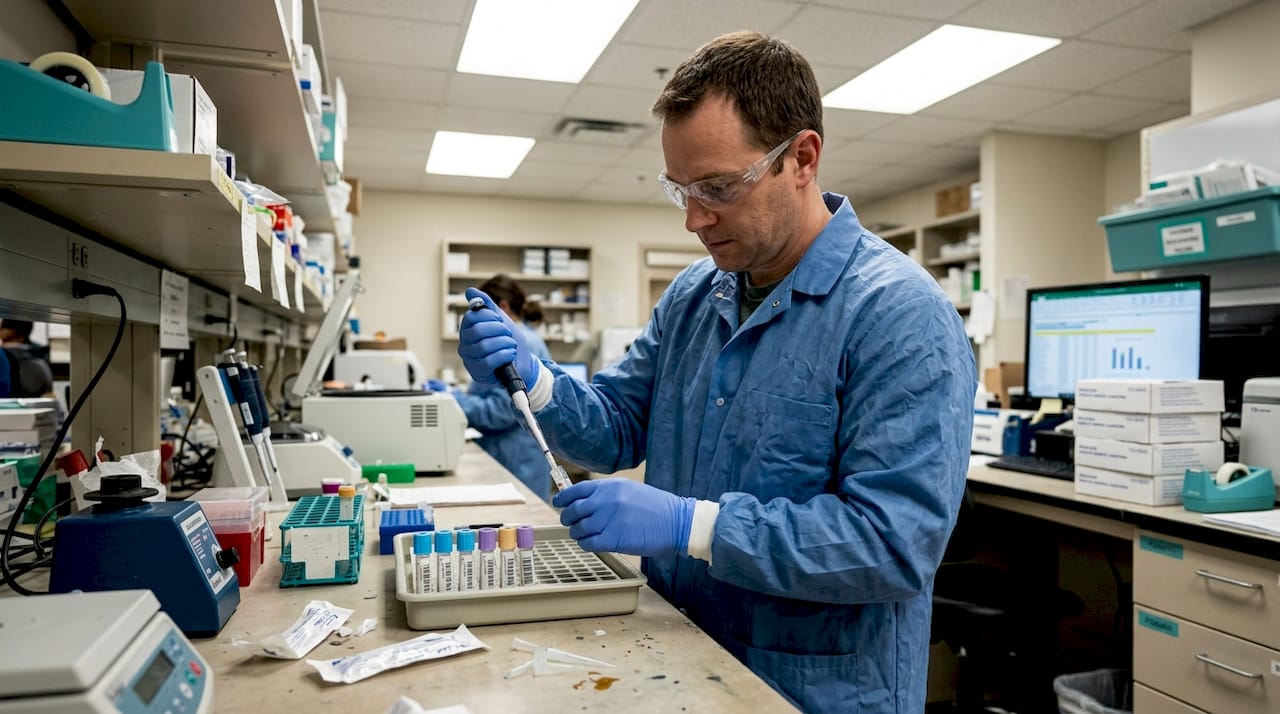
Sensitivity (meaning the test’s ability to correctly detect an infection) can reach up to 94% compared with clinician-collected samples. That’s genuinely reassuring. Here’s how home testing stacks up:
| Infection | Home test sensitivity | Clinic test sensitivity |
|---|---|---|
| Chlamydia | 90 to 94% | 95 to 99% |
| Gonorrhea | 88 to 93% | 95 to 99% |
| HIV | 92 to 96% | 97 to 99% |
| Syphilis | 88 to 92% | 95 to 98% |
Three key factors affect reliability:
- Sample quality: Did you collect enough? Was it contaminated?
- Timing: Did you test too soon after potential exposure? Some infections need a window period before they show up.
- Storage and posting: Was the sample exposed to extreme heat or delayed?
Results are typically delivered via a secure app, text message, or online portal within 2 to 5 days of the lab receiving your sample. Here’s what to do based on your outcome:
- Negative result: Great news. Keep testing regularly based on your activity level, ideally every 3 to 6 months if you have multiple partners.
- Positive result: A clinician from the provider will contact you directly and confidentially. Treatment is usually straightforward and fast. Don’t panic.
- Unclear or void result: This usually means a sample issue. Contact your provider for a replacement kit.
For a deeper look at this topic, the home test accuracy explained and interpreting your STI results guides are both worth a read.
Common mistakes and troubleshooting tips
Even with simple instructions, a few missteps can affect your results. Here’s what to look out for.
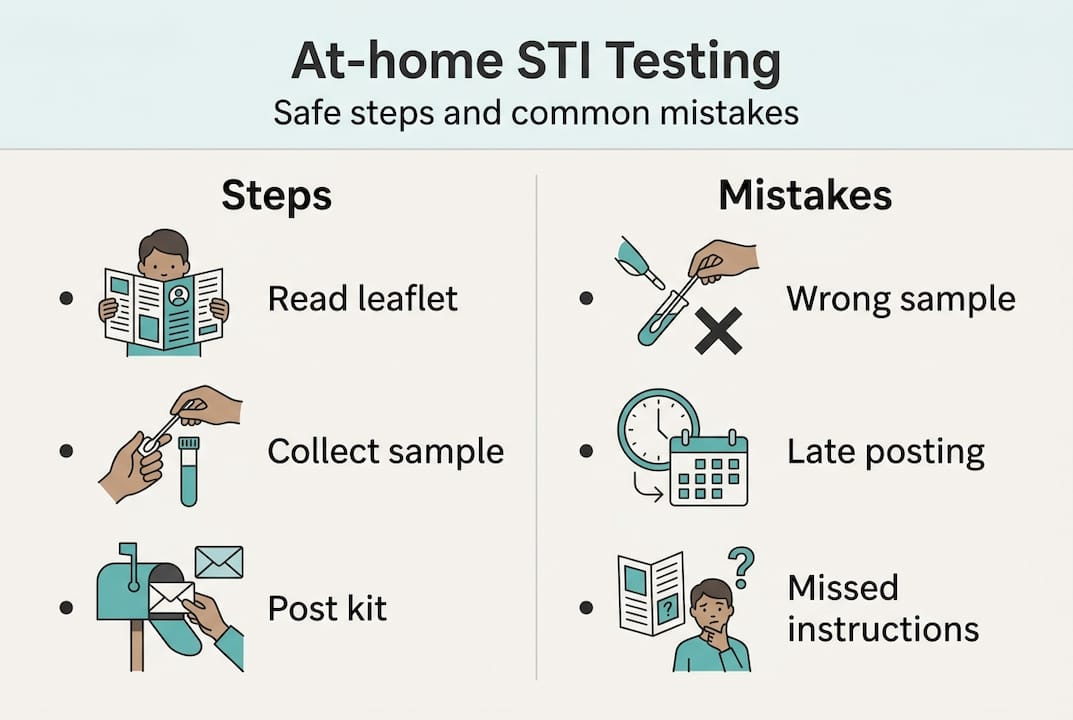
The good news is that most errors are totally avoidable. Return rates for home STI kits sit at 60 to 80% and accuracy is highest when instructions are closely followed. The bad news is that the most common mistakes are also the most predictable.
Top 5 mistakes people make:
- Not reading the instructions first. Jumping straight in is the number one cause of collection errors.
- Urinating too soon before a urine test. You need to wait at least one hour. Less time means a diluted sample.
- Mislabeling samples. If you’re collecting multiple sample types, label everything immediately after collection.
- Delayed posting. Samples degrade. Posting on a Friday and letting the kit sit in a postbox for three days will affect results.
- Not collecting enough blood. Finger-prick samples need a specific volume. Warming your hands first and letting your arm hang down before pricking helps.
What to do when things go wrong:
- Spilled a sample? Contact your provider. Most will send a replacement kit free of charge.
- Instructions aren’t clear? Every reputable provider has a helpline or live chat. Use it.
- Can’t get blood from the finger-prick? Try a different finger, warm your hands under hot water for two minutes, and try the other hand.
- Missing an item from your kit? Again, call or message your provider right away.
For more practical guidance, the private STI testing tips on our blog cover some of the trickier scenarios in more detail.
Pro Tip: Watch the video tutorial your provider includes or links to. Studies consistently show that people who watch them collect better samples and make fewer mistakes. It’s three minutes well spent.
A fresh perspective: Why at-home STI testing is changing the landscape
Here’s something most guides won’t tell you: at-home STI testing isn’t just a convenience upgrade. It’s quietly reshaping how sexual health is managed at a population level.
When testing becomes private and easy, more people actually do it. That includes younger adults, people in rural areas, and anyone who has historically avoided clinics out of fear or stigma. Those are exactly the groups where infections often go undetected longest.
Self-tests are driving declining rates of STIs in some areas and offer accuracy close to clinic-based approaches. That’s a meaningful public health shift, not just a personal convenience.
The biggest myth we’d push back on is that home testing is somehow a second-rate option. For routine screening in people without symptoms, it’s not. The lab processes your sample the same way regardless of who collected it. What matters is that you follow the instructions.
The real opportunity here is normalization. Regular testing, done privately and easily at home, removes the emotional weight that stops so many people from ever getting checked. If you’re using at-home STI testing as part of your regular health routine, you’re ahead of the curve.
Ready to take control of your sexual health?
If you’ve read this far, you’re clearly taking your health seriously. That matters. And the next step is simple.
At Rapidtest, we make it easy to get tested without the wait, the awkward conversations, or the need to book an appointment. Our at-home STI test kits deliver results in just 15 minutes, right at home. If you want rapid results with no lab involved, check out our 15-minute STI rapid test. Or browse the full range of our discreet STI screening kits to find the right fit for you. Fast, accurate, and completely private.
Frequently asked questions
How do I know if I should use a home STI test or go to a clinic?
If you have symptoms or need a wider range of tests, visit a clinic. Home kits are ideal for routine checks when you feel well and value privacy. Clinic-based testing is the better option for complex or symptomatic cases.
How quickly will I get my results from a home STI test?
You’ll usually get your results within 2 to 5 days after returning your sample. Results are delivered via a secure app, text, or online portal.
How accurate are at-home STI tests compared to clinic tests?
When used as instructed, home STI tests reach 90 to 94% sensitivity compared to clinician-collected samples for most infections.
What if I make a mistake when collecting my sample?
Contact your kit provider right away. They can usually send a replacement kit and offer guidance to help you get it right the second time. Support is available for most collection errors.