


How to read STI test results: at-home kit guide
That moment when you’re staring at a test strip, heart rate slightly elevated, wondering what those lines actually mean — it’s more common than you think. Reading at-home STI test results shouldn’t feel like decoding a foreign language. This guide walks you through every step, from preparing your kit to understanding what each result means and what to do next. Whether you’re testing for the first time or the tenth, clarity matters. And for men over 40 who are sexually active, getting that clarity quickly and privately can make a real difference to your health and peace of mind.
Table of Contents
- What you need before checking your STI results
- Step-by-step: How to decode your at-home STI test results
- Common mistakes and how to avoid them
- What to do next: Interpreting results and follow-up
- Why understanding your test matters more than you think
- Fast, private STI results — take control at home
- Frequently asked questions
Key Takeaways
| Point | Details |
|---|---|
| Prepare carefully | Gather all kit materials and follow instructions to ensure accurate reading of your at-home STI test results. |
| Interpret results step-by-step | Read both control and test indicators as directed for a valid result and know what each outcome means. |
| Avoid common mistakes | Be careful with timing, handling, and interpreting faint or unclear results to minimize errors. |
| Take action after testing | If results are positive or unclear, consult a healthcare provider and avoid sexual contact until confirmed. |
What you need before checking your STI results
You understand the importance — now set yourself up for success before you touch your test kit. Getting your preparation right is half the battle. Rushing through the setup phase is one of the most common reasons people misread results or end up with invalid tests.
Here’s what you should have ready before you start:
- Your test kit with all components intact (lancet, swab, collection tube, result window)
- A clean, well-lit surface so you can see result lines clearly
- A timer — most kits require you to read results at a specific minute mark
- Your kit’s instruction leaflet open and within sight
- A glass of water if a urine sample is needed (and you haven’t urinated for at least one hour)
- Good lighting — natural light or a bright lamp, not a dim bathroom bulb
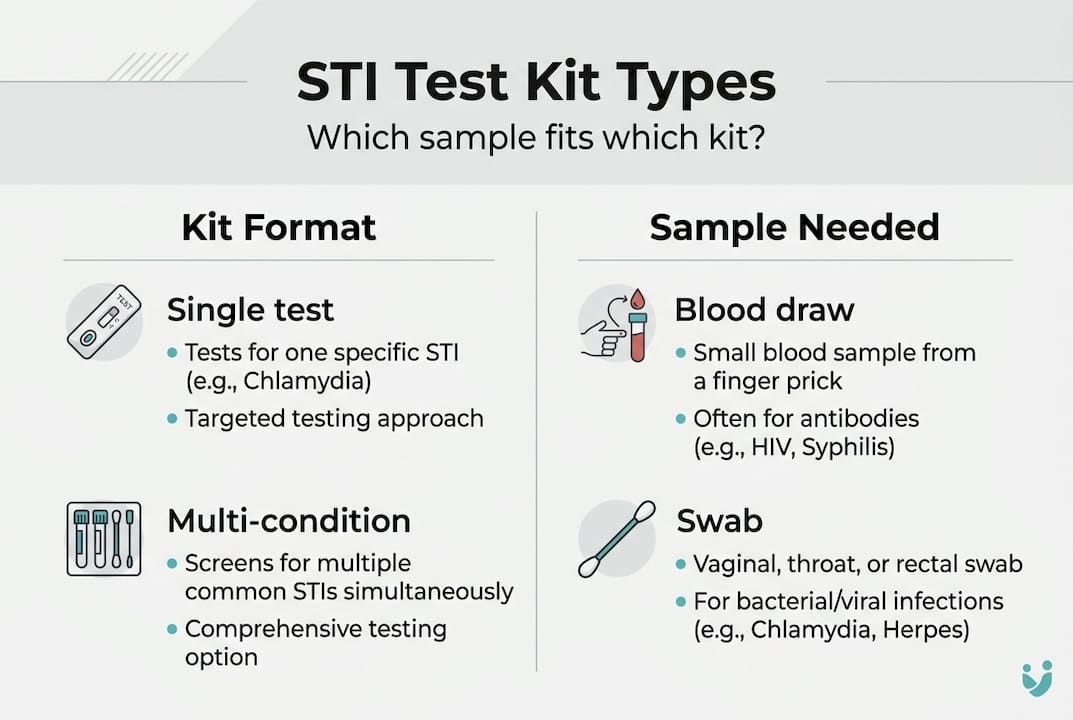
At-home STI tests come in a few different formats. Single-condition tests focus on one infection, like chlamydia or HIV. Panel tests screen for multiple infections at once, which is useful if you want broader coverage in one go. You can read more about STI test basics to understand which format suits your situation.
| Test type | What it screens for | Sample needed |
|---|---|---|
| Single test (e.g., HIV) | One specific STI | Blood or saliva |
| Chlamydia/gonorrhea | One or two STIs | Urine or swab |
| Panel test | Multiple STIs at once | Blood, urine, swab |
Following the instructions precisely is non-negotiable. Home kits are reliable for routine screening when instructions are followed correctly. Cut corners, and you risk an inaccurate result. It really is that straightforward.
If you’re a man who has sex with men (MSM), or you’re in a higher-risk group, pay close attention to swabbing instructions. Some kits require throat or rectal swabs in addition to urine samples. Skipping those can leave infections undetected. The benefits of home testing are real, but only when you use the kit properly.
Pro Tip: Lay out every component before you begin. A quick visual check ensures nothing is missing and prevents mid-test panic.
Step-by-step: How to decode your at-home STI test results
With everything ready, walk through precisely how to interpret your at-home STI test results. Most at-home STI kits use one of three display formats: line-based strips, color-change indicators, or digital readouts.
Reading line-based strips (the most common format):
- Apply your sample to the test area as instructed
- Start your timer immediately
- Wait the full recommended time — usually 15 minutes
- Look at the result window for lines labeled C (control) and T (test)
- Read your result based on the guide below
- Photograph the result if you need to share it with a healthcare provider
- Dispose of the kit safely according to the instructions
Here’s how to interpret what you see:
| Result | What you see | What it means |
|---|---|---|
| Negative | C line only | No infection detected |
| Positive | C line + T line | Infection likely present |
| Invalid | No C line | Test failed — retest needed |
The control line © must always appear. It confirms the test worked. If only the T line shows and the C line is missing, the result is invalid regardless of what the T line looks like. A faint T line still counts as a positive. Don’t dismiss it.
“Self-sampling positivity rates tend to be lower than in clinic settings — if you have symptoms, clinic testing is preferred over self-sampling.”
Digital readout kits are simpler. They display words like “Reactive” or “Non-Reactive” directly on a screen. Color-change tests work similarly to strips but use a color shift instead of lines. Always cross-reference with your kit’s specific guide since color meanings vary by brand.
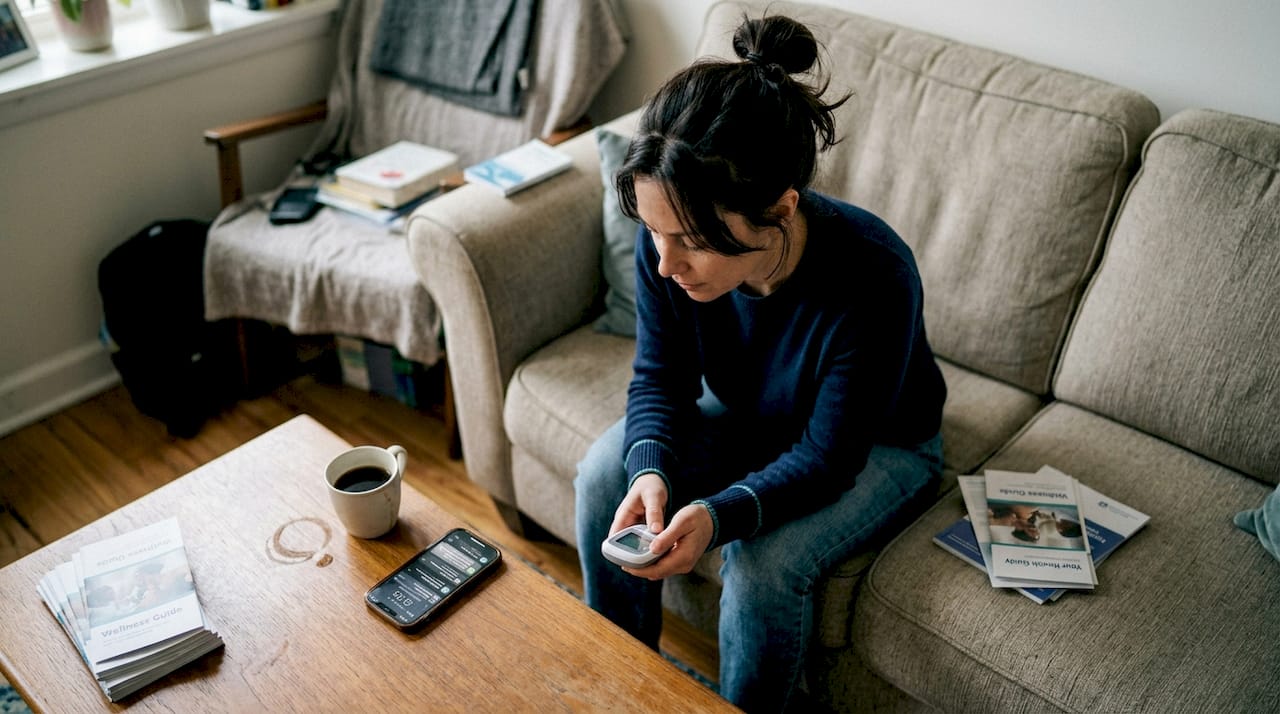
For accurate STI results, reading at the exact time window matters. Reading too early or too late can produce misleading results.
Pro Tip: Never read results after the time window has closed. A line that appears at 25 minutes on a 15-minute test is not a valid result.
Common mistakes and how to avoid them
Even the best-prepared readers can slip up — these are the most frequent pitfalls, and what to do about them.
Misreading your results is easier than you’d expect, especially under stress. Here’s what catches people out most often:
- Ignoring faint lines. A faint T line is still a positive. Many people convince themselves it doesn’t count. It does.
- Reading results outside the time window. Too early and the reaction hasn’t completed. Too late and evaporation lines can appear, mimicking a positive.
- Poor sample collection. Not enough blood, contaminated swabs, or a urine sample taken too soon after urinating all affect accuracy.
- Failing to recognize an invalid result. If the C line doesn’t appear, the test hasn’t worked. Don’t try to interpret it. Retest.
- Ignoring the window period. This is the time between exposure and when a test can detect an infection. Testing too soon after exposure can produce a false negative even if you’re infected.
“Lower self-sampling uptake among straight men and those in more deprived areas highlights a gap — free, confidential NHS services exist to fill it.”
Window periods vary by infection. HIV has a window of up to 45 days with some tests. Chlamydia is usually detectable within one to two weeks. If there’s any chance you tested too soon, wait and retest. It’s not wasted effort — it’s smart screening.
Privacy is something many men over 40 worry about when testing at home. You don’t need to worry. At-home kits are discreet, and NHS-affiliated services are fully confidential. If you’re unsure about your result, the STI test mistakes guide can help you figure out your next move.
Pro Tip: Store your kit at room temperature before use. Kits stored in very hot or cold environments (like a car glove box in summer) can degrade and produce unreliable results.
What to do next: Interpreting results and follow-up
After reading your results, the next moments are crucial — here’s how to handle them with confidence.
If your result is negative:
- Take a breath. A negative result is good news.
- Check whether you tested within the correct window period. If not, retest at the right time.
- Continue regular screening, especially if you’re sexually active with multiple partners.
- Consider testing every three to six months if you’re in a higher-risk group.
If your result is positive:
- Don’t panic. A positive result means action, not catastrophe.
- Contact a sexual health clinic or your GP to confirm the result and start treatment.
- Avoid sexual contact until you’ve spoken with a healthcare provider.
- Think about who you may need to notify. Partner notification can be done confidentially through your clinic.
- Most STIs are very treatable when caught early.
If your result is invalid:
- Retest with a new kit following instructions carefully
- If you’re still getting invalid results, visit a clinic for a lab-based test
For men over 40, regular screening isn’t optional if you’re sexually active. Many STIs show no symptoms at all, which means you could carry and transmit an infection without knowing. Clinic testing is preferred when symptoms are present, results are complex, or confirmation is needed.
Quick stat: Chlamydia remains the most commonly diagnosed STI in England, with hundreds of thousands of new cases each year — many in people who had no idea they were infected.
You can find next steps after testing and browse additional self-test kits to keep your screening routine consistent and affordable.
Why understanding your test matters more than you think
Stepping back, there’s an angle most guides miss entirely. Getting a result — positive or negative — is only part of the picture. What you do with that result, and how much you trust it, depends entirely on whether you understand its limitations.
At-home tests are a genuinely powerful tool. But they work best as part of an ongoing health habit, not as a one-off reassurance exercise. We see a lot of people who test once after a scare, get a negative, and then don’t test again for years. That’s not screening. That’s hoping.
The evidence is clear that positive rates are lower in self-testing compared to clinic-based testing, which tells us that home testing works well for routine monitoring but isn’t always the right tool when something feels off. Symptoms, pain, unusual discharge — those warrant a clinic visit, not a home kit.
For men over 40, the stakes are a little higher. Immune responses can be slower, and some infections can cause complications if left untreated. Regular, informed screening is the difference between catching something early and dealing with something much harder later. Understanding clinic vs. at-home results helps you make smarter choices about when to test at home and when to get professional input.
Fast, private STI results — take control at home
If you want maximum convenience with trustworthy results, here’s the simplest way to get started.
At Rapidtest, we make private health screening genuinely easy. No queues. No awkward waiting rooms. No appointments. Our 15-minute self-test kits are delivered discreetly to your door, and you get your results in the time it takes to make a cup of coffee.
Whether you’re screening routinely or following up after a concern, our discreet at-home screening range covers the most common STIs with clinical-grade accuracy. You stay in control, you stay private, and you get answers fast. That’s the whole point.
Frequently asked questions
How long do I need to wait after possible exposure before using an at-home STI test?
Most at-home STI tests are accurate after two weeks, but some STIs may require longer. Always check the instructions for the recommended window period specific to your kit.
What should I do if my at-home STI test result is invalid or unclear?
Repeat the test with a new kit, following the instructions carefully. If results are still unclear, clinic confirmation is preferred over continued self-testing.
Are at-home STI test results confidential in the UK and Europe?
Yes, at-home STI tests are completely discreet. NHS-affiliated services are also free and confidential, so you always have a private option available.
Are there special considerations for men over 40 interpreting STI home test results?
The interpretation steps are the same for everyone, but regular screening is especially recommended for men over 40 and higher-risk groups, even when there are no symptoms.