


How to read at-home test results with confidence
You’ve just run an at-home test. Maybe it’s for chlamydia, gonorrhea, or something like PSA levels. And now you’re staring at the result window wondering what that faint line actually means. It’s surprisingly common to feel lost in that moment, even when the instructions are right in front of you. Getting a result is one thing. Knowing what to do with it is another. This guide walks you through exactly how to interpret your at-home test results step by step, what those results really mean, and what your next move should be, whether the line is positive, negative, or somewhere frustratingly in between.
Table of Contents
- Understanding at-home test accuracy and limitations
- What you need before interpreting your results
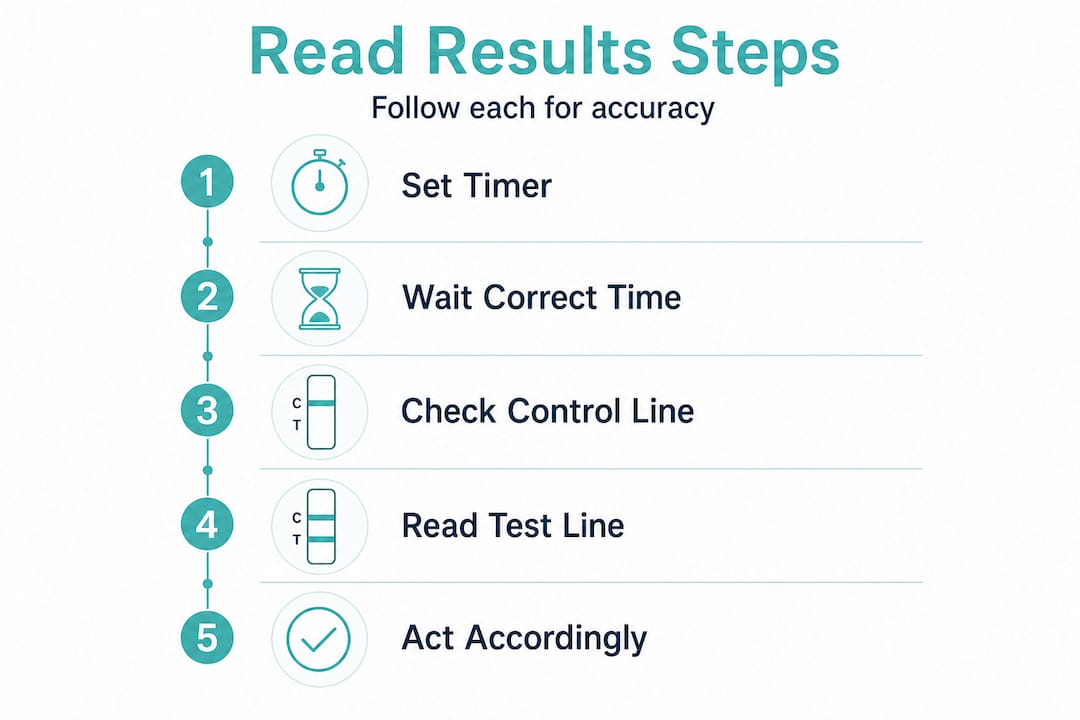
- Step-by-step: How to read your at-home test results
- Troubleshooting: Common issues and mistakes to avoid
- What to do after getting your results
- What most guides miss about at-home test results
- Explore safe, reliable home test options
- Frequently asked questions
Key Takeaways
| Point | Details |
|---|---|
| Test accuracy matters | Always understand the strengths and limits of your specific at-home test kit. |
| Follow instructions exactly | Accurate sample collection and timing are critical for reliable results. |
| Invalid results need retesting | If your result is unclear or invalid, repeat with a new kit for safety. |
| Seek confirmation when in doubt | Positive or inconclusive results should always be shared with a healthcare provider. |
| Testing is part of prevention | Regular at-home testing alongside safe practices is key for men’s sexual health over 40. |
Understanding at-home test accuracy and limitations
Before you read a single line on your test strip, it helps to understand what your kit is actually capable of. Not all tests are created equal, and knowing the basics will save you a lot of unnecessary panic or misplaced relief.
Two terms matter most here: sensitivity and specificity.
- Sensitivity refers to how good the test is at detecting an infection when it’s actually there. A high-sensitivity test misses fewer real cases.
- Specificity refers to how good the test is at correctly coming back negative when you’re genuinely clear. A high-specificity test produces fewer false positives.
- False positive: The test says you have something, but you don’t.
- False negative: The test says you’re clear, but you’re not.
Research confirms that self-sampling approaches can have moderate-to-high sensitivity and specificity for common bacterial STIs, but performance varies by product and infection. That “varies” part is important. A test that performs brilliantly for chlamydia might be less reliable for a different infection type.
| Test type | Typical sensitivity | Typical specificity | Notes |
|---|---|---|---|
| Chlamydia rapid test | Moderate to high | High | Generally reliable with correct sampling |
| Gonorrhea rapid test | Moderate | High | Lower sensitivity than lab PCR |
| HIV rapid test | Very high | Very high | Window period applies |
| PSA blood test | Moderate | Moderate | Requires clinical context |
Pro Tip: Always check whether your kit has been validated against a laboratory standard. Reputable brands will list this information in the packaging or on their website. Our self-testing kits explained guide covers what to look for when choosing a reliable product.
One more thing worth knowing: the accuracy of home tests is closely tied to how closely you follow the instructions. User error accounts for a significant portion of inaccurate results, which brings us neatly to the next step.
What you need before interpreting your results
With a grasp of how reliable your test kit is, it’s time to prepare properly before you start interpreting your results. This part gets skipped far too often, and it’s where a lot of mistakes happen.
Here’s what to check before you even open the packaging:
- Expiration date: An expired test kit may not produce accurate results. Check the date on both the box and the individual test pouch.
- Storage conditions: Most rapid test kits need to be stored at room temperature, away from direct sunlight and moisture. A kit that’s been left in a hot car or a damp bathroom cabinet may be compromised.
- Sample collection timing: Some tests work best with a first-morning urine sample. Others require a specific swab technique. Getting this wrong is one of the most common causes of invalid results.
- The instruction leaflet: Keep it open in front of you throughout the process. Don’t rely on memory, even if you’ve done this before.
| Step | Do this | Avoid this |
|---|---|---|
| Before testing | Check expiry date and storage | Using a kit stored in heat or humidity |
| Sample collection | Follow kit-specific instructions | Guessing or improvising technique |
| Timing | Set a timer immediately | Estimating time by eye |
| Recording results | Photograph or note the result | Relying on memory |
As research notes, performance varies by product and infection, so confirmation and testing pathways remain important regardless of what your initial result shows.
Pro Tip: Before you collect your sample, read the instructions twice all the way through. Then read the relevant section one more time just before you do each step. Our guide on collecting urine samples covers the specifics in plain language.
If you want a full walkthrough before you test, check out our step-by-step resource on screening for STIs at home. It’s designed to take the guesswork out of the entire process.
Step-by-step: How to read your at-home test results
Once you have the right setup and materials, follow these steps to interpret your test result with confidence.
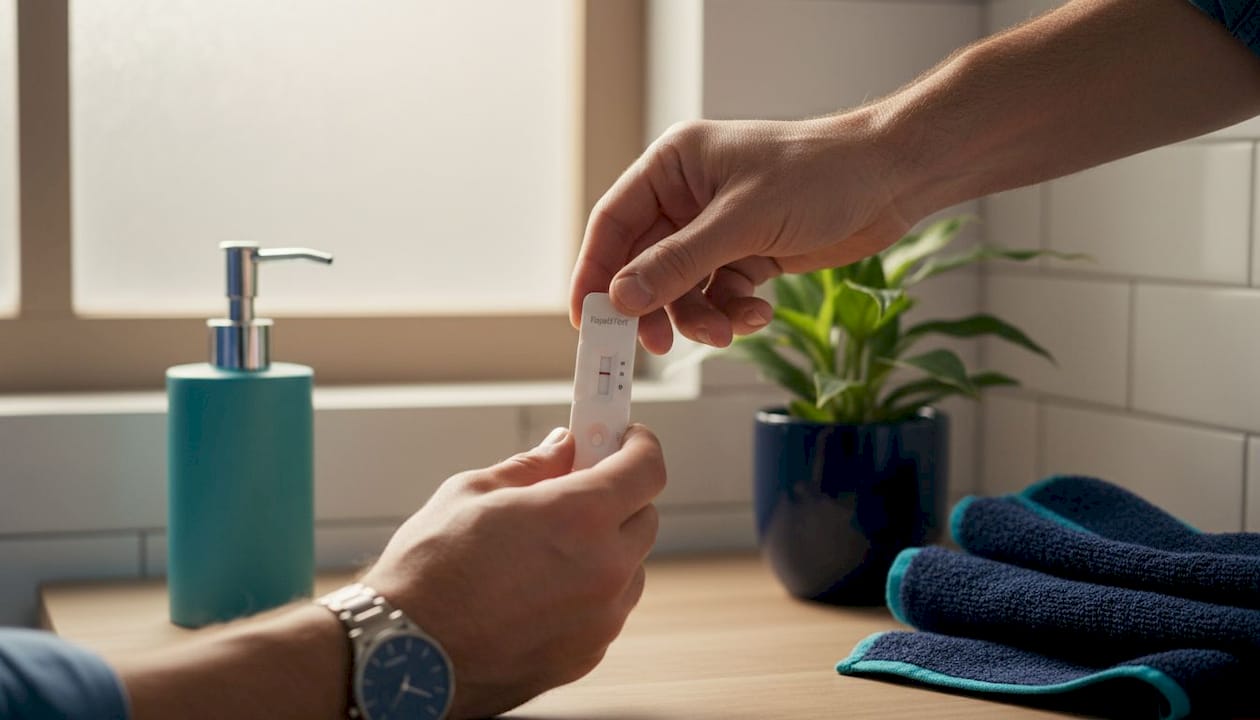
Step 1: Start your timer the moment you apply the sample. Most rapid test kits require you to read results between 10 and 15 minutes after applying your sample. Reading too early or too late can produce a misleading result.
Step 2: Identify the control line © first. The control line confirms the test has worked. If it doesn’t appear, the result is invalid. Full stop. Don’t try to interpret anything else.
Step 3: Look at the test line (T). This is the line that tells you whether the test detected what it’s looking for. Here’s how most rapid tests work:
- Two lines (C and T): Positive result. Even a very faint T line usually counts as positive.
- One line (C only): Negative result. The infection marker was not detected.
- One line (T only) or no lines: Invalid result. The test failed and needs to be repeated.
Step 4: Photograph the result immediately. Light, temperature, and time can all cause test lines to fade or change. Snap a photo within the valid reading window so you have a clear record.
Step 5: Record what you find. Note the date, time, test brand, and outcome. If you ever need to share this information with a healthcare provider, having a clear record helps.
“Even a faint second line on a rapid test is generally considered a reactive (positive) result and should be followed up professionally. Do not dismiss it because it looks light.”
Research consistently shows that confirmatory testing pathways remain important after at-home tests, particularly when a positive result appears or when the result feels uncertain. A positive at-home result is a prompt to act, not a final diagnosis.
For a more detailed breakdown of what lines mean on specific test types, our guide on reading STI test results goes into greater depth.
Troubleshooting: Common issues and mistakes to avoid
After reading your results, here are the most common mistakes men make, plus easy fixes to ensure accurate interpretation.
The control line didn’t appear. This means your test is invalid. Don’t try to read the T line. Something went wrong with the sample, the test strip, or the kit itself. Discard it and start again with a new kit.
You read the result outside the time window. Reading too early might show no result at all. Reading too late can cause evaporation lines that look like faint positives. Both scenarios can mislead you significantly.
The test line looks very faint. Many men second-guess a faint T line. In most rapid tests, any visible line counts as a positive signal. The concentration of the marker in your sample determines how dark the line appears, not whether the infection is present.
You used the wrong sample type. Some tests require a first-void urine sample (the first portion of your morning urination). Others need a mid-stream sample. Using the wrong type can dilute the sample or miss the target concentration entirely.
Common mistakes to avoid:
- Shaking the test device during the waiting period
- Touching the test strip window with your fingers
- Using a kit that was stored incorrectly
- Testing too soon after a potential exposure (before the window period has passed)
- Not following the exact sample volume or timing specified in the instructions
Research supports that self-sampling approaches can achieve moderate-to-high sensitivity and specificity, but confirmatory testing pathways remain important, especially when any doubt exists about your result.
Pro Tip: If you’re unsure whether to trust your result, treat it as inconclusive and retest with a fresh kit. Our resources on safe home STI testing and using STI tests safely cover this in more practical detail.
What to do after getting your results
Finally, once you’ve interpreted the result, here’s how to protect your health and make informed decisions.
If your result is positive:
- Contact your GP or a sexual health clinic as soon as possible.
- Don’t assume the result is wrong just because you feel fine. Many STIs are completely asymptomatic.
- Inform any recent sexual partners so they can also be tested.
- Avoid sexual contact until you’ve received confirmation and, if needed, treatment.
If your result is negative:
- Continue using protection, especially if you’ve had recent exposures or you’re in a higher-risk period.
- A single negative result does not guarantee you’re clear, particularly if you tested during a window period.
- Consider retesting after 2 to 4 weeks if you have ongoing risk or symptoms.
If your result is inconclusive or invalid:
- Retest with a new kit as soon as possible.
- Contact a healthcare provider if the uncertainty is causing you significant concern.
“A negative result on an at-home test is reassuring, but it is not the same as a confirmed clinical negative. If symptoms persist, don’t wait. Get checked.”
Studies confirm that confirmation and testing pathways remain essential even after at-home tests. This applies whether you’re dealing with a positive, negative, or borderline result.
You’ll find a broader breakdown of next steps and relevant services in our STI testing resources section.
What most guides miss about at-home test results
Here’s the uncomfortable truth that most step-by-step guides quietly skip over: a test result, positive or negative, is a starting point. It’s not a verdict.
We hear from men who got a negative result and assumed they were completely in the clear, stopped using protection, and later discovered they’d been infected during the window period. We also hear from men who got a faint positive line, convinced themselves it was a smudge or a defect, and delayed getting proper treatment by weeks. Both situations are avoidable.
The problem is that home testing guides often treat results as binary: positive or negative, done and dusted. But in real life, results exist in context. Your sexual history over the past few weeks, any symptoms you’ve noticed, the specific infection you tested for, and how carefully you followed the collection instructions all shape what your result actually means for you.
Research is clear that even tests with moderate-to-high sensitivity may miss certain infections, and confirmation is key. A home test is a powerful tool. But it works best when paired with judgment, not replaced by it.
The men who get the most value from at-home testing are the ones who treat it as one layer of their overall health awareness, not the final word. They test regularly, they know when to follow up, and they don’t let a negative result make them complacent. That’s where the advantages of home testing really show up: not just in convenience, but in building a habit of knowing where you stand.
The bottom line is this. Use your result as information. Act on it. But don’t mistake a strip of plastic for a clinical consultation.
Explore safe, reliable home test options
Taking your health seriously doesn’t have to mean booking appointments weeks in advance or sitting in a waiting room. With Rapidtest, you get fast, discreet results at home in just 15 minutes, no awkward conversations, no queues, and no delays.
Our at-home STI testing kits are designed for men who want clear answers on their own terms. Whether you’re checking for common bacterial STIs, monitoring PSA levels, or screening for broader health concerns, we have test kits that are straightforward to use and easy to interpret. Every kit comes with clear instructions, and our online resources are there if you need extra guidance. Privacy, speed, and accuracy, without the hassle.
Frequently asked questions
How soon after exposure can I use an at-home STI test?
Most STI home tests are reliable at least 2 weeks after exposure, but timing varies by infection type, so checking the specific window period for each test is important.
What does it mean if I get an invalid or unclear test result?
An invalid or unclear result usually means the test did not work properly and should be repeated with a new kit. As research notes, self-sampling approaches can have high specificity, but confirmatory testing pathways remain important when any doubt exists.
Is one negative result enough to be sure I don’t have an STI?
No. A single negative result doesn’t guarantee you’re free from STIs, particularly if you have symptoms or recent risk exposure. Studies confirm that performance varies by product and infection, so retesting or professional confirmation is recommended.
Are at-home STI tests as accurate as lab-based tests?
At-home tests can be highly accurate but often have slightly lower sensitivity than lab-based methods. Research shows that self-sampling approaches perform well for common bacterial STIs, but performance varies by product, so always follow up on positive or uncertain results with a healthcare professional.
What should I do if my test is positive but I have no symptoms?
You should consult a healthcare professional to confirm the result and discuss treatment options, even without symptoms. As research confirms, confirmation and testing pathways remain essential after at-home tests, since many STIs are asymptomatic but still transmissible and treatable.