


What is a preventative health check? UK guide
A preventative health check is any screening that looks for health markers or risk factors before symptoms appear, giving you a chance to act early and avoid bigger problems down the line. At-home rapid tests sit squarely within that definition: they screen for specific markers like STIs, fertility hormones, PSA and FOB in around 10–15 minutes, privately, without a GP appointment. They are not a replacement for clinical assessment, but they are a genuinely useful first step.
Quick overview:
- Who benefits most: sexually active adults, people monitoring fertility, and men with concerns about prostate or bowel health
- NHS Health Check eligibility: the NHS Health Check is offered free every five years to people aged 40–74 who do not already have diagnosed cardiovascular conditions or are on statins
- Clinical caveat: rapid tests carry trade-offs in sensitivity and specificity compared with laboratory testing, and a positive result usually requires confirmatory lab testing before any treatment decision is made
Table of Contents
- What do preventative health checks typically cover?
- Which checks are right for you?
- Benefits and limitations of at-home rapid tests
- How to use an at-home rapid test correctly
- What to do after your result in the UK
- Why repeat testing and a baseline matter
- Key takeaways
- A note on testing and what it actually changes
- Rapidtest: discreet at-home kits with results in 15 minutes
- Useful sources
- FAQ
What do preventative health checks typically cover?
Preventative care focuses on identifying risk factors before symptoms develop. For people shopping for at-home kits, the relevant tests fall into three main groups, alongside a few routine vitals that clinical checks cover.
| Test type | What it screens for | Sample type | Result time |
|---|---|---|---|
| STI panel (chlamydia, gonorrhoea, syphilis, HIV, Hep B/C, HSV-2, HPV) | Active infections, antibodies | Urine, finger-prick blood, swab | rapid results |
| Fertility markers (FSH, LH, HCG, sperm concentration) | Hormonal and reproductive function | Urine, semen | rapid results |
| PSA (prostate-specific antigen) | Elevated prostate marker | Finger-prick blood | rapid results |
| FOB (faecal occult blood) | Hidden blood in stool, bowel screening | Stool swab | rapid results |
| Routine vitals (BP, cholesterol, blood glucose) | Cardiovascular and metabolic risk | Clinical measurement | Varies |
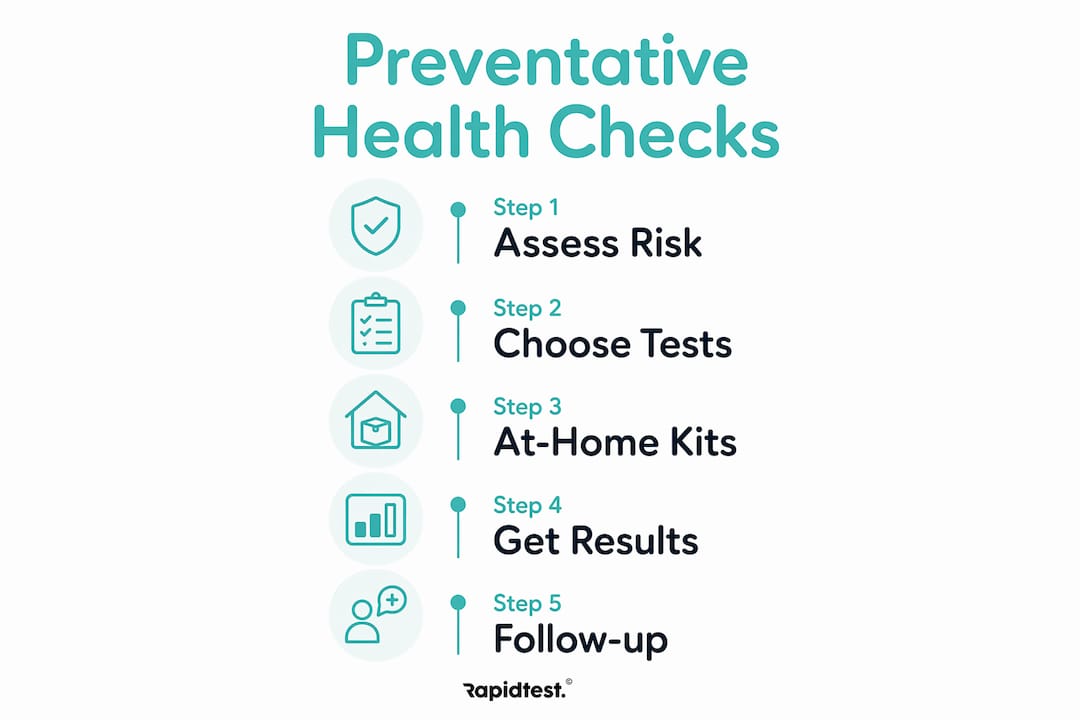
Routine vitals like blood pressure, cholesterol and blood glucose are not typically covered by at-home rapid kits in the same format, but they form a core part of the NHS Health Check programme, which targets seven major cardiovascular risk factors.
When choosing a kit, check the packaging for a CE or UKCA mark. That mark tells you the test has met the regulatory standards required for sale in the UK. Instructions for confirmatory testing should also be included.
Which checks are right for you?
Screening is most effective when tests are matched to personal risk rather than used indiscriminately. Here is how to think through it.

Age and sex shape the picture significantly. Fertility concerns tend to be most pressing under 40, while PSA and FOB screening becomes more relevant for men over 40. Women have their own reproductive markers to track, from LH and FSH for cycle monitoring to HCG for pregnancy confirmation. For a detailed breakdown of men’s health screenings by age, the risk thresholds shift meaningfully around 40 and 50.
Sexual behaviour is the clearest driver for STI screening. If you have had a new partner, multiple partners, or unprotected sex recently, an STI panel makes sense regardless of symptoms. Many infections, including chlamydia and HIV in early stages, produce no obvious signs.
Family history matters for cancer markers. A first-degree relative with prostate or bowel cancer raises your personal risk and is a reasonable prompt to start PSA or FOB monitoring earlier than the general population.
Window periods are worth understanding before you test. STI tests need time after exposure to detect an infection reliably: HIV, for example, has a window period of up to 45 days for some tests. Testing too soon after exposure can produce a false negative. Hormone tests for female fertility are most informative when timed to specific cycle days. FOB and PSA are generally one-off or annual checks rather than cycle-dependent.
The practical rule: prioritise tests that a clear risk factor actually warrants. Buying a broad panel when only one or two markers are relevant adds cost and can generate unnecessary anxiety.
Benefits and limitations of at-home rapid tests
The appeal is real. You get results in 10–15 minutes, at home, with no queue and no awkward conversation at a clinic. Privacy matters to a lot of people, and that barrier alone stops many from testing at all. Repeat testing is also far easier, which is useful for trend monitoring over time.
The limitations are equally real, and worth knowing upfront.
Window periods mean a recent exposure may not yet show up, even on a well-made kit. Rapid formats can have lower sensitivity and specificity than laboratory-based tests, which means both false negatives and false positives are possible. A false positive can cause significant anxiety; a false negative can give false reassurance.
Pro Tip: A negative rapid result after a recent high-risk exposure is not necessarily conclusive. Retest once the window period has passed, or book a lab-based test through your local NHS sexual health service.
Lifestyle changes remain as important as any test. Preventive care combines risk detection with behaviour change: smoking cessation, diet and exercise often have as much impact on long-term outcomes as early detection alone. A test tells you where you are; what you do next determines where you end up. For more on the benefits of rapid testing for men’s health, including PSA and FOB, the case for convenience is well supported.
How to use an at-home rapid test correctly
Getting an accurate result depends almost entirely on following the instructions. Here is the standard process:
- Read the instructions fully before opening anything. Each kit has specific steps; skipping ahead is the most common cause of invalid results.
- Prepare your sample area. Clean surface, good lighting, and everything you need within reach before you start.
- Collect the sample correctly. Midstream urine for STI urine tests; a clean finger-prick for blood-based tests; a semen sample collected per kit instructions for sperm concentration; a stool swab for FOB.
- Follow the timing window exactly. Reading a result too early or too late can give a misleading line. Set a timer.
- Interpret the result as instructed. A faint line is still a line on most lateral flow tests. An invalid result (no control line) means the test has not worked and should be repeated.
- Dispose of used materials safely. Treat all biological samples as biohazard waste and follow the disposal guidance in the kit.
Temperature and expiry dates affect accuracy. Store kits at room temperature, away from direct sunlight, and never use a kit past its expiry date. For a full step-by-step home health check guide, particularly for men over 40, the procedural detail is worth reviewing before your first test.
What to do after your result in the UK
Negative result: a negative is reassuring, but not always conclusive. If your exposure was recent, check the window period for that specific infection and retest when enough time has passed. A negative rapid STI test taken two days after unprotected sex is not a reliable clearance.
Positive result: do not self-treat. Seek confirmatory laboratory testing, which your GP or an NHS sexual health clinic can arrange. For STIs, consider notifying recent partners so they can also test. NHS sexual health services are free, confidential, and available without a GP referral.
Unclear or invalid result: repeat the test using a fresh kit if you have one, or book a lab-based test. If you contact a clinical service, note the kit batch number and expiry date — it helps them advise you accurately.
The early detection benefits principle applies broadly: catching something early, whether an STI or a raised PSA, gives you more options and usually simpler treatment.
Why repeat testing and a baseline matter
A single test gives you a snapshot. A series of tests over time gives you a trend, and trends are where the real clinical value lies. A baseline of measurements enables year-to-year analysis that helps spot subtle changes earlier than any one-off test can.
Pro Tip: Keep a simple record of each test: the date, the marker tested, the result, and the kit batch number. That log is genuinely useful if you ever need to discuss results with a GP or specialist.
Suggested frequency varies by marker. PSA and FOB are typically annual or less frequent depending on your risk profile. STI screening frequency depends on your sexual behaviour: if you have multiple partners or a new partner regularly, quarterly screening is reasonable. Female fertility markers are most informative when tested at consistent cycle points each month.
For at-home health monitoring over time, building a simple habit around testing dates makes the trend data far more useful.
Key takeaways
A preventative health check screens for risk factors before symptoms appear, and at-home rapid tests are a fast, private way to do exactly that for STIs, fertility markers, and men’s health indicators.
| Point | Details |
|---|---|
| Definition | Preventative checks screen for markers before symptoms appear, enabling earlier action. |
| Test what risk warrants | Match tests to your age, sex, sexual behaviour, and family history rather than buying broad panels. |
| Respect window periods | Testing too soon after exposure can produce a false negative; retest once the window has passed. |
| Positives need confirmation | A positive rapid result requires confirmatory lab testing before any treatment decision. |
| Rapidtest for at-home screening | Rapidtest offers STI, fertility, PSA, and FOB kits with results in 10–15 minutes and discreet delivery. |
A note on testing and what it actually changes
There is a version of preventative health that is just anxiety in a box: buy every test available, worry about every faint line, and never quite feel reassured. That is not what good screening looks like.
The point of a preventative health check is to give you specific, useful information about a specific risk you actually have. If you are sexually active with new partners, an STI screen is genuinely worth doing. If you are a man over 45 with a family history of prostate cancer, a PSA baseline is worth establishing. But testing for everything, all the time, without a clear reason, tends to generate noise rather than signal.
At-home rapid kits have made it easier than ever to test privately and quickly. That is a real improvement. The limitation is that ease of access can encourage over-testing as much as it encourages appropriate testing. The most useful thing you can do is be honest about your actual risk factors, test accordingly, and follow up properly when a result warrants it. A rapid test is a starting point, not a verdict.
Rapidtest: discreet at-home kits with results in 15 minutes
If you have worked out which markers are worth checking, Rapidtest makes the next step straightforward. No appointment, no waiting room, no awkward conversation.
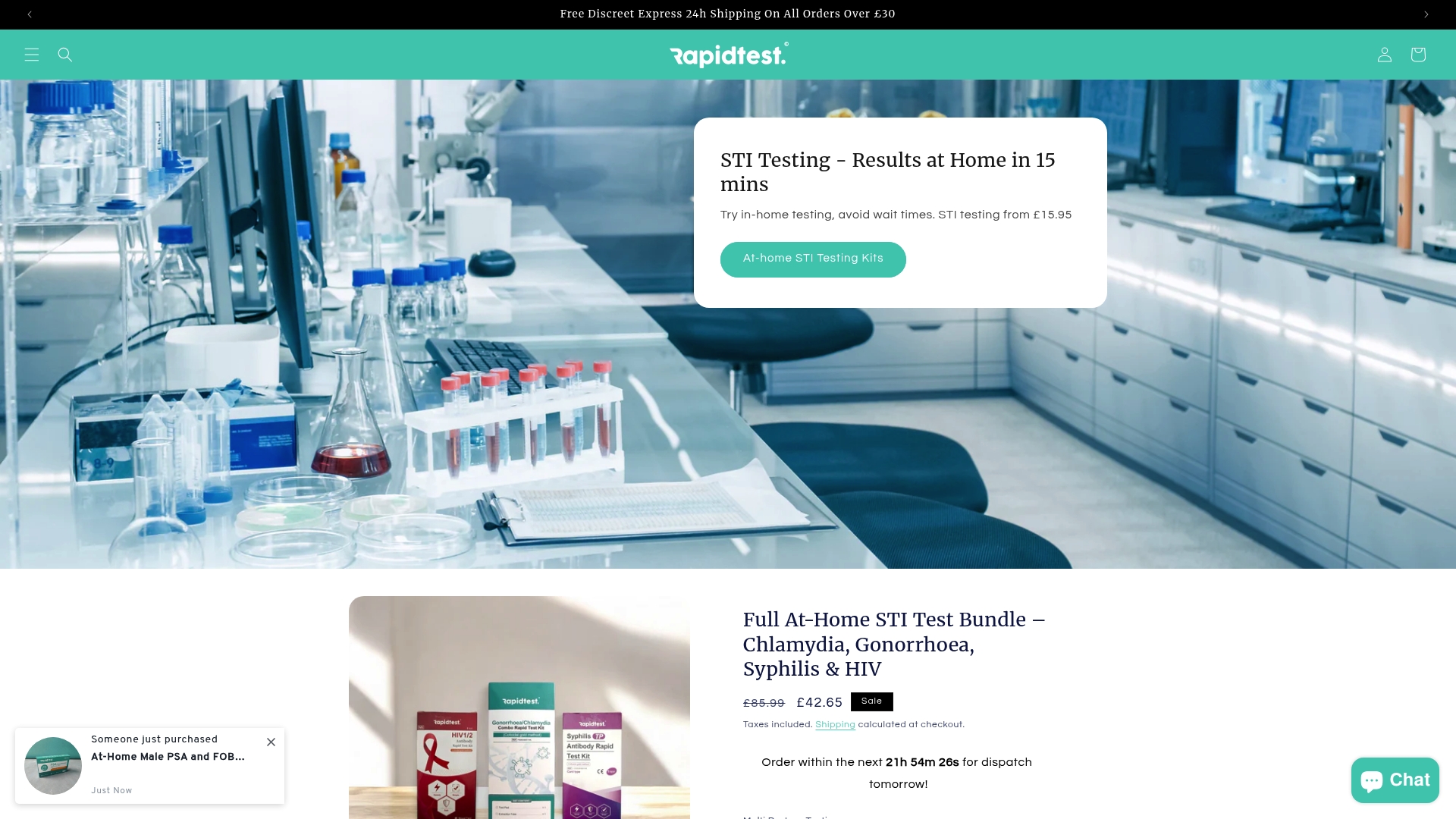
Rapidtest’s range covers STI rapid test kits for chlamydia, gonorrhoea, syphilis, HIV, Hep B/C, HSV-2 and HPV, fertility tests for FSH, LH, HCG and sperm concentration, and PSA and FOB kits for prostate and bowel screening. Every kit arrives in discreet packaging, includes full instructions, and returns results in 10–15 minutes at home. Where a result warrants confirmatory testing, the kit guidance tells you clearly what to do next. Choose the kit that matches your risk factors and follow the included instructions for sample collection and follow-up.
Useful sources
| Resource | What it covers |
|---|---|
| NHS Health Check | Eligibility, what the check involves, and how to book (ages 40–74) |
| NHS Health Check best practice guidance | Programme structure, CVD risk factors, and the prevention pathway |
| GOV.UK: NHS Health Check programme review | Evidence on programme effectiveness and OHID oversight |
| BMJ Open: NHS Health Check evaluation | Modelling estimates on prevented MIs, strokes and CVD deaths |
| NHS: STIs | Confirmatory testing pathways and NHS sexual health service guidance |
FAQ
What is a preventative health check?
A preventative health check screens for health markers or risk factors before symptoms appear, with the aim of catching problems early when they are easier to treat. At-home rapid tests for STIs, fertility hormones, PSA and FOB are all forms of preventative screening.
Who is eligible for the NHS Health Check?
The NHS Health Check is offered free every five years to people aged 40–74 who do not already have diagnosed cardiovascular conditions and are not on statins.
Do at-home rapid tests replace a GP or clinic visit?
No. At-home rapid tests are a useful first step, but a positive result requires confirmatory laboratory testing and clinical follow-up through your GP or an NHS sexual health service before any treatment is started.
How often should I get an STI screen?
Frequency depends on your sexual behaviour. If you have new or multiple partners regularly, quarterly screening is a reasonable approach. After a specific high-risk exposure, test once the window period for the relevant infection has passed.
What should I do if my rapid test result is unclear?
An invalid result, where no control line appears, means the test has not worked. Repeat with a fresh kit or book a lab-based test. Note the batch number and expiry date if you contact a clinical service for advice.