


STI screening panels explained: your guide to proactive sexual health
Most people assume getting tested for STIs means taking one simple test. You go in, something gets checked, you get a result. Done. But that’s not how it works. STIs are caused by different bacteria, viruses, and parasites, so each one needs its own specific test. A screening panel bundles multiple tests together so you get a fuller picture of your sexual health in one go. With gonorrhoea cases rising 31% across Europe in 2023 alone, understanding what you’re actually being tested for has never mattered more. This guide breaks down what STI screening panels include, how they differ, and how to choose one that fits your real life.
Table of Contents
- What is an STI screening panel?
- Common STI panel types: NHS vs. private options
- How STI panels are tailored to individual risk
- Practical barriers and recent STI trends in Europe
- Our perspective: Smart screening, not over-testing
- Find your optimal STI screening solution
- Frequently asked questions
Key Takeaways
| Point | Details |
|---|---|
| Panel covers multiple STIs | An STI screening panel checks for several infections with a single process, typically four to eleven. |
| Options differ by provider | NHS offers free testing for core STIs while private panels expand the range—both tailored to risk and need. |
| Screening is risk-based | Guidelines recommend selecting panels based on personal risk rather than universal screening. |
| Barriers impact testing access | Costs, consent rules, and low coverage often limit STI screening rates across Europe. |
| At-home kits offer convenience | Rapid, discreet at-home kits make screening more accessible for sexually active adults. |
What is an STI screening panel?
Having set expectations around STI testing, let’s break down exactly what a screening panel covers and why it matters.
An STI screening panel is not a single test. It’s a structured set of tests designed to check for multiple infections at once. Think of it like a blood panel at your annual physical, but focused entirely on sexual health. Each infection in the panel is tested using the method best suited to detect it.
An STI screening panel is designed to detect multiple sexually transmitted infections simultaneously, typically including chlamydia, gonorrhoea, HIV, and syphilis as core components, with hepatitis B and C added for higher-risk individuals. That core four is the baseline most providers start with.
Here’s what a typical panel structure looks like:
| Infection | Test type | Included in core panel? |
|---|---|---|
| Chlamydia | Urine or swab (NAAT) | Yes |
| Gonorrhoea | Urine or swab (NAAT) | Yes |
| HIV | Blood test | Yes |
| Syphilis | Blood test | Yes |
| Hepatitis B | Blood test | Expanded panels only |
| Hepatitis C | Blood test | Expanded panels only |
| Herpes (HSV) | Swab or blood | Expanded panels only |
| Trichomonas | Swab (NAAT) | Expanded panels only |
Not every panel is the same. Some providers offer a basic four-infection check. Others go wider and test for eight or more infections depending on your risk profile. The key is knowing what’s actually included before you commit to a test.
Here are the main infections you might find across different panel types:
- Core four: Chlamydia, gonorrhoea, HIV, syphilis
- Mid-range panels: Add hepatitis B and C
- Expanded panels: Also include herpes, trichomonas, mycoplasma genitalium
You can explore our STI screening guides to see how different panels are structured and what might suit your situation.
Pro Tip: Always check which specific infections a panel covers before purchasing or booking. Two panels labeled “comprehensive” can test for very different things.
Common STI panel types: NHS vs. private options
With the core structure of panels clear, let’s compare how NHS and private screening approaches differ in breadth and accessibility.
In the UK, you have two main routes for STI screening: through the NHS or through a private provider. Both have real value, but they work quite differently.
The NHS offers free home kits for the core four STIs in many areas of the UK. Private panels expand that to 8 to 11 infections, adding things like trichomonas, mycoplasma, and herpes. Clinical guidelines generally prioritize targeted testing over universal screening, so the NHS approach is evidence-based, not just budget-driven.
*“Private screening panels can include up to 11 infections, while standard NHS panels focus on 4 core STIs.”
Here’s a side-by-side comparison:
| Feature | NHS panel | Private panel |
|---|---|---|
| Cost | Free | Paid |
| Infections covered | 4 core STIs | 8 to 11 STIs |
| Home testing available | Yes (select areas) | Yes (widely available) |
| Turnaround time | Days to a week | Often 15 minutes to 48 hours |
| Includes herpes/trichomonas | No | Often yes |
NHS panels: the pros and cons
- Pro: Free and accessible for most UK residents
- Pro: Covers the most commonly transmitted infections
- Con: Limited geographic availability for home kits
- Con: Doesn’t test for less common but still relevant infections
Private panels: the pros and cons
- Pro: Broader coverage, especially for higher-risk individuals
- Pro: Faster results, more discreet options
- Con: Costs money, which can be a barrier
- Con: Not all expanded infections require routine testing for everyone
Understanding the different STI test types available can help you figure out which route makes the most sense for your situation. If you’re low-risk and just want peace of mind, the NHS core panel might be enough. If you’ve had multiple partners or a specific exposure, a broader private panel gives you more complete information.
How STI panels are tailored to individual risk
Beyond basic panel selection, understanding how screenings are personalized for risk groups is essential.

One of the most important things to understand about STI screening is that it’s not one-size-fits-all. Your panel should reflect your actual sexual practices, anatomy, and exposure history. A panel designed for someone with one long-term partner looks very different from one designed for someone with multiple recent partners.
For gay and bisexual men and other men who have sex with men (MSM), standard urine and blood tests aren’t always enough. Infections like gonorrhoea and chlamydia can infect the throat and rectum as well as the genitals. That means extragenital site testing using throat and rectal swabs is recommended for MSM, trans patients with specific anatomy, and others with relevant exposures.
Here’s how panels shift based on risk:
- Lower-risk individuals: Core four panel, urine and blood only
- MSM and higher-risk groups: Add throat swab, rectal swab, hepatitis B/C
- Trans patients: Anatomy-specific swab sites based on current anatomy
- People with symptoms: Clinic exam required, home kits are not sufficient
The IUSTI (International Union against Sexually Transmitted Infections) advises against broad population-wide chlamydia screening due to limited evidence of benefit. Their guidelines favor risk-based approaches where testing is matched to real exposure. This is smart medicine. Testing everyone for everything doesn’t improve outcomes. Testing the right people for the right things does.
Symptoms are also a separate category. If you have discharge, pain, sores, or other signs of infection, a home kit is not the right tool. You need a physical examination at a clinic. Home panels are for asymptomatic screening, not diagnosis.
Pro Tip: When booking a test or ordering a kit, be honest about your sexual practices and anatomy. It’s not about judgment. It’s about making sure the panel actually covers what it needs to.
We talk more about normalizing STI testing and why being upfront about your health is always the right move.
Practical barriers and recent STI trends in Europe
With personalized panels explained, let’s look at broader trends and barriers affecting how people access STI screening.
STI rates across Europe have been climbing steadily, and the numbers are hard to ignore. EU and EEA data shows gonorrhoea cases jumped 31% in 2023, and chlamydia reports exceeded 230,000 cases across the region. These aren’t just statistics. They reflect real gaps in how people access testing.
Stat callout: Europe saw a 31% increase in gonorrhoea cases in 2023.
Here’s a snapshot of STI trends across Europe:
| STI | Trend (2023) | Key concern |
|---|---|---|
| Gonorrhoea | +31% | Rising antibiotic resistance |
| Chlamydia | 230,000+ cases | High rates of asymptomatic infection |
| Syphilis | Increasing | Congenital syphilis re-emerging |
| HIV | Stable to declining | Late diagnosis still a problem |
Despite these numbers, access to screening is far from universal. The ECDC report identified serious structural barriers across the region:
- Cost: Testing fees exist in 13 out of 29 European countries
- Age restrictions: Parental consent required for under-18s in 7 countries
- Geographic gaps: Rural areas often have limited clinic access
- Stigma: Many people avoid testing due to embarrassment or fear of judgment
- Awareness: Low public knowledge of what panels cover and when to test
These barriers mean a lot of infections go undetected and untreated. Asymptomatic infections are especially risky because people don’t know they have them and can unknowingly pass them on. The rise of at-home STI testing directly addresses several of these barriers by removing cost, geography, and stigma from the equation.
Our perspective: Smart screening, not over-testing
As we reflect on the practicalities and trends, here’s an evidence-backed perspective on why targeted STI screening is truly better for health.
Here’s something the broader conversation around STI testing often gets wrong: more testing is not always better testing. There’s a real difference between proactive, risk-based screening and blanket over-testing that creates anxiety without improving outcomes.
The ECDC highlights that rising STI epidemics demand accessible testing, but also notes significant gaps in free access and data quality. IUSTI advises against broad population screening, favoring risk-based approaches to avoid unnecessary testing and the stress that comes with it.
We think that’s the right call. A 22-year-old in a monogamous relationship does not need the same panel as someone with multiple recent partners and a new exposure. Treating them the same wastes resources and creates false alarm. What matters is matching the panel to the person.
Our STI screening guidance is built around this principle. We want you to test smart, not just test often. Know your risk, choose a panel that reflects it, and use the results to actually inform your decisions. That’s what proactive sexual health looks like in practice.
Find your optimal STI screening solution
Now that you understand panel types and strategies, here’s where to find the right kit for your needs.
Taking control of your sexual health doesn’t have to mean booking appointments, sitting in waiting rooms, or having awkward conversations. Our at-home STI testing kits let you screen for multiple infections privately, at home, with results in just 15 minutes.
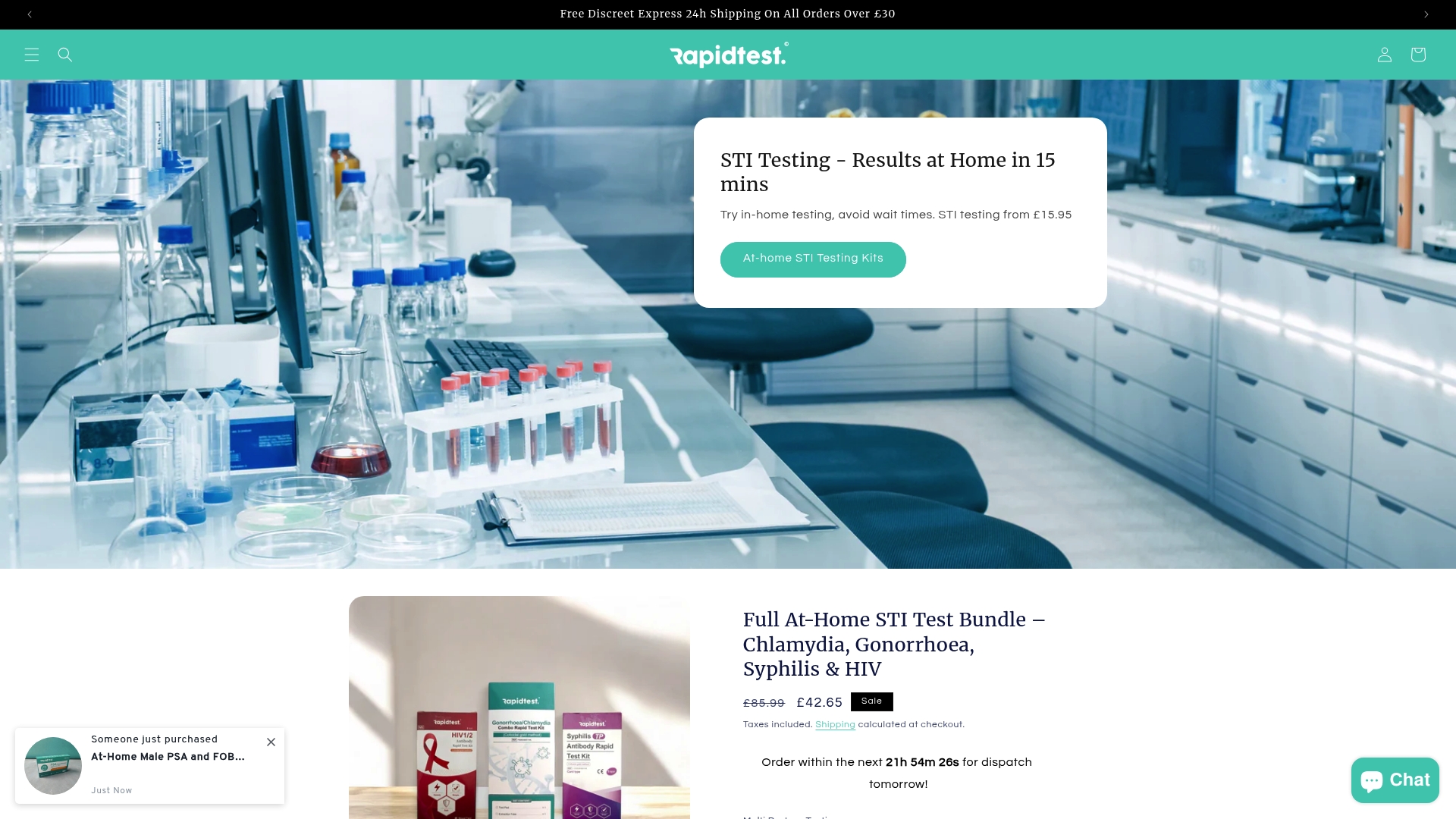
Whether you want a focused core panel or a broader check, we have options to match your risk profile and comfort level. Our at-home rapid STI kits are discreet, straightforward, and built for real life. No queues, no doctor, no awkward conversations. Just clear results when you need them.
Frequently asked questions
Which STIs are included in a standard screening panel?
Most standard panels cover chlamydia, gonorrhoea, HIV, and syphilis as the core four. Higher-risk panels may also include hepatitis B and C.
Are all STI tests available at home?
Home kits work well for asymptomatic screening of the core STIs, but symptoms require a clinic exam rather than a home kit.
Why are some panels broader than others?
Panels are built around your risk profile. Private panels expand to 8 to 11 infections, adding things like trichomonas, mycoplasma, and herpes for people with higher risk or specific exposures.
Is regular STI screening recommended for everyone?
Not universally. Major European guidelines, including IUSTI recommendations, favor risk-based screening over blanket testing to avoid unnecessary procedures and anxiety.
What barriers affect STI screening in Europe?
The biggest obstacles include cost in 13 of 29 countries, parental consent requirements for under-18s in 7 countries, and limited access in rural areas.