


The role of home tests in public health: a UK guide
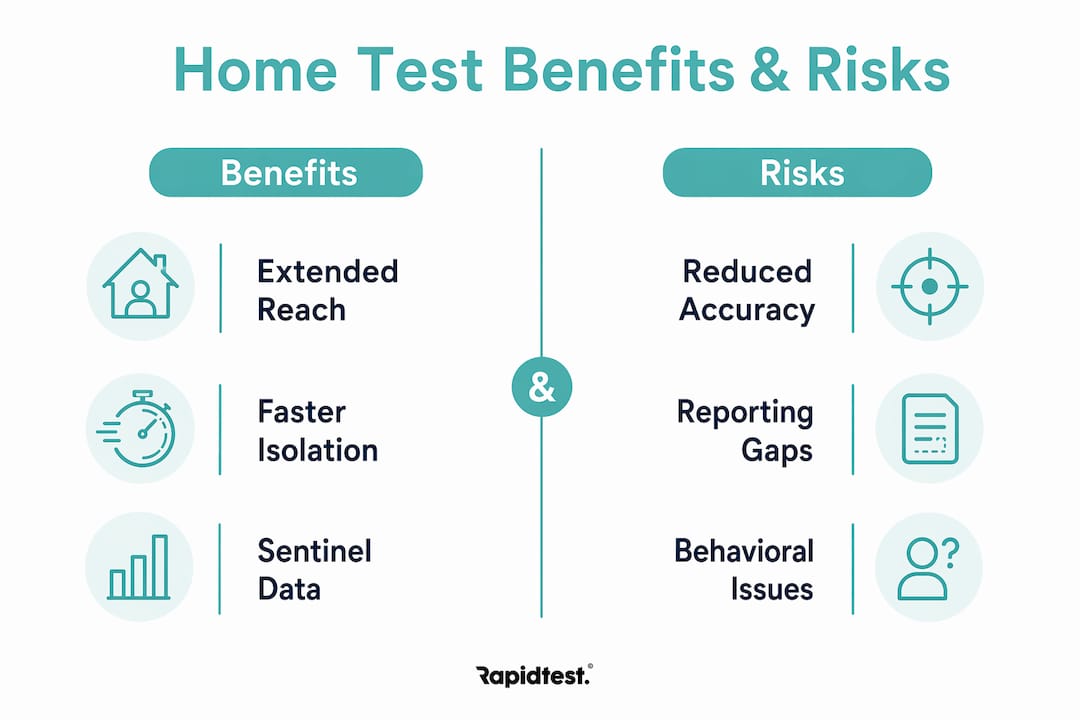
Home tests are a genuine public health asset — but only when they are connected to reporting pathways, clinical follow-up, and regulatory oversight. The MHRA sets the quality bar for devices entering the UK market, the UKHSA translates test data into surveillance intelligence, and the NHS provides the confirmatory and care pathways that give a positive result its meaning. Without all three working together, a home test is just a piece of plastic that tells someone something they may not know how to act on.
The COVID-19 pandemic made this tension visible at scale. Widespread home rapid testing improved isolation behaviour and reduced onward transmission, but many positive results were never reported into national surveillance systems, creating epidemiological blind spots that undermined the very intelligence public health teams needed.
The primary public health uses of home and self-testing kits fall into two categories:
- Case detection and behavioural change: rapid results prompt immediate isolation, care-seeking, or partner notification, reducing transmission before a clinical appointment is possible.
- Sentinel and early-warning signals: targeted distribution to high-risk groups or sentinel households, linked to anonymised digital reporting, can generate near-real-time local incidence data.
Table of Contents
- How home tests can feed public health surveillance
- What the research and case studies show
- What are the key limitations and risks to manage?
- What does the UK regulatory framework require?
- How do you connect home-test results to health system workflows?
- What should policymakers require when procuring home tests?
- How should clinicians and researchers interpret home-test data?
- Key takeaways
- A frank view on where the field actually stands
- Rapidtest’s validated kits, built for real-world use
- Useful sources and further reading
- FAQ
How home tests can feed public health surveillance
The role of home tests in public health surveillance depends almost entirely on what happens after the result appears. A test that is read and discarded contributes nothing to population-level intelligence. A test linked to a voluntary reporting pathway — a QR code on the packaging, an SMS prompt, a web portal, or an integrated app — can feed anonymised data into local and national dashboards within hours of a result.
During the COVID-19 rollout in England, the NHS and UKHSA used a combination of online result registration portals and lateral flow test reporting pages to capture some of this data. The timeliness advantage is real: a home antigen test delivers a same-day behavioural trigger that a GP appointment or laboratory referral cannot match. Digital reporting tools and supervised settings demonstrably improve both test performance and surveillance integration.
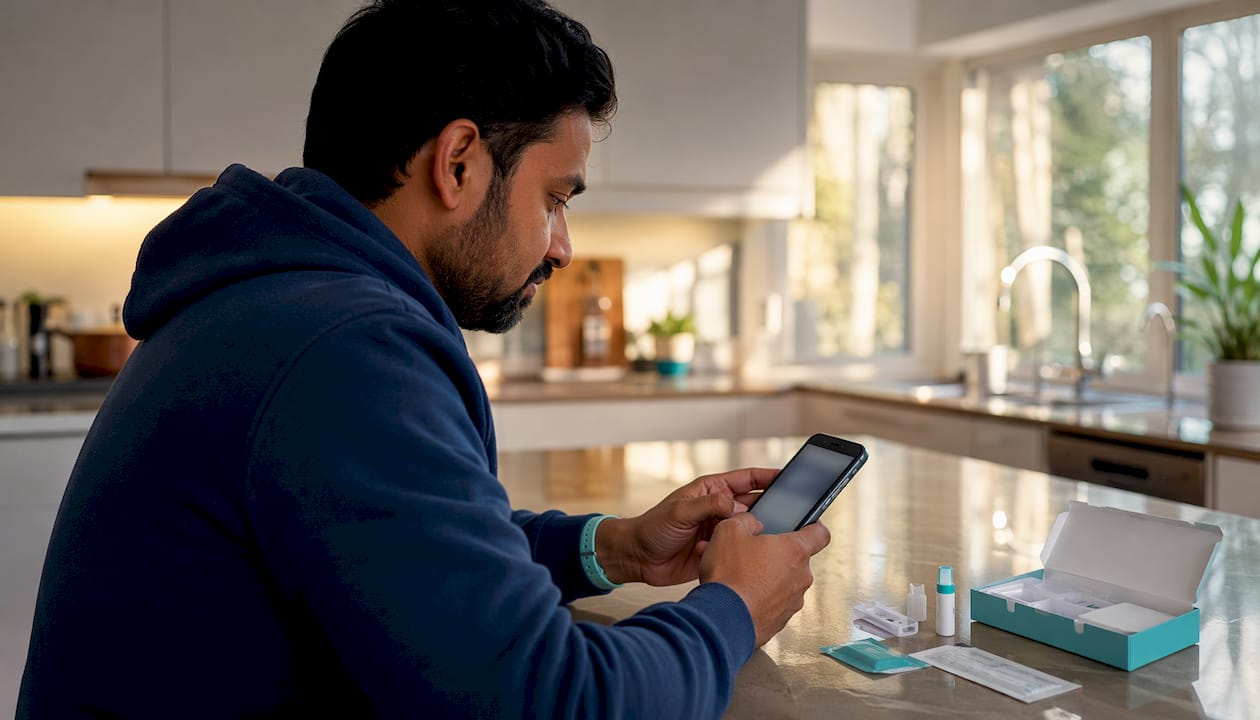
Sentinel distribution adds another layer. Distributing kits to priority populations — care home residents, school-age children in high-incidence postcodes, or occupational groups — and linking those kits to anonymised geo-tagged reporting can generate local outbreak signals even when overall reporting rates are partial.
Practical barriers remain significant:
- Underreporting: many people read a result and take action without registering it anywhere.
- Digital exclusion: older adults, people without smartphones, and those with limited literacy may not engage with app-based reporting.
- Privacy concerns: GDPR compliance and public trust require transparent data minimisation and clear consent flows.
- Pipeline gaps: voluntary reports rarely feed automatically into UKHSA or NHS datasets without bespoke ingestion infrastructure.
What the research and case studies show
The evidence base is growing, though it is uneven. Most evaluations measure uptake or acceptability rather than long-term surveillance impact, which limits what can be concluded about population-level benefit.

| Study / Setting | Key Outcome | Limitation |
|---|---|---|
| COVID-19 home rapid testing (UK/US) | Improved isolation behaviour; surveillance blind spots when reporting was passive | Reporting rates not systematically captured |
| Test Us at Home cohort (US) | Ag-RDT sensitivity peaked on day 2 post-symptom onset; serial testing improved detection | US setting; may not generalise to all UK populations |
| STI direct-to-consumer testing (literature review) | Increased testing uptake among underserved groups; follow-up and reporting gaps persisted | Variable linkage to care across programmes |
| Self-test kit quality evaluation (20 kits) | Only three of 20 kits met scientific recommendation criteria | Snapshot evaluation; market has evolved since publication |
The STI evidence is particularly instructive. Direct-to-consumer testing has expanded access among groups who would not otherwise present to a clinic — a genuine equity gain. The persistent gap is linkage to care: a positive result that does not reach a clinician or trigger treatment is a missed opportunity, not a public health win.
Key study-level caveats worth noting:
- Most trials measure uptake, not long-term health outcomes or surveillance completeness.
- Demographic biases in who self-tests (younger, more digitally literate, less marginalised) affect generalisability.
- Equity gains are real but conditional on follow-up pathways being in place.
What are the key limitations and risks to manage?
Home tests carry real risks that procurement decisions must account for. Ignoring them does not make them go away.
Accuracy in real-world use is the first problem. Even analytically accurate tests suffer reduced sensitivity and specificity in unsupervised home settings, primarily because of user errors in sample collection and timing. A nasal swab taken too shallowly, or a test read at 12 minutes rather than 15, can produce a false negative that gives someone false reassurance.
Market reliability is the second. An evaluation of 20 consumer self-test kits found only three could be recommended on scientific grounds, with most providing limited information beyond price and basic usage instructions. Many high-street kits lack clinical validation or interpretative guidance.
Behavioural risks compound both. Over-testing, anxiety from ambiguous results, and self-treatment without clinical input are documented patterns. The ‘lure of information’ can push people toward tests that generate more uncertainty than clarity.
Equity risks cut the other way. Cost barriers, digital exclusion, and stigma mean that the populations who most need testing may be least likely to access, use, or report results correctly.
Risk checklist for commissioners:
- Has the kit been clinically validated in the intended population and setting?
- Does packaging include clear next-step guidance (confirmatory testing, care pathways, emergency contacts)?
- Is there a digital reporting option that meets GDPR requirements?
- Are there provisions for non-digital users?
- Is there a funded follow-up pathway for positive results?
Pro Tip: When evaluating kits for procurement, distinguish between analytically validated tests (laboratory performance data) and clinically validated tests (real-world performance in the intended population). The gap between the two is where most real-world accuracy problems live. For guidance on what validation data actually means in practice, see Rapidtest’s home test validation explainer.
What does the UK regulatory framework require?
The MHRA is the competent authority for in vitro diagnostic (IVD) devices in Great Britain. Since the UK left the EU’s regulatory framework, home and point-of-care tests must carry UKCA marking for the GB market (CE marking remains valid in Northern Ireland under the Windsor Framework). The MHRA’s guidance sets out performance requirements, labelling standards, and post-market surveillance obligations for manufacturers.
The UKHSA sits downstream of the MHRA: it advises on which tests are suitable for public health deployment, publishes evaluation reports on specific devices, and sets the surveillance frameworks into which test data should flow. NHS England and the devolved health services then operationalise those frameworks through procurement, distribution, and clinical pathway design.
A significant gap exists in labelling requirements. Regulatory labelling often omits actionable next steps, leaving users uncertain about what to do after a positive or negative result. Experts recommend that kits include clear instructions for confirmatory testing and when to seek urgent care — a pragmatic policy lever that improves both individual outcomes and surveillance completeness.
Key policy insight: Mandating that all home test packaging include a QR code linking to confirmatory testing pathways, a telephone support number, and a voluntary reporting portal would cost manufacturers very little and could substantially improve both clinical safety and surveillance data quality. The MHRA’s labelling guidance is the natural vehicle for this requirement.
Recent and relevant policy reference points:
- MHRA’s IVD regulatory framework post-Brexit (UKCA marking requirements)
- UKHSA’s COVID-19 lateral flow device evaluation reports
- NHS guidance on self-testing and result registration
- PHG Foundation analyses of genomic and diagnostic equity in home testing
How do you connect home-test results to health system workflows?
The operational gap between a home test result and a useful data point in a surveillance system is where most programmes fail. Closing it requires a deliberate architecture, not an afterthought.
Recommended reporting flow:
- User performs test and reads result.
- QR code or app prompt on packaging directs user to a reporting portal.
- User submits anonymised data: date, partial postcode, test type, result, age band, and consent flag.
- Data flows into a local public health dashboard with automated ingestion into UKHSA/NHS datasets.
- Positive results trigger an automated prompt to contact primary care or a telemedicine service.
- Local public health teams review dashboard data for cluster signals and feed back to commissioners.
Minimum data set for surveillance (GDPR-compliant):
- Date of test
- Partial postcode (first three to four characters)
- Test type and manufacturer
- Result (positive/negative/invalid)
- Age band (not date of birth)
- Consent flag
Technical options for reporting include QR codes printed on kit packaging, Bluetooth-enabled devices that push results to a paired app, decentralised privacy-preserving apps, and sentinel cohort sampling where a representative subset of users agrees to full data linkage.
Data governance checklist:
- Data minimisation: collect only what is needed for surveillance purposes.
- Explicit consent: separate consent for surveillance reporting from consent for care.
- Interoperability: use HL7 FHIR or equivalent standards for NHS dataset ingestion.
- Linkage to care: positive result pathways must be funded and staffed, not just signposted.
Pro Tip: Pilot the reporting pathway in a defined sentinel population before scaling. A small, well-instrumented pilot in two or three GP practice areas will surface pipeline failures, consent friction, and digital exclusion problems that a national rollout would amplify. The future trends in at-home testing analysis covers the technical directions worth watching.
What should policymakers require when procuring home tests?
Procurement criteria should be non-negotiable, not aspirational. The following dimensions provide a framework for commissioners evaluating kits for public health deployment.
| Procurement dimension | Minimum requirement |
|---|---|
| Clinical validation | Peer-reviewed performance data in the intended population and setting |
| User instructions | Plain-language, illustrated, available in relevant community languages |
| Next-step messaging | Confirmatory testing pathway, care contact, and reporting QR code on packaging |
| Digital reporting | Integrated QR/app reporting option meeting GDPR requirements |
| Linkage to care | Funded pathway for positive results (telemedicine or primary care) |
| Equity measures | Non-digital reporting option; subsidised or free access for priority groups |
Operational recommendations:
- Pilot in sentinel groups before population-wide deployment.
- Build digital opt-in reporting into the kit design, not as a separate campaign.
- Fund telemedicine linkage for positive results from the programme budget, not as an add-on.
- Establish a local public health feedback loop so commissioners can see cluster signals in near-real-time.
- Require manufacturers to provide post-market real-world performance data as a condition of contract.
Suggested implementation timeline: pilot phase with sentinel sampling and full data instrumentation (months 1–6); independent evaluation of reporting completeness, accuracy, and equity (months 7–9); phased scale with automatic reporting options and sentinel cohort maintained for ongoing signal detection (months 10 onwards).
How should clinicians and researchers interpret home-test data?
Home-test data is useful but requires careful handling. It is not equivalent to laboratory-confirmed data, and analyses that treat it as such will produce biased estimates.
For research protocols, ask:
- Was the test supervised or unsupervised? Unsupervised use introduces user-error variance that supervised settings do not.
- How complete is reporting? Underreporting is systematic, not random — digitally excluded and stigma-affected groups report less.
- What are the demographic biases in who self-tested? Self-selection affects prevalence estimates.
- Is there linkage to confirmatory laboratory testing for a validation subset?
Clinical cautions:
- A negative home antigen test in a symptomatic patient does not rule out infection. Serial testing improves detection; the Test Us at Home cohort found that Ag-RDT sensitivity peaked on day 2 post-symptom onset, with cumulative detection improving substantially by day 4.
- Counsel patients that a positive result requires confirmatory testing and clinical assessment before treatment decisions are made.
- When to seek laboratory confirmation is a clinical judgement, not a packaging decision.
Data-analysis notes:
- Adjust prevalence estimates for underreporting using capture-recapture methods or sentinel cohort benchmarks.
- Apply sensitivity and specificity corrections using real-world (not analytical) performance figures for the specific kit and population.
- Use sentinel sampling strategies — a defined, representative subset with full data linkage — to produce robust estimates from a population that is otherwise self-selecting.
Key takeaways
Home tests extend public health reach, accelerate individual action, and can generate sentinel data — but only when linked to validated reporting pathways, clear next-step guidance, and funded clinical follow-up.
| Point | Details |
|---|---|
| Surveillance requires active reporting | Passive home testing creates blind spots; QR-linked digital reporting is the minimum viable solution. |
| Validation gaps are widespread | Only a small fraction of evaluated consumer kits met scientific recommendation criteria; procurement must require peer-reviewed performance data. |
| Equity gains are conditional | Direct-to-consumer testing increases uptake in underserved groups, but only delivers public health value when matched with funded care pathways. |
| Labelling must mandate next steps | Packaging should include a confirmatory testing pathway, care contact, and reporting QR code as a regulatory requirement, not a manufacturer option. |
| Rapidtest’s approach | Rapidtest supplies clinically validated rapid kits with clear user guidance and supports linkage to follow-up care for STI, fertility, and cancer screening. |
A frank view on where the field actually stands
The conversation about home testing in public health tends to split into two camps: enthusiasts who see distributed diagnostics as a democratising force, and sceptics who worry about accuracy, over-testing, and surveillance gaps. Both are right, and that is precisely the problem.
The surveillance blind spot created by unreported home tests is not a technical failure — it is a design failure. Kits were deployed at scale during COVID-19 without mandatory reporting infrastructure, and the epidemiological record has gaps as a result. The fix is not complicated: a QR code, a consent prompt, and a data ingestion pipeline. What it requires is political will to mandate it and procurement budgets to fund the follow-up pathways that make a positive result mean something.
The equity argument is similarly double-edged. Home testing genuinely reaches people who would not attend a clinic — whether because of stigma, geography, cost, or time. But a test result without a care pathway is not equity; it is the appearance of equity. The populations most likely to benefit from home testing are also the most likely to fall through the cracks if follow-up is left to chance.
What the field needs is not more tests. It needs better integration of the tests that already exist: mandatory next-step labelling, funded telemedicine linkage, and surveillance pipelines that treat home-test data as a first-class input rather than an afterthought.
Rapidtest’s validated kits, built for real-world use
Rapidtest offers a practical alternative to waiting rooms and laboratory queues for people who need answers quickly and privately. The kits cover STI screening, fertility testing, and PSA and FOB cancer markers — all returning results in 15 minutes at home, with no appointment needed.
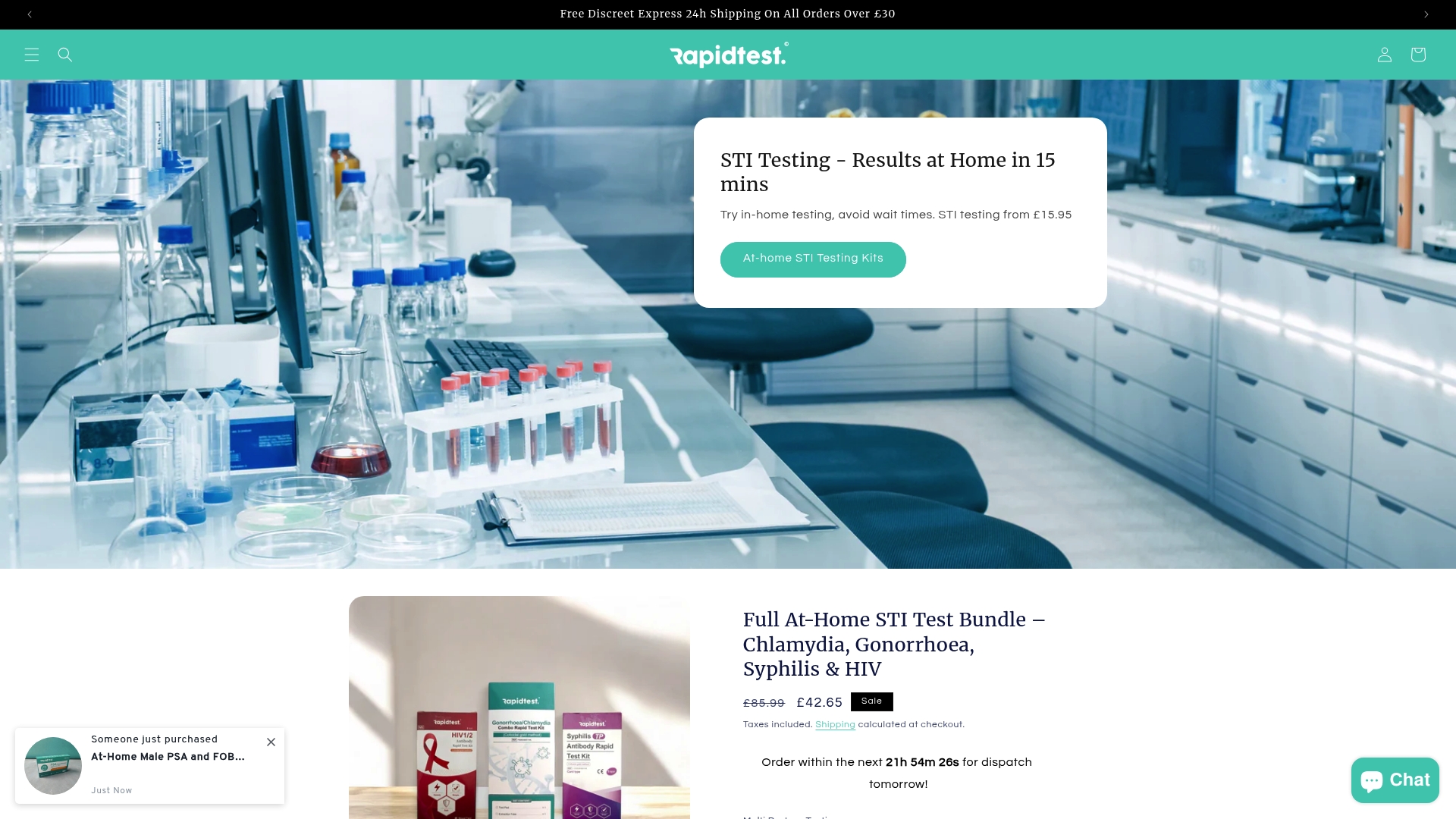
What sets Rapidtest apart from the high-street options that dominate pharmacy shelves is the emphasis on clinical validation and clear user guidance. Every kit is designed with plain-language instructions and explicit next-step messaging, so a positive result points directly to a care pathway rather than leaving the user uncertain. For health teams considering a pilot, Rapidtest’s at-home STI testing kits are a practical starting point for sentinel distribution in high-risk groups.
If you are a commissioner or clinician looking to evaluate rapid kits against the procurement criteria outlined above, contact Rapidtest to discuss a pilot arrangement or review the validation evidence directly.
Useful sources and further reading
For commissioners, clinicians, and researchers who want to go deeper, these are the most authoritative starting points:
-
MHRA IVD regulatory guidance — the primary source for UKCA marking requirements, post-market surveillance obligations, and labelling standards for home and point-of-care tests in Great Britain. Best for: procurement and regulatory compliance.
-
UKHSA COVID-19 lateral flow device evaluation reports — device-specific performance evaluations used to inform NHS procurement decisions. Best for: surveillance methodology and device selection.
-
NHS self-testing guidance — patient-facing and professional guidance on result registration, confirmatory testing, and care pathways. Best for: patient-facing communications and pathway design.
-
Integrating at-home diagnostic testing with public health surveillance (PMC) — peer-reviewed analysis of the technical and governance challenges of connecting home-test results to surveillance systems. Best for: surveillance integration and data governance.
-
At-home infectious disease testing: an idea whose time has come (PMC) — the foundational commentary on surveillance blind spots and the case for digital reporting mandates. Best for: policy rationale and surveillance design.
-
Quality and information content of home self-sampling/testing kits (PMC) — the kit evaluation study showing that most consumer products fail scientific recommendation criteria. Best for: procurement standards and regulatory policy.
-
Direct-to-consumer testing for STI control (MDPI) — critical review of DTC STI testing uptake, equity gains, and linkage-to-care gaps. Best for: STI programme design and equity analysis.
-
PHG Foundation — independent analyses of genomic and diagnostic equity, including home testing policy implications. Best for: equity and policy foresight.
-
UK home testing workflow guide — practical workflow guidance for connecting home-test users with clinical advice and follow-up. Best for: operational implementation.
FAQ
What is the main public health benefit of home tests?
Home tests extend reach to populations who would not attend a clinic, prompt faster isolation or care-seeking after a positive result, and can feed sentinel surveillance systems when linked to digital reporting pathways.
How accurate are home tests compared to laboratory tests?
Analytical accuracy can be high, but real-world sensitivity drops in unsupervised settings due to user errors in sample collection and timing. Serial testing and clear instructions reduce, but do not eliminate, this gap.
What regulatory approval do home tests need in the UK?
Home and point-of-care tests sold in Great Britain must carry UKCA marking and comply with MHRA IVD regulations; CE marking remains valid in Northern Ireland under the Windsor Framework.
Why do home tests create surveillance blind spots?
Most users do not voluntarily report results to UKHSA or NHS systems, so positive results go unrecorded in national surveillance datasets. Mandatory QR-linked reporting on packaging is the most practical fix.
Can Rapidtest kits be used in public health pilot programmes?
Yes. Rapidtest supplies clinically validated rapid kits for STI, fertility, and cancer screening, with plain-language instructions and next-step guidance designed to support linkage to care — the criteria commissioners should prioritise in any pilot.