


Home test validation process: what it really means
You pick up a home testing kit, follow the instructions, and get a result in 15 minutes. But a nagging question lingers: how do you actually know if it’s accurate? The home test validation process is far more rigorous than most people realise, and understanding it changes how you think about at-home health screening. This guide breaks down exactly how rapid tests earn their certifications, how scientists and regulators check they work for real people at home, and what you should look for before you trust any result.
Table of Contents
- Key takeaways
- The home test validation process explained
- Human factors: testing how real people use tests
- Analytical and clinical performance
- Reading results and what happens after the test ships
- How to choose a reliable home test
- My take on trust and what validation actually protects
- Rapidtest: tested, certified, and ready when you are
- FAQ
Key takeaways
| Point | Details |
|---|---|
| Validation goes beyond the lab | Certified home tests must pass scientific, usability, and clinical performance evaluations before reaching consumers. |
| CE marking signals rigour | CE marked tests meet strict European regulatory standards, giving you a reliable benchmark for quality. |
| Usability is tested on real people | Manufacturers test with lay users in realistic home settings, not just scientists in controlled labs. |
| Invalid results are a feature | A failed or invalid result means the test is working as designed, catching errors before they mislead you. |
| Instructions are part of the test | How clearly a kit explains itself is formally assessed, making the leaflet as important as the chemistry inside. |
The home test validation process explained
Let’s start with what validation actually means, because it is not just a lab doing a quick check and stamping an approval.
The home test validation process is the structured series of scientific, regulatory, and usability evaluations a test must pass before it can be sold for people to use on themselves, without a clinician present. It covers everything from the chemistry inside the test strip to whether a 70-year-old can read the instructions without making a mistake.
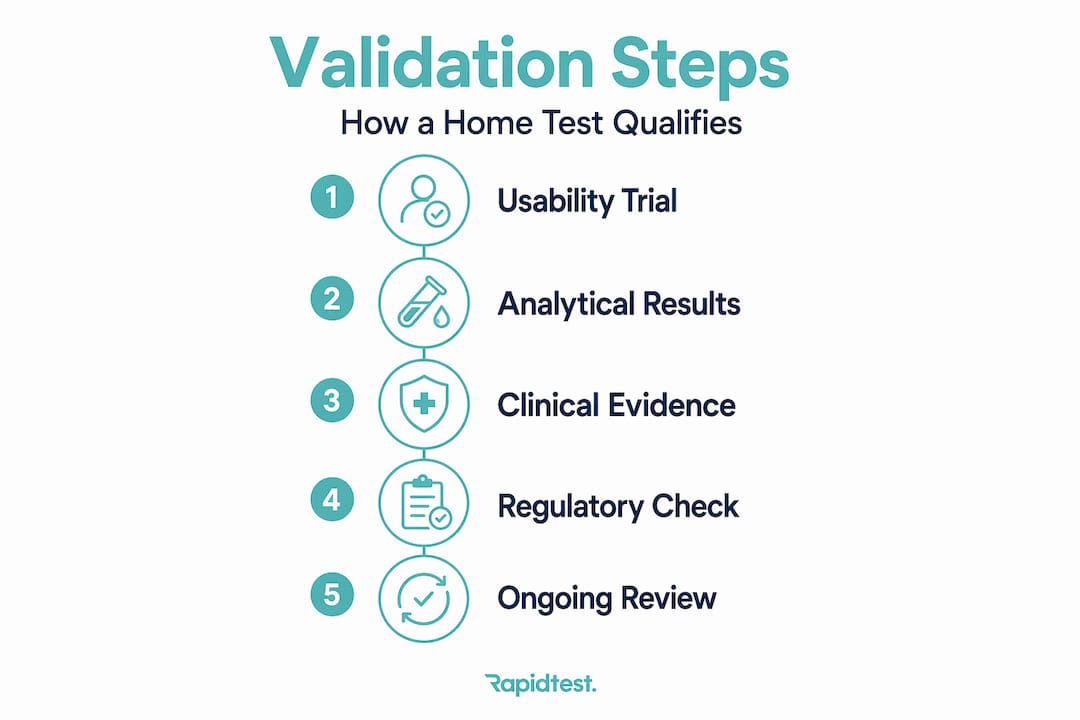
In the UK and EU, the key marker to look for is CE marking under the In Vitro Diagnostic Regulation (IVDR). This tells you the manufacturer has demonstrated the test meets performance and safety standards for the intended population. In the US, the relevant standard is FDA authorisation. FDA-cleared home-use tests are automatically CLIA waived, which means they meet a defined threshold of simplicity and accuracy for non-clinical settings.
Home tests are separately classified from professional-use tests. A test designed for a hospital lab does not automatically qualify for home use. The self-test classification triggers additional requirements, specifically because the person using it has no clinical training and is working alone in their kitchen or bathroom, not a controlled medical environment.
Key things a validated home test must demonstrate:
- Accurate performance across a realistic range of conditions, including temperature variation and user-collected samples
- Clear, comprehensible instructions that prevent misuse
- Safety features that flag errors rather than deliver misleading results
- Evidence that the intended user population, including older adults and people with no medical background, can use it correctly
Self-testing kits explained with verified regulatory standards give you a much stronger foundation than anything sold without those credentials.
Human factors: testing how real people use tests
This is the part most people do not know about, and it might be the most interesting bit.
Before a home test reaches the market, manufacturers must run formal usability studies. These are not surveys or focus groups. They are structured tests observing real lay users attempting to complete the test as they would at home, without coaching or assistance.
The standard process under IEC 62366-1, the international framework for usability engineering, requires:
- Use-related risk analysis. Identify every way a user could make an error and what the consequences would be.
- Formative testing. Early-stage testing to shape the product design and instructions, catching problems before the final version is locked.
- Summative testing. The formal final validation. FDA human factors guidance expects manufacturers to test with at least 15 representative lay users per user group to confirm the design is safe.
- Comprehension assessment. Checking whether users actually understand what the instructions are telling them to do.
Each of these stages produces documented evidence. If a critical task, like collecting the sample or reading the result, fails usability criteria, the manufacturer must redesign and retest. It cannot simply be noted and moved on.
One finding worth taking seriously: age is a strong predictor of use errors in home test studies. Older adults face disproportionate challenges with small print, fiddly sample collection, and multi-step processes. A well-validated kit has specifically addressed these issues, not just assumed everyone will manage.
It is also worth noting that the minimum of 15 users in summative testing may be too low to capture all usability challenges across diverse populations. Better manufacturers go beyond the minimum.
Pro Tip: When comparing kits, check whether the product description or packaging mentions human factors validation or usability studies. It is a sign the manufacturer took the self-test classification seriously, not just the chemistry.
Analytical and clinical performance
Once usability is established, there is a separate, equally rigorous layer of evaluation: does the test actually detect what it claims to detect?
This is where sensitivity and specificity come in. Sensitivity measures how well a test identifies people who genuinely have the condition. Specificity measures how well it avoids flagging people who do not. A test with high sensitivity produces fewer false negatives. A test with high specificity produces fewer false positives. You want both to be as high as possible.
For home rapid tests, analytical performance must be demonstrated under conditions that reflect real-world use, including samples collected by untrained users rather than healthcare professionals, results read by lay people rather than technicians, and testing across a range of environmental conditions, not just controlled lab temperatures.
Here is how accuracy measures typically compare across common home rapid test categories:
| Test type | Typical sensitivity | Typical specificity | Key validation factor |
|---|---|---|---|
| STI (e.g. syphilis, HIV) | 95-99% | 98-99% | Sample type and user collection |
| COVID-19 antigen | 80-95% | 97-99% | Viral load at time of testing |
| Flu A/B antigen | 62-85% | 96-99% | Symptom timing critical |
| FOB (bowel cancer screening) | 79-85% | 87-96% | Dietary prep and sample handling |
Clinical performance studies go further than laboratory analysis. They require testing with lay users under realistic conditions, then comparing results against a confirmed clinical reference. If users cannot reliably collect an acceptable sample, the test’s laboratory accuracy becomes irrelevant.
- Manufacturers must use iterative design evaluation to refine both the device and instructions based on actual user performance data.
- Risk mitigation can include design features such as fill indicators on collection tubes, not just relying on written instructions.
- Post-validation, manufacturers must demonstrate the product performs consistently across production batches.
Pro Tip: Look for published sensitivity and specificity figures on the product page or package insert. If they are absent, that is a red flag worth taking seriously when you are making a health decision.
Reading results and what happens after the test ships
Getting a result right is not just about what is in the test. It is about how clearly the kit communicates what that result means.
Labelling and instructions are formally assessed as part of the home diagnostic test review process. Regulators check that the language, layout, and visual design of the result window genuinely help users interpret outcomes correctly, rather than assuming they will figure it out.
Here is something that surprises most people: invalid or failed results are intentional safety features, not signs of a faulty kit. If the control line does not appear, the test is telling you it cannot give you a reliable answer this time. That is the system working correctly. Treating an invalid result as a negative is the dangerous misinterpretation, and well-designed kits work hard to prevent that. Properly designed invalid-result workflows guide users through the correct response, whether that means retesting or seeking clinical advice.
After a test reaches the market, the validation work does not stop. Regulatory standards require ongoing post-market surveillance. For home tests, this is especially demanding because manufacturers must monitor unconventional channels, including app reviews, social media, and user forums, for evidence of real-world problems. This means a false-negative cluster spotted in online comments can trigger a formal investigation.
This ongoing feedback loop is what separates responsible home test manufacturers from those just meeting the minimum threshold to ship a product.
How to choose a reliable home test
Knowing how the validation process works gives you a practical filter for choosing between products. Here is what to actually check:
- CE marking or FDA authorisation. Non-negotiable. Without it, there is no evidence the test has cleared any regulated standard.
- Published sensitivity and specificity data. These figures should be accessible. If a brand cannot or will not share them, look elsewhere.
- Evidence of lay user testing. Phrases like “validated for home use” or references to usability testing are meaningful signals, not just marketing language.
- Clear instructions with a genuine invalid-result protocol. A kit that tells you what to do when the test fails is a kit that takes your safety seriously.
- Repeat testing guidance. Any reputable brand will tell you to retest if symptoms persist after a negative result, because no single test result is the final word.
Choosing a brand with a track record of transparent, certified testing is not about paying more. It is about knowing your result is telling you something real.
My take on trust and what validation actually protects
I’ve seen a lot of scepticism about home tests, and honestly, some of it is deserved. Not every kit on the market has been through the rigorous process described here. There are products that carry ambiguous wording, absent data, and instructions that would confuse a pharmacist, let alone someone testing themselves at home after a late night.
What I’ve learned is that consumer education is the missing piece. People dismiss home tests as unreliable without knowing that a properly validated kit has passed more scrutiny than most people imagine. At the same time, people sometimes over-trust a result without understanding what sensitivity and specificity actually mean in practice.
The uncomfortable truth is that the test is only as good as the person using it. And manufacturers know this. The best ones design around it, using intuitive packaging, visual cues, and built-in fail-safes rather than hoping users read every word of a tiny leaflet.
My advice? Do not just look for a CE mark and stop there. Ask whether the brand publishes its performance data. Check whether the instructions are written for a real person, not a lab technician. The validation process exists to protect you. Make it work for you by choosing brands that take it as seriously as the regulators intended.
— Jack
Rapidtest: tested, certified, and ready when you are
If you have made it this far, you know what to look for. Rapidtest exists for exactly the kind of person who wants to take their health seriously without the wait, the awkwardness, or the queues.
Every kit Rapidtest sells is CE marked and validated for home use, with sensitivity and specificity figures you can actually find. The instructions are written for real people, the results come in 15 minutes, and if you get an invalid result, you will know exactly what to do next. Whether you are looking for an STI testing kit with certified accuracy, or specifically need a syphilis test at home that delivers 99.8% accuracy in 15 minutes, Rapidtest has you covered. Private. Fast. Done properly.
FAQ
What does CE marking mean on a home test?
CE marking confirms a home test has met European regulatory standards for safety, performance, and labelling. It means the manufacturer has demonstrated the test works reliably for untrained lay users in a home setting.
How accurate are home rapid tests?
Accuracy depends on the test type and condition being detected. Validated STI rapid tests typically achieve 95-99% sensitivity and 98-99% specificity. Always check the published figures for the specific product you are using.
What does an invalid result on a home test mean?
An invalid result means the test did not run correctly, not that your result is negative. It is a built-in safety feature. Discard the kit and retest with a new one, following the instructions provided.
Do home tests go through the same validation as hospital tests?
Home tests actually face additional requirements. Because they are used by people without clinical training, they must pass human factors validation and lay user usability testing on top of standard analytical and clinical performance evaluation.
How many people are used to validate a home test?
Under FDA guidance, manufacturers must conduct summative usability testing with at least 15 lay users per user group. Some experts consider this a minimum threshold, and thorough manufacturers test with larger and more diverse groups.