


Home health testing privacy guide for men 40+
Wanting to check your prostate or get an STI test is a completely normal part of looking after yourself. But for a lot of men over 40, the idea of sitting in a waiting room or having that conversation with your GP feels like a barrier too big to cross. At-home testing has changed that. You can now screen for some serious conditions from your own bathroom, with results in minutes. The question is: how private is it really? And can you trust what those results are telling you? This guide walks you through everything you need to know.
Table of Contents
- Why privacy matters for men considering at-home testing
- How privacy is built into home test kits in the UK and Europe
- How at-home tests work: from sample to results
- Test accuracy, expert warnings, and what you need to know
- Key questions to ask before choosing a private home test
- Our take: Privacy is a right, but so is trustworthy health advice
- Confidential home testing options for men 40+
- Frequently asked questions
Key Takeaways
| Point | Details |
|---|---|
| Privacy-first design | Home test kits use discreet packaging and secure results platforms to keep your health information confidential. |
| Know limitations | Test accuracy varies, so understand results and seek GP advice when needed. |
| GDPR compliance matters | Choose providers that follow UK/EU data laws for top privacy protection. |
| Ask the right questions | Before you buy, check for clear privacy policies, data handling, and support options. |
Why privacy matters for men considering at-home testing
Let’s be real. Men over 40 are not exactly lining up to talk about their health. Whether it’s embarrassment, stigma, or just not wanting to make a fuss, millions of men quietly avoid screenings they genuinely need. And when the topic is prostate health or sexual health, that reluctance gets even stronger.
There’s no national prostate cancer screening program in the UK, which means men who want a PSA (prostate-specific antigen) check have to actively seek one out. That gap in the system pushes a lot of men toward private, self-managed options. The privacy benefits of home STI testing are well documented, and the same logic applies to prostate screening.
Here’s what drives men toward at-home testing in the first place:
- Avoiding the GP conversation they find awkward or uncomfortable
- No waiting rooms, no referrals, no time off work
- Control over who knows about their health status
- Speed: results in 15 minutes for rapid kits, not weeks
- No paper trail connected to their medical records
That last point matters more than people realize. For some men, the concern isn’t just embarrassment. It’s insurance implications, workplace privacy, or simply not wanting sensitive information sitting in a system they don’t fully control.
But privacy comes with trade-offs. Discreet home PSA and STI tests avoid GP stigma and enable proactive screening, but that convenience has to be balanced against accuracy risks and the absence of professional guidance when results come back. A positive result with no counselor to call is a lonely place to be.
“The appeal of at-home testing isn’t laziness. It’s a rational response to a system that hasn’t made it easy for men to ask for help.”
Understanding why privacy matters is step one. Step two is knowing exactly how modern kits protect it.
How privacy is built into home test kits in the UK and Europe
With privacy so crucial, let’s break down exactly how modern home tests keep your information and identity protected.
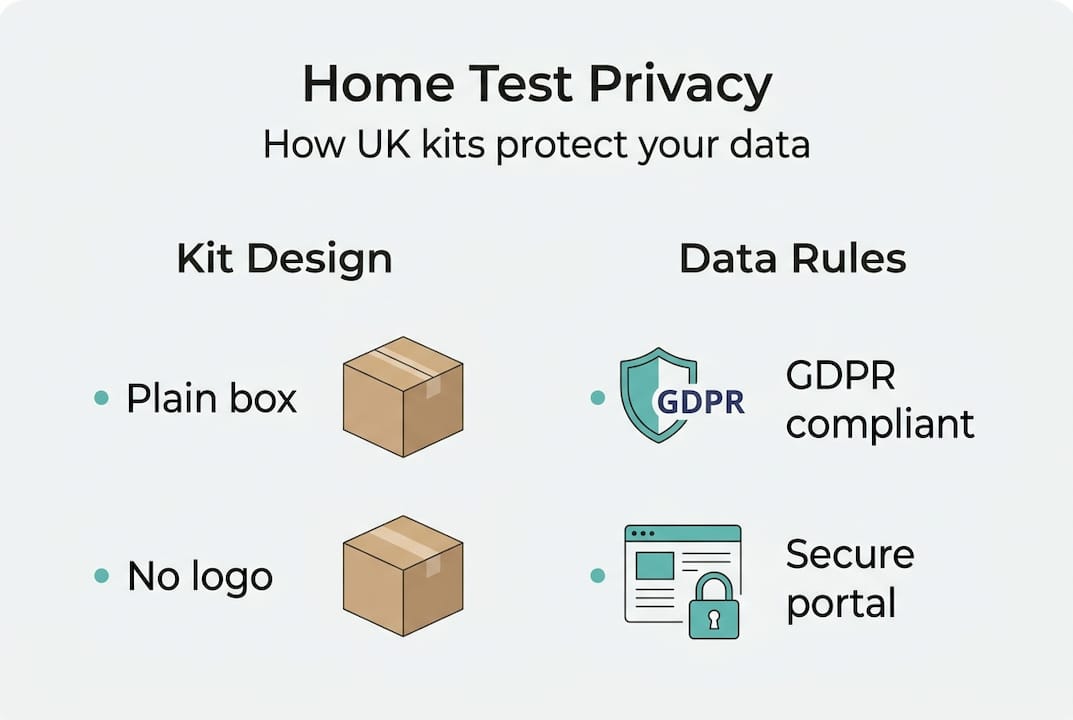
The first thing you’ll notice is the packaging. Reputable providers ship in plain, unbranded boxes or padded envelopes. No logos. No health-related text on the outside. It fits through your letterbox like any other delivery. Nobody standing at your door, nothing to explain to a housemate or partner.
Home health testing kits in the UK and Europe are specifically designed with discreet packaging and delivery to protect user privacy from the moment your order ships.
Here’s what good privacy-focused packaging looks like:
- Neutral sender name on the return address, not a health brand
- No product description on the outer packaging
- Letterbox-friendly size so no signature is needed
- Sealed inner packaging to protect sample integrity
Once your kit arrives and you’ve used it, results are typically delivered through a secure online portal or app. They are not automatically sent to your GP. You decide whether to share them. That’s a meaningful distinction.
Pro Tip: Before ordering, check whether the provider uses a named sender or a neutral one. Some brands still print health-related text on the envelope, which defeats the purpose entirely.
On the data side, UK GDPR and EU data protection laws classify health data as “special category” information, which means it gets the highest level of legal protection. Providers must get your explicit consent before collecting or storing it, and you have the right to request deletion.
| Feature | Privacy-first provider | Standard provider |
|---|---|---|
| Packaging | Plain, unbranded | May include brand name |
| Results access | Secure portal or app | Email or post |
| GP notification | Only if you choose | Varies |
| Data storage | UK/EU servers, GDPR compliant | May vary |
| Consent process | Explicit opt-in | Sometimes assumed |
For men looking at confidential PSA test kits or exploring private STI testing benefits, these features are the baseline you should expect.
How at-home tests work: from sample to results
Once you understand the privacy safeguards, it’s helpful to see exactly how a confidential home test experience works in practice.
The process is more straightforward than most men expect. Here’s a typical flow:
- Order your kit using a secure checkout. No GP referral needed.
- Receive discreet delivery through your letterbox within a day or two.
- Collect your sample at home. For PSA tests, that’s a finger-prick blood sample. For STI tests, it’s a urine sample or swab, depending on the test.
- Follow the instructions included in the kit. They’re written in plain language, step by step.
- Read your results at home, usually within 10 to 15 minutes for rapid kits.
- Access your results through a secure app or portal if it’s a lab-based test.
For a detailed walkthrough, the PSA test step-by-step guide covers exactly what to expect from start to finish.
The mechanics of self-collection involve either rapid on-site reading or lab analysis, with results delivered via app or portal, and no entry into GP records for anonymous kits.
Pro Tip: Do your test first thing in the morning when PSA levels are most stable, and follow the timing instructions precisely. Rushing the read window is one of the most common user errors.
Here’s a quick comparison of the main test types available for men over 40:
| Test type | Sample method | Result time | GP record? |
|---|---|---|---|
| PSA (prostate) | Finger-prick blood | 10 to 15 mins | No (anonymous) |
| STI panel | Urine or swab | 15 mins to 2 days | No (anonymous) |
| FOB (bowel) | Stool sample | Lab-based, a few days | No (anonymous) |
If you’re ready to try one, the men’s home PSA test is a good starting point for prostate health screening.
Test accuracy, expert warnings, and what you need to know
Understanding privacy is key, but accuracy and safety should never be overlooked. Here’s what current evidence and expert opinions reveal.
Home testing has real limitations. A BBC investigation into 5 PSA kits found inconsistencies between home test results and lab results, and many kits lacked clear accuracy claims on their packaging. That’s a serious concern when you’re making health decisions based on a number.
The core issue with rapid PSA tests is that they give you a binary result: above or below a threshold. A lab test gives you a precise number, which your doctor can interpret alongside your age, family history, and symptoms. Context matters enormously with PSA.
Here’s what you need to keep in mind:
- False negatives can give you false reassurance and delay necessary care
- False positives can cause serious anxiety without any support in place
- No counseling is included with a home kit, unlike a GP consultation
- Results interpretation requires medical knowledge that most of us don’t have
Prostate Cancer UK and the BMA advise against home PSA kits due to the absence of counseling and the risk of adding pressure to NHS services, preferring that men speak with a GP to make an informed choice.
The accuracy debate around home health tests is ongoing across Europe, with regulators urging buyers to read accuracy claims carefully before purchasing.
The bottom line: at-home testing is a useful first step, not a final answer. If your result is positive or unclear, follow up with a professional.
For reference, our official PSA test kit is 98.79% accurate, which puts it among the most reliable rapid options available.
Key questions to ask before choosing a private home test
Armed with expert warnings, here’s how to protect your privacy and well-being when deciding on a self-testing kit.
Many tests lack clarity on accuracy and reliable user guidance, which means the responsibility falls on you to ask the right questions before buying.
Here’s your checklist:
- Is the provider GDPR or EU data protection compliant? Look for a clear privacy policy, not just a checkbox.
- Are consent policies easy to find and understand? If you can’t find them in two clicks, that’s a red flag.
- What is the stated accuracy, and what are its limitations? A reputable provider will tell you both.
- How is your data stored, and for how long? You have the right to know and the right to request deletion.
- Is follow-up support available if your result is positive? Some providers offer access to a nurse or GP referral service.
- Will results stay off your GP records? Confirm this explicitly, especially if you’re using an anonymous option.
Pro Tip: Search the provider’s name alongside “data breach” or “GDPR fine” before ordering. It takes 30 seconds and tells you a lot about how seriously they take your information.
If you’re weighing up your options, understanding why at-home STI testing works for busy people can also help you think through what matters most to you in a provider.
Our take: Privacy is a right, but so is trustworthy health advice
We believe strongly in your right to test privately. No one should have to feel embarrassed about checking their health. The privacy and empowerment that come with at-home testing are genuinely life-changing for men who would otherwise test for nothing at all.
But here’s our honest view: privacy shouldn’t mean going it alone. A home test is a powerful first step. It gets you information you might never have sought otherwise. That’s valuable. What it isn’t, though, is a substitute for a conversation with someone who can help you understand what that information means.
If your result comes back elevated or unclear, please talk to someone. A GP, a nurse helpline, or even a private consultation. You’ve already done the hard part by testing. Don’t let the result sit in an app with no follow-up. The goal isn’t just privacy. It’s actually getting healthier.
Confidential home testing options for men 40+
Ready to take control of your health with privacy in mind? At Rapidtest, every kit is designed with discretion built in from the start. Plain packaging, secure results, no GP notification unless you want it.
For prostate health, our PSA cancer screening kits give you a 98.79% accurate result in 10 minutes, at home, with no waiting room required. For sexual health, our discreet STI test kits cover the most common infections with the same level of privacy and speed. No queues. No awkward conversations. Just clear results, on your terms.
Frequently asked questions
How private is the delivery of home health test kits in the UK?
Home test kits use unbranded packaging and are sized to fit through your letterbox, so there’s nothing to sign for and nothing to explain to anyone.
Are my test results kept off my medical records?
Anonymous test options mean your results stay with you. No GP records are created for anonymous kits unless you actively choose to share the information.
What data protection laws apply to at-home testing kits?
UK GDPR and EU data protection laws classify health data as special category information, giving it the strongest legal protections available.
How accurate are home PSA and STI test kits?
Accuracy varies between providers. Some home PSA kits show inconsistencies compared to lab results, so always check the stated accuracy before buying and follow up with a GP if your result is positive.
Recommended
- The Rise of At-Home STI Testing Kits: Privacy, Convenience, and Peace – RapidTest
- Men’s 35+ Full Health MOT Bundle - Results at home in 10 Minutes for E – RapidTest
- At-Home Male PSA and FOB Testing Kits - Results in 15 minutes, no lab – RapidTest
- Private At-Home Chlamydia & Gonorrhoea Test – Fast Results for £19.65 – RapidTest