


How to choose the right at-home health test
Picking an at-home health test sounds simple until you’re staring at a wall of options online and realising you have no idea which one actually fits your situation. Knowing how to choose an at home test properly means understanding more than just the price or the brand. It means knowing what the test is actually designed to do, whether the lab behind it is trustworthy, and whether you can realistically collect the sample yourself without compromising the result. This guide walks you through every criterion that matters, so you can buy with confidence rather than just guessing.
Table of Contents
- Key takeaways
- Different types of at-home health tests
- Accuracy, lab certification, and sample collection
- Ease of use, turnaround time, and result clarity
- Matching tests to your personal health situation
- Single tests vs bundle options
- My honest take on home test marketing
- Start testing with confidence using Rapidtest
- FAQ
Key takeaways
| Point | Details |
|---|---|
| Match test to purpose | Screening tests and diagnostic tests serve different goals. Choosing the wrong type wastes money and time. |
| Check lab certification | A certified lab analysing your sample is more important than the packaging or brand name of the kit. |
| Follow sample instructions precisely | How you collect, store, and post your sample affects accuracy far more than most people realise. |
| Factor in result clarity | A test that returns confusing data without any support can leave you more anxious, not less. |
| Consider bundles for multiple concerns | Panel tests and bundles offer better value and coverage when you have more than one health question. |
Different types of at-home health tests
Before you start comparing kits, it helps to understand that not all tests do the same job. There are two broad categories worth knowing.
Screening tests are designed for people with no symptoms. They look for early signs of a condition before you would even know something was wrong. The NHS bowel cancer screening programme is a classic example. It sends FIT kits to eligible individuals aged 50 to 74 every two years, not because they feel unwell, but because catching something early dramatically changes outcomes.
Diagnostic tests are for people who already have symptoms or a known exposure risk. A COVID-19 antigen test you take when you have a sore throat and a temperature is a diagnostic test. You are looking for confirmation of something you already suspect.
Here is where it gets practical. The best at home tests are the ones chosen with a clear purpose in mind. Consider which category applies to you:
- Symptomatic testing. You have noticeable symptoms and want to check a suspected cause quickly. Examples include COVID antigen tests or STI tests following a potential exposure.
- Routine screening. You feel fine but want to stay on top of your health. Bowel cancer FIT tests, PSA tests for prostate health, and cholesterol panels fall here.
- Fertility and hormonal testing. You are trying to conceive or investigating a hormonal concern. These include LH ovulation tests, sperm count kits, and HCG pregnancy tests.
- Sexual health checks. Regular STI testing is genuinely recommended for sexually active adults regardless of symptoms. Many STIs present with no obvious signs at all.
Getting this distinction right from the start saves you from buying a test that is not designed for your actual situation.
Accuracy, lab certification, and sample collection
Let us be real: the biggest thing people worry about with home testing kits is whether they actually work. Accuracy is not just about the kit itself. Sample collection and handling by the user affects the reliability of results just as much as the quality of the assay in the lab.
Most reputable at-home tests involve you collecting a sample at home, which is then analysed by a certified laboratory. The lab processing quality is where real diagnostic confidence comes from. When you are choosing home testing kits, look for evidence that the company uses an accredited lab. In the UK, look for UKAS accreditation or equivalent regulatory standards. A well-designed kit processed by a poorly regulated lab is not worth buying.
Then there is the practical side of self-sampling. Blood tests require you to be well-hydrated, fasted for around eight hours beforehand, and careful about when you post the sample. Sending a blood sample on a Friday afternoon in summer is a recipe for degraded results. Urine samples need to be mid-stream. Stool samples for FIT testing must be correctly collected, labelled, and posted promptly to remain valid.
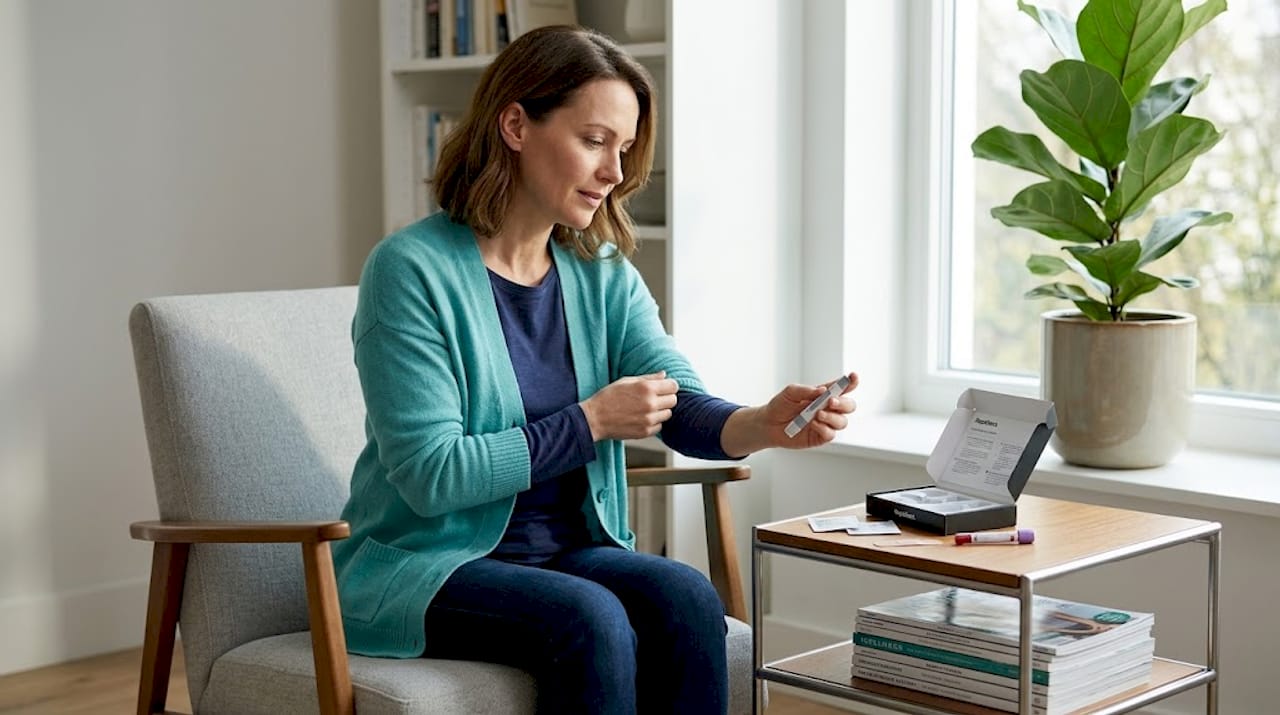
Some tests require a venous blood draw, where a needle goes into a vein. These are difficult to do at home and generally better left to a clinic or GP. For most general health screening, finger-prick blood samples or urine and swab collection are entirely achievable at home when you follow the instructions carefully.
Pro Tip: Read the full instruction leaflet before you open any collection materials. The biggest cause of invalid samples is people starting the process before understanding all the steps.
Ease of use, turnaround time, and result clarity
Even a highly accurate test becomes a problem if you cannot understand the result or if waiting ten days for an answer leaves you in a spiral of anxiety. These are the criteria for at-home tests that often get overlooked.
Sample collection methods vary widely across home test kit options:
- Swabs (nasal, throat, or genital) are simple and non-invasive for most people.
- Finger-prick blood samples require a small lancet and a collection card or tube. Most kits include everything you need.
- Urine samples are arguably the easiest. Collect, transfer, done.
- Stool samples can feel uncomfortable but are straightforward once you follow the guide.
Turnaround time matters enormously depending on why you are testing. Rapid at-home tests like those offered by Rapidtest return results in 15 minutes, right there in your home. No queues, no waiting for a letter. For time-sensitive situations like checking for an STI before a new relationship or confirming pregnancy, that speed genuinely changes how quickly you can make decisions.
Lab-based postal tests take longer, often two to five days, but may offer a broader panel of markers in a single test. The question to ask is: do you need results today, or do you need more comprehensive data?
Result clarity is the piece that DIY health kit buyers frequently underestimate. Some kits return a simple positive or negative. Others return numerical values with reference ranges. If a result is outside the normal range, do you know what to do next? Look for tests that include clear guidance on interpreting results, and ideally, access to a clinician for follow-up if something looks concerning.
Pro Tip: If a kit does not explain what an abnormal result means or who to contact, that is a red flag. Support after the result matters as much as the test itself.
Matching tests to your personal health situation
Choosing the right test is not just about accuracy and instructions. It is about whether this particular test is appropriate for your age, your symptoms, and your circumstances.
Here is a practical way to think through your situation:
- Are you symptomatic or asymptomatic? If you have symptoms, a screening test designed for healthy people is the wrong choice. Go for a test built to detect active infection or active disease markers. COVID antigen tests show around 90% detection in symptomatic individuals, but that figure drops in asymptomatic cases.
- Are you within an eligible age group for NHS screening? The NHS sends bowel cancer FIT kits to people aged 50 to 74. If you are younger and concerned, a private at-home FOB test may be worth considering. If you are in the eligible group, use the NHS programme first.
- Have you considered the testing window? Most tests have a window period. An STI test taken 24 hours after exposure may not yet detect anything. Pregnancy tests are most reliable from the first day of a missed period. Testing too early produces unreliable negatives.
- Are you prepared to do a repeat test? For antigen-based tests, a single negative does not definitively rule out infection. The FDA advises repeat testing after 48 hours for COVID tests to reduce the risk of a missed positive.
- What are your privacy and cost priorities? Home testing sidesteps the waiting room entirely. For sensitive topics like sexual health or fertility, many people find the privacy factor alone justifies the cost.
Understanding how to read your results after testing is the final piece. An accurate result you misinterpret is no better than no result at all.
Single tests vs bundle options
Once you understand what you are testing for, the next question is whether to buy one test or a bundle covering multiple conditions.
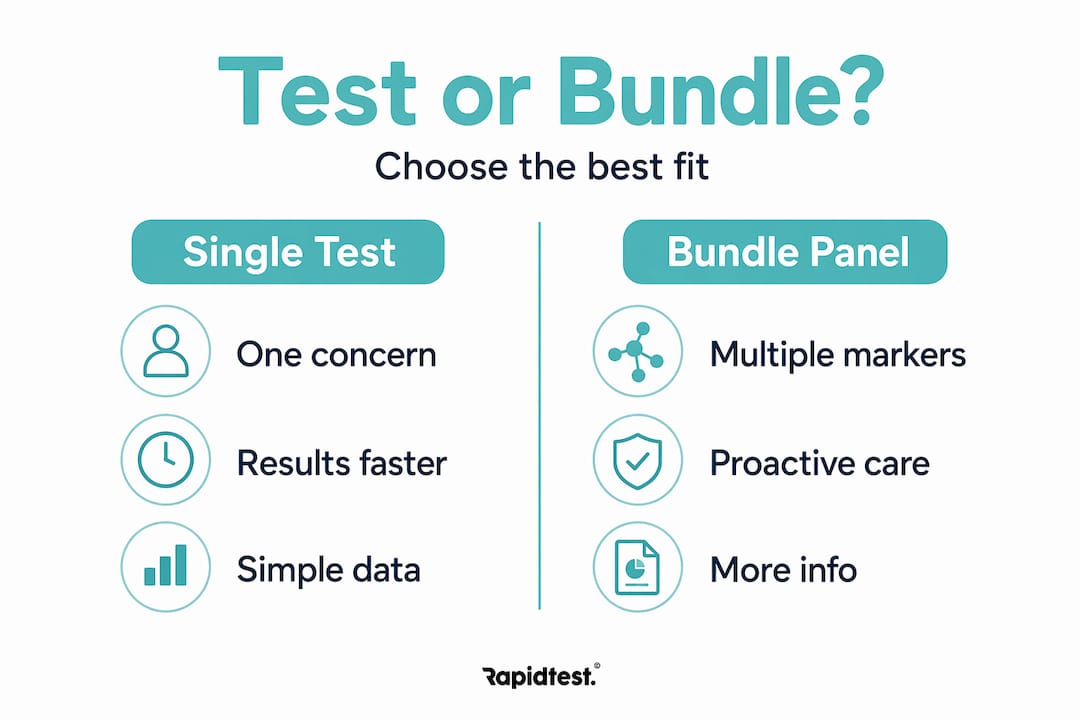
| Single test | Bundle or panel | |
|---|---|---|
| Best for | One specific concern | Multiple questions or routine health checks |
| Cost per test | Usually lower upfront | Better value per condition tested |
| Result complexity | Simple and focused | More data, may need clinician support |
| Convenience | One collection, one result | One collection, multiple answers |
| Ideal user | Specific symptom or exposure | Preventative health focus, several concerns |
Bundles make the most sense when you have more than one area of concern or when you are approaching health proactively rather than reactively. A man in his forties who wants to check his PSA level, cholesterol, and liver markers in one go is far better served by a health screening panel than by three separate kits purchased at different times.
Single tests are better when you know exactly what you are looking for and speed matters. An STI testing guide will typically confirm that a targeted STI test after a specific exposure is more appropriate than a broad sexual health panel in that moment.
The only caveat with bundles is that more results mean more data to interpret. Make sure the kit or service you choose provides clear reference ranges and, ideally, access to a healthcare professional if something flags as abnormal.
My honest take on home test marketing
I have spent a fair amount of time looking at the home testing market, and the thing that genuinely concerns me is how much emphasis gets placed on branding and packaging rather than what actually determines accuracy. A beautifully designed box with confident marketing claims tells you almost nothing about whether the lab processing your sample is any good.
In my experience, the most important questions buyers rarely ask are: who is analysing this sample, and what happens if the result is abnormal? I have seen people take a home health test, get an unexpected result, and have nowhere to turn because the company offered no follow-up support whatsoever. That is not proactive healthcare. That is false reassurance wearing a wellness costume.
The other thing I would flag is overtesting. Buying a broad panel of tests every few months without a clear reason can create anxiety around minor fluctuations that have no clinical significance. More testing is not always more informative. Test with purpose, not panic.
What I think genuinely works is combining the speed and convenience of a good rapid test with the discipline to follow up with your GP if anything flags. Home testing is a starting point, not a verdict. Use it as the first step in a sensible health conversation, not the last word.
— Jack
Start testing with confidence using Rapidtest
You have done the hard work of understanding what to look for. Now you need tests that actually deliver on those criteria.
Rapidtest offers a range of certified, rapid at-home health tests that return results in 15 minutes, without queues or appointments. Whether you are checking your STI status before a new relationship, monitoring fertility markers while trying to conceive, or keeping an eye on your general health with a wellness screening kit, Rapidtest has a straightforward option for your situation. Every kit is designed for real people to use at home, with clear instructions and results you can actually understand.
FAQ
What should I look for in a reliable at-home test?
Look for kits backed by an accredited laboratory, clear sample collection instructions, and straightforward result guidance. Support from a clinician if results are abnormal is a strong positive sign.
How accurate are rapid at-home health tests?
Accuracy depends on both the test design and how carefully you collect the sample. Rapid antigen tests for symptomatic users show around 90% detection rates, while accuracy drops with incorrect sample handling regardless of test quality.
When is the right time to use a home test?
Use a diagnostic test as soon as symptoms appear or shortly after a known exposure. Use a screening test as part of a routine health check, following any age or eligibility guidelines relevant to the condition being screened.
Should I repeat a home test if it comes back negative?
For antigen-based tests especially, one negative result does not rule out infection. The FDA recommends retesting after 48 hours if you still have symptoms or believe you have been exposed.
Are home test bundles worth the extra cost?
Bundles offer better value per condition tested and are ideal if you have multiple health concerns or a general wellness focus. For a single, specific concern, a targeted single test is often faster and simpler.