


Future trends in at home testing 2026: what's changing
What are the biggest at-home testing trends in 2026?
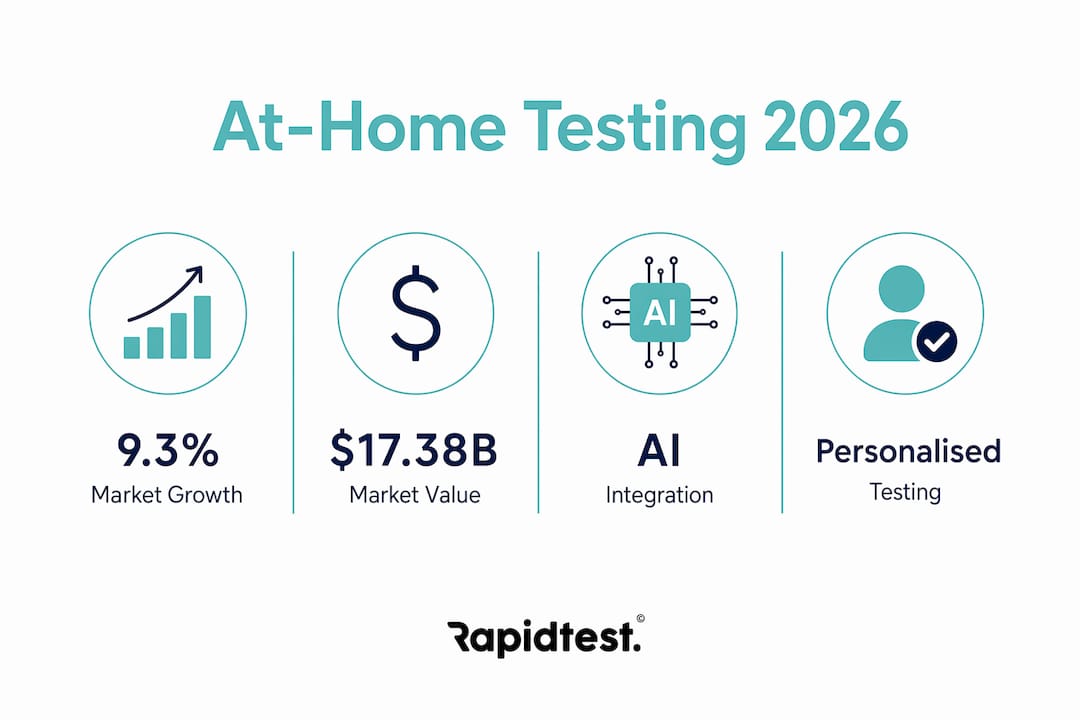
The future of at-home diagnostics is already here, and it’s moving fast. In 2026, the global at-home lab testing market is growing rapidly and is expected to significantly expand by 2030, reflecting a structural shift in healthcare access. This is not a niche trend. It is a structural shift in how people access healthcare.
The key forces driving this shift right now:
- AI integration is moving from buzzword to genuine diagnostic tool, interpreting results and flagging risk patterns in real time
- Decentralised testing is replacing the “one-off kit” model with continuous, connected health monitoring
- Personalised medicine is pushing tests to adapt to your genetics, lifestyle, and health history
- Regulatory evolution in the UK and EU is gradually opening the door to more sophisticated home-use devices
- Molecular diagnostics are shrinking from lab benches into pocket-sized consumer devices
- Rapidtest sits at the heart of this shift, offering fast, private results for STI, fertility, PSA, and FOB screening without a single waiting room
The rise of at-home testing isn’t just about convenience. It’s about people taking real ownership of their health, on their own terms.
How AI and digital governance are reshaping at-home diagnostics
AI is no longer just a back-end tool for large hospital systems. It’s becoming central to how at-home tests work, from interpreting a faint line on a lateral flow strip to predicting whether a result warrants urgent follow-up. The global POC diagnostics market is expanding at a 6–7% CAGR, with AI-enabled platforms delivering faster, more accurate, and predictive results through deep learning and real-time interpretation.
What does this look like in practice?
- Autonomous result reading: AI-powered smartphone apps can now analyse test images, reducing misreads caused by user error or poor lighting
- Predictive health insights: Connected testing ecosystems can flag longitudinal patterns, not just single results
- Clinical decision support: Infrastructure is being designed to deliver clinically relevant outputs within minutes of a test being completed
- Data interoperability: Health systems increasingly expect test results to feed directly into electronic health records, not sit in a standalone app
The challenge is trust. Consumer data privacy and interoperability between test devices and electronic health records are increasingly pivotal to user confidence. If people don’t trust where their data goes, they won’t use the test. Full stop.
Digital governance frameworks, covering cybersecurity, consent, and regulatory compliance, are therefore not optional extras. They’re the foundation that makes connected diagnostics viable. For UK consumers especially, post-Brexit data regulation adds another layer of complexity that providers must navigate carefully.

Why decentralised and personalised testing is changing everything
The old model was simple: feel unwell, visit a clinic, wait for results. The new model looks nothing like that. Diagnostics is transitioning from rapid, single-use kits to interconnected devices that support continuous health monitoring and preventative care.
Here’s what’s driving that change:
- Lab-at-home molecular platforms: Visby Medical’s FDA-cleared RT-PCR device detects flu and COVID-19 from an anterior nasal swab in approximately 30 minutes at home, without any lab processing or separate reader hardware. That’s a genuine shift in what’s technically possible outside a clinical setting.
- Wireless biosensors and wearables: Researchers at the University of Illinois have developed the VPodDuo, an AirPods-sized fluorimeter that detects genetic markers for Zika, HIV, and cancer-associated biomarkers using fluorescent assay chemistry, wirelessly connected to a smartphone app.
- Personalised genomic testing: The growth of personalised medicine is fuelling demand for tests that adapt to an individual’s genetic profile, lifestyle, and chronic conditions. In recent years, the FDA has approved an increasing number of personalised treatments, reflecting the growing adoption of personalised medicine.
- Diagnostic loops: Rather than a one-off test, people are moving toward regular monitoring cycles. Home testing increasingly integrates with digital health platforms to enable longitudinal tracking of chronic conditions.
- Multiplex testing: A single kit that simultaneously screens for multiple conditions, from respiratory infections to STIs to nutritional markers, is fast becoming the standard expectation rather than a premium feature.
Pro Tip: If you’re evaluating at-home testing platforms for chronic disease management, prioritise those with EHR integration capability. A result that lives only in an app is a missed clinical opportunity.
One honest caveat: many kits still rely on lab processing after sample collection, which limits immediacy. The fully self-contained molecular test remains the exception rather than the rule, though that gap is closing quickly.

What does the UK regulatory and market environment look like in 2026?
The UK market requires balanced regulatory oversight that safeguards safety while enabling innovation to meet growing consumer demand. That balance is genuinely difficult to strike, and the UK is still finding its footing post-Brexit.
North America leads in at-home testing adoption, driven by consumer interest and regulatory openness. European markets, including the UK, are moving in the same direction but more cautiously. Experts in the US are more likely than their European counterparts to anticipate higher adoption levels, partly because of regulatory differences around cancer screening and genetic testing.
Key dynamics shaping the UK picture right now:
- Regulatory frameworks: The UK’s Medicines and Healthcare products Regulatory Agency (MHRA) governs at-home diagnostic device approvals. Post-Brexit divergence from EU MDR (Medical Device Regulation) creates both opportunity and complexity for manufacturers.
- Value-based care integration: The primary barrier to adoption isn’t technology. It’s integrating test results into NHS care pathways in a way that’s clinically useful and operationally practical.
- Market growth: By 2035, 10–25% of diagnostic testing is expected to shift into home settings, and nearly a third of experts anticipate over 25% will be performed at home.
- Partnerships: Providers, NHS trusts, and payors are increasingly working together to build reimbursement models that make at-home testing financially sustainable beyond the direct-to-consumer market.
- User trust barriers: Interoperability concerns and data privacy worries remain real obstacles. Consumers want to know their results are secure and their data won’t be misused.
The opportunity for UK-based providers is clear. The challenge is building the infrastructure, both technical and regulatory, to make that opportunity real for everyday people.
How Rapidtest fits into the future of UK home testing
Rapidtest is built around a simple idea: you shouldn’t need a GP appointment to find out something important about your health. Results in 15 minutes, at home, with no queues and no awkward conversations.
That philosophy maps directly onto where the market is heading. Demand for private, convenient testing is growing across every category, and Rapidtest’s core product range covers the areas where that demand is strongest.
- STI testing kits: At-home STI screening is one of the fastest-growing segments in UK home diagnostics. Infectious disease testing ranks among the top three areas experts predict will shift most significantly to home settings.
- Fertility testing kits: Women’s health and fertility ranks second globally among diagnostic areas expected to move home. Rapidtest’s fertility test range covers LH, HCG, and SP-10 markers for both men and women.
- PSA and FOB testing: Prostate and bowel cancer screening at home addresses a genuine gap. Many men avoid GP visits for these checks. A 15-minute PSA test removes that barrier entirely.
- Consumer shift toward proactive health: People aren’t waiting to feel ill before they test. The move toward preventive, insight-driven care is exactly what Rapidtest was built for.
Knowing how to choose the right test for your situation matters as much as having access to one. Rapidtest’s educational content helps people make that call confidently, without needing a medical degree.
The shift toward proactive, personalised health monitoring isn’t a future prediction. It’s what Rapidtest customers are already doing, every day, from their own homes.
Key takeaways
The at-home testing market is growing at a 9.3% CAGR and will reach $17.38 billion by 2030, driven by AI integration, personalised diagnostics, and a structural shift toward decentralised, preventive care.
| Point | Details |
|---|---|
| Market growth is confirmed | The global at-home lab testing market grows from $11.14 billion in 2025 to a projected $17.38 billion by 2030 at a 9.3% CAGR. |
| AI is central, not optional | AI-enabled platforms deliver faster, more accurate, and predictive results through real-time interpretation and EHR integration. |
| Molecular testing is going home | Devices like Visby Medical’s RT-PCR kit deliver lab-grade results in approximately 30 minutes without any lab processing. |
| UK adoption lags North America | European markets including the UK are moving cautiously; regulatory frameworks and NHS integration remain the key barriers. |
| Proactive testing is the new norm | By 2035, 10–25% of all diagnostic testing is expected to shift into home settings, with nearly a third of experts predicting over 25%. |
FAQ
What are the main trends in at-home testing in 2026?
The biggest shifts are AI-driven result interpretation, molecular diagnostics moving into consumer devices, multiplex testing, and the integration of home test results with digital health records and care pathways.
How big is the at-home testing market right now?
The global at-home lab testing market reached $11.14 billion in 2025 and is projected to grow to $17.38 billion by 2030 at a 9.3% CAGR, driven by personalised health insights and digital diagnostics adoption.
What will drive the biggest changes in home diagnostics by 2030?
Personalised medicine, genetic testing, and AI-powered platforms are the primary growth drivers, alongside rising demand for remote health monitoring and direct-to-consumer testing services.
How does the UK compare to the US in at-home testing adoption?
North America leads adoption due to regulatory openness and stronger consumer demand. The UK and wider European market are moving in the same direction but more gradually, with NHS integration and MHRA regulation shaping the pace.
Are at-home tests as accurate as lab tests?
Accuracy varies by test type. Molecular tests, such as PCR-based kits, offer high sensitivity comparable to lab results. Antigen-based rapid tests are faster but can have a higher rate of false negatives, particularly early in an infection.