


What is a silent STI infection? Your UK guide
A silent STI is a sexually transmitted infection that causes no noticeable symptoms in the person carrying it. You can feel completely fine, look completely fine, and still have an infection that can be passed on to a partner or cause serious health problems later. Testing is the only reliable way to know your status.
If you think you may have been exposed, here’s what to do right now:
- Find your nearest NHS sexual health clinic at nhs.uk and book a test
- Consider an accredited at-home rapid STI test if you want a private, quick result at home
- If you test positive, tell recent sexual partners so they can get tested too
Table of Contents
- What does ‘silent’ or ‘asymptomatic’ actually mean?
- Which common STIs are often silent in the UK?
- Why silent infections are genuinely dangerous
- How long can you have an STI without knowing?
- Who should get tested, and what tests are used in the UK?
- What happens after a positive test?
- How to reduce your risk of a silent STI
- Common myths about STIs — and the truth
- Your testing options in the UK: clinics, postal kits, and rapid home tests
- Where to get help in the UK
- Key takeaways
- Rapidtest at-home STI kits: private results in 15 minutes
- Useful sources
- FAQ
What does ‘silent’ or ‘asymptomatic’ actually mean?
The word asymptomatic simply means no symptoms, ever, during the course of an infection. You pick up the infection, your immune system may partially respond, but you never experience the discharge, sores, pain, or burning that people typically associate with an STI. The infection is still there. It can still spread.
Presymptomatic is a slightly different thing. It describes the window between catching an infection and symptoms appearing. Someone who is presymptomatic will eventually develop symptoms; someone who is asymptomatic may never develop them at all. The practical difference matters for testing timing: a presymptomatic person might test negative too early, before the infection is detectable, whereas a truly asymptomatic person could carry an infection for months or years without ever having a reason to suspect it.
Both situations carry real transmission risk. That’s why routine STI screening is recommended for sexually active people, not just those with symptoms.
Which common STIs are often silent in the UK?
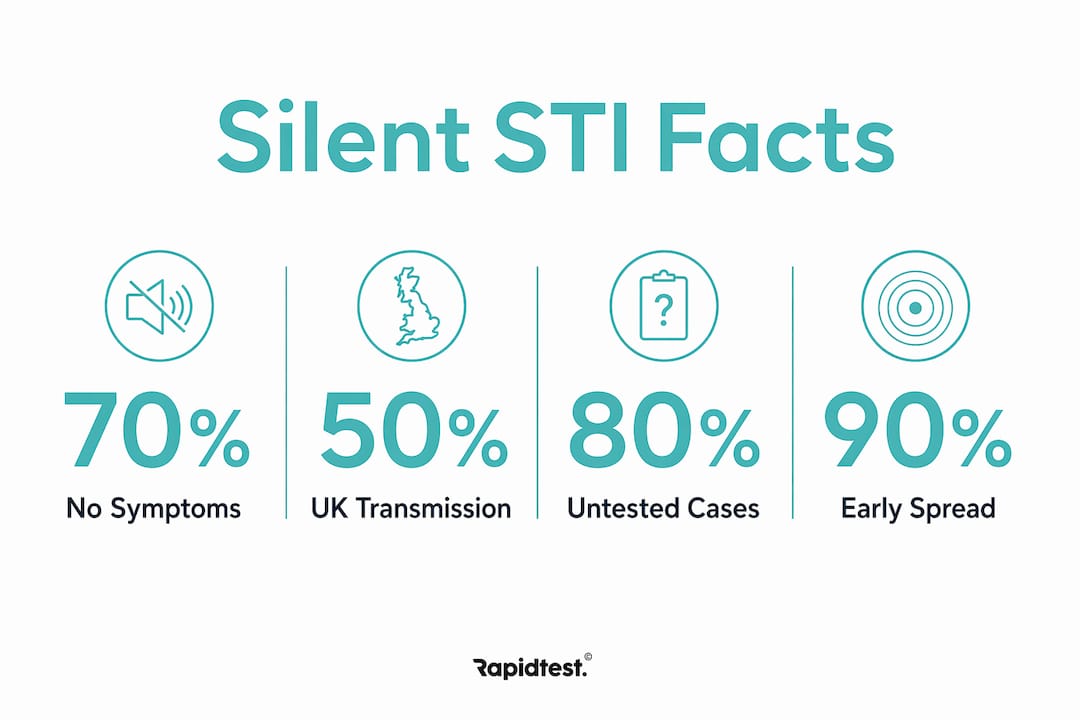
Many common STIs — including chlamydia, gonorrhoea, syphilis, and HPV — are frequently asymptomatic, sometimes for months or years. Here’s a quick breakdown of the ones most likely to go unnoticed:
- Chlamydia — the most commonly diagnosed STI in the UK. Cervical chlamydia is asymptomatic in a significant proportion of women; men may also carry it without symptoms, particularly in the throat or rectum.
- Gonorrhoea — often silent in women. Rectal and throat infections are asymptomatic in up to about 85% of cases regardless of gender.
- HPV (human papillomavirus) — most people with HPV never know they have it. Many strains cause no warts or visible changes, yet high-risk strains can quietly lead to cervical, anal, or throat cancer over years.
- Syphilis — the primary stage produces a painless ulcer that often goes unnoticed. Latent syphilis is entirely asymptomatic and can persist for years.
- HIV — early infection can feel like a brief flu, but many people miss this stage entirely. Without testing, HIV can remain undetected for years while the immune system is gradually affected.
- Herpes simplex virus (HSV) — a large proportion of people with HSV-2 have never had a recognisable outbreak. Shedding (and transmission) can occur even without visible sores.
- Trichomonas vaginalis — often produces no symptoms, particularly in men, yet remains transmissible.
- Hepatitis B — vaccine-preventable and frequently silent in adults during the acute phase; chronic infection can develop without any obvious warning signs.
The pattern here is consistent: the absence of symptoms tells you very little about whether an infection is present.

Why silent infections are genuinely dangerous
The real risk with asymptomatic infections is that they keep spreading. Public health experts describe this as the iceberg phenomenon: the symptomatic cases you hear about are just the visible tip, while the majority of infections sit silently beneath the surface, undetected and untreated.
Left undetected, silent STIs can cause serious long-term harm:
- Pelvic inflammatory disease (PID) — untreated chlamydia or gonorrhoea can travel to the uterus and fallopian tubes, causing PID, which is a leading cause of infertility and ectopic pregnancy.
- Infertility — in both men and women, chronic untreated infections can cause scarring that permanently affects fertility.
- Cancer — persistent high-risk HPV strains are responsible for the majority of cervical cancers, as well as cancers of the anus, throat, and penis.
- Congenital infection — syphilis, HIV, herpes, and gonorrhoea can all be passed from mother to baby during pregnancy or birth, with potentially severe consequences.
- Increased HIV risk — having an untreated STI, even a silent one, can make it significantly easier to acquire or transmit HIV.
The WHO recommends targeted screening as the primary tool for identifying unrecognised infections before these complications develop. NHS and BASHH (the British Association for Sexual Health and HIV) both support regular, proactive testing for sexually active people in the UK, not just those with symptoms.
The WHO estimated hundreds of millions of new cases of curable STIs annually — chlamydia, gonorrhoea, syphilis, and trichomoniasis — the vast majority of which go undiagnosed because they cause no symptoms.
How long can you have an STI without knowing?
The honest answer: it depends on the infection, and sometimes the answer is years.
- Chlamydia and gonorrhoea — detectable by NAAT within days to a couple of weeks after exposure, but symptoms may never appear at all.
- Syphilis — the primary ulcer appears roughly 2–3 weeks after exposure and often heals on its own. Latent syphilis, which follows the secondary stage, is completely asymptomatic and can last for years.
- HIV — a p24 antigen/antibody test can detect infection from around 4 weeks after exposure. Without testing, HIV can remain undetected for a decade or more.
- Herpes (HSV) — the first outbreak, if it happens at all, typically occurs within 2–12 days of exposure. Many people never have a recognisable outbreak but can still shed the virus and transmit it.
- HPV — warts or cell changes may appear months to years after initial infection, or never.
The key point is that contagiousness doesn’t wait for symptoms. You can transmit most STIs before, during, and after any symptomatic phase — or throughout an entirely asymptomatic infection. Knowing when to take an STI test after a potential exposure is one of the most practical things you can do for your own health and your partners’.

Who should get tested, and what tests are used in the UK?
Testing is the only definitive way to know your STI status. Feeling well is not a reliable indicator.
Who should prioritise testing:
- Sexually active people under 25 (annual chlamydia screening is recommended by the NHS)
- Anyone with a new or multiple sexual partners
- Men who have sex with men (MSM) — 3–6 monthly screening is recommended by BASHH
- Pregnant people (routine antenatal screening covers HIV, syphilis, and hepatitis B)
- Sex workers and their clients
- Anyone who has had unprotected sex and is unsure of a partner’s status
What tests are used:
| STI | Test type | Sample | Window period |
|---|---|---|---|
| Chlamydia | NAAT | Urine or swab | 2 weeks post-exposure |
| Gonorrhoea | NAAT | Urine or swab | 2 weeks post-exposure |
| Syphilis | Blood test | Blood | 6 weeks (some labs 12 weeks) |
| HIV | Antigen/antibody blood test | Blood | 4 weeks |
| Hepatitis B | Blood test | Blood | 6 weeks |
| Herpes (HSV) | Swab (active sore) or blood | Swab/blood | Variable |
| HPV | Cervical screening / swab | Swab | N/A (screen-based) |
NAATs are the preferred method) for detecting chlamydia and gonorrhoea because of their high sensitivity on urine and swab samples. Blood tests cover HIV, syphilis, and hepatitis. NHS sexual health services provide all of these tests free of charge, and BASHH issues clinical guidance on screening frequency for different risk groups.
What happens after a positive test?
Getting a positive result is not the end of the story. Most STIs are either curable or very manageable with the right treatment.
Curable with antibiotics:
- Chlamydia, gonorrhoea, syphilis, and trichomoniasis are all bacterial or parasitic infections that respond to antibiotic treatment. Gonorrhoea in particular requires a test-of-cure appointment because of rising antibiotic resistance — follow-up testing confirms the infection has cleared.
Managed long-term:
- HIV, herpes, and HPV are viral infections with no cure, but all are manageable. Antiretroviral therapy (ART) for HIV can reduce the viral load to undetectable levels, meaning transmission risk drops to effectively zero. Antiviral medication for herpes reduces outbreak frequency and transmission risk. HPV often clears on its own; persistent high-risk strains are monitored through cervical screening.
Partner notification matters. If you test positive, your recent sexual partners need to know so they can get tested too. NHS sexual health clinics offer a confidential partner notification service, and you don’t have to make contact yourself if you’d rather not. Abstaining from sex until treatment is complete (and your partner has also been treated) prevents reinfection.
Pro Tip: Don’t stop treatment early just because symptoms improve or you feel better. Finishing the full course is what clears the infection.
How to reduce your risk of a silent STI
Prevention isn’t complicated, but it does require consistency.
- Use condoms and dental dams for all penetrative and oral sex. They significantly reduce the risk of most STIs, though they don’t provide complete protection against skin-to-skin infections like herpes and HPV.
- Get vaccinated. The HPV vaccine is offered to all young people in the UK as part of the NHS school programme, and catch-up doses are available for eligible adults. The hepatitis B vaccine is recommended for people at higher risk, including MSM and sex workers, and is available through NHS sexual health clinics.
- Consider PrEP if you’re at risk of HIV. Pre-exposure prophylaxis (PrEP) is highly effective at preventing HIV when taken correctly. It’s available on the NHS in England, Scotland, Wales, and Northern Ireland — ask at a sexual health clinic about eligibility.
- Test regularly. Knowing your status, and your partner’s, is one of the most effective prevention tools available. Testing before a new partner is a straightforward way to protect both of you.
Common myths about STIs — and the truth
“I’d know if I had an STI.” This is the most persistent and most dangerous myth. The evidence is clear: you can carry a transmissible infection for months or years without any symptoms at all. Feeling healthy is not the same as being STI-free.
“I can tell by looking.” Visual checks are not a reliable method of detection. Many infections, including chlamydia, gonorrhoea, and early syphilis, leave no visible signs. Even herpes can be present without visible sores.
“Condoms make me completely safe.” Condoms are excellent and you should use them, but they don’t cover all skin-to-skin contact. HPV and herpes can be transmitted from areas not covered by a condom. Condoms reduce risk significantly; they don’t eliminate it.
“I was tested recently, so I’m fine.” A negative test result is accurate only up to the point of your last exposure. If you’ve had sex since your last test, your status may have changed.
“Only certain types of people get STIs.” STIs don’t discriminate. Anyone who is sexually active can acquire one, regardless of relationship status, age, or how many partners they’ve had.
For a deeper look at STI symptoms and what to watch for, it’s worth reading up even if you feel fine.
Your testing options in the UK: clinics, postal kits, and rapid home tests
There’s no single right way to test. The best option is the one you’ll actually use.
| Testing route | Speed | Privacy | Cost | Best for |
|---|---|---|---|---|
| NHS sexual health clinic | Same day to a few days | High (confidential) | Free | Full STI screen, clinical support |
| GP referral | Days to weeks | Moderate | Free | Routine screening, ongoing care |
| NHS postal home kit | Results in days | High | Free (some areas) | Chlamydia/gonorrhoea screening |
| At-home rapid test (e.g. Rapidtest) | 10–15 minutes | Very high | Paid | Quick, private screening at home |
What to check before buying any home test kit:
- UKCA or CE marking — confirms the device meets safety and performance standards
- Clear instructions included in the kit
- Transparent about what the test covers — a single-infection test and a multi-infection panel are very different things
Pro Tip: At-home rapid tests are excellent for screening — getting a quick answer when you have no symptoms and want peace of mind. If you test positive, or if you have symptoms, follow up with an NHS sexual health clinic for confirmatory testing and treatment.
Rapidtest supplies accredited at-home rapid STI kits. Full disclosure: this article is published by Rapidtest, and the testing options above include our own products alongside NHS routes.
Where to get help in the UK
Routine testing and advice:
- NHS sexual health services — find your nearest clinic at nhs.uk/conditions/sexually-transmitted-infections-stis
- BASHH (British Association for Sexual Health and HIV) — the professional body that issues clinical guidance for sexual health practitioners in the UK; their patient resources are available at bashh.org
- SH:24 and SHL.UK — NHS-commissioned online testing services offering free postal kits in many parts of England
When to seek urgent care:
- Severe pelvic or abdominal pain
- High fever alongside genital symptoms
- Unusual bleeding not related to your menstrual cycle
- Acute swelling of the genitals or lymph nodes
These symptoms warrant same-day attention. Go to an NHS urgent treatment centre or A&E if your sexual health clinic cannot see you immediately.
Confidentiality: All NHS sexual health services are strictly confidential. Your GP is not automatically informed, and results are not shared without your consent. You can also use a service outside your local area if you prefer.
You can also access online pharmacy services such as Pharmacy + Me for prescription support and sexual health products where relevant.
Key takeaways
Silent STIs are common, serious, and entirely detectable with the right test — the only barrier is choosing to get tested.
| Point | Details |
|---|---|
| Silent STIs have no symptoms | You can carry and transmit an infection without ever feeling unwell. |
| Testing is the only reliable check | Feeling healthy or checking visually is not a substitute for an actual test. |
| Several STIs are often asymptomatic | Chlamydia, gonorrhoea, HPV, syphilis, HIV, and herpes can all be silent for months or years. |
| Untreated infections cause real harm | PID, infertility, cancer, and congenital infection are all linked to undetected STIs. |
| Rapidtest offers at-home rapid testing | Results in 10–15 minutes, discreet delivery, no clinic appointment needed. |
The thing nobody tells you about feeling fine
Here’s what I find genuinely striking about silent STIs: the very thing that makes them dangerous is also what makes them so easy to dismiss. When nothing hurts, it’s natural to assume nothing’s wrong. But that logic doesn’t hold for infections that are, by definition, designed to go unnoticed.
The good news is that testing has never been easier or more private. You don’t need to sit in a waiting room or have an awkward conversation with your GP. You can test at home, get a result in 15 minutes, and know your status before the end of your lunch break. The stigma around STI testing is slowly fading, and that’s worth encouraging. Routine sexual health checks are no different from any other health screen. They’re just sensible.
If you’ve been putting off a test because you feel fine, that’s exactly the moment to do it.
Rapidtest at-home STI kits: private results in 15 minutes
Rapidtest exists for people who want clear answers without the wait. Our at-home rapid STI test kits cover chlamydia, gonorrhoea, syphilis, HIV, hepatitis B, hepatitis C, HSV-2, and HPV, with results in 10–15 minutes from home. No appointment, no queue, no awkward conversation.
Every kit arrives in discreet packaging with full instructions. You don’t need any medical background to use one. And if your result is positive, the next step is straightforward: contact an NHS sexual health clinic for confirmation and treatment.
For anyone who wants to screen proactively, check their status before a new relationship, or simply avoid the wait at a clinic, a Rapidtest kit is a practical, private option. Order your kit here and have your result today.
This article is published by Rapidtest. We sell the at-home rapid test kits described above.
Useful sources
- NHS — Sexually transmitted infections (STIs) — the primary UK resource for testing, treatment, and finding local services
- WHO — STI fact sheet) — global epidemiology, diagnostic guidance, and treatment recommendations
- WHO — Guidelines for the management of asymptomatic STIs — clinical guidance on screening rationale and targeted testing
- NCBI Bookshelf — Asymptomatic STI management — detailed clinical reference on asymptomatic rates and testing approaches
- Mayo Clinic — Sexually transmitted diseases — accessible clinical overview of STI symptoms, causes, and testing
- BASHH (bashh.org) — professional guidance for sexual health clinicians in the UK; patient-facing resources also available
For personalised advice, contact your nearest NHS sexual health clinic directly.
FAQ
Which STI is most commonly a silent infection?
Chlamydia is the most frequently diagnosed silent STI in the UK. It causes no symptoms in a large proportion of those infected, particularly in women, yet remains transmissible and can cause serious complications if left untreated.
Can you have an STI without any symptoms at all?
Yes. Many STIs, including chlamydia, gonorrhoea, HPV, and syphilis, are frequently asymptomatic. Some people carry an infection for months or years without ever developing noticeable symptoms.
How do you detect a silent STI?
Testing is the only reliable method. In the UK, NAAT tests (urine or swab) are used for chlamydia and gonorrhoea; blood tests cover HIV, syphilis, and hepatitis. At-home rapid tests such as those from Rapidtest can provide results in 10–15 minutes for initial screening.
How often should you get tested if you have no symptoms?
NHS guidance recommends annual chlamydia screening for sexually active people under 25. BASHH recommends 3–6 monthly testing for men who have sex with men and others at higher risk. After any new or unprotected sexual contact, testing is sensible regardless of symptoms.
Are STIs always symptomatic eventually?
No. Some infections, such as HPV and chlamydia, can remain entirely asymptomatic throughout. Others, like HIV, may cause a brief early illness that passes unnoticed. Relying on symptoms to appear before testing is not a safe approach.
This article provides general health information only and is not a substitute for professional medical advice. For your own situation, please consult an NHS sexual health clinician or qualified healthcare professional.