


The Real Challenges of STI Diagnosis Explained
You might assume that if something were wrong, you’d know. A symptom. A sign. Something. But that’s exactly where STI diagnosis gets complicated. The truth is, the challenges of STI diagnosis go well beyond a quick test and a yes-or-no answer. Infections can hide for months without a single signal, symptoms get mistaken for other conditions, and even when you do try to get tested, barriers like cost, stigma, and timing can get in the way. Understanding all of this isn’t just reassuring. It’s the first step toward doing something about it.
Table of Contents
- Key Takeaways
- Challenges of STI diagnosis: when silence is the symptom
- Barriers to STI testing: what gets in the way
- Why testing timing makes STI diagnosis so complicated
- Who falls through the cracks: age, gender, and social blind spots
- How technology is closing the gap on STI diagnosis
- My honest take on all of this
- Test from home with Rapidtest
- FAQ
Key Takeaways
| Point | Details |
|---|---|
| Most STIs show no symptoms | Over 80% of women with STIs report no symptoms, making routine screening critical. |
| Stigma delays diagnosis | Fear of judgment is one of the biggest reasons people avoid or postpone getting tested. |
| Timing affects accuracy | Testing too soon after exposure can produce false negatives due to the window period. |
| Older adults are at rising risk | STI rates in adults 55 and older have more than doubled in five years, often going undetected. |
| At-home testing removes barriers | Rapid, private test kits make it easier to screen without appointments or clinic visits. |
Challenges of STI diagnosis: when silence is the symptom
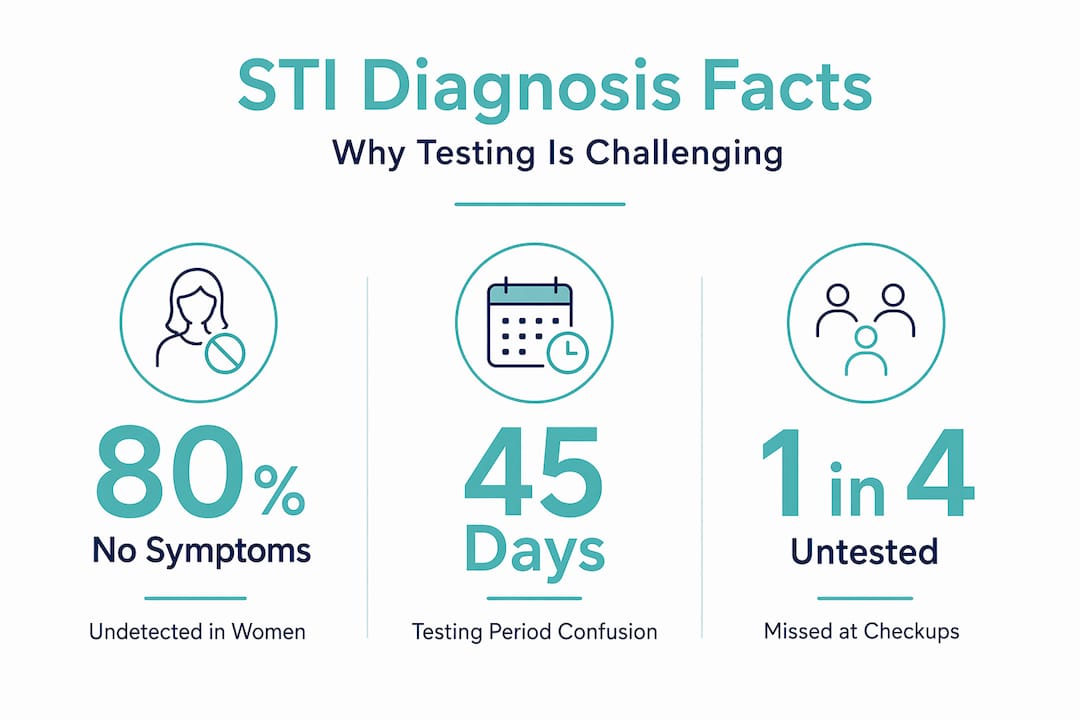
Here’s something that catches most people off guard. Over 80% of women with STIs experience no symptoms at all. None. That means the classic mental image of an STI — obvious discomfort, visible signs, something impossible to ignore — simply doesn’t match reality for the majority of people who have one.
This is one of the most significant STI diagnosis difficulties out there. When there’s nothing to notice, there’s no reason to get tested. And when testing doesn’t happen, infections spread silently.
Even when symptoms do appear, they often don’t look like an STI. They look like something else entirely. Discharge, irritation, mild discomfort — these can all point to:
- A yeast infection
- Bacterial vaginosis
- A skin condition like eczema
- Urinary tract infections
This overlap is what clinicians call diagnostic mimicry. STI symptoms mirror common non-STI conditions, which leads doctors down the wrong treatment path. You treat the yeast infection. The STI stays. The cycle continues. It’s a frustrating reality that makes comprehensive testing far more reliable than waiting for a clear symptom to appear.
Pro Tip: If you’ve been treated for recurring yeast infections or BV more than once in a year, it’s worth asking specifically for STI screening. Symptom overlap is common, and one test can rule out a lot.
“Relying solely on symptoms is insufficient given the frequency of asymptomatic infections and how closely STI symptoms resemble other conditions.” — Hologic
Barriers to STI testing: what gets in the way
Even when someone suspects they might need testing, getting there isn’t always straightforward. STI screening challenges aren’t just medical. They’re social, financial, and logistical.
Here’s a look at the most common obstacles in STI diagnosis and testing:
- Stigma and fear of judgment. Stigma remains a major barrier to testing, causing people to delay care even when they know they’re at risk. Worrying about what a doctor, partner, or pharmacist will think is enough to stop many people from acting at all.
- Cost and coverage gaps. Not everyone has insurance that covers STI testing, and out-of-pocket costs for full panels can be surprisingly high. This pushes people to skip testing or only get partial screening.
- Clinic access and scheduling. Sexual health clinics often have limited hours, long wait times, and require advance appointments. For someone working multiple jobs or caring for family, carving out that window is genuinely hard.
- Privacy concerns. Younger adults, people in smaller communities, and those from marginalized groups often worry about confidentiality. The fear that results could reach family members, employers, or partners without consent is a real and documented concern.
- Testing not offered during routine visits. Annual exams frequently omit sexual health screening unless the patient specifically asks for it. Most people don’t know to ask.
That last point is particularly important. You could go in for your yearly physical and walk out with zero STI screening because sexual health topics simply weren’t raised. The responsibility often falls on the patient to initiate that conversation.
Pro Tip: At your next checkup, say directly: “I’d like to include STI testing today.” You don’t need to explain yourself. Doctors respond to specific requests, and you have every right to make one.
Why testing timing makes STI diagnosis so complicated
You tested. It came back negative. Great news, right? Not necessarily. One of the most misunderstood common STI diagnosis issues is the window period, and it catches a lot of people out.

The window period is the gap between the moment of exposure and when a test can actually detect the infection. If you test during this period, false negatives are common. The infection is there. The test just can’t see it yet.
Here’s how window periods differ across common infections:
| Infection | Typical Window Period | Recommended Retest |
|---|---|---|
| HIV | 18-45 days (antigen/antibody) | At 45 days, confirm at 90 days |
| Chlamydia | 1-2 weeks | Retest at 3 months if at risk |
| Gonorrhea | 1-2 weeks | Retest at 3 months if at risk |
| Syphilis | 3-6 weeks | Confirm at 6 weeks and 3 months |
| Herpes (HSV-2) | 12-16 weeks | Confirm at 16 weeks post-exposure |
Beyond timing, the type of test matters too. Antibody tests detect your immune response to an infection, which takes time to develop. Antigen tests detect the virus or bacteria itself, which can be faster. Nucleic acid amplification tests (NAAT) are the gold standard for accuracy but are more expensive and not always available on demand.
The practical takeaway is straightforward:
- Test at the right time, not just the first available moment
- Understand that a negative result during the window period is not a clean bill of health
- Follow up with a second test if you’re within the window period at first screening
Misreading a negative result as definitive is one of the biggest reasons why is STI testing hard for so many people to act on correctly. A negative today can become a positive in three weeks.
Who falls through the cracks: age, gender, and social blind spots
One group that consistently gets overlooked when discussing STI screening challenges? Adults over 55. STI rates in this age group have more than doubled in five years, yet screening rarely gets recommended because providers and patients alike assume the risk doesn’t apply.
The assumption that STIs are a “young person’s problem” is genuinely dangerous. Older adults are less likely to use protection, less likely to be asked about sexual health by their doctor, and less likely to seek testing because the idea of personal risk doesn’t register.
Women face a distinct set of challenges too. Because most STIs are asymptomatic in women, and because symptoms that do appear overlap heavily with other reproductive health conditions, STI risk in women is consistently underestimated. An undiagnosed chlamydia infection, for example, can quietly cause pelvic inflammatory disease and affect fertility before anyone realizes something was wrong. When STI symptoms overlap with reproductive tract issues, it can sometimes complicate fertility evaluations as well.
Other groups who experience heightened barriers include:
- Teenagers and young adults navigating privacy concerns and parental insurance
- LGBTQ+ individuals who may not always receive relevant, inclusive screening recommendations
- People in rural areas with limited access to sexual health clinics
- Individuals from communities where talking about sexual health carries heavy social stigma
Tailored screening recommendations that account for these realities would make a significant difference. Until then, knowing your own risk profile matters more than waiting for a provider to ask.
How technology is closing the gap on STI diagnosis
The good news is that the medical and technological tools for getting accurate STI diagnoses have improved significantly. The gap between “hard to detect” and “detected” is narrowing.
Nucleic acid amplification tests, known as NAATs, are now considered the most sensitive method for detecting infections like chlamydia and gonorrhea. They work by amplifying tiny traces of the pathogen’s genetic material, which means they can pick up infections that older tests would miss entirely.
Even better, multiplex molecular tests allow clinicians to screen for multiple infections from a single sample. One swab. Multiple results. That’s a practical improvement for patients who want thorough screening without multiple procedures.
| Testing Method | What It Detects | Speed | Accuracy |
|---|---|---|---|
| NAAT | Chlamydia, gonorrhea, others | 1-3 days | Very high |
| Antigen test | HIV, some others | Hours to days | High |
| Antibody test | HIV, syphilis, herpes | Days | Moderate to high |
| Rapid at-home test | HIV, chlamydia, others | 15 minutes | High for target infection |
At-home STI testing kits are arguably the most accessible development of the past decade. Home kits offer privacy, convenience, and results in as little as 15 minutes, which directly addresses the biggest barriers: stigma, scheduling, and cost. When you can test in your own bathroom without a waiting room, the number of excuses to delay drops considerably.
Opt-out screening strategies in clinical settings are also gaining traction. Rather than asking patients to request testing, providers offer STI screening as a default part of care. This shifts the dynamic and reduces the weight of stigma by normalizing testing as routine rather than reactive.
Pro Tip: If you’re ordering an at-home test, check what specific infections the kit screens for before you buy. Some test for two or three infections, others cover eight or more. Matching the kit to your actual risk profile gives you much more useful information.
My honest take on all of this
I’ve looked closely at how STI diagnosis plays out for real people, and what stands out to me is how much the system relies on patients already knowing things they were never taught. You’re expected to ask for testing your doctor didn’t offer, time your test around a window period you might not know exists, and push back when a “negative” result doesn’t feel right given your timeline.
The reliance on symptoms alone is genuinely risky, and I think most people underestimate how often “feeling fine” and “being fine” are two completely different things with STIs. Stigma makes this worse. When people are embarrassed or afraid of judgment, they delay testing, don’t disclose to partners, and end up in a cycle that’s harder to break the longer it goes.
What actually works? Regular testing as part of routine health maintenance, not just a reaction to a scare. Honest conversations with partners. And choosing testing formats that remove as many barriers as possible. At-home kits aren’t a replacement for clinical care in every situation, but they’re a genuinely useful tool for removing the friction that stops so many people from testing at all.
— Jack
Test from home with Rapidtest
Getting tested shouldn’t require a long wait, an awkward conversation, or a full afternoon off work. Rapidtest makes it straightforward.
With at-home STI test kits that deliver results in 15 minutes, Rapidtest takes the most common obstacles in STI diagnosis and removes them one by one. No clinic. No queue. No judgment. Just a discreet kit that arrives at your door, with clear instructions and fast results you can act on. Whether you want to test after a new partner, after a potential exposure, or just as part of regular health maintenance, Rapidtest has a rapid STI test kit designed to fit your life. Proactive health doesn’t have to be complicated.
FAQ
Why are STIs so hard to diagnose?
Many STIs produce no symptoms at all, and when symptoms do appear, they often resemble other conditions. This combination of asymptomatic infections and diagnostic mimicry makes STI diagnosis difficult without specific testing.
What is the window period in STI testing?
The window period is the time between exposure to an infection and when a test can detect it. Testing too early during this period can produce a false-negative result, even when an infection is present.
Can you have an STI without any symptoms?
Yes. Over 80% of women with STIs report no symptoms, and many men also carry infections without noticeable signs. Regular testing is the only reliable way to know your status.
Do annual physicals include STI testing?
Not automatically. Routine annual exams frequently omit sexual health screening unless the patient asks for it. You need to specifically request STI testing for it to be included.
Who is most at risk for undetected STIs?
Anyone who is sexually active can carry an undetected STI, but women, older adults over 55, and individuals who face barriers to testing are particularly likely to go undiagnosed due to asymptomatic infections and limited screening access.