


Can you have an STI without symptoms?
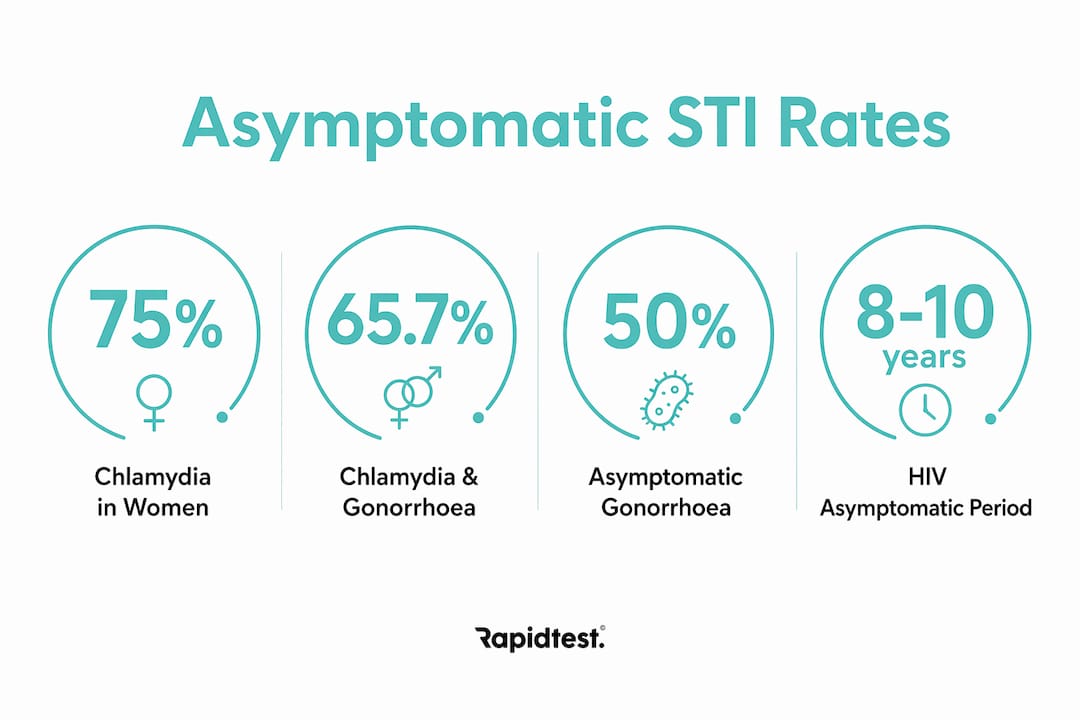
You can have an STI without symptoms and never know it. This is the defining challenge of sexual health today. Sexually transmitted infections, or STIs, are frequently asymptomatic, meaning the clinical term for an infection that produces no noticeable signs. Up to 75% of females and 50% of males with chlamydia show no symptoms at all. That means millions of people are carrying and transmitting infections while feeling completely fine. Understanding this is not just reassuring. It is the first step toward doing something about it.
Can you have an STI without symptoms? Which ones and how often?
The short answer is yes, and it happens far more often than most people realise. Asymptomatic STIs are not rare edge cases. They are the norm for several of the most common infections in the UK.
Chlamydia is the clearest example. 65.7% of gonorrhoea and chlamydia cases are asymptomatic overall. For chlamydia specifically, up to three quarters of infected women and half of infected men will notice nothing at all. No discharge, no pain, no burning. Nothing.

Gonorrhoea follows a similar pattern. Around 50% of women with gonorrhoea have no symptoms. Men are more likely to notice something, but still a significant proportion do not.
HIV can remain asymptomatic for 8 to 10 years after initial infection. During that entire period, the virus is still transmissible. Many people only discover their status when they test for an unrelated reason.
Herpes and HPV are similarly silent. Herpes can lie dormant between outbreaks, and most people with HPV never develop visible warts or symptoms. HPV is also the leading cause of cervical cancer, making its silent nature particularly serious.
Here is a quick comparison of how often these infections present without symptoms:
| STI | Asymptomatic rate (approximate) | Notes |
|---|---|---|
| Chlamydia (women) | Up to 75% | Often discovered only through screening |
| Chlamydia (men) | Up to 50% | Discharge may appear but is often mild |
| Gonorrhoea (women) | Around 50% | Symptoms easily confused with other conditions |
| HIV | High during latency | Latent phase can last 8–10 years |
| HPV | Very common | Most infections clear silently; some cause cancer |
| Herpes | Common between outbreaks | Dormant periods are still potentially infectious |
One factor that makes this even more complex is where the infection sits in the body. Extragenital infections, those in the throat or rectum, are asymptomatic 76.5% of the time, compared to 31.3% for genital infections. A throat infection from gonorrhoea, for example, almost never causes a sore throat. You would not think to connect the two.
Why symptom-based STI testing is unreliable
Waiting for symptoms before getting tested is one of the most common mistakes people make. The logic feels sound: if something were wrong, you would feel it. But the data says otherwise.
72.9% of chlamydia infections would be missed entirely if only people with symptoms were screened. For gonorrhoea, that figure is 50%. Half of all gonorrhoea cases, gone undetected, simply because the person felt fine.
There is another problem on top of that. STI symptoms are frequently mistaken for other common conditions. Discharge gets written off as a yeast infection. Mild pelvic discomfort is blamed on period pain. A sore throat is assumed to be a cold. Self-diagnosis is unreliable and can delay treatment that genuinely matters.
The reasons people fall through the cracks include:
- Assuming that no symptoms means no infection
- Confusing STI symptoms with everyday ailments
- Feeling embarrassed to ask for a test without a clear reason
- Not knowing that extragenital infections rarely cause any signs at all
- Believing that a previous negative test provides ongoing protection
Risk-based screening is the approach public health professionals now recommend. That means testing based on your sexual history and behaviour, not on whether you feel unwell. Clinicians are encouraged to ask about the number of partners, types of sexual contact, and condom use, then screen accordingly.
Pro Tip: If you have had a new sexual partner, stopped using condoms, or had unprotected sex of any kind, that is reason enough to get tested. You do not need symptoms to justify a test.
How silent STIs affect your health and your partners
The consequences of an untreated asymptomatic STI are not minor. They build quietly over months or years, and by the time symptoms appear, real damage may already have been done.
Here is what untreated infections can lead to:
- Pelvic inflammatory disease (PID). Untreated chlamydia or gonorrhoea can spread to the uterus and fallopian tubes, causing PID. This is a leading cause of chronic pelvic pain and ectopic pregnancy.
- Infertility. Scarring from repeated or prolonged infections can block the fallopian tubes in women and affect sperm production in men.
- Increased HIV risk. Untreated STIs like gonorrhoea and chlamydia cause inflammation that makes it significantly easier to acquire or transmit HIV.
- Transmission to partners. Asymptomatic carriers transmit infections effectively. The absence of symptoms does not reduce contagiousness. HIV during its latent phase is still transmissible. Herpes can be passed on between visible outbreaks.
- Complications in pregnancy. Undetected infections during pregnancy can cause premature birth, low birth weight, and transmission to the baby during delivery.
The idea that you would know if something were wrong is one of the most persistent and damaging misconceptions in sexual health. Many people incorrectly assume that no symptoms means no risk of transmission. That assumption breaks chains of care and keeps infections circulating.
When and how to get tested if you have no symptoms
Routine screening is the standard recommendation for sexually active people, regardless of whether they feel well. Feeling healthy does not guarantee being infection-free. Testing before starting with a new partner or before stopping condom use is a straightforward way to protect both yourself and others.
Who should be testing regularly:
- Anyone with a new sexual partner
- People with multiple partners
- Those who have had unprotected sex, including oral and anal sex
- Anyone who has previously had an STI
- People whose partners have tested positive
What types of testing are available:
Different infections require different samples. A urine test alone will not catch a throat or rectal infection. Multi-site screening, covering genital, throat, and rectal sites, dramatically improves detection rates, especially for people who have oral or anal sex.
| Testing option | Accessibility | Privacy | Speed |
|---|---|---|---|
| NHS sexual health clinic | High | Moderate | Days to a week |
| GP referral | Moderate | Moderate | Days to weeks |
| At-home rapid test kit | Very high | Full | 15 minutes |
| Private clinic | High | High | Same day to 48 hours |
At-home rapid test kits sit at the top of that list for convenience. You collect your own sample, follow the instructions, and get your result in 15 minutes. No queue, no appointment, no awkward conversation in a waiting room. For many people, that privacy is what finally gets them to test. You can find a step-by-step guide to at-home STI screening if you want to know exactly what to expect.
Pro Tip: One negative test does not guarantee future protection. STIs can be dormant or cyclical, so regular screening is the only reliable way to stay on top of your sexual health.
If you do visit a clinic or GP, be honest about your sexual history. The type of contact you have had, and where, determines which tests you actually need. Holding back information means you might leave without the right tests done.
Key takeaways
Asymptomatic STIs are the norm, not the exception, and routine testing based on sexual behaviour is the only reliable way to protect yourself and your partners.
| Point | Details |
|---|---|
| Symptoms are not a reliable indicator | Up to 75% of women with chlamydia have no symptoms at all. |
| Extragenital infections are almost always silent | Throat and rectal infections are asymptomatic 76.5% of the time. |
| Untreated infections cause serious harm | Chlamydia and gonorrhoea can lead to infertility and PID if left undetected. |
| Asymptomatic does not mean non-contagious | HIV remains transmissible during its 8–10 year latent phase. |
| At-home testing removes the biggest barrier | Rapid kits deliver results in 15 minutes with full privacy and no appointment. |
The silent epidemic nobody talks about enough
I have spent a long time thinking about why asymptomatic STIs remain so poorly understood by the general public, and I keep coming back to the same problem. We have built our entire cultural understanding of sexual health around symptoms. If it hurts, if something looks wrong, if you feel off, then you get checked. That model is simply broken.
The data is unambiguous. Symptom-based testing misses the majority of infections in high-risk groups. And yet the default behaviour for most people is still to wait and see. That gap between what the evidence says and what people actually do is where infections spread, where complications develop, and where transmission chains grow.
What I find genuinely encouraging is the shift toward risk-based screening. Asking “what is your sexual history?” rather than “do you have symptoms?” is a small change in language that makes an enormous difference in practice. It removes the stigma of needing a visible reason to test. It normalises testing as a routine part of adult health, like checking your blood pressure or getting a dental check-up.
The other shift I think matters enormously is access. When testing requires a clinic visit, an appointment, and a face-to-face conversation, a lot of people simply do not go. At-home testing removes every one of those barriers. The 2026 guide on when to test makes the case clearly. Regular, private, convenient testing is not a luxury. For sexually active people, it is the baseline.
— Jack
Private STI testing from Rapidtest, results in 15 minutes
Knowing you can have an STI without symptoms is one thing. Acting on that knowledge is another.
Rapidtest offers at-home STI testing kits that give you results in 15 minutes, with no lab visit, no appointment, and no waiting room. You collect your sample at home, follow the simple instructions, and know where you stand within a quarter of an hour. Rapidtest also offers an HPV rapid test kit for private, fast screening at home. Whether you have had a new partner, want to test before stopping condoms, or simply want peace of mind, Rapidtest makes proactive screening straightforward and genuinely private.
FAQ
Can you have an STI without any symptoms at all?
Yes. Many STIs, including chlamydia, gonorrhoea, HIV, herpes, and HPV, frequently cause no symptoms. Up to 75% of women with chlamydia have no signs of infection.
Can you transmit an STI asymptomatically?
Yes. Asymptomatic carriers transmit infections effectively. HIV remains contagious during its latent phase, and herpes can be passed on between visible outbreaks.
How long can an STI go undetected without symptoms?
HIV can remain asymptomatic for 8 to 10 years. Chlamydia and gonorrhoea can also persist for months or years without causing noticeable signs, causing damage silently in the meantime.
How often should you get tested if you have no symptoms?
Public health guidance recommends testing based on sexual behaviour, not symptoms. Testing before a new partner, after unprotected sex, or every 3 to 6 months if you have multiple partners is a sensible approach.
Are throat and rectal STIs more likely to be silent?
Yes. Extragenital infections are asymptomatic 76.5% of the time, compared to 31.3% for genital infections. Multi-site testing is the only way to catch them reliably.