


Why early STI detection matters for your health
Most people assume they’d know if something was wrong. That’s the biggest myth in sexual health. The importance of early STI detection isn’t just a public health talking point. It’s the difference between a quick course of antibiotics and a long-term complication that nobody saw coming. Many STIs produce no symptoms whatsoever, meaning you can carry and pass on an infection without ever feeling unwell. This guide walks you through what you need to know about timing, symptoms, and the practical steps that keep you and your partners protected.
Table of Contents
- Key takeaways
- Why early STI detection is critical
- When and how to get tested
- Recognising early symptoms
- Prevention strategies and protecting your partners
- Taking the next step
- My honest take on testing stigma
- Test from home with Rapidtest
- FAQ
Key takeaways
| Point | Details |
|---|---|
| Many STIs have no symptoms | Infections like chlamydia and gonorrhoea are often silent, making routine testing the only reliable way to know your status. |
| Window periods affect accuracy | Testing too soon after exposure can produce a false negative; timing your test correctly is just as important as doing one. |
| Annual testing is the baseline | Sexually active adults should test at least once a year, and every three to six months if you have multiple partners. |
| Early treatment protects fertility | Untreated STIs can lead to pelvic inflammatory disease and infertility; catching them early prevents lasting damage. |
| At-home testing removes barriers | Private, rapid tests make it easier to screen regularly without appointments, queues, or difficult conversations. |
Why early STI detection is critical
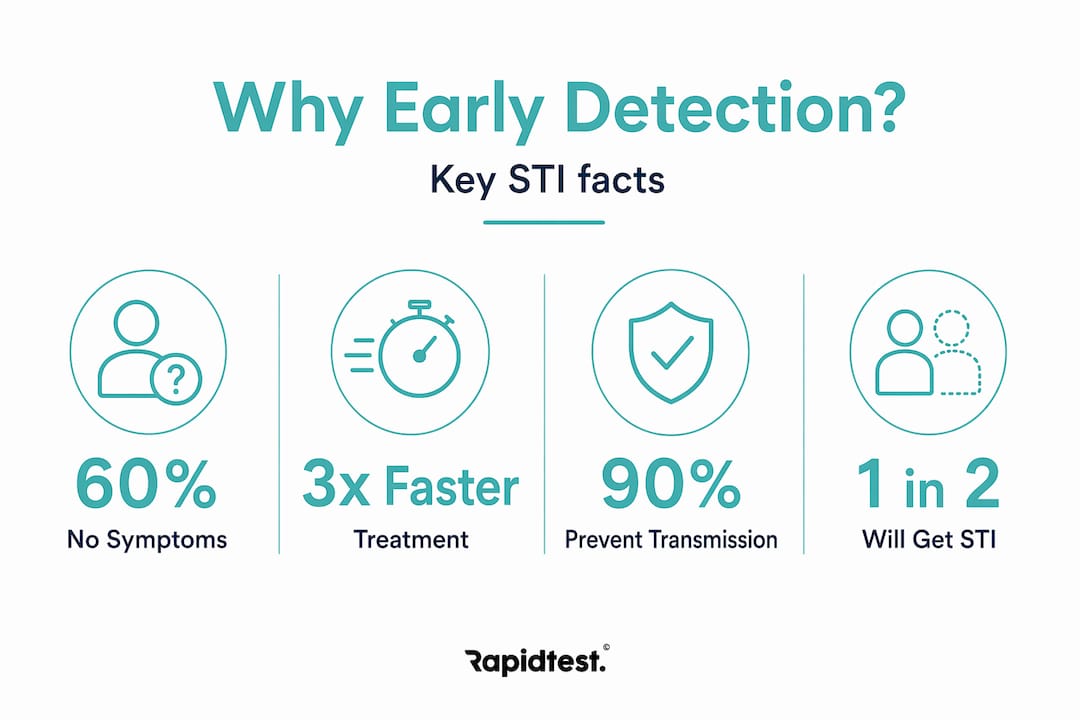
Let’s be real. The idea that you’ll definitely notice an STI is comforting, but it’s not accurate. Many STIs are asymptomatic, meaning your body shows no obvious signs that anything is wrong. Chlamydia, gonorrhoea, and early HIV infection are the clearest examples. You can live with any of these for months or even years without a single symptom that rings alarm bells.
This is not a fringe situation. Undetected infections cause complications including pelvic inflammatory disease, chronic pelvic pain, and infertility, all of which develop quietly over time. By the point symptoms do appear, the infection may have already done considerable damage.
There are a few STIs worth understanding in this context:
- Chlamydia. The most commonly diagnosed STI in the UK. The majority of people with chlamydia experience no symptoms at all. Left untreated, it can scar the fallopian tubes and cause infertility in women, and epididymitis in men.
- Gonorrhoea. Often symptomless, particularly in women. When symptoms do appear, they’re frequently mistaken for a urinary tract infection or thrush.
- HIV. Early infection can produce flu-like symptoms for a short window, after which many people feel completely well for years while the virus continues to affect the immune system.
- Syphilis. Early sores may be painless and appear in places that aren’t immediately visible, so they’re easily missed.
The pattern is the same across all of them. Absence of symptoms does not mean absence of infection. Waiting to feel unwell before getting tested is exactly how infections spread and complications develop.
Pro Tip: If you’re sexually active, treat STI testing the same way you’d treat a dental check-up. You don’t wait until your tooth hurts to see a dentist. Don’t wait until you feel unwell to test.
When and how to get tested
Timing matters more than most people realise. This is where the concept of the window period comes in. Every STI has a window period: the time between exposure and when a test can accurately detect the infection. Testing too soon leads to false negatives, which can give you a false sense of security.
Here’s how the window periods break down for the most common infections:
- Chlamydia and gonorrhoea. Most tests are accurate from around two weeks after exposure. A urine sample or swab is used for both.
- HIV. A 4th-generation combination test is reliable from 45 days post-exposure, though NAT tests detect HIV from 10 to 14 days post-exposure. Retesting at three months is still recommended to confirm a negative result.
- Syphilis. Blood tests for syphilis antibodies are typically accurate from three to six weeks after exposure, with a confirmatory test at three months.
- Herpes. Blood tests are unreliable in the very early stages. Swabs taken from active sores are more accurate during an outbreak.
- Hepatitis B and C. The window period is roughly six to eight weeks for hepatitis B and eight to eleven weeks for hepatitis C.
As for how often you should test, annual testing is recommended for syphilis, chlamydia, gonorrhoea, and HIV for sexually active adults. If you have multiple partners, every three to six months is a more appropriate schedule.
| Infection | Window period | Recommended retest |
|---|---|---|
| Chlamydia and gonorrhoea | 2 weeks | If symptomatic or exposed again |
| HIV (4th-generation test) | 45 days | At 3 months to confirm |
| Syphilis | 3 to 6 weeks | At 3 months |
| Hepatitis B | 6 to 8 weeks | As advised by clinician |
| Hepatitis C | 8 to 11 weeks | As advised by clinician |
You can find a full breakdown of types of STI tests available, from urine samples to blood tests and swabs, along with what each one detects.
Recognising early symptoms
Symptoms, when they do appear, are often mild enough to be dismissed or misattributed to something else entirely. Knowing what to look out for can genuinely make the difference between catching something early and letting it progress.
Watch out for these signs, even if they seem minor:
- Unusual discharge from the penis, vagina, or rectum
- A burning or stinging sensation when urinating
- Sores, blisters, or unusual bumps around the genitals, mouth, or rectum
- A rash on the body, particularly on the palms of the hands or soles of the feet (which can indicate syphilis)
- Unusual bleeding, particularly between periods or after sex
- Swollen lymph nodes in the groin or neck
- Pain during sex
The tricky part is that several of these symptoms overlap with entirely unrelated conditions. Discharge might be attributed to thrush. Burning when urinating gets assumed to be a UTI. STI symptoms are often mild or easily ignored, and that’s precisely why they fall through the cracks.
“Testing should be viewed as responsible health management rather than a cause for fear. An STI test is not an admission of wrongdoing. It’s a practical health decision.”
Seek testing immediately rather than waiting if you’ve had unprotected sex with a new or casual partner, if a partner has told you they’ve been diagnosed with an STI, or if you notice any of the symptoms above. In these cases, don’t sit on it for a few weeks. Prompt testing and, if needed, treatment is always the right move. It’s also worth noting that positive antibody test results can sometimes reflect past exposure rather than an active infection, which is why professional interpretation matters alongside self-testing.
Prevention strategies and protecting your partners

Early detection isn’t just about protecting yourself. One of the clearest early STI testing benefits is what it does for the people around you. Early detection prevents passing infections unknowingly and allows treatment to begin before any further transmission occurs.
Here’s where practical prevention strategies come together:
- Use barrier methods consistently. Condoms remain the most effective barrier against most STIs, though they don’t provide complete protection against skin-to-skin infections like herpes or HPV.
- Test before new relationships. Getting screened before becoming sexually active with a new partner is one of the most considerate things you can do. This testing before a new partner approach significantly reduces transmission risk.
- Notify partners if you test positive. It can feel like an uncomfortable conversation, but partner notification is critical to breaking transmission chains. Many clinics offer anonymous notification services if you’d rather not do it directly.
- Test together. Couples who test simultaneously remove the uncertainty from relationships and make sexual health a shared responsibility rather than an individual one.
- Explore accessible testing options. Prescription-free access to STI testing increases uptake among young adults by removing the stigma and logistical friction of booking a clinic appointment.
Bacterial STIs are at their highest level in a decade according to recent ECDC data. Routine, periodic testing combined with safe sex practices is more relevant right now than it has been in years.
Pro Tip: If you’re thinking about starting a family or preserving your fertility, early detection of treatable infections is a key part of the picture. Untreated STIs are one of the most preventable causes of infertility. Consider reading about fertility testing steps alongside your sexual health screening routine.
Taking the next step
The impact of STIs on health compounds over time when infections go undetected. The risks from delayed diagnosis, including infertility, chronic pain, and increased transmission, are all avoidable with routine screening. You don’t need to be in a high-risk category to benefit from regular testing. You just need to be sexually active.
Align your testing schedule to your lifestyle. Annual testing is the minimum baseline. Every three to six months if you have multiple partners. Test promptly after any potential exposure, and always respect the window period before drawing conclusions from a negative result.
Knowledge is the most practical tool you have. Use it.
My honest take on testing stigma
I’ve spent a long time thinking about why people avoid testing, and the answer is almost always the same. It’s not laziness. It’s fear of what a positive result might say about them.
What I’ve seen consistently is that stigma does far more damage than any diagnosis. When people delay testing out of embarrassment or fear of judgement, infections sit undetected for months. Complications develop that are entirely preventable. Partners are exposed who might never have been.
In my view, the framing needs to shift. Testing is not something you do because something went wrong. It’s something you do because you’re a responsible adult who takes your health seriously. The same way you’d test your blood pressure or get a smear test.
The uncomfortable truth I’ve found is that the people most resistant to testing are often the ones most at risk, not because of their behaviour, but because stigma creates blind spots. If you’ve been putting it off, now is a good time to stop.
Sexual health is health. Full stop.
— Jack
Test from home with Rapidtest
Taking charge of your sexual health doesn’t have to mean sitting in a waiting room. Rapidtest makes it straightforward to screen privately, from home, with results in 15 minutes.

Our at-home STI testing kits cover a full range of infections including chlamydia, gonorrhoea, HIV, syphilis, and more. No appointment. No awkward conversations. No queue. Just clear, accurate results you can act on straight away. Whether you’re building a routine testing schedule or need to check after a potential exposure, Rapidtest gives you the privacy and speed to stay on top of it. Browse our STI testing resources to find the right kit and learn more about what each test covers.
FAQ
What is the importance of early STI detection?
Early STI detection allows you to begin treatment before complications develop and prevents you from unknowingly passing an infection to a partner. Many STIs cause no symptoms, making routine testing the only reliable way to know your status.
How soon can I test after potential exposure?
It depends on the infection. Most tests for chlamydia and gonorrhoea are accurate from around two weeks after exposure, while HIV testing is most reliable from 45 days with a confirmatory test at three months. Testing too soon can produce a false negative result.
How often should I get tested for STIs?
Sexually active adults should test at least once a year for the most common infections. If you have multiple partners, a testing schedule of every three to six months is more appropriate, in line with current CDC guidance.
Can I test for STIs at home?
Yes. At-home rapid testing kits are a reliable and private option for routine screening. They detect infections from a urine, blood, or swab sample and deliver results in around 15 minutes, with no lab or clinic visit required.
What happens if an STI goes undetected?
Untreated STIs can lead to serious complications including pelvic inflammatory disease, chronic pelvic pain, and infertility. Some infections, if left unmanaged, can also increase the risk of certain cancers or contribute to long-term immune damage.