


The rise of STIs in Europe: what you need to know
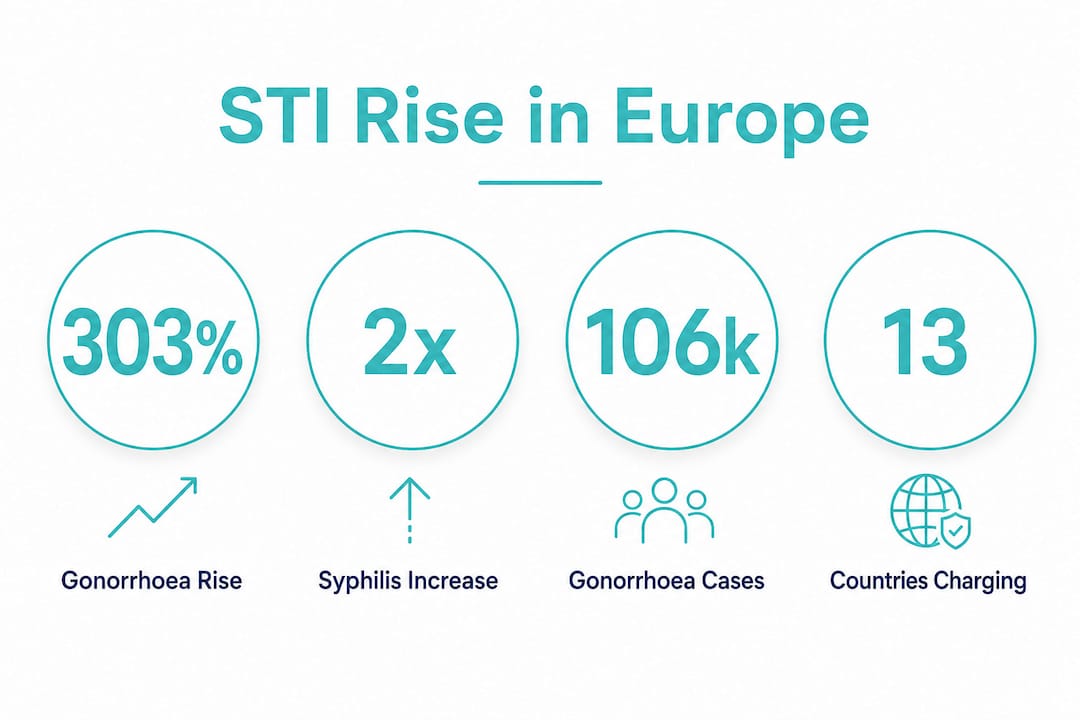
Sexually transmitted infections across Europe have reached record highs, with gonorrhoea notifications hitting 106,331 in 2024 alone. That is a 303% increase since 2015. Syphilis cases more than doubled to 45,577 in the same period, and congenital syphilis, passed from mother to baby during pregnancy, nearly doubled from 78 cases in 2023 to 140 in 2024. The European Centre for Disease Prevention and Control (ECDC) has described these figures as the highest in over a decade. The rise of STIs across Europe is not a scare story. It is a documented public health trend that affects real people, and understanding it is the first step to protecting yourself.
What factors are driving the rise of STIs in Europe?
The increase in sexually transmitted infections is not down to one single cause. The surge is complex, shaped by a mix of behavioural shifts, healthcare system gaps, and changes in how infections are detected and reported.
Several factors are contributing to the upward trend:
- Post-pandemic behaviour shifts. Following extended periods of social restriction, patterns of sexual activity changed across Europe. More people reported new or multiple partners, and the use of dating apps accelerated connections between individuals who may not have previously crossed paths.
- PrEP expansion and increased testing. The wider rollout of HIV pre-exposure prophylaxis (PrEP) among men who have sex with men (MSM) requires regular STI screening as part of the programme. This means more asymptomatic infections are being detected that would previously have gone unnoticed. Rising PrEP-linked testing is inflating case counts in ways that do not necessarily reflect riskier behaviour.
- Outdated national strategies. Many prevention strategies across EU and EEA countries have not been updated to reflect post-pandemic behavioural changes, leaving gaps in public health responses.
- Women of reproductive age. The rise in syphilis is particularly concerning among women of reproductive age, where missed diagnoses are directly linked to the near-doubling of congenital syphilis cases.
- Reduced condom use. Across multiple age groups, consistent condom use with new partners has declined, removing one of the most effective barriers against transmission.
Pro Tip: If you are using PrEP, your regular STI screening appointments are one of the most important parts of the programme. Do not skip them, even when you feel completely well.
The picture here is nuanced. Some of the increase in reported cases reflects better detection, not purely more transmission. But that does not mean the trend can be dismissed. Both things are true at once: testing is improving, and transmission is also genuinely rising.

How do current testing and treatment options shape STI trends?
Access to testing across Europe is far from equal. 13 of 29 EU/EEA countries still charge out-of-pocket costs for STI testing, and seven require parental consent for under-18s. These barriers mean that people who need testing most are often the least likely to get it. When infections go undetected, they spread.
| Testing barrier | Impact on STI trends |
|---|---|
| Out-of-pocket costs in 13 countries | Reduces testing uptake, allowing asymptomatic infections to go undetected |
| Parental consent rules for under-18s | Discourages young people from seeking testing, increasing transmission risk |
| Limited clinic availability | Creates delays in diagnosis and treatment, extending infectious periods |
| Stigma around sexual health | Prevents individuals from seeking care, particularly in smaller communities |
Treatment is also becoming more complicated. The ECDC’s Euro-GASP surveillance programme analysed 3,371 gonococcal isolates in 2024 and found rising levels of extensively drug-resistant gonorrhoea strains. This matters because it means the antibiotics that have historically treated gonorrhoea are becoming less reliable. Clinicians in some countries now ask patients about their antibiotic history before prescribing, because resistance patterns vary by country and even by infection site.
Congenital syphilis prevention is another area where the system is falling short. Preventing it requires more than a single antenatal test. It needs correct infection staging, timely treatment, and follow-up testing to confirm the mother and foetus are both protected. When any one of those steps is missed, the consequences can be lifelong for the child.
Pro Tip: If you are pregnant or planning to become pregnant, ask your midwife or GP specifically about syphilis screening. It should be offered routinely, but gaps in follow-up care mean it does not always happen as it should.
The distinction between increased detection and increased transmission is worth holding onto. More reported cases do not always mean more people are behaving recklessly. Sometimes they mean the system is finally catching infections it previously missed. Both interpretations carry different implications for how you respond.
What practical steps can you take to protect your sexual health?
Knowing the scale of the problem is useful. Knowing what to do about it is better. Here are the most effective steps you can take right now.
- Use condoms consistently with new or multiple partners. Condoms remain one of the most effective tools against gonorrhoea, syphilis, chlamydia, and HIV. Their effectiveness depends on consistent use, not occasional use.
- Get tested regularly, even when you have no symptoms. Many STIs, including gonorrhoea and chlamydia, produce no obvious signs. Untreated infections can lead to infertility, chronic pelvic pain, and neurological complications. Testing is the only way to know for certain.
- Talk to new partners about testing. It feels awkward the first time. It gets easier. Asking a partner when they last tested is a normal, responsible part of sexual health.
- Understand doxy-PEP if you are in a high-risk group. Doxycycline post-exposure prophylaxis is a course of antibiotics taken after potential exposure to an STI. The ECDC advises targeted use of doxy-PEP for syphilis and chlamydia prevention in high-risk populations, but does not recommend it broadly for gonorrhoea due to the risk of accelerating antimicrobial resistance. Speak to a sexual health clinic before using it.
- Notify partners if you test positive. Partner notification is one of the most effective ways to break transmission chains. Many sexual health services offer anonymous notification tools if you are not comfortable doing it directly.
Pro Tip: You do not need to wait for symptoms to get tested. If you have had unprotected sex with a new partner in the past three months, that alone is a reasonable reason to screen. Check out our at-home STI screening guide to understand which infections to prioritise.
The goal is not to be anxious about sex. It is to be informed. Regular testing, honest communication, and consistent protection are the three habits that make the biggest difference.
How can at-home STI testing improve access and privacy?
For many people, the biggest barrier to testing is not knowledge. It is the practical reality of booking a clinic appointment, sitting in a waiting room, and having a conversation with a stranger about your sex life. That barrier is real, and it stops people from testing.
At-home STI testing removes most of those friction points. Privacy and convenience are the two most commonly cited reasons people choose at-home options over clinic visits, and for good reason. You test in your own space, on your own schedule, with no one else involved.
Here is what modern at-home rapid testing looks like in practice:
- Speed. Results in as little as 15 minutes, comparable to a clinic lateral flow test.
- Privacy. No waiting rooms, no paperwork with your name on it, no awkward conversations.
- Accuracy. Modern rapid tests for infections like HIV, syphilis, chlamydia, and gonorrhoea are clinically validated and reliable when used correctly.
- Accessibility. No appointment needed. No GP referral. No out-of-pocket clinic fees in countries where those apply.
- Frequency. At-home testing makes it easier to test more often, which is exactly what the ECDC recommends for sexually active individuals with multiple partners.
The ECDC has explicitly called for improved testing access across Europe as part of its response to the current STI epidemic. At-home testing is one of the most practical ways to close the gap between what is recommended and what people actually do. You can explore your affordable testing options to find the right fit for your situation.
Key takeaways
The rise of STIs in Europe is driven by a combination of genuine transmission increases, improved detection, systemic testing barriers, and outdated prevention strategies, all of which require individual awareness and action.
| Point | Details |
|---|---|
| Record-high STI rates | Gonorrhoea up 303% since 2015; syphilis doubled. ECDC data confirms the trend is real. |
| Multiple causes | Behavioural shifts, PrEP-linked testing, and outdated national strategies all contribute. |
| Testing barriers remain | 13 EU/EEA countries charge for testing; 7 require parental consent for under-18s. |
| Resistance is a growing concern | Drug-resistant gonorrhoea strains are rising, complicating treatment across Europe. |
| At-home testing closes the gap | Rapid home tests offer privacy, speed, and accessibility without clinic appointments. |
Why the numbers tell only half the story
I have spent a long time reading public health data, and the one thing I have learnt is that a headline number rarely tells you the full story. The 303% rise in gonorrhoea since 2015 is striking. But part of that increase reflects the fact that we are simply better at finding infections that were always there. PrEP programmes, in particular, have brought thousands of people into regular testing cycles who were never screened before. Some of those cases were always circulating. We just did not know about them.
That does not mean the situation is fine. It is not. Transmission is genuinely rising in several populations, and the consequences of untreated infections, including infertility, congenital disease, and antibiotic resistance, are serious. But the framing matters. If people believe the rise is entirely about reckless behaviour, they are less likely to see themselves as part of the affected group. The truth is that anyone who is sexually active and not testing regularly is flying blind.
The most empowering thing you can do is get informed and get tested. Not because you should be frightened, but because knowing your status puts you in control. That is always a better place to be than guessing.
— Jack
Test at home with Rapidtest
Rapidtest offers at-home STI testing kits that give you results in 15 minutes, with no appointment, no GP, and no waiting room. If the ECDC data has prompted you to think about your own sexual health, this is the easiest way to act on that. You test at home, in private, and you know your status within a quarter of an hour. Rapidtest kits cover the infections that matter most, including HIV, syphilis, chlamydia, and gonorrhoea. Taking control of your sexual health does not have to be complicated or expensive. It just has to happen.
FAQ
What is causing the rise of STIs across Europe?
The increase is driven by a combination of post-pandemic behavioural changes, expanded PrEP testing programmes detecting more asymptomatic infections, reduced condom use, and outdated national prevention strategies. The ECDC confirmed in 2026 that gonorrhoea and syphilis have reached their highest recorded levels in the EU and EEA.
Can you have an STI without any symptoms?
Yes. Many STIs, including chlamydia, gonorrhoea, and early-stage syphilis, produce no noticeable symptoms. This is one of the main reasons infections spread undetected and why regular testing is recommended for sexually active individuals, regardless of how they feel.
How often should I get tested for STIs?
Sexual health guidelines recommend testing at least once a year if you are sexually active, and every three months if you have multiple partners or are part of a higher-risk group such as MSM using PrEP. At-home rapid tests make it straightforward to test more frequently without clinic visits.
Is at-home STI testing as accurate as a clinic test?
Modern clinically validated rapid tests are reliable for detecting infections like HIV, syphilis, chlamydia, and gonorrhoea when used correctly. For confirmed diagnoses or complex cases, a clinic follow-up may be recommended, but at-home testing is an effective first step for routine screening.
What should I do if I test positive at home?
Contact a sexual health clinic or your GP as soon as possible for confirmation and treatment. Most bacterial STIs, including chlamydia, gonorrhoea, and syphilis, are treatable with antibiotics. You should also inform recent sexual partners so they can get tested and treated if necessary.