


The rise of STIs in Europe: what you need to know
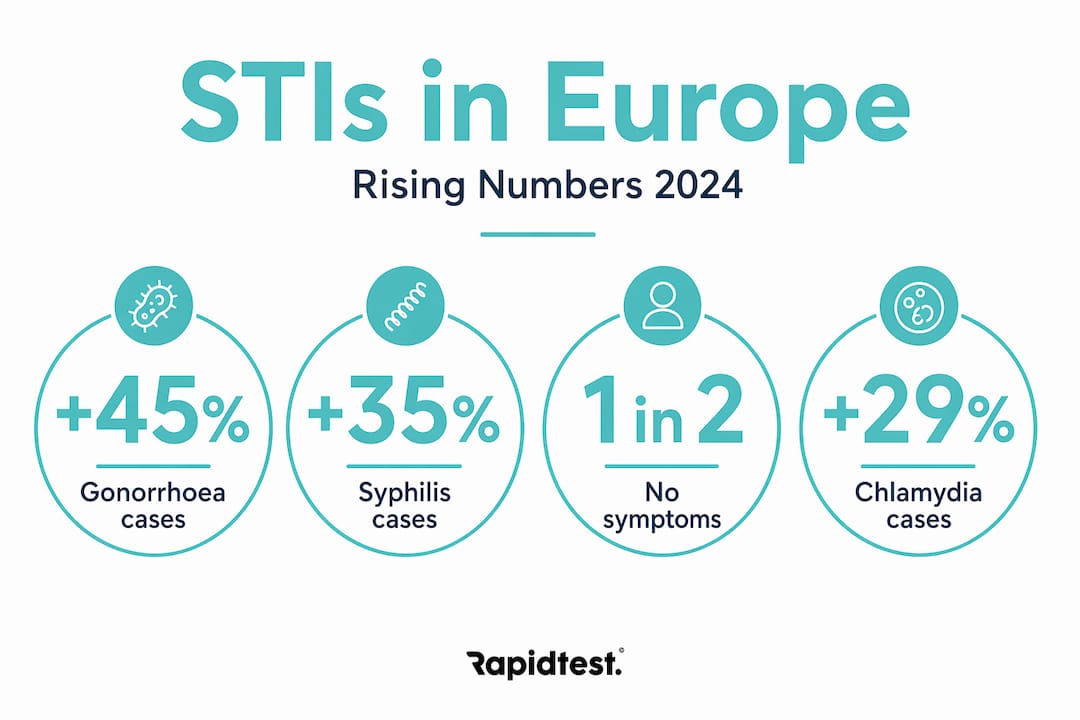
Gonorrhoea cases in the EU and EEA hit 106,331 in 2024, a staggering 303% increase since 2015. Syphilis more than doubled. Congenital syphilis, passed from mother to baby during pregnancy, nearly doubled in a single year. The rise of STIs across Europe is not a slow creep. It is a sharp, well-documented trend that is affecting people of all ages, backgrounds, and relationship statuses. And the uncomfortable truth is that most people carrying one have absolutely no idea.
Table of Contents
- Key takeaways
- The rise of STIs: what the numbers actually show
- Why are STI rates rising?
- Why you might have an STI and not know it
- Prevention and testing options that actually work
- How public health is responding
- My take on what really needs to change
- Test at home with Rapidtest
- FAQ
Key takeaways
| Point | Details |
|---|---|
| Record highs in 2024 | Gonorrhoea and syphilis have reached their highest levels in Europe in over a decade. |
| Young adults most affected | Those aged 15 to 34 are disproportionately impacted, with gonorrhoea rates among young women up nearly 200% since 2021. |
| Most STIs have no symptoms | Chlamydia and gonorrhoea often cause no visible signs, making routine testing the only reliable way to know your status. |
| Testing barriers still exist | Out-of-pocket costs and parental consent rules in several European countries are stopping people from getting tested. |
| At-home testing changes the equation | Rapid at-home kits give you results in 15 minutes, with no appointment, no queue, and no awkward conversation. |
The rise of STIs: what the numbers actually show
The data is hard to ignore. According to the European Centre for Disease Prevention and Control (ECDC), gonorrhoea cases tripled between 2015 and 2024. Syphilis cases rose to 45,557. And congenital syphilis, which had been close to elimination in parts of Europe, jumped from 78 to 140 cases in just one year.
Both the BBC and Metro covered this story prominently in May 2026, reflecting just how significant these figures are. This is not niche public health data. It is mainstream news.
Chlamydia remains the most reported bacterial STI with 213,443 cases in 2024, though it has actually declined slightly since 2015. The real drivers of the increase in STIs are gonorrhoea and syphilis, both of which are now at record levels.
Who is most affected? The picture is fairly clear:
- Young adults aged 15 to 34 account for the largest share of new diagnoses across Europe.
- Gonorrhoea notification rates among women aged 20 to 24 rose nearly 200% between 2021 and 2023 alone.
- Men who have sex with men (MSM) remain disproportionately affected by syphilis in particular.
- Women of reproductive age face added risk from congenital syphilis transmission during pregnancy.
These are not abstract statistics. They represent real people, many of whom had no symptoms and no idea anything was wrong.
Why are STI rates rising?
There is no single, clean answer here. The causes of STIs rising at this rate are layered and interconnected, which is part of why the trend has been so hard to reverse.
Post-pandemic behaviour shifts played a significant role. During COVID-19, sexual health services were disrupted, testing dropped, and many infections went undiagnosed. This created what researchers call a “testing debt,” where a backlog of undetected infections quietly spread before anyone caught them. When services reopened, the numbers that emerged were alarming.
Dating apps have also changed the picture. More sexual partners, faster connections, and a false sense of security among users who assume that being symptom-free means being STI-free. That assumption is genuinely dangerous, and dating app use has contributed to reduced condom use and increased transmission.
HIV PrEP is another factor worth understanding clearly. PrEP is a genuinely life-changing medication that protects against HIV. But its uptake has been associated with a decline in condom use among some groups, which reduces protection against bacterial STIs like gonorrhoea and syphilis. This is not a criticism of PrEP. It is simply a consequence that public health teams are now working to address.
It is also worth noting that some of the increase in reported cases reflects better detection. Increased screening among high-risk groups means more asymptomatic cases are being caught. That is actually a good thing. But it does not account for the full scale of the rise.
Pro Tip: If you have started using PrEP or changed your sexual health routine recently, it is worth reviewing your STI testing schedule at the same time. PrEP protects against HIV but not bacterial infections.
Why you might have an STI and not know it
This is the part that catches most people off guard. STIs are not always obvious. In fact, they are frequently invisible.

Chlamydia, the most commonly reported STI in Europe, often presents with no symptoms at all. Gonorrhoea can be the same. You can feel completely fine, have no discharge, no pain, no unusual signs whatsoever, and still be carrying an infection that is doing damage in the background.
Left untreated, these infections can cause:
- Pelvic inflammatory disease in women, which can lead to chronic pain and scarring of the reproductive organs.
- Infertility in both men and women, often discovered only when trying to conceive.
- Increased HIV risk, as untreated STIs can make transmission easier in both directions.
- Complications in pregnancy, including premature birth and, in the case of syphilis, serious harm to the baby.
The challenges of STI diagnosis are compounded by the fact that many people only test when they have symptoms. If there are no symptoms, testing never happens. The infection continues. Partners are not told. The cycle repeats.
Stigma is a real barrier too. Many people feel embarrassed to ask for a test, assume it implies promiscuity, or simply do not want to have that conversation with a GP. In seven European countries, young people under a certain age still require parental consent to test, which is a significant deterrent for the age group most at risk.
Pro Tip: Testing is not a sign that something is wrong. It is a sign that you are taking care of yourself. Treating it like a routine health check, the same as a blood pressure reading or a dental appointment, takes a lot of the weight out of it.
Prevention and testing options that actually work
Knowing the risks is one thing. Doing something about them is another. The good news is that the options available to you today are better than they have ever been.
Condoms: still the most effective tool
Consistent condom use remains the single most effective way to reduce STI transmission. That has not changed. What has changed is that usage has dropped in some groups, partly due to PrEP uptake and partly due to a general shift in attitudes. Getting back to basics here genuinely matters.
Doxy-PEP: a newer option for high-risk groups
Doxycycline post-exposure prophylaxis, known as doxy-PEP, is a course of antibiotics taken after potential exposure to an STI. It is recommended for targeted high-risk groups and has shown effectiveness against syphilis and chlamydia. It is not recommended broadly due to concerns about antimicrobial resistance, particularly for gonorrhoea. Speak to a sexual health clinician to find out whether it is appropriate for you.
Your testing options compared
| Testing route | Cost | Privacy | Speed | Convenience |
|---|---|---|---|---|
| NHS sexual health clinic | Free | Moderate | 1 to 7 days | Appointment needed |
| Private clinic | Paid | High | Same day | Appointment needed |
| At-home rapid test kit | Low | Very high | 15 minutes | No appointment |
| GP referral | Free | Moderate | Several days | Appointment needed |
At-home testing has genuinely changed what is possible for people who want to screen for STIs without the friction of booking appointments or sitting in waiting rooms. Results in 15 minutes, at home, with no one else involved. For a lot of people, that removes the biggest barrier of all.
If you are unsure which tests to take, this at-home screening guide walks you through the process clearly.
How public health is responding
European public health bodies are not ignoring this. The ECDC has issued clear recommendations for member states, calling for updated national STI strategies, reduced testing barriers, stronger education programmes, and evidence-based treatment guidelines.
Progress is happening, but it is uneven. Out-of-pocket testing costs persist in 13 of 29 European countries. Seven countries still require parental consent for minors to access testing. These are structural problems that STI awareness campaigns alone cannot fix.
The most promising areas of progress include:
- Expanded sexual health education in schools, with a growing focus on STI prevention rather than just contraception.
- Targeted campaigns for MSM communities, who have historically been underserved by mainstream health messaging.
- Improved surveillance systems that allow faster identification of outbreaks and emerging resistance patterns.
- Comprehensive sexual health education and removing financial barriers to testing are widely recognised as the most effective levers for reversing the trend.
The data-driven approach matters. When public health teams can see where infections are clustering and spreading, they can respond faster and more precisely. That requires investment in surveillance, and it requires people to actually test.
My take on what really needs to change
I have spent a lot of time thinking about why the numbers keep rising despite better treatments, better awareness, and more accessible testing than ever before. And honestly, I keep coming back to the same thing: stigma is still doing enormous damage.
People do not test because they are afraid of what a positive result says about them. Not about their health. About their character. That is a cultural problem, and no amount of clinical guidance fixes it on its own.
What I have seen work is normalisation. When testing becomes as unremarkable as checking your blood pressure, when it is something people do routinely rather than reactively, the whole dynamic shifts. You catch things early. You treat them quickly. You protect your partners. The normalisation of STI testing is not just a nice idea. It is genuinely one of the most effective public health tools we have.
The access barriers are real too. Parental consent rules, costs in certain countries, and long waits at clinics all push people away from testing. At-home kits do not solve every structural problem, but they do remove a significant amount of friction for a significant number of people. That matters.
My honest view is this: if you are sexually active, testing should be part of your routine. Not because something is wrong, but because that is what looking after yourself looks like in 2026.
— Jack
Test at home with Rapidtest
If the data in this article has prompted you to think about your own status, that is a good thing. And acting on it does not need to be complicated.
Rapidtest offers at-home STI testing kits that give you accurate results in 15 minutes. No lab visit. No appointment. No queue. You test at home, in private, and you know where you stand in the time it takes to make a cup of tea. Whether you want to test before a new partner, as part of a regular routine, or simply because you have not checked in a while, Rapidtest makes it straightforward. You can also explore the full range of rapid test options to find the right kit for your needs. Regular testing is not a reaction to something going wrong. It is what proactive sexual health looks like.
FAQ
What is causing the rise of STIs in Europe?
There is no single cause. Factors include post-pandemic testing delays, increased sexual partners linked to dating app use, reduced condom use associated with HIV PrEP uptake, and a backlog of undiagnosed infections from disrupted services during COVID-19.
Can you have an STI with no symptoms?
Yes. Infections like chlamydia and gonorrhoea frequently cause no symptoms at all, which is why routine testing is the only reliable way to know your status.
How often should sexually active people test for STIs?
Most sexual health guidelines recommend testing at least once a year if you are sexually active, and more frequently if you have multiple partners or change partners regularly. Testing before a new relationship is also a sensible habit.
Are at-home STI tests accurate?
Yes, when used correctly. Rapid at-home tests are designed to deliver reliable results, and many are CE-marked for use across Europe. If you receive a positive result, follow up with a healthcare provider for confirmation and treatment.
Which STIs are increasing the most in Europe right now?
Gonorrhoea and syphilis are driving the current surge. Gonorrhoea cases rose 303% between 2015 and 2024, and syphilis more than doubled over the same period. Chlamydia remains the most commonly reported STI but has slightly declined.