


Thyroid home testing kit: best options for UK screening
For a quick, private check with instant results, Rapidtest rapid screening is the most convenient starting point. If you need a full diagnostic picture — TSH, Free T4, Free T3, and antibodies processed by an accredited laboratory — a UK lab-processed full-panel kit is the stronger clinical choice. And if you’d rather have a professional draw your blood, a pharmacy or clinic collection service removes the guesswork from sample collection entirely.
Here’s the short version:
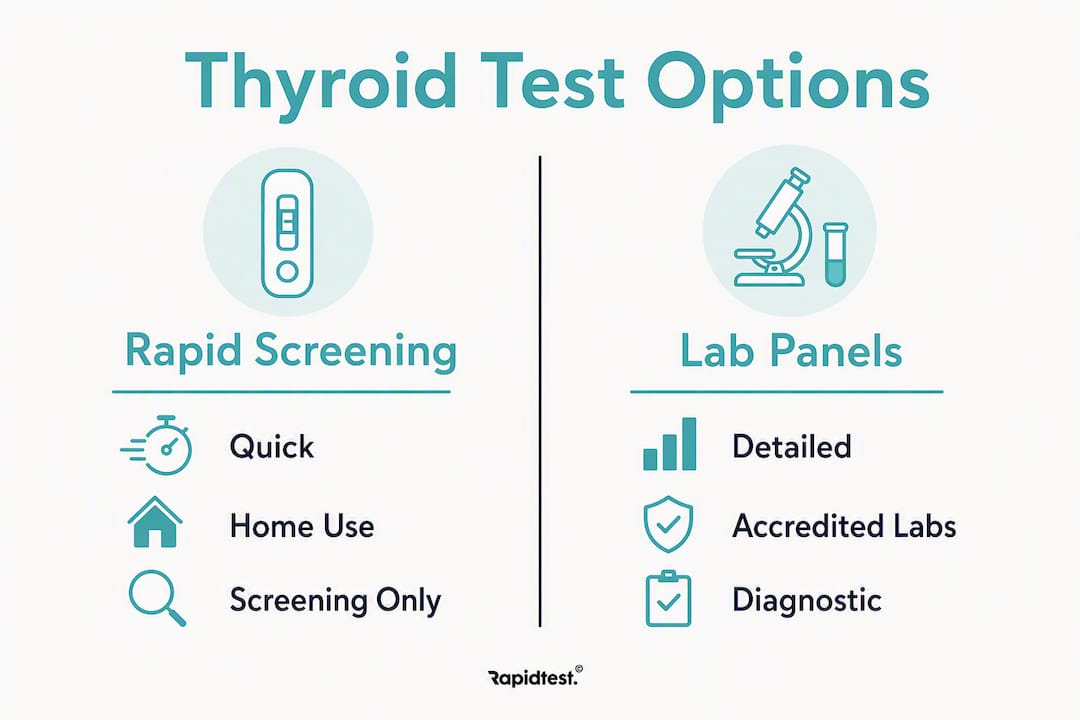
- Rapidtest rapid screening — best for instant, private hormone screening at home with results in minutes, no lab return needed
- UK lab-processed full-panel kit (Medichecks, Thriva, Randox Health, LetsGetChecked) — best for diagnostic-grade results, medication monitoring, or anything you’ll share with your GP
- Pharmacy/clinic collection service (Boots, Rezure) — best when you want professional sample handling or a venous draw for maximum accuracy
TL;DR: Pick rapid screening for a quick, private check. Choose a lab panel when you need clinical certainty or are adjusting levothyroxine. See your GP if results are abnormal or symptoms are severe.
Table of Contents
- How do the main thyroid home testing kit options compare?
- How do thyroid home testing kits actually work?
- How do you choose the right kit for your situation?
- Are home thyroid tests accurate enough to rely on?
- What do your results actually mean?
- Key takeaways
- The case for rapid screening alongside lab panels
- Rapidtest rapid screening: instant private health checks at home
- Useful sources and further reading
- FAQ
How do the main thyroid home testing kit options compare?
The table below covers the three broad categories and the named UK providers that sit within each. Everlywell, myLab Box, and Paloma Health are US-based services; they are included here for completeness, but UK readers should note these are not readily available in the UK market and are not recommended as primary options.
| Provider | Biomarkers | Sample type | Turnaround | Price (typical) | Lab accreditation / oversight | Result delivery | Best for |
|---|---|---|---|---|---|---|---|
| Rapidtest rapid screening | TSH (lateral-flow) | Finger-prick | Instant (within 15 minutes) | Low | Rapid lateral-flow device | At-home, immediate | Private instant screening |
| Randox Health | TSH + FT4 + FT3 + antibodies | Finger-prick DBS | a few working days | Mid–high | UKAS-accredited lab | Online report | Full diagnostic panel |
| Boots (Online Doctor / home test kit) | TSH + FT4 | Finger-prick DBS | a few working days | Mid | Clinician review available | Online / clinician message | Convenience + GP-ready results |
| Rezure | TSH (rapid) | Finger-prick | Instant | Low | Rapid lateral-flow device | At-home, immediate | TSH-only rapid screening |
| Medichecks | TSH + FT4 + FT3 + TPOAb | Finger-prick DBS | a few working days | Mid | UKAS-accredited lab, clinician review | Online report + clinician message | Comprehensive monitoring |
| Thriva | TSH + FT4 + antibodies | Finger-prick DBS | a few working days | Mid | UKAS-accredited lab | Online report | Ongoing home monitoring |
| LetsGetChecked Thyroid Antibody Test | TSH + FT4 + TPOAb + TgAb | Finger-prick DBS | a few working days | Mid–high | Clinical lab, nurse support | Online + nurse call | Antibody-focused testing |
| Everlywell Thyroid Test | TSH + FT4 + FT3 | Finger-prick DBS | Varies | Varies | US-based lab | Online | US market only |
| myLab Box Thyroid Health Screening | TSH | Finger-prick | Varies | Varies | US-based lab | Online | US market only |
| Paloma Health Complete Thyroid Test | TSH + FT4 + FT3 + TPOAb | Finger-prick DBS | Varies | Varies | US-based lab | Online + clinician | US market only |
| Pharmacy/clinic collection | TSH + FT4 + FT3 + antibodies | Venous draw | Same day–2 days | Mid–high | NHS or accredited clinical lab | Printed/online report | Professional sample collection |
Pricing note: UK lab-processed kits typically range from around £30 to over £100 depending on the panel depth. Rapid lateral-flow kits are generally the most affordable entry point.
How do thyroid home testing kits actually work?
Understanding what happens between the finger-prick and the result helps you pick the right kit — and avoid a wasted test.
The four main sample types
- Venous draw at a clinic or pharmacy — a trained professional draws blood from a vein. This is the gold standard for sample quality and is used by clinic collection services and NHS testing.
Poor finger-prick technique or an insufficient blood volume on a DBS card can invalidate the test entirely, so following the collection instructions precisely is not optional.
What the biomarkers actually tell you
NICE recommends TSH as the first-line marker for suspected thyroid dysfunction, with a cascade to Free T4 and Free T3 when TSH falls outside the reference range.
- TSH (thyroid-stimulating hormone) — the pituitary signal that tells the thyroid to produce hormones. A high TSH suggests the thyroid is underactive; a low TSH suggests it may be overactive.
- Free T4 (FT4) — the main hormone the thyroid releases. Measured alongside TSH, it confirms whether the thyroid is actually producing enough hormone.
- Free T3 (FT3) — the biologically active form of thyroid hormone. NICE guidance notes FT3 is particularly useful in suspected T3 toxicosis and when adjusting treatment.
- TPOAb and TgAb (thyroid antibodies) — markers of autoimmune thyroid disease (Hashimoto’s or Graves’). Positive antibodies with a normal TSH can still indicate early autoimmune activity.
The result path
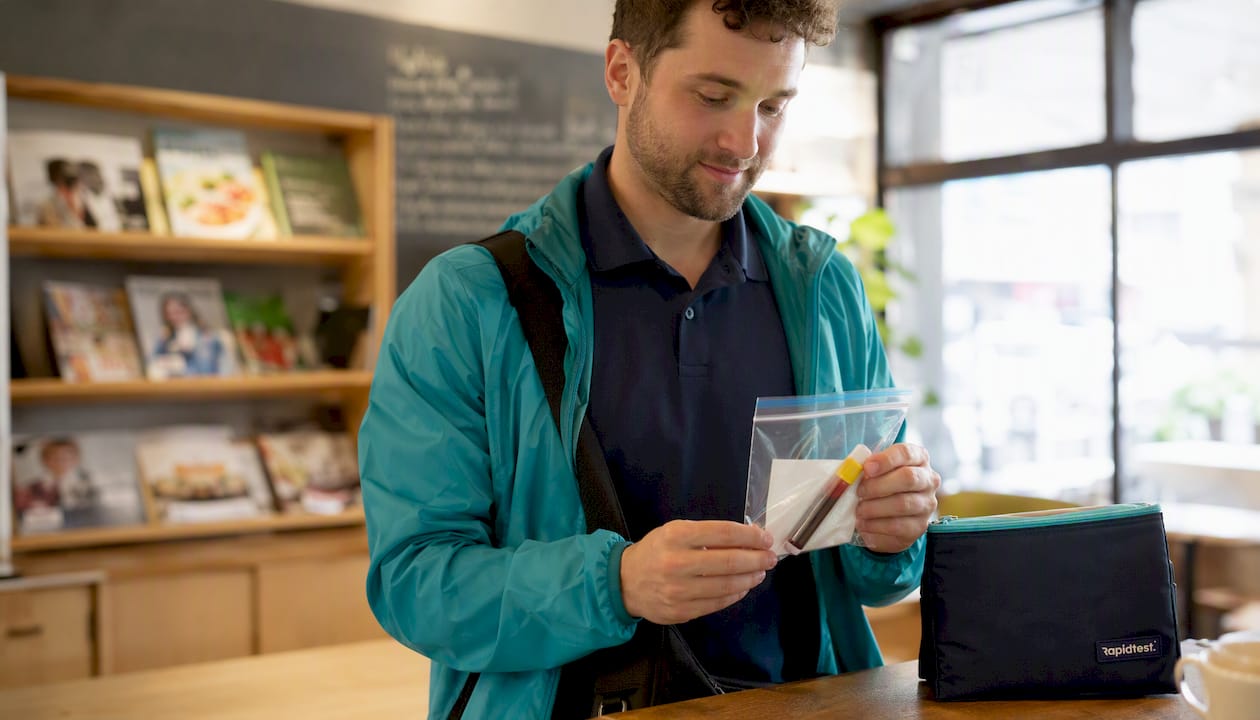
For lab-processed kits: collect your sample → post to the accredited laboratory → analysis (usually a few working days) → online report, often with clinician review or a follow-up message. For lateral-flow kits: collect → apply to cassette → read result at home within 15 minutes.
Pro Tip: Stop any biotin-containing supplements at least 48 hours before sampling. Biotin can interfere with thyroid hormone assays and produce falsely high or low results depending on the assay design. Also aim to test in the morning before taking levothyroxine if you’re on it, as timing affects circulating hormone levels.
How do you choose the right kit for your situation?
The honest answer is that the right kit depends on what you’re actually trying to find out.
If you want a quick, private check — perhaps you’ve been feeling tired or sluggish and want to rule out a thyroid issue before booking a GP appointment — a TSH-only lateral-flow kit from Rapidtest or Rezure gives you a quick answer. It won’t give you a full clinical picture, but it’s a sensible first filter.
If you’re monitoring a known condition or adjusting medication, a lab-processed full panel is the right call. When results will change whether you continue, stop, or alter a levothyroxine dose, NICE evidence supports measuring both TSH and FT4 in the same sample to reduce the risk of misclassification from an isolated TSH reading. Medichecks and Randox Health both offer this level of panel.
If you’re pregnant or planning a pregnancy, TSH-only screening is not sufficient. Pregnancy changes thyroid hormone requirements significantly, and both FT4 and antibody status matter. A full lab panel with clinician review is the minimum here.
If you have an autoimmune condition (or a family history of one), adding TPOAb and TgAb to your panel is worth the extra cost. LetsGetChecked’s Thyroid Antibody Test covers both.
Questions to ask before you buy
Before purchasing any at-home thyroid function test kit, check:
- Which biomarkers does the kit measure? TSH alone is a screening tool, not a diagnosis.
- Is the laboratory UKAS-accredited?
- Is there clinician review of results, or a follow-up pathway if something is abnormal?
- Does the provider publish validation data (sensitivity/specificity)?
- What is the data privacy policy for your health information?
Pro Tip: Be cautious of any kit that claims to “diagnose” thyroid disease from a single TSH reading alone. Which? has flagged that many consumer kits lack publicly available validation data. Prefer providers that use UKAS-accredited labs and offer clinician oversight.
Are home thyroid tests accurate enough to rely on?
The short answer: it depends on the kit type and what you’re using the result for.
Lab-processed kits from UKAS-accredited providers (Medichecks, Randox Health, Thriva) use the same analytical methods as NHS laboratories. The main variables are sample quality and the biomarkers included. A well-collected DBS sample sent to an accredited lab is clinically reliable. A lateral-flow TSH test is a useful screening signal, but it is not a substitute for a full panel when clinical decisions are on the table.
Which? has noted that many self-testing kits lack publicly available validation data and are not regulated to the same standard as clinical laboratory products. That gap matters most for rapid lateral-flow devices, where sensitivity and specificity figures are not always published.
Experts also caution that TSH detection alone can miss important clinical information. Dr Nirusha Kumaran has noted that FT4 and FT3 provide a fuller diagnostic picture than TSH in isolation — particularly when symptoms persist despite a normal TSH.
Trust signals to look for
- UKAS accreditation on the processing laboratory
- Clinician review of results before they’re released to you
- CE or UKCA marking on the device itself (relevant for lateral-flow kits sold in the UK)
- Published sensitivity/specificity data for the specific assay used
- Clear pre-test instructions, including the biotin warning and medication timing guidance
When to see your GP
Go to your GP rather than relying on a home result if:
- Your result is abnormal and you have symptoms (fatigue, palpitations, unexplained weight change)
- You are pregnant or trying to conceive
- You are on levothyroxine and your symptoms have changed
- You have a suppressed TSH — NICE guidance recommends measuring both FT4 and FT3 in the same sample to define the type of thyrotoxicosis and guide treatment
What do your results actually mean?
Common result patterns
High TSH, low or normal FT4 — the classic pattern for primary hypothyroidism (underactive thyroid). The pituitary is working hard to stimulate a thyroid that isn’t keeping up. This warrants a GP referral for confirmatory testing and discussion of levothyroxine.
Low TSH, raised FT4 and/or FT3 — suggests hyperthyroidism (overactive thyroid). Causes range from Graves’ disease to a toxic nodule. Do not wait on this one; book a GP appointment promptly.
Normal TSH, positive TPOAb — your thyroid function is currently within range, but the antibodies indicate autoimmune activity (often Hashimoto’s thyroiditis). This doesn’t always require treatment, but it does warrant monitoring, particularly if you have symptoms.
Normal TSH, no antibodies — reassuring. If symptoms persist, consider whether other causes (iron deficiency, vitamin D, sleep) might explain how you’re feeling.
Immediate next steps by pattern
| Result pattern | Recommended action |
|---|---|
| High TSH | GP referral; confirmatory NHS test |
| Low TSH + raised FT4/FT3 | Urgent GP appointment |
| Positive TPOAb, normal TSH | Repeat test in 6–12 months; discuss with GP |
| All normal | No immediate action; retest if symptoms change |
Pro Tip: If you take levothyroxine, take your morning dose after the blood draw, not before. TSH levels are also naturally highest in the early morning, so testing between 7am and 9am gives the most consistent reading. For interpreting your results with confidence, Rapidtest’s guide walks through what each line or value means and when to act.
Key takeaways
Lab-processed full-panel kits are the right choice for diagnostic clarity, while rapid lateral-flow kits like Rapidtest serve best as a quick, private first screen.
| Point | Details |
|---|---|
| TSH alone has limits | A TSH-only result is a screening signal, not a diagnosis; FT4 and FT3 are needed for clinical decisions. |
| Biotin pause is non-negotiable | Stop biotin supplements at least 48 hours before sampling to avoid false results. |
| UKAS accreditation matters | Prefer lab-processed kits from UKAS-accredited providers (Medichecks, Randox Health, Thriva) when results will inform treatment. |
| See your GP for abnormal results | Abnormal findings, pregnancy, or medication changes all require GP confirmation, not just a home repeat. |
| Rapidtest for instant screening | Rapidtest rapid screening delivers a private TSH check in minutes with no lab return, suited to a quick first filter. |
The case for rapid screening alongside lab panels
There’s a tendency in health writing to treat rapid home tests as the inferior option and lab panels as the obvious answer. That framing is too simple.
Lab-processed panels are genuinely the right tool when you need clinical certainty. If you’re adjusting levothyroxine, investigating persistent symptoms, or pregnant, a UKAS-accredited full panel with clinician review is not optional — it’s the appropriate standard of care. The NICE cascade approach exists for good reason: TSH alone can look normal while FT4 tells a different story.
But rapid screening fills a real gap that lab panels don’t cover well. The several days turnaround on a DBS kit is fine when you’re planning ahead. It’s less useful when you want to know right now, at home, whether your TSH is wildly off before you decide whether to call the GP in the morning. A lateral-flow TSH test in 15 minutes doesn’t replace a full panel — it helps you decide whether you need one. That’s a genuinely different use case, and it’s one worth taking seriously rather than dismissing as a lesser version of the real thing.
The readers who get the most out of home thyroid testing are the ones who understand which tool answers which question. Use rapid screening to triage. Use lab panels to confirm. Use your GP to act.
Rapidtest rapid screening: instant private health checks at home
If you’ve read this far and you’re thinking “I just want a quick, private result without posting anything to a lab,” that’s exactly what Rapidtest is built for.
Rapidtest offers rapid lateral-flow screening kits for hormone and health markers with results in minutes, delivered straight to your door in discreet packaging. No queues, no appointments, no waiting days for a result. The range covers STI and sexual health screening, fertility and hormone testing, and men’s health markers including PSA — all using the same lateral-flow format that gives you an answer at home, fast.
To be clear: Rapidtest’s rapid kits are screening tools, not full diagnostic thyroid panels. For a complete TSH + FT4 + FT3 + antibody workup processed by an accredited lab, the providers in the comparison table above are the right route. But if you want a fast, private first check — or you’re monitoring adjacent health markers — head to rapidtest.co to see the full range and order today.
Useful sources and further reading
These are the authoritative UK sources behind the clinical guidance in this article.
| Source | What it covers |
|---|---|
| NICE NG145 Recommendations | TSH-first cascade testing strategy; when FT4 and FT3 should be added |
| NICE NG145 Evidence Review C | Clinical evidence on thyroid function tests, including pregnancy and thyrotoxicosis scenarios |
| NCBI Bookshelf — Thyroid disease assessment and management | Full NICE-aligned clinical guidance on assessment, biomarkers, and treatment monitoring |
| NHS — Underactive thyroid (hypothyroidism) | Patient-facing overview of hypothyroidism symptoms, diagnosis, and treatment |
| NHS — Overactive thyroid diagnosis | How hyperthyroidism is confirmed, including blood test interpretation |
| Gloucestershire Hospitals NHS — Thyroid function tests | Plain-language explanation of TSH, FT4, and FT3 reference ranges |
| Which? — DIY home health test kits | Independent review of accuracy, regulation, and consumer risks of home test kits |
This article is general information, not medical advice. Always confirm abnormal results and any treatment decisions with your GP or a qualified clinician.
FAQ
Are home thyroid tests accurate?
Lab-processed kits from UKAS-accredited providers are clinically reliable when the sample is collected correctly. Rapid lateral-flow TSH tests are useful screening tools but are not validated to the same standard as full laboratory assays, and Which? notes that many consumer kits lack published validation data.
Can I get a thyroid test at Boots?
Yes. Boots offers a home thyroid test kit through its Online Doctor service, which typically measures TSH and FT4 via a finger-prick DBS sample sent to a laboratory, with results delivered online and clinician review available.
What are the warning signs of a thyroid problem?
Common signs of an underactive thyroid include persistent fatigue, unexplained weight gain, feeling cold, dry skin, and low mood. An overactive thyroid often causes weight loss, palpitations, anxiety, and heat intolerance. The NHS provides a full symptom list for both conditions.
Can I test for thyroid problems at home?
You can screen for thyroid dysfunction at home using either a rapid lateral-flow TSH kit (results in minutes) or a lab-processed full-panel kit posted to an accredited laboratory. A home result is a useful starting point, but an abnormal finding should always be confirmed by your GP with an NHS blood test before any treatment decision is made.