


Annual or Quarterly? UK STI Testing Frequency and Home Kit Guidance
Most sexually active adults should book an STI screen annually, but if you fall into a higher-risk group, more frequent testing every three months is recommended. On top of that baseline, test after any new partner or unprotected sex, giving the window period time to pass first. It sounds simple because it is: annual for most, quarterly for some, and always after a change in your situation.
TL;DR:
- People with multiple partners, anonymous partners, recent STI diagnoses, or using recreational drugs should test every three months rather than annually.
- Testing too early for HIV and syphilis can miss infections; a follow-up test at three months ensures near-complete accuracy.
- Combining a clinical exam with NAAT testing at multiple anatomical sites improves detection chances for bacterial and viral STIs.
- Self-testing kits offer quick, private results but should be used alongside professional care if positive or symptoms appear.
- Regular testing is essential for all risk groups, regardless of vaccination status or relationship type, to prevent undetected infections.
Table of Contents
- Risk-based guidance: who should test annually and who needs more frequent checks
- Who is higher risk: a concise checklist
- Window periods and timing after exposure
- What a comprehensive sexual health screen includes
- Retesting after treatment and test-of-cure
- Choosing where and how to get tested
- Age-specific recommendations for STI testing frequency
- STI testing frequency based on sexual orientation and gender identity
- Guidance on testing frequency for pregnant individuals
- Impact of vaccination status on testing frequency
- Recommendations for testing frequency in monogamous versus non-monogamous relationships
- Making testing part of routine life
- RapidTest for routine or ad-hoc screening
- Primary guidance and evidence
- Sources
- FAQ
Risk-based guidance: who should test annually and who needs more frequent checks
Let’s be real: nobody wants to think about their sex life in terms of a testing schedule. But once you’ve got the two basic rules down, you barely have to think about it again.
If you’re sexually active with new or casual partners, Gov recommends an annual comprehensive sexual health screen, with anyone under 25 tested for chlamydia every year or whenever they change partners. That’s your floor, not your ceiling.
Some people need to test more often. BASHH sets out clear higher-risk criteria that call for three-monthly screening:
- Men who have sex with men with multiple or anonymous partners
- Anyone taking PrEP, as part of routine follow-up
- People recently diagnosed with a bacterial STI
- Anyone with several sexual partners in a short period
Outside of these set schedules, a few moments should always trigger a fresh test: a new partner, sex without a condom, or finding out a partner’s status was unclear. None of these need to wait for your annual reminder.
Pro Tip: Set a recurring calendar reminder for your annual test, and treat any new partner as an automatic prompt for an extra check, regardless of where you are in the cycle.
Who is higher risk: a concise checklist
Working out which category you’re in takes about ten seconds. Run through this list:
- More than 10 sexual partners in the past year
- Anonymous or app-based partners with limited background information
- Condomless sex with a new or casual partner
- A bacterial STI diagnosis in the last twelve months
- Sex while using recreational drugs, which can lower guard around protection
- Currently taking PrEP for HIV prevention
Age matters too. Anyone under 25 should prioritise annual chlamydia screening even without other risk factors, as GOV.UK sets out, since rates run highest in this group. If you tick even one box on the higher-risk list, three-monthly testing is worth adopting rather than waiting for symptoms that may never show.
Window periods and timing after exposure
Testing too early is one of the most common mistakes people make, and it’s an easy one to fix once you know the timelines.
- Chlamydia and gonorrhoea: often detectable from around two weeks after exposure.
- HIV and syphilis: need longer. Devon Sexual Health’s guidance notes that serology reaches about 99% sensitivity at six weeks.
- Confirmation point: near-100% sensitivity for HIV and syphilis is reached at three months, which is why a repeat test at that stage matters if the six-week result was negative but exposure was significant.
A test at six weeks catches around 99% of HIV and syphilis infections, rising to near-complete accuracy by three months, according to Devon Sexual Health. That gap between six weeks and three months is why a single early test can give false reassurance. If you’ve had a specific high-risk exposure, such as a condom failure with a partner of unknown status, testing too soon can miss an infection entirely, so it’s worth pairing an early check with a follow-up rather than relying on one result. Sample site matters as much as timing: a swab from the wrong location, or blood drawn before antibodies have developed, will read negative even in an infected person.
What a comprehensive sexual health screen includes
A proper screen isn’t just one swab. It typically checks:
- Chlamydia and gonorrhoea, using NAAT (nucleic acid amplification testing), the most sensitive method available for these bacteria
- HIV, via a combined antigen/antibody blood test
- Syphilis, through serology
- Hepatitis B and C, where relevant to exposure history
- HPV, in specific clinical contexts rather than as routine
Which anatomical sites get sampled depends on what you’ve actually been doing. Genital swabs cover vaginal or urethral exposure, but rectal and throat swabs matter too if oral or anal sex has been part of the picture. The UK’s STI prioritisation framework is clear that NAATs perform best when the sample matches the exposure site, so skipping a relevant swab can mean missing an infection that’s sitting somewhere the test never reached.
Retesting after treatment and test-of-cure
Getting treated isn’t always the end of the story. BASHH recommends retesting around three months after treatment for many bacterial STIs, mainly to catch reinfection rather than treatment failure.
- Routine test-of-cure isn’t usually needed for standard chlamydia or gonorrhoea treatment
- It becomes relevant during pregnancy, if symptoms persist, with lymphogranuloma venereum (LGV), or after non-standard treatment
- When it is needed, timing matters: no earlier than three weeks post-treatment, to avoid a false positive from residual bacterial DNA
Pro Tip: If you’re diagnosed with an STI, make sure any recent partners get tested and treated too. Skipping this step is the most common reason people end up reinfected within months.
Choosing where and how to get tested
Your options break down into four broad routes, each with a different trade-off between speed, privacy and thoroughness.
- Sexual health clinics offer the widest test panel and direct access to partner notification services.
- GP surgeries can arrange testing but often refer on for anything beyond the basics.
- Postal self-sampling uses lab-grade NAATs, giving strong sensitivity even in earlier windows.
- Rapid at-home tests give same-day answers and total privacy, though panels are narrower and early-window sensitivity can be lower than a lab NAAT.
Choosing between them comes down to what you value most in that moment.
| Route | Best for | Trade-off |
|---|---|---|
| Sexual health clinic | Full screening and partner services | Appointment needed, less private |
| GP surgery | Initial advice and referral | Limited on-site testing |
| Postal self-sampling | Lab-accurate results by post | Days-long wait for results |
| Rapid at-home test | Speed and discretion | Narrower panel, timing matters |
If you’re buying a kit, check it’s CE-marked, confirm exactly which infections and anatomical sites it covers, read the instructions before you start, and make sure there’s a clear path to clinical care if the result comes back positive. Self-testing has real advantages, but knowing its limits matters just as much as knowing its benefits.
Age-specific recommendations for STI testing frequency
Age changes the picture more than most people expect. Under-25s carry the highest chlamydia rates in the UK, which is why GOV.UK singles out this group for annual screening or testing with every new partner, whichever comes first. If you’re in this bracket and sexually active, treat the annual test as non-negotiable rather than optional.
Once you’re past 25, the annual baseline still applies if you’re sexually active, but the emphasis shifts slightly. You’re less likely to be flagged automatically by targeted campaigns, so it becomes more your own responsibility to keep the rhythm going. Risk factors matter more than age at this stage: someone in their 40s with multiple partners needs the three-monthly schedule just as much as someone younger with the same pattern.

At the other end, older adults sometimes assume testing stops being relevant once children or long-term relationships are no longer a concern. That’s a misconception. STI risk tracks behaviour, not age. A new relationship at 55 carries the same testing logic as one at 25: get tested before you stop using condoms with a new partner, and again after, if the window period demands it.
The consistent thread across every age group is that targeted, population-specific screening works better than a blanket approach, which is the direction UK public health guidance has been moving in for some time.
STI testing frequency based on sexual orientation and gender identity
Sexual practices, not identity labels, drive the right testing frequency, but certain patterns show up often enough to be worth naming directly. BASHH’s three-monthly recommendation specifically calls out men who have sex with men with multiple or anonymous partners, reflecting how bacterial STI and HIV incidence cluster in this group when partner turnover is high.
For anyone on PrEP, regardless of orientation, integrated three-monthly testing covering HIV and bacterial STIs is standard practice, aligned with combined BASHH and BHIVA recommendations. This isn’t a judgement on lifestyle, it’s simply how PrEP monitoring works: the medication needs regular HIV testing alongside it, and bundling in a full STI screen at the same appointment makes sense logistically.
Trans and non-binary people should be guided by the sex practices they engage in and the anatomical sites involved, rather than by gender identity alone. A screen should cover whichever sites are relevant to your sexual activity, genital, rectal or pharyngeal, since that’s what determines where an infection might actually be sitting. The UK’s STI prioritisation framework is built around this principle: testing should match real exposure patterns rather than broad demographic assumptions. If you’re unsure which category you fall into, the risk checklist above (partner count, condom use, recent diagnoses) is a more reliable guide than any label.

Guidance on testing frequency for pregnant individuals
Pregnancy changes testing priorities because an untreated infection can affect the baby as well as the parent. Routine antenatal care in the UK includes screening for HIV and syphilis early in pregnancy, and this isn’t optional the way annual screening can feel for someone outside pregnancy. If you’re diagnosed with chlamydia or gonorrhoea during pregnancy, a test-of-cure becomes relevant in a way it wouldn’t for most other cases, precisely because the stakes of a missed reinfection are higher.
If you’re pregnant and fall into any of the higher-risk categories, such as a new partner during the pregnancy or condomless sex outside a monogamous relationship, that three-monthly rhythm still applies. Pregnancy doesn’t lower your risk of acquiring an STI, and in some cases the consequences of an infection going unnoticed are more serious than they would be otherwise.
Anyone planning a pregnancy should also consider a full screen before trying to conceive, simply to rule out anything that might need treating in advance rather than discovering it partway through. This isn’t about assuming risk, it’s about ruling it out at a point where doing so is straightforward.
Impact of vaccination status on testing frequency
Vaccination changes what you’re protected against, but it doesn’t change how often you need testing for everything else. HPV vaccination, now offered routinely in the UK to adolescents of all genders, reduces the risk of the HPV strains most linked to cervical and other cancers. It doesn’t cover every HPV strain, and it does nothing for chlamydia, gonorrhoea, syphilis or HIV, so your testing schedule for those infections stays exactly the same regardless of HPV vaccination status.
Hepatitis B vaccination works similarly. If you’ve had the full course, your risk of hepatitis B specifically drops substantially, and this is reflected in some clinical screening panels where hepatitis B testing becomes less of a priority for vaccinated individuals with no other risk factors. But hepatitis C, which has no vaccine, and every bacterial STI on the standard panel still need the same annual or three-monthly rhythm based on your behaviour.
The mistake worth avoiding is treating vaccination as a substitute for testing. Being vaccinated against HPV or hepatitis B tells you nothing about your chlamydia or HIV status. Keep your testing schedule based on your risk category, and treat vaccination as a separate, additional layer of protection rather than a reason to test less often.
Recommendations for testing frequency in monogamous versus non-monogamous relationships
A genuinely monogamous relationship, where both partners have tested clean and neither has other partners, doesn’t need the three-monthly rhythm. Once you’re both confirmed negative and staying exclusive, annual testing or even less frequent checks become reasonable, mainly as a general health habit rather than a response to ongoing risk.
The catch is that “monogamous” and “confirmed monogamous with testing” aren’t always the same thing. Plenty of couples assume monogamy without ever actually testing together at the start of the relationship, which means any prior exposure from previous partners is still an open question. If that’s your situation, a baseline test as a couple is worth doing once, even if you don’t plan to repeat it often afterwards.
Non-monogamous relationships, whether that’s open relationships, polyamory or casual dating alongside a primary partner, sit closer to the higher-risk category by default, simply because partner count and exposure opportunities are higher. Three-monthly testing fits this pattern better than annual, and it’s worth each partner testing independently rather than assuming one person’s result covers the group. Communication about testing schedules within non-monogamous relationships tends to work best when it’s treated as routine, the same way you’d mention any other health habit, rather than as a loaded conversation.
Making testing part of routine life
I’ve found the two-rule approach works because it removes the guesswork. Annual if you’re settled, three-monthly if you’re not; test after anything that changes. Treating it like a routine, rather than a reaction, makes it far less likely anything falls through the cracks.
— Jack
RapidTest for routine or ad-hoc screening
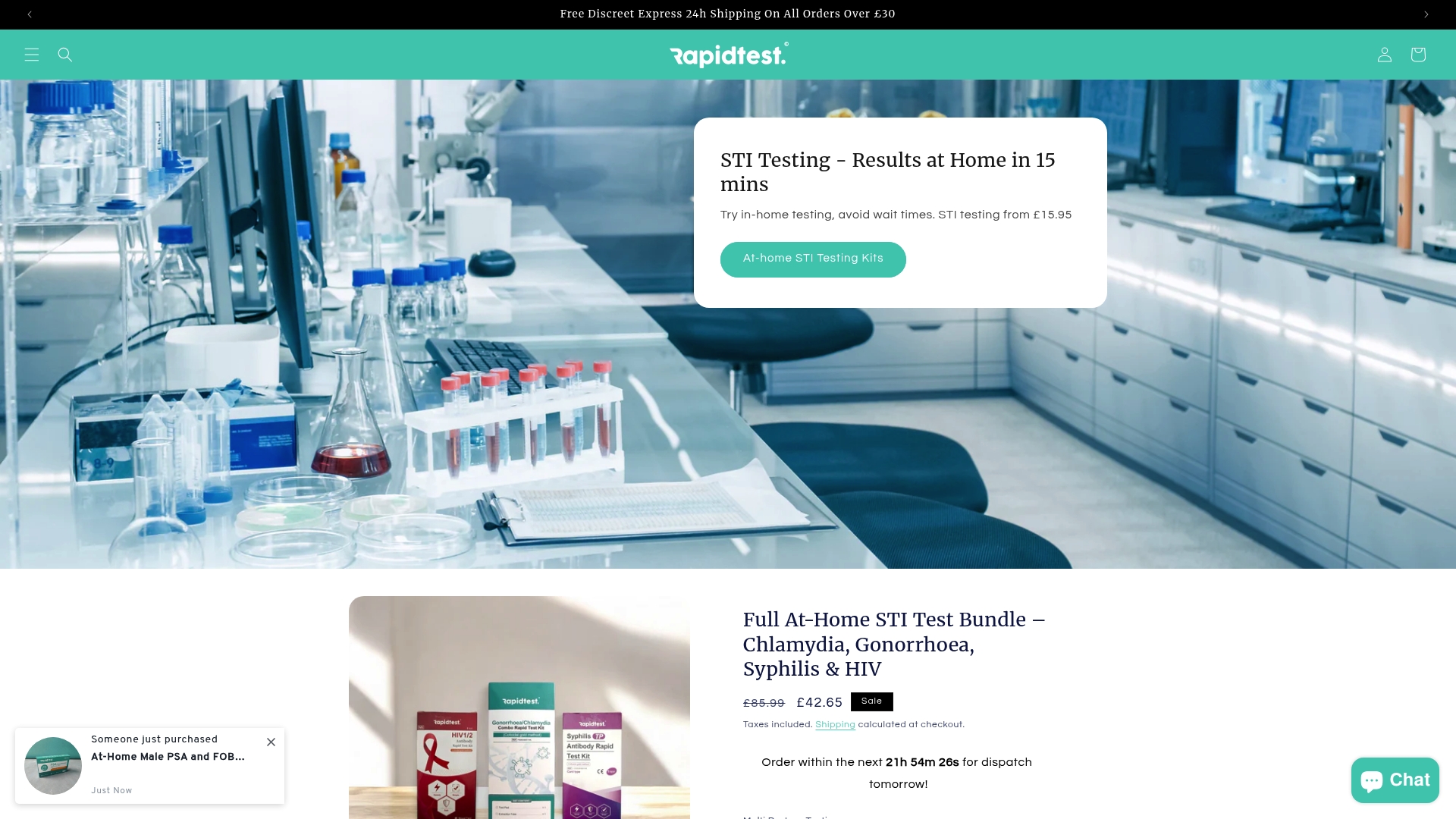
Once you’ve settled on your testing rhythm, the harder part is actually following through, especially when clinic waiting times or awkward conversations get in the way. RapidTest kits give you results in 15 minutes at home, with discreet delivery and no lab returns needed.
- CE-marked kits covering the core infections most people need checked
- Results in 15 minutes, with clear instructions included in every kit
- Discreet packaging and no appointment required
That convenience is exactly why it works for a routine annual check or an extra test after a new partner. It’s not a replacement for clinical care: a positive result, or any symptoms, still need proper follow-up with a sexual health service. For screening on your own schedule, browse RapidTest’s STI test kits and find the option that fits your testing routine.
Primary guidance and evidence
- Gov
- UKHSA: getting tested for an STI
- BASHH
- STI prioritisation framework
- Devon Sexual Health: STI screening in primary care
This article is general information, not a substitute for advice from a qualified doctor. Consult a qualified healthcare professional about your own circumstances before acting on anything here.
Sources
- Gov
- British Association for Sexual Health and HIV (BASHH)
- STI screening in primary care (Devon Sexual Health)
- Getting tested for an STI: Your guide to how it works - UKHSA
- STI prioritisation framework (UK public-health evidence)
FAQ
Is testing for STIs every three months too much?
Not for everyone, but it’s the right rhythm for defined higher-risk groups. BASHH recommends three-monthly screening for people with multiple or anonymous partners, those on PrEP, and anyone recently treated for a bacterial STI. If none of those apply to you, annual testing is the appropriate baseline.
How often should STI tests be done?
Most sexually active adults should test annually, moving to three-monthly if they fall into a higher-risk category. On top of that schedule, test again after any new partner or unprotected sex, allowing time for the relevant window period to pass.
How long do you have to wait between taking STI tests?
It depends on the infection and the reason for testing.
How often should you get checked if you’re sexually active?
If you’re sexually active with a stable, tested partner, annual screening is generally enough. If you have new or multiple partners, condomless sex, or other risk factors, three-monthly testing is the better fit, with an extra test whenever your situation changes.