


STI symptoms in men: 2026 guide to signs and testing
Sexually transmitted infections (STIs) in men are defined by a recognisable set of physical warning signs, including burning urination, unusual penile discharge, genital sores, and testicular pain. The medical term is sexually transmitted infection, though you may also see STD (sexually transmitted disease) used interchangeably. Chlamydia alone accounts for 1.6 million cases annually in the US, and that figure only reflects diagnosed cases. The real number is higher, because many men carry and pass on infections without ever noticing a single symptom. Knowing what to look for is the first step toward protecting yourself and your partners.
What are the common STI symptoms in men?
STI symptoms in men tend to cluster around the genitals and urinary tract, though some infections affect the skin, throat, or rectum too. The most frequently reported signs are:
- Unusual discharge from the penis: white, yellow, or green in colour
- Burning or pain during urination or ejaculation
- Genital sores, blisters, or ulcers on or around the penis, scrotum, or anus
- Warts or lumps with a rough, cauliflower-like texture
- Testicular pain or swelling, sometimes with no other obvious cause
- Redness, itching, or irritation around the tip of the penis
Discharge colour is a useful early clue. A thin, watery, or milky discharge often points toward chlamydia. A thick yellow or green discharge is more characteristic of gonorrhoea. Neither is a definitive diagnosis, but both are strong reasons to get tested without delay.
Testicular pain is easy to dismiss as a minor strain or knock. When it appears alongside discharge or burning, testicular pain with discharge is a recognised sign of epididymitis, which chlamydia and gonorrhoea can both cause. Left untreated, epididymitis can affect fertility.
Pro Tip: If a symptom persists for more than two or three days after sexual activity, treat it as a screening trigger rather than waiting to see if it clears up on its own.
How do different STIs present unique symptoms in men?
Each major STI has a distinct symptom profile. Knowing the differences helps you understand what you might be dealing with, even before a test confirms it.
| STI | Key symptoms in men | Typical onset |
|---|---|---|
| Chlamydia | Milky discharge, urethral burning, testicular pain | 7–21 days post-exposure |
| Gonorrhoea | Thick yellow-green discharge, severe pain on urination | 1–14 days post-exposure |
| Syphilis | Painless sore (chancre), swollen lymph nodes | 10–90 days post-exposure |
| Genital herpes | Painful fluid-filled blisters, ulcers, flu-like symptoms | 2–12 days post-exposure |
| HPV | Soft genital warts with cauliflower-like appearance | Weeks to months post-exposure |
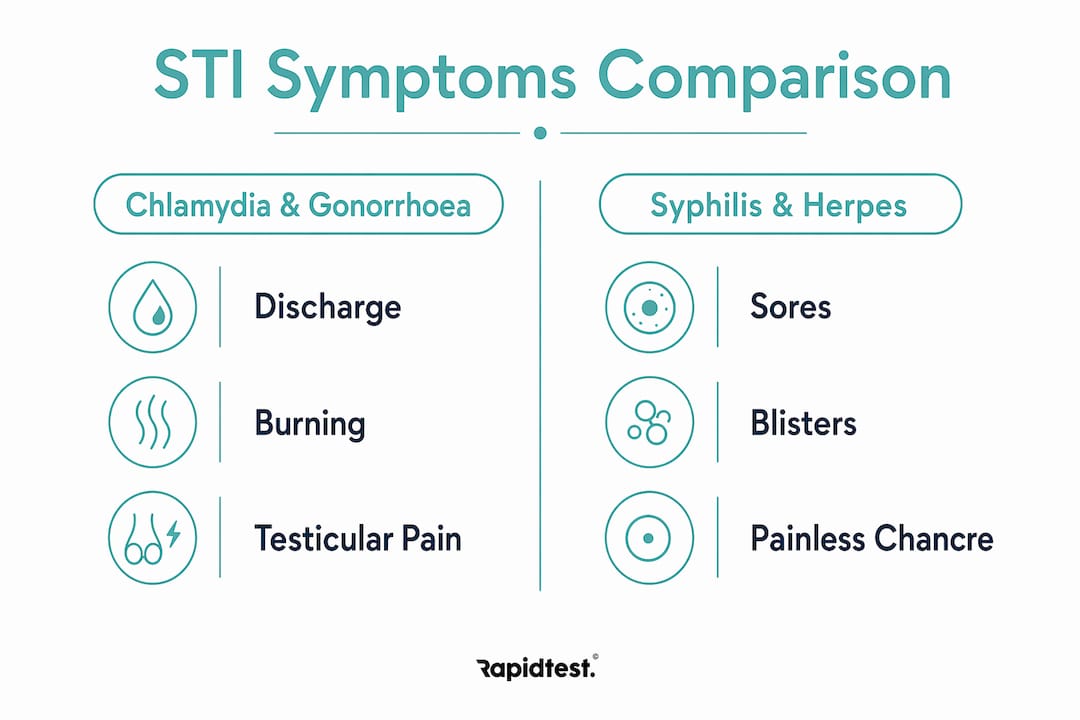
Chlamydia symptoms include urethral pain, a milky discharge, and testicular discomfort. Gonorrhoea produces a thicker, more coloured discharge alongside severe pain when urinating. Both are bacterial and both respond well to antibiotics when caught early.
Syphilis is the one that catches men off guard most often. The painless chancre of syphilis appears and then disappears on its own, which many men interpret as the problem resolving itself. It has not. Untreated syphilis progresses through stages and can cause serious long-term damage to the heart and nervous system.
Genital herpes produces painful, fluid-filled blisters that rupture into ulcers. These look very different from the smooth, firm chancre of syphilis. Syphilis chancres and herpes blisters are both genital lesions, but they require completely different treatments. Never attempt to self-treat either. Home remedies risk worsening the infection and delaying proper care.
Pro Tip: Take a photo of any new genital sore or lesion before it changes or heals. A clear image helps a clinician or sexual health nurse make a faster assessment.
Why symptom awareness alone is not enough
Many STIs produce no symptoms at all, yet remain fully transmissible. Absence of symptoms does not mean absence of infection. This is the single most dangerous misconception in male sexual health. Men who feel fine can still pass chlamydia, gonorrhoea, or HIV to partners without knowing it.
Routine screening matters for every sexually active man, not just those with visible signs. The NHS recommends annual STI testing for sexually active men under 25, and testing after every new partner at any age. The following situations all warrant a test, regardless of whether you have symptoms:
- You have had unprotected sex with a new partner
- A current or previous partner has been diagnosed with an STI
- You have had multiple partners in the past year
- You are planning to stop using barrier contraception with a partner
“Physical assessment alone cannot reliably diagnose STIs. Testing remains critical even without symptoms.” — Verywell Health
Stigma causes many men to delay testing, and that delay is where real harm happens. Early detection prevents long-term complications and stops further transmission. The conversation around testing has shifted significantly in recent years. Getting tested is now widely understood as a responsible, normal part of sexual health, not a sign that something is wrong with you.
Talking to your partner about STI testing is easier than most men expect. Framing it as a shared health decision rather than an accusation changes the entire tone of the conversation.
Pro Tip: If you are uncomfortable visiting a clinic, at-home STI test kits let you collect a urine sample or swab privately and get results within 15 minutes. No appointment, no waiting room.
How to recognise symptoms correctly and when to seek advice
Burning during urination is the symptom men most commonly mistake for something else. Burning urination can be confused with a UTI or general irritation, particularly after alcohol or spicy food. The key difference is context. If the burning started within days of sexual activity and is accompanied by discharge or soreness, an STI is the more likely cause.
The following signs warrant prompt professional evaluation, not a wait-and-see approach:
- Any new sore, blister, or ulcer on or around the genitals
- Discharge that is coloured, thick, or has an unusual smell
- Pain or swelling in one or both testicles without a clear physical cause
- Burning that persists beyond two to three days after sexual activity
- Flu-like symptoms combined with genital irritation, which can indicate a primary herpes outbreak or early HIV infection
Persistent urethral symptoms after sexual activity should always prompt screening. Waiting for symptoms to resolve on their own is not a safe strategy. Untreated bacterial STIs like chlamydia and gonorrhoea can lead to epididymitis, urethral scarring, and reduced fertility. Early STI detection prevents these outcomes and keeps treatment straightforward.
If you are unsure whether to get tested, check the 2026 guide on when to take an STI test for clear timing guidance based on your specific situation.
Pro Tip: When collecting a urine sample for a home test, use the first portion of your urine stream rather than midstream. This captures the highest concentration of bacteria or viral material from the urethra.
Key takeaways
Many STIs in men produce no symptoms, making routine testing after any new sexual contact the only reliable way to know your status.
| Point | Details |
|---|---|
| Symptoms vary by infection | Discharge colour, sore type, and pain location all point to different STIs. |
| Asymptomatic infections are common | You can carry and transmit chlamydia, gonorrhoea, or HIV with no symptoms at all. |
| Symptom onset has a window | Most bacterial STI signs appear within 1–21 days of exposure; syphilis can take up to 90 days. |
| Self-treatment is harmful | Never treat genital sores at home. Syphilis chancres and herpes blisters require different clinical treatments. |
| Testing is the only confirmation | Physical symptoms suggest an infection but cannot diagnose it. A test is always required. |
Let’s be real about male sexual health
I have spent years reading about how men approach sexual health, and the pattern is frustratingly consistent. Most men wait. They notice a symptom, decide it is probably nothing, and carry on. By the time they seek help, a simple antibiotic course has turned into a more complicated conversation.
The stigma is real, but it is also shrinking. The generation of men coming through now is far more open about testing than their predecessors. That shift matters, because the infections have not changed. Chlamydia is still the most commonly diagnosed STI in the UK, and it still shows no symptoms in a significant proportion of men who carry it.
What I find genuinely encouraging is how much easier testing has become. You no longer need to sit in a waiting room or explain yourself to a receptionist. At-home kits have removed the friction that used to make men put it off. There is no good reason to delay any more.
The men who handle this best are not the ones who never get an STI. They are the ones who test routinely, treat promptly, and do not let embarrassment get in the way of their health. That is the standard worth aiming for.
— Jack
At-home STI testing from Rapidtest: quick, private, and straightforward
Noticing a symptom and not knowing what to do next is an uncomfortable place to be. Rapidtest makes the first step simple.

Rapidtest’s at-home STI and STD test kits deliver results in 15 minutes, with no lab visit, no appointment, and no awkward waiting rooms. You collect your sample at home, follow the straightforward instructions, and have a clear result in the time it takes to make a cup of tea. If you want a faster, more discreet option, the rapid STI test kit is designed specifically for private use. Both kits complement, rather than replace, professional healthcare. They give you the information you need to act quickly and confidently.
FAQ
What are the first signs of an STI in men?
The most common early signs are burning during urination, unusual penile discharge, and genital sores or blisters. Some infections, including chlamydia, often produce no noticeable symptoms at all.
Can you have an STI with no symptoms?
Yes. Many men carry infections such as chlamydia, gonorrhoea, and HIV without any symptoms, yet remain fully able to transmit them. Routine STI screening is the only reliable way to know your status.
How soon do STI symptoms appear after exposure?
Gonorrhoea symptoms can appear within 1–14 days. Chlamydia typically shows signs within 7–21 days. Syphilis can take anywhere from 10–90 days before the first sore appears.
How do I tell the difference between an STI and a UTI?
A UTI causes burning urination but rarely produces discharge or genital sores. If burning urination follows sexual activity and is accompanied by discharge or skin changes, an STI is the more likely cause and warrants a test.
When should I get tested after unprotected sex?
Test as soon as symptoms appear, or within two weeks of unprotected sex with a new or unknown partner. For syphilis, wait at least 90 days for a reliable result. The at-home screening guide walks you through the process step by step.