


Pregnancy test timing: when to test for the most accurate results
The most reliable time to take a home pregnancy test is from the first day of your missed period. If you’re not sure when your period is due, testing at least three weeks after unprotected sex gives your body enough time to produce detectable levels of the pregnancy hormone hCG, according to NHS guidance. Early-detection tests exist and can pick up pregnancy sooner, but here’s the honest bit: a positive result early on is usually trustworthy, while a negative one is much less certain.
So what do you actually do with that information?
- If your test is positive: contact your GP or a sexual health service to confirm and start early antenatal care.
- If your test is negative but your period hasn’t arrived: wait and re-test, ideally around a week after your missed period, or ask about a blood test.
Key Takeaways
Accurate pregnancy test timing depends on testing from the first day of a missed period, or 21 days after unprotected sex if your cycle date is unknown, and reading results within the manufacturer’s stated window.
| Point | Details |
|---|---|
| Best testing window | Test from the first day of your missed period, or 21 days after unprotected sex if your cycle is unknown. |
| hCG rises after implantation | Implantation can take up to around 12 days after ovulation, and hCG only starts climbing afterwards. |
| Positives are more trustworthy than negatives | Urine tests reach 97 to 99% accuracy a week or two after a missed period, but early negatives can be wrong. |
| Retest before assuming a negative | Re-test about a week after your missed period, or ask a clinician for a blood test if still unsure. |
| Rapidtest supports the same timing rules | Rapidtest’s HCG kits give results in 10 to 15 minutes with clear instructions for testing at the right moment. |
Table of Contents
- Understanding the timeline: ovulation, implantation and the rise of hCG
- How pregnancy tests detect hCG, and what “sensitivity” actually means
- Your step-by-step guide to testing at home accurately
- What your result means, and what to do next
- Testing timing for irregular cycles, contraception and fertility treatment
- How Rapidtest supports accurate at-home timing
- Sources
Understanding the timeline: ovulation, implantation and the rise of hCG
Pregnancy hormone levels don’t switch on the moment sperm meets egg. Your body only starts producing hCG once a fertilised egg implants in the uterine lining, and that step doesn’t happen on a fixed schedule.
- Ovulation releases an egg, usually around the midpoint of your cycle.
- Fertilisation can happen within about 24 hours of ovulation.
- Implantation follows, typically 6 to 10 days after ovulation, though the NHS notes it can take up to around 12 days in some women.
- hCG production begins only after implantation, then climbs quickly.
Statistic to know: hCG typically doubles every few days in early pregnancy, according to Cleveland Clinic. That doubling window is exactly why a test taken two days too soon can show a stark “negative” when a test taken 48 hours later shows a clear “positive.”
Here’s how that plays out in practical windows:
- Blood tests can pick up hCG earliest, sometimes before a missed period, because clinical assays measure much smaller concentrations than home kits.
- Urine tests marketed as “early result” may detect hCG from around 10 days after conception, per Cleveland Clinic, though this depends heavily on when implantation actually happened.
- First day of missed period is the point where most standard urine tests become reliable for most women.
- 21 days after unprotected sex is the fallback rule when you don’t know your due date, and it accounts for a slower implantation timeline plus a few days of hCG build-up.
The tighter the gap between implantation and testing, the more you’re relying on a hormone level that’s still climbing rather than one that’s fully established. Waiting even a few extra days closes that gap.
How pregnancy tests detect hCG, and what “sensitivity” actually means
Every home pregnancy test, urine or blood, works by detecting hCG. The difference is in the ceiling and floor of what they can measure.
- Urine tests are qualitative, meaning they give you a yes/no answer based on whether hCG has crossed a threshold built into the strip.
- Blood tests, done at a clinic, can be qualitative or quantitative, the latter giving an actual hCG number, which is why they can confirm pregnancy earlier and track how it’s progressing.
Manufacturers often market “early” or “6 days sooner” tests, meaning they’re built to catch a lower hCG concentration than a standard strip. That sounds like a straightforward win, but there’s a trade off worth knowing about.
Home pregnancy tests are more likely to be accurate after a missed period. Manufacturers’ “early” claims usually refer to increased test sensitivity, but they don’t remove the risk of a false negative if you test too soon, notes Mayo Clinic.
There’s also a quieter issue: some early positives detect a biochemical pregnancy, an implantation that starts producing hCG but doesn’t progress. Testing earlier can occasionally mean picking up a pregnancy that would have resolved on its own before you’d have known otherwise. A positive result on a standard urine test is usually reliable, but a faint or ambiguous line taken well before your missed period deserves a second look rather than an instant conclusion either way.
Your step-by-step guide to testing at home accurately
Getting the timing right matters, but so does the small stuff around it. Here’s how to stack the odds in your favour.
- Use first-morning urine where possible. Overnight, hCG becomes more concentrated in urine, which is why MedlinePlus recommends testing straight after waking.
- If you can’t test first thing, hold your urine for around three hours and avoid drinking large amounts of fluid beforehand. Diluted urine can mask a true positive, especially close to the limit of a test’s sensitivity.
- Check the expiry date on the box. An expired test is simply less reliable, whatever the timing.
- Collect the sample properly, either mid-stream or into a clean cup, following the instructions for your specific kit.
- Set a timer and read within the manufacturer’s stated window. Cleveland Clinic warns that reading too early or too late risks misinterpreting an evaporation line or an invalid result.
Pro Tip: Keep a spare test in the house rather than buying one at a time. If your first result is negative but your period still hasn’t shown up a few days later, you’ll want to retest without a trip to the pharmacy interrupting your peace of mind.
If you’ve tested twice with a week’s gap and both are negative, but there’s still no period, that’s the point to consider a clinical blood test rather than a third home kit.
What your result means, and what to do next
A clear positive on a standard home test is generally something you can trust, particularly if it appears after a missed period. From there, the sensible next move is contacting your GP or a sexual health service to confirm the pregnancy and get booked in for early care.
A negative result is more nuanced. If you tested before your period was due, or right on the edge of the recommended window, a negative doesn’t rule pregnancy out.
- Re-test around one week after your missed period, when hCG levels are far more likely to have climbed above the test’s threshold.
- If you’re still unsure or your period hasn’t arrived, book a blood test with a clinician, since blood tests can often detect pregnancy earlier and more precisely than urine tests.
- Watch out for faint lines, which can be a genuine early positive rather than an error. Our guide on interpreting a faint line covers what to look for.
- An evaporation line appears after the read window has passed and has no colour tint, unlike a true positive line.
- No control line at all means the test is invalid, whatever the result line shows. Discard it and use a fresh one.
Urine tests done a week or two after a missed period are generally very accurate when used correctly(https://medlineplus.gov/lab-tests/pregnancy-test/). That figure drops the earlier you test relative to your missed period, which is the whole reason timing gets so much attention.
If you’re waiting on a result and finding it hard to sit with the uncertainty, that’s a completely normal response. Confirmation from a GP or sexual health clinic, whichever way the test goes, tends to settle that far faster than staring at a strip for the tenth time.
Testing timing for irregular cycles, contraception and fertility treatment
Standard advice assumes a fairly predictable cycle, so a few common situations need their own approach.
- Irregular cycles: if you can’t pin down when your period is “due,” count 21 days after unprotected sex, or roughly 36 days from the start of your last period, both of which NHS guidance suggests improve the odds hCG will be detectable.
- Hormonal contraception or breastfeeding: these don’t typically cause false positives on a standard hCG test, but irregular bleeding patterns can make it harder to know your baseline, so lean on the day count rather than guessing from your last “period.”
- Fertility treatment or ovulation tracking: if you’ve had fertility treatment involving an hCG trigger shot, testing too soon can give a false positive from the medication itself, not pregnancy. Speak to your clinic about the correct testing date for your specific protocol, and see our guide on timing a fertility test at home for more detail.
How Rapidtest supports accurate at-home timing
Getting the timing right is half the job. The other half is using a test that gives you clear, unambiguous instructions once that moment arrives.
- Rapidtest’s HCG kits deliver results in around 10 to 15 minutes, with a clear step-by-step insert covering exactly when and how to read the result window.
- A home HCG test suits you well once you’ve reached the first day of a missed period, or the 21 day mark after unprotected sex; if you need certainty before that, a clinic blood test remains the more sensitive option.
- For interpreting what you see on the strip, our guide on reading at-home results with confidence walks through faint lines and control indicators in more depth.
A note from Rapidtest
Waiting to test is genuinely one of the harder parts of trying to conceive, or simply wondering. Following the timing advice above, rather than testing out of impatience, gives you a result you can actually trust. Rapidtest builds every kit around clear, plain-English instructions and discreet packaging, precisely so that moment feels less clinical and less stressful. Whatever the result, a follow-up conversation with a GP or sexual health service is always worth having.
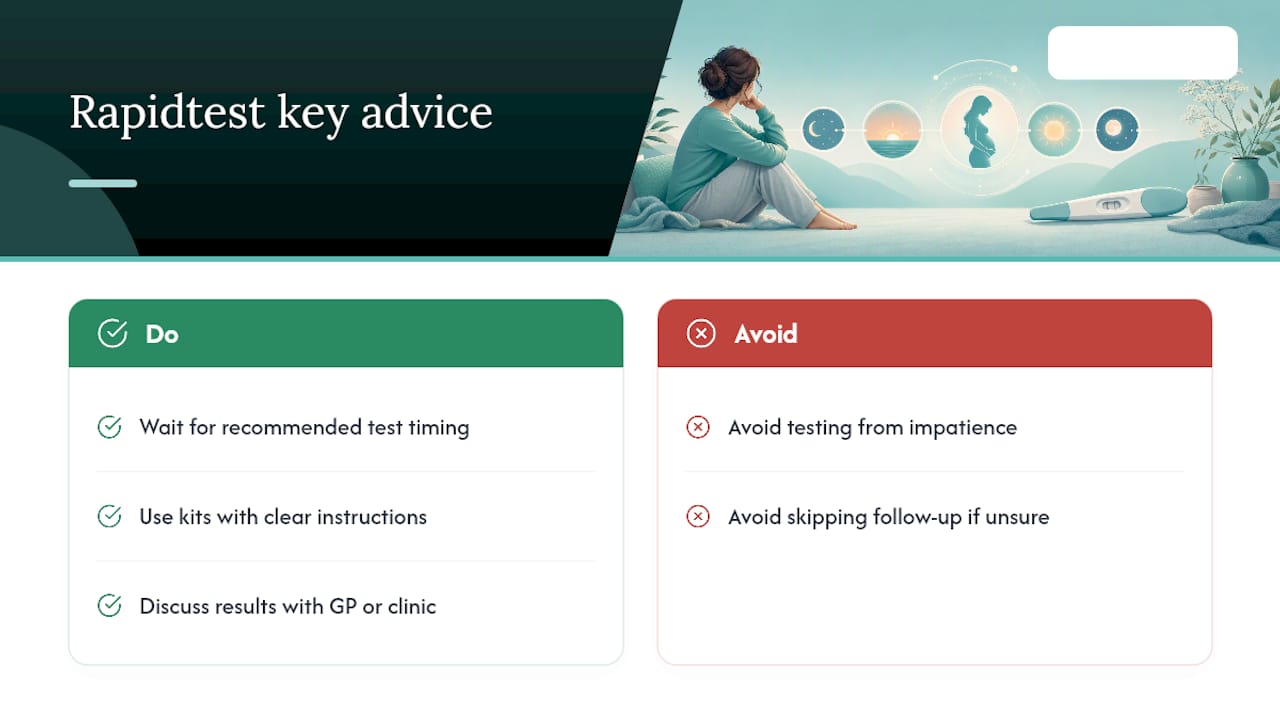
Why a Rapidtest HCG kit fits this exact timing advice
Everything above points to one practical conclusion: test at the right moment, and use a kit that removes room for user error when you do. A Rapidtest home HCG test is built around exactly that, with a clear result window, a straightforward instruction leaflet, and results in 10 to 15 minutes rather than a wait for a lab callback.
Ordering is simple. Pick your kit from the Rapidtest fertility and HCG testing hub, and it arrives in discreet packaging with everything you need for a first-morning test. Follow the same rules covered above: test from the first day of your missed period, or 21 days after unprotected sex if you’re unsure, read within the stated window, and retest a week later if your first result is negative but your period still hasn’t arrived. Where a Rapidtest kit can’t help is the very earliest window before a missed period. If you need detection sooner than that, a clinic blood test is the more sensitive route. For most people wondering whether now is the right moment to test, an at-home HCG kit ordered through the fertility testing hub is the practical next step.
Sources
- Doing a pregnancy test - NHS
- Pregnancy Test: When To Take, Types & Accuracy - Cleveland Clinic
- Pregnancy test - MedlinePlus
- Home pregnancy tests: Can you trust the results? - Mayo Clinic
- Womenshealth
FAQ
Can I confirm pregnancy 3 days after sex?
No. Implantation hasn’t usually happened yet at 3 days, so there’s no hCG to detect. A blood test won’t help this early either, since hCG only begins after implantation, which typically takes 6 to 12 days.
How soon will a pregnancy test read positive?
Some early-detection urine tests can turn positive around 10 days after conception if implantation happened early, but most tests become reliable from the first day of a missed period.
When is the correct time to take a pregnancy test?
The correct time is from the first day of your missed period, or at least 21 days after unprotected sex if you don’t know your cycle dates, as recommended by the NHS.
Is a pregnancy test still valid after 30 minutes?
No. Manufacturers set a specific read window, usually a few minutes long, and results checked well after that window can show a misleading evaporation line rather than a true result.
What should I do if my test is negative but my period hasn’t come?
Re-test around one week after your missed period, since hCG levels rise quickly in that time, or speak to a clinician about a blood test for earlier, more sensitive confirmation.
This article is general information, not a substitute for advice from a qualified doctor. Consult a qualified healthcare professional about your own circumstances before acting on anything here.