


What is a test window period? Timing explained
The test window period is defined as the time between exposure to an infection or biological marker and when a diagnostic test can reliably detect it. Get this timing wrong and you could test too early, receive a false negative, and walk away with a false sense of security. That applies whether you are testing for HIV, chlamydia, or tracking your fertility cycle. Understanding the test window is not just useful knowledge. It is the difference between a result you can trust and one that tells you nothing.
What is the test window period and why does it matter?
The test window period is the interval during which your body has been exposed to an infection but has not yet produced enough detectable markers for a test to pick up. No test can detect an infection the moment it enters your body. Your immune system needs time to respond, and different tests look for different things, which is why the window varies so much.
For HIV specifically, the CDC confirms that no HIV test can detect infection immediately after acquisition. The window period depends on both the test type and whether the person is taking antiretroviral medication. This is not a flaw in the test. It is simply biology.
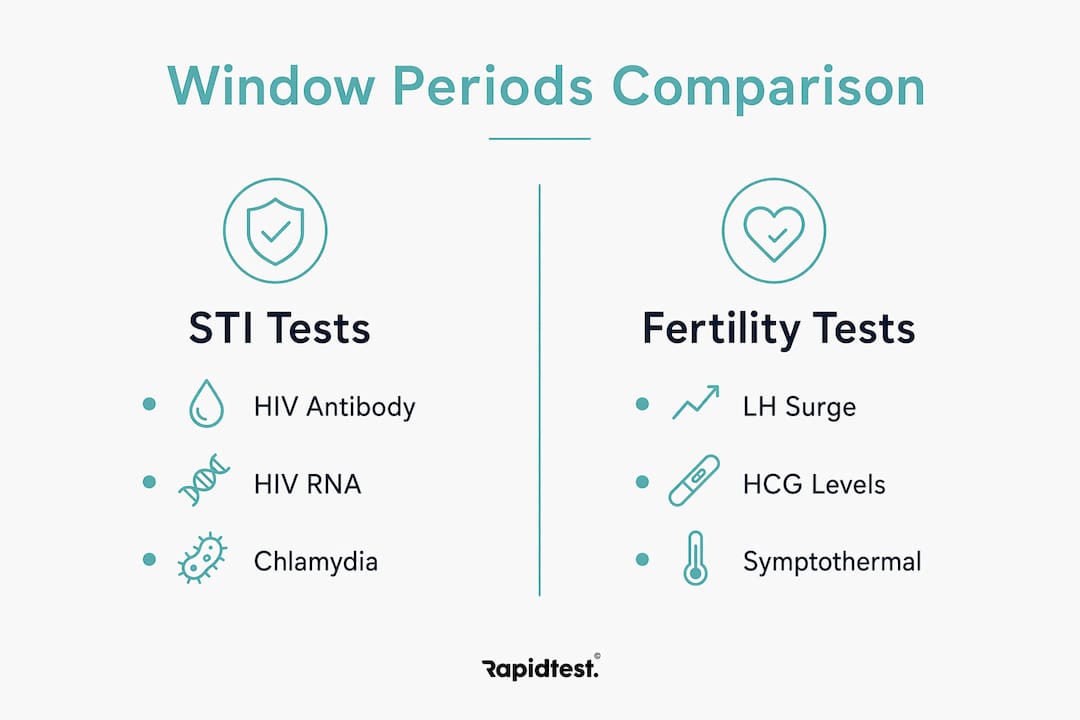
The same principle applies to fertility testing. Your body produces hormones like LH (luteinising hormone) and HCG at specific points in your cycle. Test outside those windows and the result will not reflect what is actually happening. Knowing when to test is just as important as knowing how to test.
How does the test window period vary across different STI tests?
Window periods differ significantly depending on which STI you are testing for and which test technology is being used. Here is a breakdown of the most common STIs and their typical detection windows.
| STI | Test type | Approximate window period |
|---|---|---|
| HIV | Antibody only | 23 to 90 days after exposure |
| HIV | Antigen/antibody (4th gen) | 18 to 45 days after exposure |
| HIV | Nucleic acid test (NAT) | 10 to 33 days after exposure |
| Chlamydia | NAAT | 1 to 2 weeks after exposure |
| Gonorrhoea | NAAT | 1 to 2 weeks after exposure |
| Syphilis | Antibody test | 3 to 6 weeks after exposure |
For HIV, the detection window varies considerably by test type. Antibody-only tests take the longest to turn positive. Fourth-generation antigen/antibody tests close that gap significantly. NAT tests, which look for the virus’s genetic material directly, can detect HIV as early as 10 days after exposure. That makes them the fastest option when early detection matters most.
At the biological level, HIV RNA becomes detectable around 10 days after acquisition. The p24 antigen follows at roughly 17 days. IgM antibodies appear at around 22 days, and IgG antibodies between 24 and 52 days. Each of these markers is what a different test type looks for, which explains why the window period shifts depending on what the test is designed to detect.
For chlamydia, the window is much shorter. You can read more about chlamydia test timing on the Rapidtest blog, but the general guidance is to wait at least one to two weeks after potential exposure before testing.
Pro Tip: If you have had a potential HIV exposure in the last two weeks, a standard antibody test will not give you a reliable result. Ask about NAT testing or a fourth-generation test for the most accurate early detection.
What affects the accuracy of results during the window period?
Several factors can shift the window period and affect whether your result is conclusive. Understanding these helps you decide when to test and how to interpret what comes back.
Test platform and specimen type matter more than most people realise. The detection window varies depending on whether a venous blood sample or a fingerstick sample is used, even with the same test. Venous samples generally produce more reliable results earlier in the window period. This is worth knowing if you are using a home testing kit that uses a fingerstick method.
Medications can delay detection. If you are taking PrEP (pre-exposure prophylaxis) or ART (antiretroviral therapy), antiretroviral medications can delay HIV detection by suppressing viral replication. This extends the window period and means your follow-up testing plan may need to be adjusted. This is one of the most commonly overlooked factors.
Symptoms are not a reliable guide. Many STIs produce no symptoms at all, or symptoms that appear long after the window period has passed. Testing positive or negative should never be based on how you feel. The infection stage and your immune response are what matter, not the presence or absence of symptoms.
Key factors that affect window period accuracy:
- Test technology (antibody only vs antigen/antibody vs NAT)
- Specimen type (venous blood vs fingerstick vs oral swab)
- Use of PrEP or ART medications
- Individual immune response variation
- Time elapsed since exposure
Pro Tip: If you are on PrEP and have had a potential exposure, tell your healthcare provider or testing service. Your window period may be longer than standard guidance suggests, and your follow-up schedule should reflect that.
How does the test window period apply to fertility testing?
Fertility testing has its own version of the window period, and it is just as precise. The fertile window refers to the days before, during, and just after ovulation when conception is biologically possible. Sperm can survive in the reproductive tract for up to five days before ovulation, which means the window for conception is wider than most people assume.
For hormone-based fertility tests, the timing is specific. LH (luteinising hormone) surges 24 to 36 hours before ovulation. Testing for LH too early or too late in your cycle means you will miss the surge entirely and get a negative result that does not reflect your actual fertility status. HCG, the hormone detected by pregnancy tests, only appears after a fertilised egg implants, which takes around 6 to 12 days post-ovulation.
The symptothermal method, which combines basal body temperature tracking with cervical mucus observation, helps identify the fertile window without relying solely on test kits. Basal body temperature rises slightly after ovulation, confirming it has occurred. Cervical mucus becomes clear and stretchy in the days leading up to ovulation, signalling the most fertile phase.
| Fertility marker | When to test | What it indicates |
|---|---|---|
| LH surge | Days 10 to 14 of a 28-day cycle | Ovulation likely within 24 to 36 hours |
| Basal body temperature | Daily, first thing in the morning | Confirms ovulation has occurred |
| HCG | 10 to 14 days after ovulation | Confirms pregnancy if implantation has occurred |
| SP-10 (sperm marker) | Any time | Indicates sperm presence in male fertility testing |
One thing worth knowing: fertility declines with age, and many people overestimate how long their fertile window actually lasts. Accurate tracking, combined with well-timed testing, gives you far more useful information than guessing. Rapidtest offers fertility test kits for both men and women, covering LH, HCG, and SP-10 markers.
What practical steps help you test at the right time?
Getting the timing right is the single most important thing you can do to get a result you can trust. Here is a straightforward approach for both STI and fertility testing.
-
Wait out the window period before testing for STIs. Testing too early after a potential exposure almost always produces a result that cannot be relied upon. For HIV, wait at least 18 to 45 days if using a fourth-generation test, or 10 to 33 days if using a NAT test. For chlamydia and gonorrhoea, wait one to two weeks.
-
Treat a negative result within the window period as preliminary. Serial testing at one and three months after exposure is the recommended approach for conclusive HIV results. A single negative test taken too early does not rule out infection.
-
Choose the right test type for your timing. If you have had a recent potential exposure and need an answer quickly, a fourth-generation test detects infection sooner than an antibody-only test. For the earliest possible detection, RNA testing is the most sensitive option in the first two weeks.
-
For fertility testing, track your cycle first. Knowing the length of your cycle helps you identify when to test for LH. If your cycle is irregular, use basal body temperature and cervical mucus observations alongside test kits for a clearer picture.
-
Repeat testing if your result does not match your symptoms or circumstances. Clinicians treat negative STI tests within the window period as preliminary and schedule repeats based on test modality, not symptoms. You should do the same.
Pro Tip: Keep a note of the date of potential exposure or the first day of your last period. That single piece of information determines which test to use, when to use it, and whether your result is conclusive.
You can find detailed guidance on when to test after unprotected sex on the Rapidtest blog, including a comparison of detection windows across different HIV test types.
Key takeaways
The test window period determines whether your result is conclusive or preliminary, and getting the timing right is the only way to know which one you have.
| Point | Details |
|---|---|
| Window period definition | The gap between exposure and reliable detection varies by test type and infection. |
| HIV window period range | NAT tests detect HIV from 10 days; antibody-only tests may take up to 90 days. |
| Medications extend the window | PrEP and ART can delay HIV detection, requiring adjusted follow-up testing schedules. |
| Fertility windows are precise | LH testing must align with cycle timing; testing too early or late misses the surge entirely. |
| Preliminary vs conclusive results | A negative result within the window period requires repeat testing at one and three months. |
The thing most people get wrong about window periods
People tend to assume that a negative test result means they are in the clear. That assumption is the most common mistake I see, and it is completely understandable. You test, you get a negative, you move on. But if you tested within the window period, that result is not telling you what you think it is.
The other thing that surprises people is how much the test type matters. Two people can test on the same day after the same exposure and get different results, simply because one used a fourth-generation antigen/antibody test and the other used an older antibody-only test. The technology gap between those two tests is not small. It is weeks of detection time.
Fertility testing has a similar blind spot. Many people test for LH once, get a negative, and conclude they are not ovulating. In reality, they may have simply missed the surge by a day. The fertile window is short, and the LH peak is even shorter. Daily testing during the likely window is far more reliable than a single test.
What I would say to anyone reading this is: the result is only as good as the timing. Know your window, choose the right test for where you are in that window, and treat any early negative as a prompt to test again rather than a final answer.
— Jack
Test at home, on your terms, with Rapidtest
Rapidtest takes the guesswork out of testing at home. Whether you are checking for STIs after a potential exposure or tracking your fertility cycle, the timing guidance in this article applies directly to the kits Rapidtest offers. Results arrive in 15 minutes, with no appointment, no queue, and no awkward conversation required. The at-home STI test kits cover the most common infections, and the fertility test range includes LH, HCG, and SP-10 kits for both men and women. Private, fast, and built around your schedule.
FAQ
What is the test window period in simple terms?
The test window period is the time between exposure to an infection and when a test can reliably detect it. Testing before this period ends can produce a false negative result.
How long is the window period for HIV?
The window period for HIV depends on the test type. NAT tests can detect HIV from 10 to 33 days after exposure, fourth-generation antigen/antibody tests from 18 to 45 days, and antibody-only tests from 23 to 90 days.
Does a negative STI test during the window period mean I am clear?
No. A negative result within the window period is considered preliminary. Serial testing at one and three months after exposure is recommended to confirm a conclusive negative result.
When should I test for LH if I am trying to conceive?
For a standard 28-day cycle, test for LH between days 10 and 14. The LH surge occurs 24 to 36 hours before ovulation, so daily testing during this phase gives the most accurate picture of your fertile window.
Can medications affect my test window period?
Yes. Antiretroviral medications such as PrEP can delay HIV detection by suppressing viral replication, which extends the window period. If you are taking PrEP, discuss your testing schedule with a healthcare provider to account for this.