


Faint ovulation line: what it means and what to do next
A faint line on your ovulation test means your body has luteinising hormone (LH) circulating, but not enough to count as a surge. In plain terms: LH detected, threshold not met, so it’s not a positive result. That doesn’t mean nothing’s happening. It often means you’re close.
Here’s what to do right now, before we get into the biology:
- Keep testing daily, at the same time. Consistency matters more than perfect timing on any single day.
- Watch the trend, not the snapshot. A faint line today that’s darker tomorrow is far more useful than either result alone.
- Have intercourse every 1 to 2 days from now. Sperm can survive up to five days, so you don’t need to wait for a definite positive.
- Test again tomorrow, ideally at the same time of day. Most surges build over 24 to 48 hours before peaking.
For the science behind the timing, the NHS explains the fertile window clearly: intercourse in the five days before ovulation carries a realistic chance of conception. A peer-reviewed review of LH dynamics confirms ovulation typically follows the LH peak by roughly 24 to 36 hours, though surge shape and length vary a lot between people. MedlinePlus sets out the basic interpretation rule you’ll rely on throughout this guide: a test line lighter than the control line is generally read as negative for a surge.
Key Takeaways
A faint ovulation line means LH is present but below the surge threshold, so pregnancy remains possible if ovulation follows within the next 24 to 72 hours.
| Point | Details |
|---|---|
| Faint line ≠ negative forever | It shows LH below threshold right now, not the absence of an approaching or recent surge. |
| Test consistency beats single readings | Same time daily, same fluid intake, logged and photographed for accurate comparison. |
| Fertile window extends before ovulation | Sperm survive up to five days, so intercourse before a dark positive still counts. |
| Watch for patterns, not panic points | Several days of unchanging faint lines across multiple cycles is the actual signal to act on. |
| Escalate to clinical confirmation when needed | Progesterone tests or ultrasound settle ambiguity that home strips can’t resolve. |
| Rapidtest offers a dedicated LH kit | Rapidtest’s at-home LH ovulation test kit gives a defined threshold reading in 10 to 15 minutes, without a clinic visit. |
Table of Contents
- What does a faint ovulation line actually mean?
- Why do I keep getting a faint line on my ovulation test?
- Can you still get pregnant with a faint ovulation line?
- How do you read a faint line correctly?
- When should you retest, and when should you get help?
- What else can confirm ovulation besides a test strip?
- What should you look for in a reliable at-home LH test?
- What I’d tell a friend testing for a faint line
- Get a clearer read on your surge
- Sources
- FAQ
What does a faint ovulation line actually mean?
Ovulation predictor kits (OPKs) work on a simple immunoassay principle. Urine flows across a test strip coated with antibodies that bind to LH. The control line always appears, confirming the test worked. The test line only darkens as LH concentration rises, and it needs to reach a specific concentration, usually somewhere around a typical sensitivity threshold depending on the brand, before it matches or exceeds the control line.
A faint test line simply means your urine contains some LH, just not enough yet. This is completely normal. LH isn’t a hormone that switches on and off. It’s present at low levels throughout your cycle, then surges sharply for a day or two around ovulation.
- Your pituitary gland releases LH in pulses, not a steady stream, which is why levels bounce around even hour to hour.
- The surge itself is triggered by rising oestrogen from a maturing follicle, part of the hypothalamic-pituitary-ovarian feedback loop.
- Ovulation happens roughly 24 to 36 hours after the LH peak, not at the moment the line turns dark.
- Surge patterns differ wildly. Some people get one sharp spike; others see a plateau, or even a smaller secondary rise.
“A test-line lighter than the control line is generally considered negative for an LH surge.” That single interpretation rule from MedlinePlus is the one thing worth memorising above everything else in this article.
It’s worth separating ovulation tests from pregnancy tests here, because the confusion trips up a lot of people. Pregnancy tests detect hCG, a hormone that only appears after implantation, and any visible line, however faint, usually counts as positive because hCG shouldn’t be present at all beforehand. Ovulation tests detect LH, a hormone that’s always somewhat present. That’s why faint lines on OPKs are common and mostly meaningless on their own, while faint lines on pregnancy tests get treated very differently.
Why do I keep getting a faint line on my ovulation test?
There are several genuinely different reasons your line might be sitting faint day after day, and they call for different responses.
- Baseline LH is simply visible. Many women have enough circulating LH outside the surge window to produce a faint but persistent line, cycle after cycle. This is your normal baseline, not a warning sign.
- You’re approaching the surge. LH often climbs gradually over 2 to 4 days before peaking. A line getting progressively darker is exactly what you’d expect to see.
- You’ve just passed the surge. LH drops quickly after ovulation, so a faint line appearing after a dark one usually means you’ve already ovulated.
- Your urine is too dilute. Drinking a lot of water before testing lowers hormone concentration and can mute a genuine surge into a faint line.
- You tested at the wrong time. LH tends to peak in the morning but shows up in urine a few hours later, which is why most brands recommend afternoon testing.
- You have a naturally low-amplitude surge. Research on pulsatile LH release shows some women’s surges are genuinely lower in amplitude, detectable clearly only with quantitative lab assays rather than a strip test.
- An underlying condition is raising baseline LH. PCOS and perimenopause can both elevate resting LH or disrupt the normal surge pattern, producing confusing, persistent faint lines.
- Certain medications interfere. Fertility drugs containing hCG, and some hormonal treatments, can distort OPK readings.
Pro Tip: Photograph every test at the same time each day, under the same lighting, laid flat against a plain white background. Line intensity is genuinely hard to judge from memory, and a photo log lets you compare day three against day one properly instead of guessing.
If your faint lines never seem to resolve either way, a reproductive endocrinology review notes that individual LH thresholds vary enough between women that some genuinely need a more sensitive test to catch their surge at all.
Can you still get pregnant with a faint ovulation line?
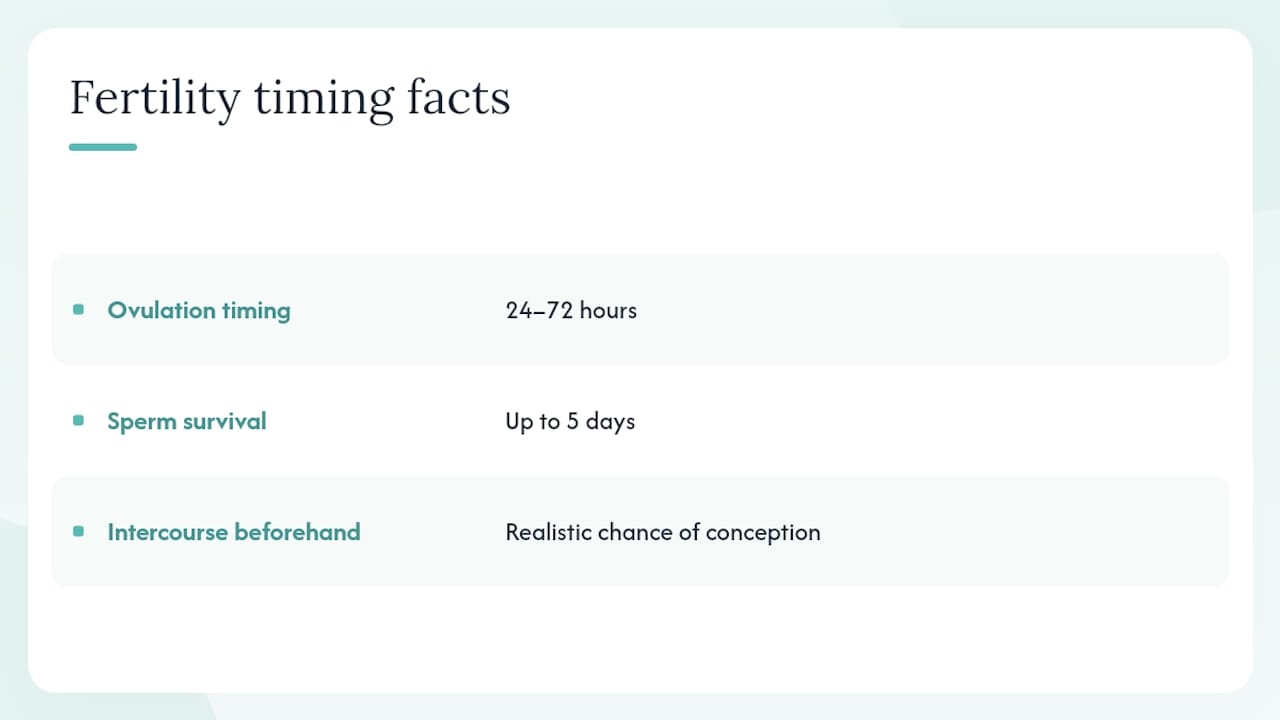
Yes, pregnancy is still possible, because a faint line doesn’t rule out ovulation happening within the next 24 to 72 hours. The line only tells you where LH stood at the moment you tested, not what’s about to happen next.
This is where sperm survival and egg lifespan matter more than most people realise. Sperm can live inside the reproductive tract for up to five days, while a released egg survives for only around 12 to 36 hours. That asymmetry is why the NHS advises intercourse in the five days before ovulation rather than waiting for a confirmed positive. If sperm is already present and waiting when the egg releases, timing works in your favour even without a picture-perfect dark line beforehand.
- A faint line rising toward darker over consecutive days suggests ovulation is approaching, so continuing intercourse every day or two remains worthwhile.
- A faint line following a recent dark positive suggests ovulation has likely already occurred, and the fertile window is closing.
- Some short or low-amplitude surges get missed entirely by once-daily testing, which is one reason repeat testing across the cycle matters more than any single result.
- Detection sensitivity varies by brand. A test with a higher mIU/ml threshold will show fainter lines for the same actual LH level than a more sensitive one.
An older but frequently cited clinical study found that many LH surges are genuinely brief, sometimes lasting under 24 hours at peak concentration. That narrow window is exactly why one faint reading, taken in isolation, tells you far less than a short run of consecutive tests.
How do you read a faint line correctly?
Compare the test line directly against the control line, inside the exact time window your manufacturer’s instructions specify, usually somewhere between three and ten minutes. A test line lighter than the control line reads negative. Equal to or darker counts as a genuine positive.
- Start testing a few days before your expected surge. For a 28 day cycle, day 10 or 11 is a sensible starting point; adjust earlier for shorter cycles.
- Test at the same time every day, ideally early to mid afternoon, since morning LH takes a few hours to show up in urine.
- Avoid drinking excessive fluids for 2 hours before testing. Diluted urine is one of the most common causes of a falsely faint result.
- Read the result inside the stated window only. Reading too early misses a developing line; reading too late risks an evaporation line that mimics a positive.
- Test twice daily once lines start darkening, morning and evening, to avoid missing a short surge between your two usual testing points.
- Log the result with a photo, the time, and any symptoms like mild cramping or increased cervical mucus, so you can spot patterns across cycles.
The most common mistake isn’t misreading the line itself, it’s reading outside the window. An evaporation line, caused by urine drying on the strip, can appear faint and colourless well after the recommended cut-off and gets mistaken for a genuine result.
Pro Tip: If two or three consecutive tests leave you genuinely unsure whether the line has darkened, a digital ovulation test that gives a clear symbol rather than a line removes the guesswork entirely.
When should you retest, and when should you get help?
Retesting rhythm should shift as your cycle progresses, starting once daily and moving to twice daily once lines begin to darken.

| Point | Details |
|---|---|
| Days 10 to 11 (28 day cycle) | Test once daily, same time, to establish your baseline and catch the early rise. |
| Lines start darkening | Switch to twice daily testing to avoid missing a short surge between windows. |
| Confirmed dark positive | Stop testing for the cycle; focus on intercourse over the next 48 hours. |
| Faint lines persist past day 10 with no darkening | Consider a different test brand or sensitivity, and note the pattern for your GP. |
| No surge detected across 2 to 3 consecutive cycles | Speak to your GP about further investigation. |
The NHS generally recommends trying to conceive naturally for up to a year (or six months if you’re over 36) before seeking referral, but that doesn’t mean staying silent if something feels off sooner. Persistent faint lines for several days with no darkening, unusually irregular cycles, or no detectable surge at all across multiple cycles are worth raising earlier. A review on ovulatory disorders points out that conditions like PCOS can produce exactly this pattern, persistently elevated or erratic LH that never resolves into a clean surge on a home test.
Before assuming something’s wrong, it’s worth trying a test with a different sensitivity threshold, since some surges are genuinely low-amplitude and simply sit below a less sensitive strip’s cut-off. If home testing across a couple of cycles still leaves you with no clear answer, a clinic-based progesterone blood test or ultrasound can confirm ovulation directly rather than inferring it from LH.
What else can confirm ovulation besides a test strip?
Combining OPKs with at least one other method gives you a far clearer picture than any single tool alone, because each one measures something slightly different.
- Basal body temperature (BBT). Rises around 0.3 to 0.5°C after ovulation and confirms it retrospectively, useful for spotting patterns over several cycles even if it can’t predict ovulation in advance.
- Cervical mucus changes. Clear, stretchy, egg-white mucus typically appears in the days leading up to ovulation and complements LH data well.
- Progesterone blood test. Taken roughly a week after suspected ovulation, this is a clinic-based method that directly confirms whether ovulation actually occurred.
- Transvaginal ultrasound. Considered the gold standard, tracking follicle growth and collapse in real time rather than relying on hormone proxies.
- Fertility monitors and digital sensors. These track multiple hormones or temperature patterns automatically and can be useful if you find manual OPK reading stressful.
If your cycles are irregular, or you suspect anovulation, clinical monitoring becomes more valuable than persisting with home tests alone. For most women with fairly regular cycles, though, a good OPK paired with mucus tracking is entirely sufficient. Readers wanting a fuller comparison of test types will find it useful to look at how SP-10, LH and hCG tests differ in what each one actually measures.
What should you look for in a reliable at-home LH test?
Not all ovulation tests are built to the same standard, and the differences genuinely affect how often you’ll see a confusing faint line.
- Sensitivity threshold. Look for the mIU/ml specification printed on the packaging; lower thresholds catch smaller surges, which matters if you’ve had ambiguous results before.
- A clearly defined reading window. Reliable tests state an exact time range, not a vague “read promptly,” which reduces evaporation-line confusion.
- A consistently strong control line. If your control line is ever faint or missing, the test itself has failed and the result should be discarded.
- Clear, illustrated instructions. Good kits show example line comparisons rather than relying on text description alone.
- In-date stock. Expired strips lose antibody sensitivity and are a genuine cause of persistently faint or missing lines.
Underlying medical causes deserve a mention here too. If a PCOS-related hormone imbalance is affecting your cycle, or you’re taking supplements that influence hormone levels, it’s worth reviewing what supplements genuinely support fertility rather than assuming the test itself is at fault.
“Some users will see faint lines for days because of gradual surges, higher baseline LH, or test sensitivity” is a pattern fertility resources note repeatedly, and it’s exactly why continued daily testing, not switching brands mid-cycle, tends to be the more reliable fix.
What I’d tell a friend testing for a faint line
Most of the anxiety around faint lines comes from treating one test like a verdict. It isn’t. It’s one data point in a sequence, and sequences are what actually tell you something.
If I had a genuine criticism of how ovulation testing gets discussed online, it’s that too much of it treats the line like a countdown clock, as though a faint result means you’ve “missed it” or a dark one guarantees success. Neither is true. Sperm survival buys you days of margin either side of a clear surge, and plenty of pregnancies happen from intercourse that took place well before a test ever turned properly positive.
The pattern matters more than any single reading, and that’s not a cop-out answer, it’s what the biology actually supports. Test consistently, log what you see, and don’t panic over one faint line unless the pattern itself, several days with zero movement across two or three full cycles, is telling you something worth raising with your GP.
Get a clearer read on your surge
If faint lines have left you second-guessing your cycle for a few months running, a dedicated test built around a defined sensitivity threshold takes a lot of the ambiguity out of the equation. Rapidtest’s LH ovulation test kit gives results in around 10 to 15 minutes at home, with a clear reading window and no lab return needed, so you’re comparing test to control on your own timeline rather than waiting days for a clinic slot.

It works the same way every ovulation test does: detecting LH concentration in urine and showing you a line against a control. What sets it apart is straightforward instructions and consistent strip quality, which matters more than people expect once you’re testing daily for a week or two. If you’d rather browse the full range first, Rapidtest’s fertility testing kits page covers LH, hCG and SP-10 options side by side, so you can pick based on what you’re actually trying to confirm this cycle. Order one, read the instructions fully before your first test, and start tracking from your next expected fertile window.
Sources
- PMC5689497 (review of LH dynamics)
- MedlinePlus: luteinizing hormone (LH) levels test
- NHS: fertility in the menstrual cycle
- PMC5712333 (review on ovulatory disorders)
- NCBI Bookshelf: diagnostic approaches to confirm ovulation
This article is general information, not a substitute for advice from a qualified doctor. Consult a qualified healthcare professional about your own circumstances before acting on anything here.
FAQ
Can you still get pregnant with a faint ovulation line?
Yes. A faint line doesn’t rule out ovulation happening in the next 24 to 72 hours, and since sperm can survive up to five days, intercourse beforehand still carries a realistic chance of conception.
Why is my ovulation test line always faint?
It’s most often normal baseline LH, dilute urine, or wrong testing time, though persistent faint lines with no darkening across several cycles can point to conditions like PCOS or a naturally low-amplitude surge.
Can a faint line still be negative?
Yes. Any test line lighter than the control line is generally read as negative for an LH surge, regardless of how visible it is.
Why is my ovulation test getting lighter instead of darker?
This usually means you’ve already passed your LH peak and ovulation may have recently occurred, since LH drops quickly once the surge ends.
How often should I retest during my cycle?
Test once daily starting a few days before your expected surge, then switch to twice daily once lines begin darkening, to avoid missing a short surge between testing windows.
When should I see a GP about faint ovulation lines?
If you get no detectable surge across two to three consecutive cycles, or persistently faint lines with irregular cycles, it’s worth raising with your GP for further investigation.