


Day 3 FSH explained: what your result really means
A day 3 FSH test measures follicle-stimulating hormone on the third day of your menstrual cycle to give a snapshot of your ovarian reserve — how well your ovaries are likely to respond to stimulation. A result under 10 mIU/mL is generally reassuring; values between 10 and 15 mIU/mL raise questions worth exploring; anything above 15 mIU/mL typically prompts further investigation.
Here is what your result usually signals at a glance:
- Under 10 mIU/mL: generally considered normal for reproductive-age women; suggests a reasonable ovarian reserve
- 10–15 mIU/mL: borderline; may indicate a reduced response to stimulation, worth repeating alongside an AMH test
- Elevated levels above the upper borderline range suggest diminished ovarian reserve; a fertility clinic referral is usually the next step
- Much higher levels are associated with significantly reduced ovarian response; repeat testing and specialist review are recommended
One result rarely tells the whole story. FSH fluctuates month to month, and a single reading should always be interpreted alongside estradiol (E2), AMH, and your age. If your result is borderline or high, the most useful next steps are: repeat the test on a future cycle day 3, ask your GP about an AMH blood test, and request a referral to a fertility clinic if you have concerns.
Key takeaways
A day 3 FSH result only becomes meaningful when read alongside estradiol, AMH, and your age — a single number in isolation is a starting point, not a verdict.
| Point | Details |
|---|---|
| Normal FSH range | Early follicular FSH of 3.5–12.5 mIU/mL is typical; values above 10 mIU/mL warrant further investigation. |
| Always pair with estradiol | Elevated E2 on day 3 can suppress FSH artificially, making a normal result unreliable without it. |
| FSH fluctuates | A single high result does not confirm diminished reserve; two abnormal readings at least four weeks apart are needed for a POI diagnosis. |
| AMH and AFC add clarity | AMH can be tested any cycle day and, alongside AFC, gives a fuller picture of ovarian reserve than FSH alone. |
| Rapidtest at-home kit | Rapidtest’s FSH kit gives a result in 10 minutes at home — a useful first screen, best followed by a serum test if the result is elevated. |
Table of Contents
- What does the day 3 FSH test actually measure?
- Why day 3 specifically, and how do you count it correctly?
- How the day 3 blood test is done in the UK
- How to interpret your day 3 FSH result
- Reading FSH alongside estradiol, LH, and AMH
- What can affect your FSH result?
- How AMH, AFC, and the clomiphene challenge compare
- What to do after your result
- At-home FSH testing: what rapid kits can and cannot tell you
- A word on what one number cannot tell you
- Rapidtest’s at-home FSH kit: a practical first step for UK women
- Sources
- FAQ
What does the day 3 FSH test actually measure?
FSH, or follicle-stimulating hormone, is produced by the pituitary gland and its job is to recruit and stimulate follicles in your ovaries each cycle. Think of it as the signal your brain sends to your ovaries saying “wake up, it’s time to grow an egg.”
When your ovarian reserve is healthy, your ovaries respond readily to relatively low levels of FSH. As the number of available follicles declines with age (or for other reasons), the ovaries become less responsive, and the pituitary has to shout louder — producing more FSH to get the same result. That rise in basal FSH is what the test detects.
The early follicular phase, specifically cycle days 2–4, is the window when FSH, LH, and estradiol are at their most stable baseline. Testing outside this window gives a reading that reflects where you are in your cycle rather than your underlying reserve. Day 3 is the conventional midpoint of that window, which is why it has become the standard reference point in fertility clinics.
What FSH measures is ovarian quantity more than quality. A high FSH suggests fewer follicles are available, but it does not directly tell you about egg quality. That distinction matters when you are interpreting results and planning next steps.
Why day 3 specifically, and how do you count it correctly?
The timing of your blood draw is not arbitrary. Peer-reviewed research confirms that reproductive hormones vary significantly across the cycle, which is why the early follicular phase is the only reliable window for a baseline reading.
Here is how to count your cycle days and prepare correctly:
- Day 1 is the first day of full bleeding. Spotting does not count. If you wake up to full flow, that is day 1. If it starts in the afternoon or evening, most clinics count the following day as day 1.
- Days 2, 3, and 4 are all acceptable for the blood draw, provided you still have active bleeding. Day 3 is the standard, but if your clinic cannot fit you in on day 3 exactly, day 2 or 4 is clinically equivalent.
- Short cycles (under 24 days): speak to your clinic before testing, as the follicular phase may be compressed and timing more critical.
- Hormonal contraceptives: if you have recently stopped the pill or a hormonal coil, your cycle may not be regular yet. Wait for at least one natural period before testing, and tell your clinician when you stopped.
- Recent illness or acute stress: both can temporarily affect hormone levels. If you have been unwell in the week before your expected period, flag this to your GP or clinic.
- Breastfeeding: prolactin suppresses FSH and LH, making results unreliable. Testing is generally deferred until after weaning or until regular cycles resume.
- HRT or oestrogen-containing medications: these can suppress FSH artificially, producing a falsely reassuring result. Always tell the clinician or phlebotomist what you are taking.
Pro Tip: Set a phone reminder on the first day of your period so you do not miss the day 2–4 window. It sounds obvious, but it is easy to forget when you are busy.
How the day 3 blood test is done in the UK
Getting a day 3 FSH test in the UK is straightforward, though the route you take affects how quickly you get results.
NHS route: your GP can refer you for a day 3 blood test if you have been trying to conceive for 12 months (or 6 months if you are over 35, or sooner if there is a known concern). The blood draw happens at your GP surgery or a local phlebotomy service. Waiting times for the appointment and results vary by trust, but you can typically expect results within 1–2 weeks.
Private fertility clinic: you can self-refer to a private clinic without a GP referral. Most clinics offer a day 3 fertility hormone panel that includes FSH, estradiol (E2), LH, and sometimes AMH, alongside a transvaginal ultrasound to count antral follicles (AFC). Results are usually available within a few days.
What to tell the clinician or phlebotomist before your blood draw:
- The first day of your last period and which cycle day it is today
- Any hormonal contraceptives, HRT, or oestrogen-containing supplements you are taking or have recently stopped
- Recent pregnancy, miscarriage, or breastfeeding
- Any cycle irregularities (very short, very long, or absent periods)
- Medications that may affect hormone levels, including some antidepressants and antipsychotics
Results are usually communicated by letter, online patient portal, or a follow-up appointment. Private clinics often offer a nurse or consultant call to walk you through what the numbers mean.
How to interpret your day 3 FSH result
Numbers only make sense in context, but here are the ranges most UK fertility clinics work with, expressed in mIU/mL (which is equivalent to IU/L, the unit you may see on NHS results).
Early follicular reference ranges used in clinical practice place the typical normal window at approximately 3.5–12.5 mIU/mL. Values above 10 mIU/mL raise concern for diminished ovarian reserve, and values above 15 mIU/mL are associated with a reduced response to ovarian stimulation.
| FSH range (mIU/mL) | What it may suggest | Typical clinical action |
|---|---|---|
| Under 10 | Normal ovarian reserve for most ages | Reassurance; monitor with age |
| 10–15 | Borderline; possible reduced reserve | Repeat test; add AMH and AFC |
| 15–25 | Diminished ovarian reserve | Fertility clinic referral; discuss options |
| Above 25 | Significantly reduced reserve | Urgent referral; fertility preservation discussion |
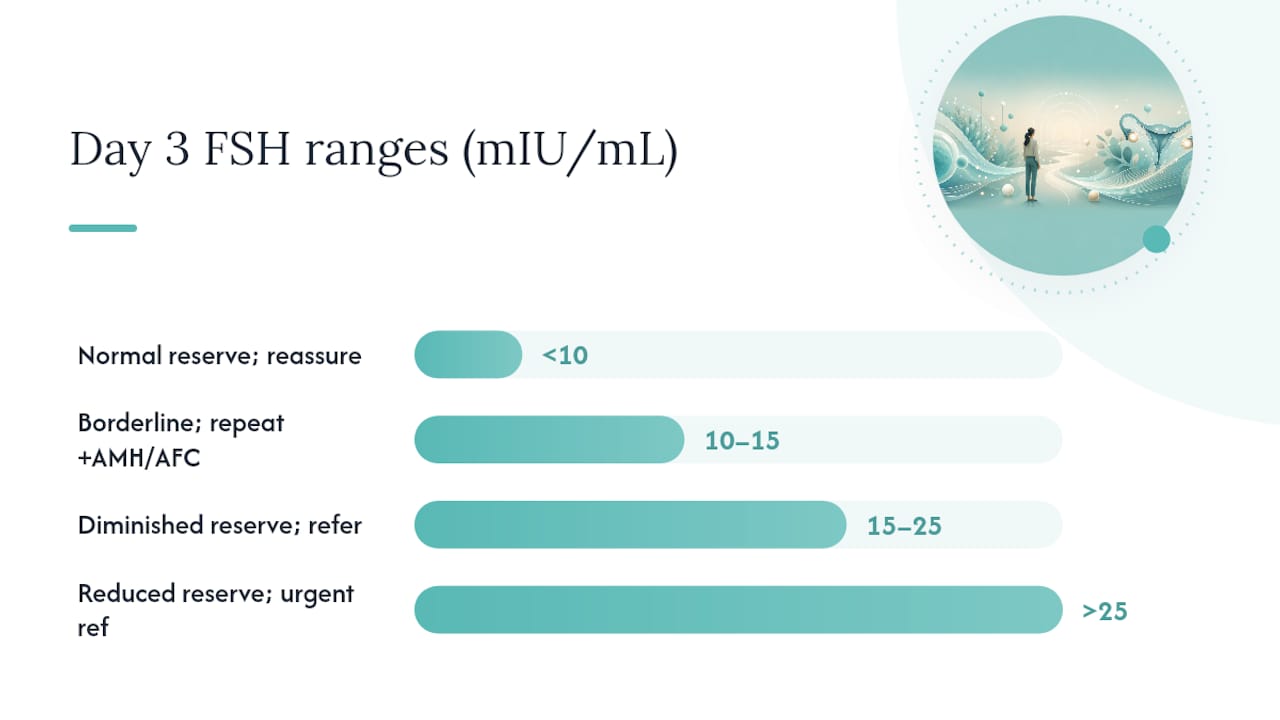
Cleveland Clinic data from IVF cohorts shows that people with a day 3 FSH under 15 mIU/mL had better pregnancy rates per attempt than those with FSH between 15 and 24.9 mIU/mL, and rates were lower still when FSH exceeded 25 mIU/mL. These are population-level patterns, not individual predictions.
A few important caveats before you read too much into a single number:
- FSH varies from cycle to cycle. A value of 12 one month and 8 the next is not unusual.
- The same FSH value carries different weight at different ages. A reading of 11 mIU/mL at 28 is more concerning than the same reading at 40, where some elevation is expected.
- Diagnosing premature ovarian insufficiency (POI) requires two abnormal readings taken at least four weeks apart, not a single high result.
Reading FSH alongside estradiol, LH, and AMH
FSH on its own is only part of the picture. The real clinical value comes from reading it alongside other markers.
Estradiol (E2) is the most critical companion test. If your estradiol is elevated on day 3 (broadly, above around 60–80 pg/mL, though lab thresholds vary), it can suppress FSH artificially, making your FSH look normal when your reserve may actually be reduced. This is a well-documented pitfall: a normal FSH paired with a high E2 is not reassuring — it may mean the FSH result is unreliable. Some clinics use a combined threshold of FSH under 10 mIU/mL and E2 under 75 pg/mL as a reassurance benchmark.
LH (luteinising hormone) on day 3 is usually low, similar to FSH. A significantly elevated LH relative to FSH can suggest polycystic ovary syndrome (PCOS), which changes the interpretation entirely.
AMH (anti-Müllerian hormone) is produced directly by small antral follicles and does not fluctuate across the cycle the way FSH does. It can be measured on any day, making it a more flexible marker. AMH tends to reflect ovarian reserve more directly than FSH, and many clinics now prefer it for predicting response to stimulation. That said, FSH and AMH can occasionally give conflicting signals.
Three scenarios worth knowing:
- High FSH + low AMH: both markers point in the same direction. This is a consistent signal of reduced reserve and warrants prompt specialist review.
- Normal FSH + elevated E2: the FSH result may be suppressed and unreliable. Repeat testing on a different cycle is advisable.
- Normal FSH + low AMH: AMH may be picking up reduced reserve that FSH has not yet reflected. This discordance is worth discussing with a fertility specialist, particularly if you are planning to conceive in the next few years.
What can affect your FSH result?
A single FSH reading can be misleading for several reasons, and knowing the common confounders helps you interpret your result more accurately.
- Elevated estradiol on the day of testing is the most common cause of a falsely normal FSH. This is why E2 must always be measured at the same time.
- Hormonal contraceptives taken recently can suppress the hypothalamic-pituitary-ovarian axis, producing artificially low FSH values.
- Short cycles mean the follicular phase is compressed, and the “day 3” baseline may not reflect the same hormonal state as in a standard 28-day cycle.
- Acute illness or significant physical stress can temporarily disrupt hormone production and skew results.
- Lab method differences: FSH assays are not fully standardised across laboratories, so a result from one lab may not be directly comparable to a result from another. Always compare results from the same lab where possible.
- Early follicular recruitment: occasionally, a follicle begins developing slightly ahead of schedule, raising estradiol and suppressing FSH before the blood draw — giving a falsely reassuring reading despite reduced reserve.
A normal FSH does not guarantee normal ovarian reserve. This is one of the test’s most important limitations. Clinical guidance specifically flags that early follicular estradiol elevation or early recruitment can produce a normal FSH despite diminished reserve. If your FSH is normal but you have other concerns (irregular cycles, a history of ovarian surgery, or a family history of early menopause), ask about AMH and AFC testing rather than relying on FSH alone.
How AMH, AFC, and the clomiphene challenge compare
Day 3 FSH is one of several tools for assessing ovarian reserve. Here is how the main options compare:
FSH (day 3 blood test): cycle-dependent, must be taken on days 2–4, measured in mIU/mL. Useful as a baseline but sensitive to estradiol interference and month-to-month variation. Widely available on the NHS.

AMH (anti-Müllerian hormone): can be measured on any cycle day, making it more convenient. Reflects the pool of small antral follicles directly and is now often preferred over FSH for predicting ovarian response to stimulation. AMH and AFC are increasingly favoured for this purpose. Measured in pmol/L (UK labs) or ng/mL.
Antral follicle count (AFC): a transvaginal ultrasound performed in the early follicular phase to count small resting follicles. Gives a direct visual count of the available follicle pool. Requires a clinic visit and trained sonographer, but provides information no blood test can replicate.
Clomiphene challenge test (CCCT): an older protocol that measures FSH before and after a course of clomiphene citrate to stress-test ovarian reserve. It is rarely used now because AMH and AFC provide similar or better information without requiring medication. You may still encounter it in older fertility literature or in some specialist contexts.
For most women, the most complete picture comes from combining FSH with AMH and AFC, interpreted alongside age and clinical history. No single test is definitive on its own.
What to do after your result
Your next steps depend on which band your FSH falls into. Here is a practical action flow:
- Normal FSH (under 10 mIU/mL): this is reassuring, but do not stop there if you have concerns. Ask about AMH if you want a fuller picture, particularly if you are over 35 or planning to delay conception. Continue monitoring with age-appropriate advice from your GP.
- Borderline FSH (10–15 mIU/mL): repeat the test on a future cycle day 3. Add AMH and AFC to the assessment. Consider an early referral to a fertility clinic, especially if you are over 35 or have been trying to conceive for more than six months. Age and context matter significantly when interpreting a borderline result.
- High FSH (15–25 mIU/mL): repeat the test to confirm. Request a referral to a fertility clinic. Discuss fertility preservation options (egg freezing) if you are not yet ready to conceive. Your consultant will likely order a full hormonal panel, transvaginal ultrasound, and AFC.
- Very high FSH (above 25 mIU/mL): seek specialist review promptly. Two readings above this threshold, taken at least four weeks apart, may indicate premature ovarian insufficiency (POI). Your clinic will discuss options including IVF with your own eggs (where possible), donor eggs, or other pathways.
- Abnormal result with no current fertility plans: a high FSH is still worth investigating even if you are not trying to conceive right now. It may have implications for long-term bone health and cardiovascular health, particularly if POI is suspected.
On the NHS, fertility treatment access varies by clinical commissioning group (now integrated care board). Private IVF and egg freezing are available at most major fertility clinics across the UK. Your GP is the right starting point for NHS referrals; a fertility consultant can advise on private options.
At-home FSH testing: what rapid kits can and cannot tell you
At-home FSH rapid test kits work by detecting FSH in a urine sample using lateral flow technology, similar to a pregnancy test. The Rapidtest at-home FSH kit gives a result in approximately 10 minutes, with no clinic visit, no queue, and no appointment needed.
Here is an honest breakdown of what you get:
- Speed and privacy: results in 10 minutes, at home, on your own terms. No waiting room, no awkward conversations.
- Qualitative result: most at-home rapid kits indicate whether FSH is above or below a threshold (typically around 25 mIU/mL, the level associated with perimenopause or significantly reduced reserve), rather than giving an exact numerical value.
- No concurrent estradiol: this is the key limitation. A home kit cannot measure E2 at the same time, which means a normal-looking result could still be masking a suppressed FSH. For a complete picture, a lab test that includes both FSH and estradiol is necessary.
- Lower quantitative precision: laboratory serum assays are more sensitive and precise than urine-based rapid tests. A home kit is a useful screening tool, not a diagnostic one.
When should an abnormal home result prompt further action? Straight away. If your at-home test suggests elevated FSH, book a GP appointment or a private lab test that includes serum FSH and estradiol. Do not wait to see if it changes next month.
When is a normal home result still worth following up? If you have irregular cycles, a family history of early menopause, or have had ovarian surgery, a normal home result does not rule out reduced reserve. Follow up with an AMH test and, ideally, an AFC scan.
Pro Tip: Time your at-home test to cycle day 3 just as you would a lab test. Testing on the wrong day reduces the result’s usefulness significantly. Rapidtest’s fertility testing timing guide can help you plan this correctly.
At-home testing works best as a first step, not a final answer. It can prompt you to seek further investigation sooner, which is often the most valuable thing it does.
A word on what one number cannot tell you
There is something worth saying plainly here: a single FSH result, whether high, low, or borderline, does not define your fertility. Many people with elevated FSH conceive naturally or with minimal intervention. Many people with a perfectly normal FSH face other challenges that FSH cannot detect.
What a day 3 FSH test gives you is a starting point. A reason to ask the right questions. A number that, when read alongside estradiol, AMH, AFC, your age, and your history, starts to paint a real picture.
If your result has left you worried, the most useful thing you can do is bring it to a GP or fertility specialist with as much context as possible: the day it was taken, what your estradiol was, your cycle length, and any relevant history. That conversation is far more valuable than any number in isolation.
Rapidtest’s at-home FSH kit: a practical first step for UK women
Waiting for a GP referral or a clinic appointment when you want answers now is genuinely frustrating. Rapidtest’s at-home FSH fertility test kit gives you a result in 10 minutes, from home, with full instructions included and discreet packaging as standard.
It is designed for women who want to check their FSH levels privately before deciding whether to pursue further testing. The kit is simple to use on cycle day 3, requires no lab return, and costs a fraction of a private clinic appointment. It will not replace a serum blood test that includes estradiol, and it does not give a precise numerical value, but it gives you a clear signal quickly.
If your result is elevated, that is your prompt to book a GP appointment or order a full at-home fertility testing panel. If it is normal but you still have concerns, an AMH test and AFC scan are the logical next steps. Either way, you are not waiting in the dark. Order your kit at Rapidtest and take the first step on your own terms.
Sources
- Follicle-Stimulating Hormone (FSH): What It Is & Function
- FSH Reference Range, Ovarian Reserve, Perimenopause & Male Fertility | Lamkin Clinic
- What is Day 3 Testing? | Shady Grove Fertility
- Why “Cycle Day 3” Is So Important in Fertility Hormone Testing | Ro
- REI Pearls Pitfalls of Day 3 FSH
This article is general information, not a substitute for advice from a qualified doctor. Consult a qualified healthcare professional about your own circumstances before acting on anything here.
FAQ
What FSH level suggests perimenopause?
An FSH level consistently above 25 mIU/mL, measured on cycle day 3, is often associated with perimenopause or significantly reduced ovarian reserve. Two readings above this threshold, taken at least four weeks apart, are typically required before a clinical conclusion is drawn.
Does a low FSH mean you are definitely fertile?
Not necessarily. A low FSH is reassuring but does not guarantee normal ovarian reserve or egg quality. A low FSH paired with a high estradiol on day 3 may indicate the FSH result is suppressed and unreliable, which is why estradiol must always be measured alongside it.
What time of day is FSH highest?
FSH tends to be slightly higher in the morning due to pulsatile secretion from the pituitary gland. Most clinics recommend a morning blood draw for consistency, though the variation across the day is generally small compared to cycle-to-cycle fluctuation.
What is a normal LH level on day 3?
On cycle day 3, LH is typically low, broadly similar to FSH, usually in the range of 2–15 mIU/mL depending on the laboratory. A significantly elevated LH relative to FSH on day 3 can suggest PCOS and changes how the overall hormonal picture is interpreted.
Can you use an at-home kit instead of a lab test?
An at-home rapid FSH kit, such as the one offered by Rapidtest, gives a useful qualitative result in around 10 minutes and is a practical first screen. It cannot measure estradiol concurrently and is less precise than a laboratory serum assay, so an abnormal home result should always be followed up with a full blood test and, where appropriate, a GP or clinic appointment.