


At home fertility testing guide: what you need to know
At-home fertility testing gives you a real, private snapshot of your reproductive health without a waiting room in sight. Whether you’re just starting to think about conception or you’ve been trying for a while, these kits measure key hormones and fertility markers that can guide your next steps. They’re not a diagnosis, but they’re a genuinely useful starting point.
The main types of test available are:
- Ovulation predictor kits (OPKs): detect the LH surge that signals ovulation is 24–36 hours away
- FSH tests: assess ovarian reserve using a urine or blood sample
- AMH tests: measure anti-Müllerian hormone to indicate egg supply, via a finger-prick blood sample sent to a lab
- Semen analysis kits: check sperm concentration at home
- Combined hormone panels: test multiple markers (FSH, LH, AMH, TSH, estradiol) from one sample
Rapidtest offers fertility testing kits for both men and women, with results in 15 minutes, no appointment needed. These are screening tools. They point you in the right direction; a fertility specialist confirms the picture.
Table of Contents
- How to use each type of home fertility test correctly
- What at-home tests can and can’t tell you
- Tracking fertility beyond the test kit
- When should you see a fertility specialist?
- Rapidtest fertility kits: quick, private, and no queues
- Key takeaways
- FAQ
How to use each type of home fertility test correctly
Getting accurate results depends almost entirely on timing and technique. Here’s what you need to know for each test type.
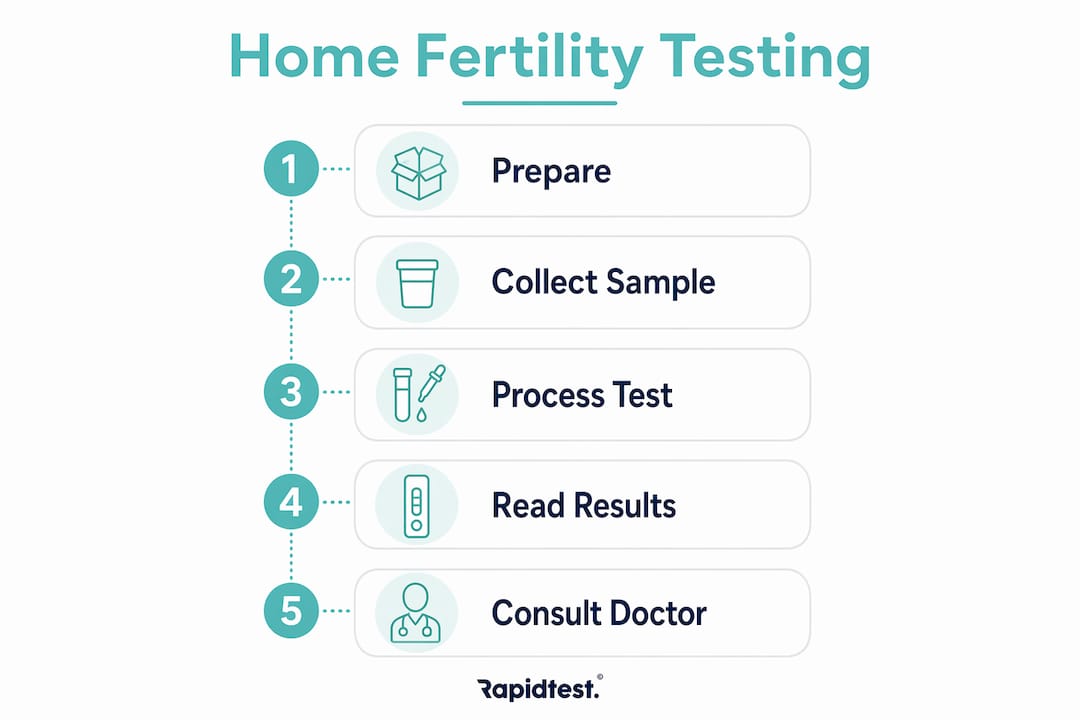
Ovulation predictor kits
Start testing around Day 9 or 10 of your cycle if you have a typical 28-day cycle. For shorter cycles (24–26 days), begin on Day 7; for longer ones (32–35 days), start around Day 14. Test every 12–24 hours until you detect a surge. OPKs detect the LH surge with high accuracy when used correctly, with most errors coming from poor timing rather than faulty tests.
- Avoid testing with first-morning urine; it can be too concentrated
- Test between 10 AM and 8 PM, and limit fluid intake for two hours beforehand
- A positive result means ovulation typically follows within 24 to 36 hours
FSH tests
FSH tests are most accurate on Day 3 of your menstrual cycle (Days 2–4 are acceptable). Testing on other days produces misleading readings because hormone levels fluctuate throughout the cycle. Women on hormonal contraception or certain psychiatric medications should avoid this test, as both can skew results.
AMH tests
AMH levels stay stable throughout the menstrual cycle, so you can test on any day. These kits use a finger-prick blood sample that you post to a lab. Handle the sample promptly and follow the kit’s storage instructions carefully, since degradation can affect accuracy.
Semen analysis kits
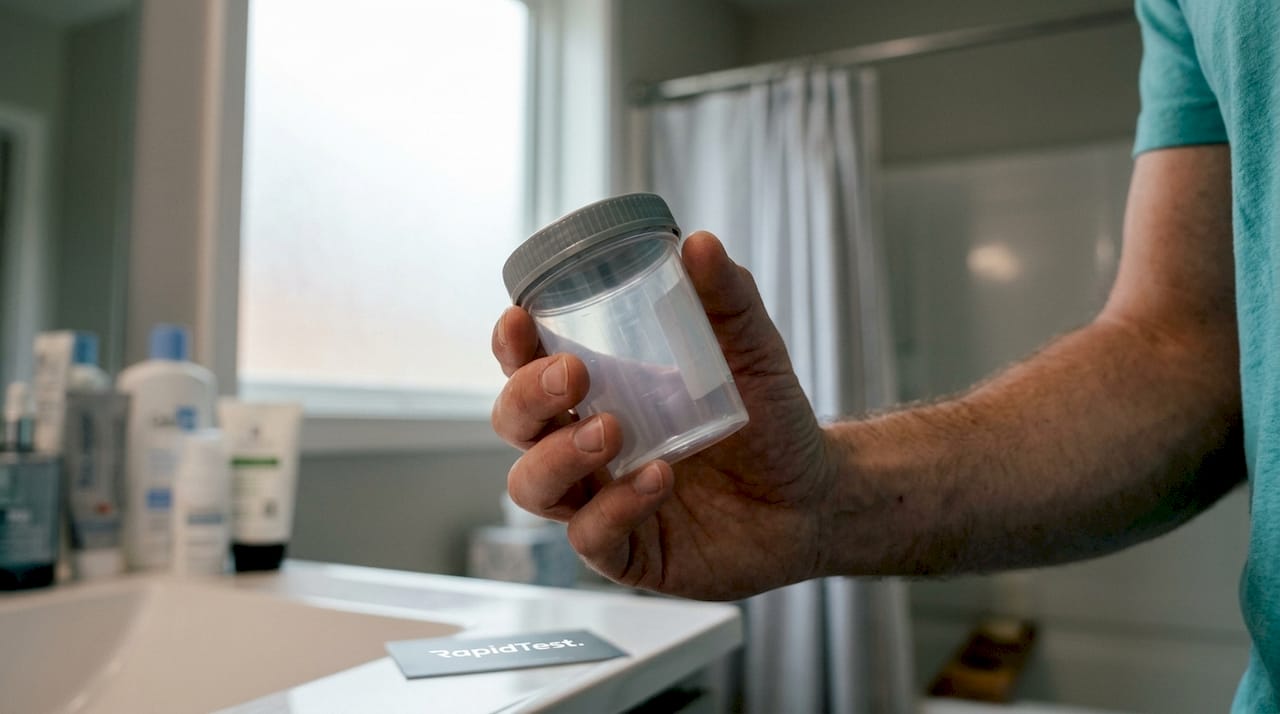
A 2–5 day abstinence period before collection is recommended. Testing too soon after ejaculation can produce a falsely low count. Collect the sample at room temperature and process it within the timeframe the kit specifies.
Cost in the UK: Basic OPKs cost as little as £1 per strip. Hormone blood panels typically range from £60–£150 depending on the number of markers tested. Semen analysis kits generally sit in the £30–£60 range. For a broader look at fertility tests for couples, comparing options before you buy saves both money and confusion.
Privacy note: App-connected tests sync your data to third-party servers. Always check the privacy policy before using one, and consider whether a standalone kit suits you better if data sharing is a concern.
What at-home tests can and can’t tell you
Let’s be real: these kits are genuinely useful, but they have limits worth understanding before you read your results.
Home fertility tests cannot assess egg quality, fallopian tube health, uterine structure, or sperm morphology. A normal OPK result confirms an LH surge happened; it doesn’t confirm the egg released was viable. A normal sperm count doesn’t rule out motility or DNA integrity issues, which account for a meaningful proportion of male factor infertility cases.
Common accuracy pitfalls include:
- PCOS: Women with polycystic ovary syndrome often have persistently elevated LH, causing false positives on OPKs
- Diluted urine: Drinking too much fluid before testing weakens the LH signal
- Wrong cycle day: FSH tested outside Days 2–4 produces unreliable readings
- Delayed sample handling: Blood samples for AMH or hormone panels that sit too long before posting can degrade and skew results
Clinical lab testing in certified environments offers higher reliability than consumer kits. That said, at-home tests give you timely baseline data that can meaningfully inform a conversation with a specialist. Think of them as a first chapter, not the whole story.
Pro Tip: Test urine between 10 AM and 8 PM for OPKs, not first thing in the morning. First-morning urine is often too concentrated and can produce inaccurate LH surge readings.
Tracking fertility beyond the test kit
A single test result is a snapshot. Tracking your fertility signs over time gives you the full picture, and it’s something you can start today without buying anything.
Monitoring basal body temperature (BBT) and cervical mucus for at least 3–6 months alongside testing helps identify ovulation patterns and fertile windows far more reliably than any one-off result. Here’s what to track:
- Menstrual cycle length: Record the first day of each period. A typical cycle runs 24–38 days; anything outside that range regularly is worth discussing with a doctor.
- Basal body temperature: Take your temperature each morning before getting out of bed, using a BBT thermometer. A sustained rise of around 0.5°F (roughly 0.3°C) after ovulation confirms it occurred, though by that point the fertile window has passed. It’s most useful for spotting patterns month to month.
- Cervical mucus: Around ovulation, mucus becomes clear, wet, and stretchy, similar to raw egg whites. This is your most fertile sign. Dry or thick mucus indicates lower fertility.
The real value of combining these methods is pattern recognition. One unusual cycle tells you little. Three to six months of consistent data tells you a great deal, and it gives any specialist you see something concrete to work with.
When should you see a fertility specialist?
At-home tests are a starting point, not a finish line. Certain results and circumstances call for professional input sooner rather than later.
Book an appointment with a fertility specialist if:
- AMH is below 0.5 ng/mL: This indicates low ovarian reserve and warrants clinical evaluation
- FSH exceeds 12 mIU/mL on Day 3: Elevated FSH can signal reduced ovarian function
- Sperm concentration is below 15 million per mL on two separate tests (taken at least two weeks apart)
- No LH surge detected over two full cycles despite correct OPK use
- You’ve been trying to conceive for 12 months (or 6 months if you’re over 35)
- Cycles are irregular (outside the 21–35-day window, or varying by more than 7 days each month)
Keep a record of all your home test results and tracking data to share with your doctor. That information shortens the diagnostic process considerably. Early medical examinations and preventive care during the preconception period can also flag issues that home tests simply aren’t designed to catch.
Clinical evaluation covers things no home kit can: ultrasound, sperm morphology analysis, fallopian tube imaging, and a full hormone panel with numerical values rather than a simple normal/elevated read-out. If your at-home results raise any concern, that’s the test doing its job. It’s pointing you towards the right next step.
Rapidtest fertility kits: quick, private, and no queues
If you want to check your fertility markers without the wait, Rapidtest’s at-home fertility kits give you results in 15 minutes, at home, with no appointment and no awkward conversations at a clinic.
Rapidtest offers kits for both men and women, covering LH, HCG, and SP-10 sperm detection. The kits are straightforward to use, clearly labelled, and designed for people who want answers quickly and privately. They’re the kind of test you do on a Tuesday morning before work, not after a six-week referral wait.
For anyone at the beginning of their fertility awareness journey, a Rapidtest kit is a low-cost, low-stress way to get your first data point. Visit rapidtest.co to find the right kit for your situation.
Key takeaways
At-home fertility testing works best as a screening tool combined with cycle tracking, not as a standalone diagnosis.
| Point | Details |
|---|---|
| OPK accuracy | OPKs detect the LH surge with 97–99% accuracy when used correctly, with timing errors being the main cause of false results. |
| AMH testing flexibility | AMH levels are stable throughout the cycle, so you can test on any day, unlike FSH which must be tested on Day 3. |
| What tests can’t measure | No home kit assesses egg quality, fallopian tube health, or sperm morphology; these require clinical evaluation. |
| When to see a specialist | Seek advice if AMH is below 0.5 ng/mL, FSH exceeds 12 mIU/mL, or you’ve been trying to conceive for 12 months (6 months if over 35). |
| Rapidtest kits | Rapidtest offers at-home fertility kits for men and women with 15-minute results, no appointment needed. |
FAQ
How accurate are at-home ovulation tests?
OPKs are 97–99% accurate at detecting the LH surge when used correctly. The most common cause of a missed result is testing at the wrong time of day or too infrequently, not a fault with the test itself.
Can at-home fertility tests diagnose infertility?
No. At-home tests are screening tools that flag potential concerns; they cannot diagnose infertility. A definitive diagnosis requires clinical evaluation including ultrasound, full hormone blood panels, and semen analysis with morphology.
When is the best time to test FSH at home?
FSH should be tested on Day 3 of your menstrual cycle (Days 2–4 are acceptable). Testing outside this window produces unreliable results due to natural hormone fluctuations.
Do at-home semen analysis kits measure sperm quality?
Most home kits measure sperm concentration only and do not assess motility, morphology, or DNA integrity. A normal count at home does not rule out male factor infertility.
How long should I track my cycle before seeing a specialist?
Tracking BBT and cervical mucus for 3–6 months gives a meaningful data set. If you’ve been trying to conceive for 12 months without success (or 6 months if you’re over 35), book a specialist appointment regardless of your tracking duration.
Recommended
- Fertility testing checklist: your complete 2026 guide – RapidTest
- How to Test Fertility at Home | At-Home Fertility Tests for Couples – RapidTest
- The Best Fertility Tests for Couples at Home: How to Check Fertility f – RapidTest
- At-Home Fertility Testing vs Clinic Testing | Which Is Right for You? – RapidTest