


How to interpret rapid test results: your UK guide
A rapid test result is a clinical data point, not a diagnosis. Knowing how to interpret rapid test results correctly means you can act quickly and calmly, rather than spiral into unnecessary worry or, worse, miss something that needs attention. The rule is simple: a result tells you the probability of a marker being present, not a definitive yes or no.
Here is what each result type means at a glance:
- Positive: the marker was detected. Avoid sexual contact where relevant, and arrange confirmatory testing through an NHS sexual health clinic or your GP.
- Negative: the marker was not detected at this moment. If you have symptoms or recent exposure, timing matters — a negative result may still need a repeat test.
- Invalid: the test did not work. Discard the kit and repeat immediately with a new one.
Rapidtest kits for STIs, fertility, and men’s health screening advertise accuracy of up to 99.8% for some kits, such as the HIV at-home kit. Even so, no single result replaces clinical confirmation.
Table of Contents
- What to do in the next 24–72 hours after your result
- How to read the lines and markings on your kit
- What accuracy claims actually mean for your result
- When to retest: window periods and UK timing guidance
- UK next steps after a positive, negative, or invalid result
- Common mistakes that cause wrong results
- Key takeaways
- Why careful interpretation matters more than the result itself
- Rapidtest kits: fast, discreet, and ready when you need them
- Useful sources
- FAQ
What to do in the next 24–72 hours after your result
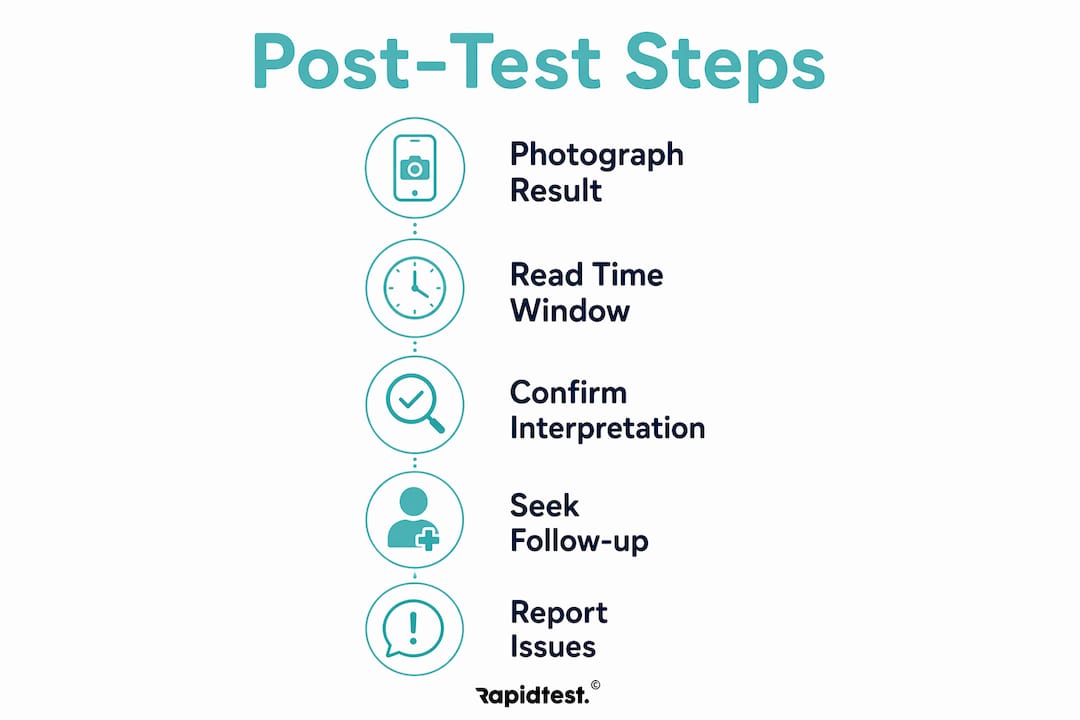
- Check the kit leaflet first. Confirm you used the correct specimen type and followed the exact steps.
- Verify the read window. Did you read the result at the manufacturer’s specified minute mark? Reading too early or too late affects accuracy.
- Positive result (0–24 hours): avoid sexual contact, contact an NHS sexual health clinic or GP to arrange confirmatory testing, and notify recent partners if advised.
- Negative result with symptoms or recent exposure (24–48 hours): do not assume you are clear. Plan a repeat test within 48 hours or per your kit’s guidance.
- Negative result, no symptoms, no known exposure (48–72 hours): a second test 48 hours later improves confidence, especially for STI screening.
- Invalid or unclear result: repeat immediately with a fresh kit. If you get a second invalid result, contact your GP or NHS 111.
- Faint line: treat it as positive and arrange confirmatory testing — do not wait to see if it darkens.
Pro Tip: Photograph your result within the valid read window. The image is useful if a clinician asks to review it later, and it gives you a record if the line fades.
How to read the lines and markings on your kit
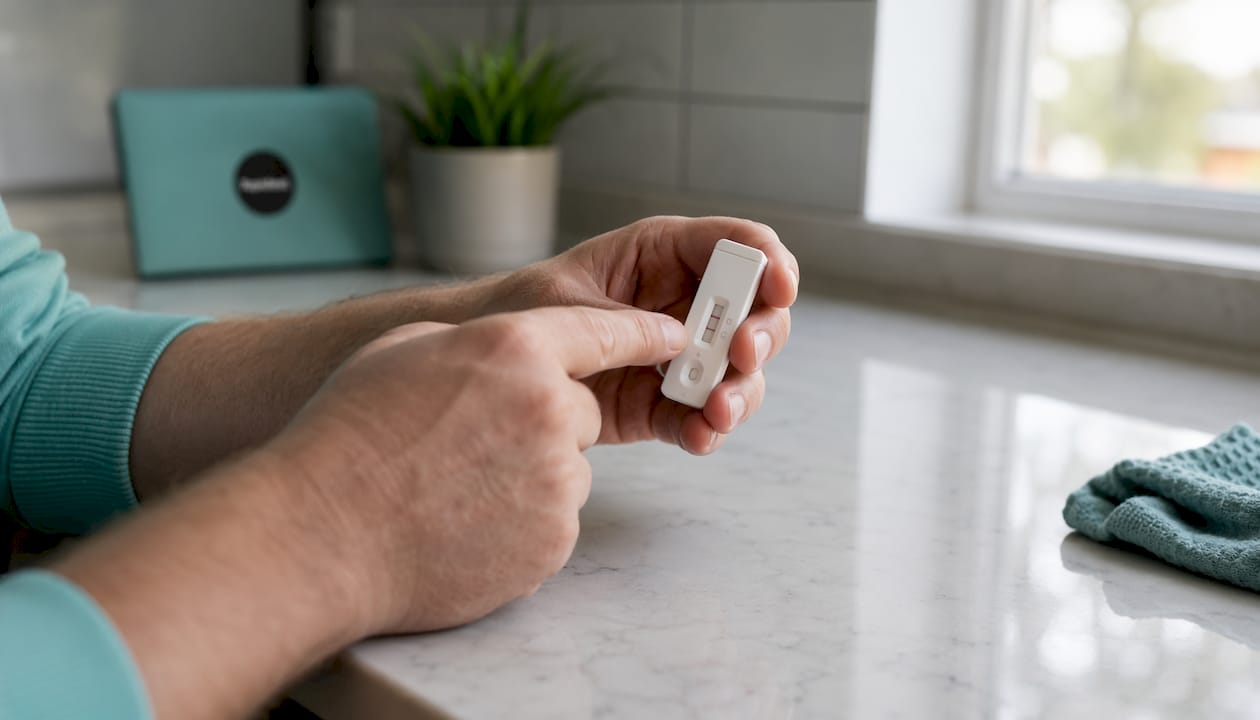
Most at-home rapid kits use a lateral flow format. The visual logic is consistent across STI, fertility, and men’s health tests, though always defer to your specific kit’s leaflet for the manufacturer’s reference ranges.
- Control line ©: this line must appear for the result to be valid. It confirms the test ran correctly and the right volume of sample moved through the strip. No C line means the result is invalid, full stop.
- Test line (T): any visible T line, even a faint one, counts as a positive on qualitative lateral flow tests. The intensity of the colour does not indicate how severe an infection is or how high a marker level is.
- Colour-change strips: some kits use a colour shift rather than lines. The leaflet will show you the reference colour for positive and negative.
- Numerical readouts: PSA kits and some fertility tests may display a number. Always compare that number to the reference range printed in your kit’s leaflet, not to ranges you find online, as values vary by manufacturer and method.
- Panel tests: if your kit screens for multiple markers at once, each T position corresponds to a different marker. Check the leaflet diagram carefully.
Pro Tip: Read your result at exactly the minute mark the manufacturer specifies. Reading outside the window risks evaporation lines that look like a faint positive, or a genuine positive that has not yet developed.
What accuracy claims actually mean for your result
Sensitivity and specificity are the two numbers behind every accuracy claim, and understanding them changes how you read your result.
Sensitivity is how good the test is at detecting the marker when it is genuinely present. A test with lower sensitivity misses some real positives, producing false negatives. Specificity is how good it is at returning a negative when the marker is genuinely absent. Lower specificity means some false positives slip through.
| Term | Plain meaning | Effect on your result |
|---|---|---|
| High sensitivity | Rarely misses a real positive | False negatives are uncommon |
| Low sensitivity | Can miss early or low-level infections | Negative may need repeating |
| High specificity | Rarely flags a false positive | Positive is more likely to be real |
| Low specificity | Occasionally flags a false positive | Positive still needs confirmation |
Pre-test probability is the piece most people skip. It means: how likely were you to have this condition before you tested? Post-test probability depends on both the test’s performance and your pre-test probability. A positive result when your pre-test probability was very low carries a higher chance of being a false positive than the same result in someone with clear symptoms and recent exposure. Conversely, a negative result when your pre-test probability is high — say, a known exposure within the window period — may still leave meaningful doubt.
Rapidtest’s advertised 99.8% accuracy for kits like the HIV and syphilis tests is a strong performance figure. Viewed alongside your personal pre-test probability and study conditions, it means a positive is very likely real, but confirmatory testing via NHS or GP remains the right call. For a deeper look at test performance limits, Rapidtest’s own guidance covers the evidence in plain terms.
Pro Tip: A positive result is a prompt for confirmatory testing, not immediate alarm. Treat it as useful information that needs one more step, not a final verdict.
When to retest: window periods and UK timing guidance
Window periods are the gap between exposure and when a test can reliably detect a marker. Testing too early produces a false negative because the marker has not yet reached detectable levels.
- STI screening: most STI rapid tests have window periods ranging from a few days to several weeks depending on the infection. Follow the specific guidance in your kit leaflet and, if in doubt, retest at 14 days post-exposure.
- Fertility tests (LH, HCG, FSH): timing within your cycle matters as much as the result itself. The kit leaflet will specify the correct day or time of day to test.
- PSA testing: a single elevated reading needs clinical context. Repeat testing and GP review are standard before any action is taken.
If a negative home rapid test follows a recent exposure or you still have symptoms, plan a repeat test or move to a laboratory NAAT for STI confirmation. Home rapid tests generally have lower sensitivity than lab-based diagnostics, so a negative result early in a window period is not a guarantee.
- Book an NHS sexual health clinic via the NHS website or call NHS 111 for same-day advice.
- GP appointments are appropriate for PSA, FOB, and fertility follow-up.
- Urgent symptoms — pain, discharge, fever — warrant same-day care regardless of your test result.
UK next steps after a positive, negative, or invalid result
After a positive result:
- Arrange confirmatory testing at an NHS sexual health clinic or GP as soon as possible.
- Avoid sexual contact until confirmation is complete.
- Discuss partner notification with your clinician; NHS sexual health services handle this confidentially.
After a negative result with symptoms or recent exposure:
- Do not assume you are clear. Repeat per window period guidance or seek NHS/GP assessment.
- A single negative result does not rule out infection when exposure is recent.
After an invalid or unclear result:
- Repeat immediately with a new kit.
- If problems persist, contact NHS 111 or your local sexual health clinic.
NHS sexual health services are free and confidential. You can find your nearest clinic via the NHS website or by calling NHS 111. For interpreting borderline or unclear results, consulting a clinician is always the right move.
Common mistakes that cause wrong results
- Expired kit: check the expiry date before you open the packaging. An expired kit can give unreliable readings.
- Wrong specimen type: using a finger-prick sample where a swab is required, or vice versa, invalidates the result.
- Inadequate sample: too little blood or an insufficient swab means the marker may not reach the test strip in detectable quantities.
- Reading outside the window: too early risks a false negative; too late risks an evaporation line that mimics a positive.
- Poor storage: kits stored in damp or hot conditions may degrade before the expiry date. Store as directed on the box.
- Medication interference: biotin supplements can interfere with some immunoassay-based tests. Check the leaflet for any listed interactions.
- Missing control line: if C does not appear, the result is invalid regardless of what T shows. Repeat with a new kit.
If you suspect a manufacturing defect, photograph the kit and result, note the batch number, and report it to the kit supplier and, if appropriate, to the MHRA via their Yellow Card scheme.
Key takeaways
A rapid test result is a data point that guides your next step, not a final diagnosis — always follow it with the action the result type calls for.
| Point | Details |
|---|---|
| Result is not a diagnosis | Use your result to choose the right next step: confirm, repeat, or seek care. |
| Faint T line counts as positive | Any visible test line on a qualitative lateral flow kit should be treated as positive. |
| Window periods affect negatives | A negative result early after exposure may need repeating at 14 days or per kit guidance. |
| Use your kit’s own reference range | Never substitute external ranges; values vary by manufacturer and method. |
| Rapidtest kits include clear instructions | Rapidtest STI, fertility, and men’s health kits come with full leaflets and customer support to help you read results correctly. |
Why careful interpretation matters more than the result itself
There is a tendency to treat a home test result as the end of the story. It is not. The result is the beginning of a decision.
What strikes me most, having spent time with the evidence on rapid test interpretation, is how often the context around a result matters more than the result itself. A positive on a high-specificity test in someone with clear symptoms and recent exposure is a very different situation from the same positive in someone who tested on a whim with no risk factors. The number on the box — 99.8%, 98%, whatever it is — only tells you how the test performed in a study population. Your personal pre-test probability shifts that figure meaningfully.
Rapidtest builds its kits with clear instructions and genuine accuracy claims. The HIV and syphilis kits, for instance, are designed so that a non-medically trained person can run the test and read the result correctly. That is real value. But the brand is also honest that confirmatory testing through NHS services is the right follow-up for a positive, and that a negative is not a guarantee when timing is off. That honesty is what makes at-home testing genuinely useful rather than falsely reassuring.
The readers who get the most from rapid testing are the ones who treat it as a first, fast filter — not the final word.
Rapidtest kits: fast, discreet, and ready when you need them
Getting a result at home in 15 minutes, without a GP queue or an awkward conversation, is the whole point of at-home rapid testing. Rapidtest offers STI testing kits with results in 15 minutes, full instructions included, and discreet packaging delivered to your door.
Whether you need to replace a failed kit, run a confirmatory rapid test before your NHS appointment, or start a new screening routine, Rapidtest has you covered across STI, fertility, and men’s health categories. The customer support team can help you work through kit instructions and reading your result — though clinical confirmation always comes from your NHS service or GP.
Browse the full range of STI kits or check out the fertility and PSA options to find the right test for your situation.
Useful sources
- MedlinePlus — How to understand your lab results: plain-language guidance on what test results mean and when to seek clinical review. Visit medlineplus.gov.
- MSD Manuals — Understanding medical tests: professional-level explanation of sensitivity, specificity, and Bayesian reasoning for interpreting results.
- MainStreet Blood Lab — Lab result interpretation checklist: a structured checklist covering test name, specimen, units, reference range, and prior trend.
- KeptWell — How to read your lab results: explains reference ranges and why a result slightly outside the range is not automatically a diagnosis.
- GOV.UK self-test instructions: official guidance on timing, faint lines, and reading lateral flow results correctly.
- NHS 111 and local sexual health clinics: for confirmatory testing, partner notification, and urgent advice. Search “sexual health clinic near me” on the NHS website or call 111.
- Rapidtest blog and help pages: kit-specific reading guidance, accuracy evidence, and support for interpreting rapid test issues at home.
FAQ
What does a faint line on a rapid test mean?
A faint test line (T) on a qualitative lateral flow test counts as a positive result. Colour intensity does not measure severity, so treat any visible line as a positive and arrange confirmatory testing.
How soon after exposure can a rapid test give an accurate result?
Most rapid tests cannot detect a marker until after the window period, which varies by condition. Testing too early risks a false negative; for STIs, retesting at 14 days post-exposure is a common recommendation, though always follow your specific kit’s leaflet.
What should I do if my rapid test result is invalid?
Discard the kit and repeat immediately with a new one. If you get a second invalid result, contact NHS 111 or your local sexual health clinic for guidance.
Can a negative rapid test result mean I definitely do not have an infection?
No. Home rapid tests have lower sensitivity than lab-based tests, so a negative result early in a window period or with ongoing symptoms should be followed by a repeat test or a laboratory NAAT.
Where can I get confirmatory testing in the UK after a positive rapid test result?
NHS sexual health clinics offer free, confidential confirmatory testing. You can find your nearest clinic via the NHS website or call NHS 111 for same-day advice.