


How accurate are rapid tests? What the evidence shows
Rapid tests promise answers in 15 minutes, no waiting room, no awkward conversation with a doctor. That sounds ideal, and for millions of people across the UK and Europe, it’s become the norm for checking everything from COVID-19 to STIs and prostate health. But here’s the thing: the accuracy numbers printed on the packaging don’t always reflect what happens in your kitchen with a finger-prick sample at 8am. Rapid at-home PSA tests have shown genuinely mixed results in real-world trials, and they’re far from alone. This article breaks down what the independent evidence actually says, so you can make smarter decisions about your health.
Table of Contents
- What is a rapid test? Types and mechanics
- Rapid test accuracy: Evidence from COVID-19, STI, and PSA kits
- Factors affecting rapid test reliability
- Practical advice: Using rapid tests for sexual health and men’s screening
- Our take: What most guides miss about rapid test accuracy
- Explore reliable rapid testing solutions
- Frequently asked questions
Key Takeaways
| Point | Details |
|---|---|
| Commercial claims vs. real evidence | Most rapid tests overstate accuracy, missing crucial details revealed in independent reviews. |
| Sensitivity and specificity explained | COVID, STI, PSA kits often show high specificity but only moderate sensitivity, which can leave infections undetected. |
| Self-sampling risks | User error and collection method dramatically affect rapid test reliability. |
| Critical need for lab confirmation | Always confirm positive or concerning rapid test results in a certified laboratory. |
| Choose evidence-backed kits | Opt for rapid tests with clear, independent validation and transparent claims. |
What is a rapid test? Types and mechanics
After setting the stage, let’s clarify what rapid tests really are and how they’re supposed to work.
A rapid test is any diagnostic test designed to deliver a result within minutes, usually at home or at the point of care, without needing a lab. The most common technology behind them is called lateral flow immunoassay (LFA). Don’t let that name put you off. It’s actually a straightforward process: a sample (saliva, blood, urine, or a swab) is placed onto a test strip. The strip contains antibodies that bind to a specific target, say a virus antigen or a hormone like PSA. If that target is present in your sample, a visible line appears. Two lines mean positive. One line means negative.
It’s elegant, fast, and genuinely useful. But as lateral flow immunoassay testing research in the BMJ confirms, self-sampling carries real risks around collection technique and result interpretation. In other words, the test strip might be perfectly calibrated, but if you didn’t swab the right spot, or you read the result too early or too late, that clean result could be misleading.
Here are the most common rapid test types you’ll come across:
- COVID-19 antigen tests detect viral proteins in nasal or throat swabs
- STI and HIV tests use blood from a finger-prick to detect antibodies or antigens for infections like HIV, chlamydia, syphilis, and gonorrhea
- PSA (Prostate-Specific Antigen) tests measure a protein in blood that may signal prostate issues
- Vitamin D tests assess circulating vitamin D levels from a blood spot
- Cholesterol tests measure lipid levels from a capillary blood sample
The technology itself is solid. The weak link is almost always the human element: how the sample was collected, how it was handled, and whether the result was interpreted correctly. That’s not a criticism of you. It’s just the reality of self-testing outside a clinical setting.
To understand more about rapid test benefits, it helps to see both sides: the convenience is real, but so are the limitations.
Pro Tip: If you’re testing for something serious, like HIV or prostate cancer markers, a postal kit where you send your sample to an accredited lab tends to offer better reliability than a purely at-home read. You get the convenience of collecting at home without the interpretation risk.
Rapid test accuracy: Evidence from COVID-19, STI, and PSA kits
Now that the basics are clear, let’s get into the accuracy numbers that actually matter.
This is where things get uncomfortable for a lot of manufacturers. The numbers on the box and the numbers from independent research don’t always line up. Let’s look at what the evidence says for the most widely used rapid tests.
COVID-19 antigen tests
COVID rapid tests are the most extensively studied. The BMJ published a major review showing that COVID rapid test sensitivity ranges from 69.9% to 79.0% in symptomatic people, rising to 83-94% in people actively seeking confirmation of a suspected infection. Specificity (how often the test correctly rules out infection in healthy people) sits close to 100%. That sounds reassuring, but here’s the issue: sensitivity in the 70% range means roughly 1 in 4 genuinely infected symptomatic people could walk away with a false negative.
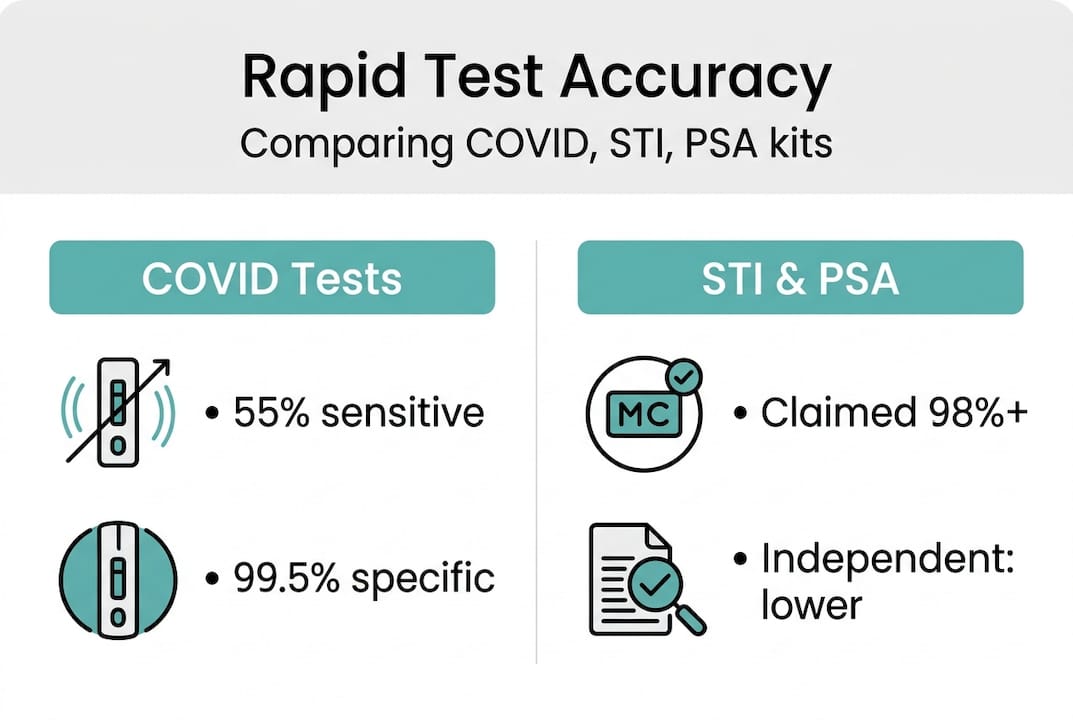
For asymptomatic individuals, the picture is worse. A Cochrane review of RATs covering 146 studies found average sensitivity dropped to just 55% and specificity was 99.5%. None of those tests met WHO minimum performance standards for asymptomatic use. That means if you had COVID with no symptoms, a rapid test would miss your infection almost half the time.
Direct-to-consumer STI and PSA tests
The picture here is trickier, because independent research is harder to find. Most manufacturers claim ≥98% accuracy for their direct-to-consumer kits. But a BMJ analysis of UK health tests found that 60% of reviewed kits showed significant usability or safety concerns, and the underlying evidence for their claimed accuracy was often poor or entirely absent.
Here’s a quick comparison to put it all in context:
| Test type | Claimed sensitivity | Independent sensitivity | Specificity | Key concern |
|---|---|---|---|---|
| COVID-19 (symptomatic) | 95%+ | 70-79% | ~100% | User collection errors |
| COVID-19 (asymptomatic) | 95%+ | ~55% | 99.5% | Low viral load detection |
| HIV/STI rapid test | 99-99.8% | Limited independent data | High | Window period timing |
| PSA rapid test | 98%+ | Mixed/unreliable | Varies | Not recommended for cancer |
| Vitamin D/Cholesterol | 95%+ | Often overstated | Moderate | Lab kits more reliable |
Key insight: High specificity is great news for positive results. It means if your rapid test comes back positive, it’s very likely correct. But modest sensitivity means a negative result doesn’t always mean you’re in the clear, especially during early infection.
For a deeper look at how STI self-test accuracy plays out specifically for men over 40, the window period and sample quality become particularly important factors.
Factors affecting rapid test reliability
With those numbers in mind, it’s important to understand what actually causes rapid tests to miss things or get them wrong.
There are several layers to this, and they interact in ways that are easy to overlook when you’re just following the instructions on the leaflet.
Sample collection quality
This is the biggest variable. A nasal swab taken too shallowly, a finger-prick that produces a small or diluted blood drop, or a urine sample collected at the wrong time of day can all reduce the concentration of the thing you’re testing for. When that concentration drops below the test’s detection threshold, you get a false negative. It’s not that the infection isn’t there. The sample just didn’t carry enough of it.
Timing and window periods
Window periods are the gaps between when you were exposed to an infection and when a test can reliably detect it. HIV, for example, has a window period of up to 45 days for some antibody-based tests. Testing too soon gives a false sense of security. Cochrane research confirms that lower sensitivity in early infection and asymptomatic cases is directly linked to low viral or antigen load, which is unavoidable when you test too early.
Population-specific factors for men over 40
If you’re over 40 and testing for PSA or STIs, there are additional wrinkles. PSA levels naturally fluctuate due to exercise, ejaculation, and prostate size, all of which increase with age. The MHRA has explicitly warned against using rapid at-home PSA tests for cancer detection because results are inconsistent and can be dangerously misleading in both directions.
Here’s what tends to go wrong in practice:
- Reading results outside the valid window: Most rapid tests have a 5 to 15 minute reading window. Too early or too late, and the result isn’t valid.
- Improper storage: Tests stored in hot or damp conditions can degrade before use.
- Confusing faint lines: A very faint second line can be a genuine positive or an evaporation line, and it’s hard to tell without experience.
- Not following up positives: A positive rapid test result needs lab confirmation before you act on it.
For step-by-step guidance, safe self-testing tips can help you avoid the most common pitfalls before you even open the kit.
Pro Tip: Always test at the right time. For STIs, wait until after the window period has passed. For PSA, avoid sexual activity and intense exercise for 48 hours before testing. Timing is often the difference between a reliable result and a false one.
Before you test, check the STI screening guide to make sure you’re testing at the right point in the window period.
Practical advice: Using rapid tests for sexual health and men’s screening
With reliability understood, here’s practical guidance for using rapid tests safely and getting the most out of them.
Rapid tests are genuinely useful tools. Used correctly and at the right time, they can give you a reliable early indication of your health status. The problem is when they’re used as a final word, rather than a useful starting point.
When rapid tests make sense:
- Checking HIV or STI status before or after a new sexual partner
- Monitoring PSA trends over time as part of a broader health routine
- Getting a quick indication of cholesterol levels between GP appointments
- Screening for symptoms that are showing up and need a fast answer
When you need more than a rapid test:
- Any positive result needs lab confirmation before treatment or major decisions
- Early in a window period (see above)
- When symptoms are persistent or severe regardless of test result
- For prostate cancer screening specifically, a GP-ordered PSA blood test and consultation are essential
Here’s a simple process to follow for safer self-testing:
- Read the instructions before opening anything. Every kit is slightly different. Don’t assume.
- Check the expiry date and storage conditions. A degraded test is worse than no test.
- Collect your sample carefully. Follow the exact technique described. Don’t rush the swab or finger-prick.
- Time the result precisely. Use a phone timer. Don’t guess.
- Photograph the result. Before it fades, take a clear photo in good lighting. This helps if you need to consult a clinician later.
- Confirm positives with a lab. Always. No exceptions.
Our HIV at-home testing kit claims 99.8% accuracy, and we stand behind that. But we also recommend lab confirmation for any positive result and for any test taken during an early window period, because that’s what responsible testing looks like.
For cholesterol monitors and similar cardiovascular kits, independent testing by Which? found that many at-home monitors overestimate their performance, and send-away lab kits consistently outperform them in accuracy.
Pro Tip: Don’t rely on a rapid test alone for any decision that significantly affects your health or a partner’s health. Rapid tests are a starting point, not a finish line. A negative result with symptoms, or a positive result on a rapid test, both deserve follow-up.
Want to understand more about at-home STI testing trends and what’s driving the shift toward private, convenient health screening? The landscape is changing fast, and knowing what to trust matters.
Our take: What most guides miss about rapid test accuracy
Most articles about rapid tests focus on the commercial claims. They quote the sensitivity and specificity numbers from the manufacturer’s insert and leave you feeling confident. We think that’s a disservice.
The real picture, based on independent reviews and regulatory scrutiny, is more nuanced. Yes, rapid tests are genuinely useful. Yes, high specificity means a positive result is almost certainly real. But modest sensitivity, particularly in asymptomatic users and early-stage infections, means missed cases are a real and documented risk.
User confidence is the part that worries us most. When someone gets a negative result on a rapid test, they often stop there. They don’t follow up. They don’t consider the window period. That false reassurance can lead to real harm.
Commercial claims are frequently overstated, and experts are now calling for greater regulation, mandatory evidence standards, and clearer guidance on when confirmatory testing is needed. We agree. Until that regulation arrives, the responsibility falls on you to understand what your test result actually means.
For men over 40 especially, understanding the limitations of STI self-test accuracy is not optional. It’s part of taking your health seriously.
Explore reliable rapid testing solutions
If you’ve made it this far, you now know more about rapid test accuracy than most people who use them. That’s a real advantage when it comes to protecting your health.
At Rapidtest, we offer 15-minute STI and STD kits designed with clear evidence, responsible accuracy claims, and full usage guidance so you’re never left guessing. For prostate health, our male PSA rapid kits are a convenient screening tool when used as part of a broader health routine. And if you’re thinking about family planning, explore our fertility testing kits for straightforward answers at home. No queues, no awkward waiting rooms, and no hidden limitations in the fine print.
Frequently asked questions
How accurate are rapid COVID-19 tests for asymptomatic individuals?
Rapid COVID tests for asymptomatic people show an average sensitivity of 55% and specificity of 99.5%, meaning they miss nearly half of real infections in people with no symptoms.
Are rapid STI/HIV tests at home trustworthy for men over 40?
Rapid STI tests claim 99.8% accuracy, but lab confirmation is strongly advised, particularly for positive results or tests taken during the early window period.
What makes rapid PSA tests unreliable for prostate screening?
At-home PSA kits have produced inconsistent results across independent trials, and the MHRA advises against using them as a basis for cancer detection without clinical follow-up.
Why do rapid test results differ between brands?
Different brands use different antibody formulations, detection thresholds, and sample volumes, all of which affect sensitivity. UK studies have documented wide variation in reliability across direct-to-consumer brands.
Is a negative rapid test result always trustworthy?
Not always. A negative result during a window period or early-stage infection may be a false negative. Cochrane data confirms that lower sensitivity in these scenarios is a documented limitation, so follow up with a lab test if you have any doubt.