


What is rapid testing? A clear guide for men's sexual health
A fast result feels reassuring. But a fast result isn’t always a complete one, and that distinction matters a great deal when you’re making decisions about your sexual health. Many men assume that if a rapid test comes back negative, they’re in the clear. Or that a positive result is the final word. The reality is more nuanced, and understanding it puts you in a much stronger position. This guide covers exactly how rapid testing works, what it’s genuinely good for, where its limits are, and how you can use it wisely as part of a bigger approach to your health.
Table of Contents
- What is rapid testing and how does it work?
- Key benefits of rapid testing for men’s health
- Limits and accuracy: What rapid tests can—and cannot—tell you
- When to use rapid testing: Screening vs. diagnosis and follow-ups
- How to choose safe, reliable rapid tests and avoid common pitfalls
- The bigger picture: Why rapid testing is a tool, not a replacement for medical care
- Get peace of mind with certified rapid testing kits
- Frequently asked questions
Key Takeaways
| Point | Details |
|---|---|
| Rapid tests are screening tools | They provide fast, convenient first results but are not substitutes for a doctor’s diagnosis. |
| Know the window period | Testing too soon after exposure can lead to false negatives, especially for HIV and syphilis. |
| Choose certified kits | Look for CE, NHS, or other validated sources to ensure reliable and safe results. |
| Home testing is empowering | It increases privacy and convenience for men over 40 to manage their sexual health proactively. |
What is rapid testing and how does it work?
With rapid testing growing in popularity, let’s start with what it really means and why it’s different from traditional lab tests.
A rapid test is exactly what it sounds like: a test that gives you a result quickly, usually within 10 to 30 minutes, without needing to send a sample to a laboratory. Instead of waiting days for a clinic to process your results, you get an answer at home, on your own schedule, with no waiting room involved.
Most rapid tests work through one of three sample types:
- Finger-prick blood sample for infections like HIV, syphilis, and markers like PSA (prostate-specific antigen)
- Urine sample for infections like chlamydia and gonorrhea
- Swab sample from the throat, rectum, or genital area for STI screening
Once you collect your sample, you apply it to a cassette or test strip. The cassette contains reactive agents that respond to specific proteins or antibodies in your sample. A visible line (or lines) appears within minutes to show your result.
Here’s a quick breakdown of what rapid tests are most commonly used for:
| Test type | What it screens for | Typical sample |
|---|---|---|
| HIV rapid test | HIV antibodies/antigens | Finger-prick blood |
| Syphilis rapid test | Syphilis antibodies | Finger-prick blood |
| Chlamydia/gonorrhea | Bacterial STIs | Urine or swab |
| PSA rapid test | Prostate cancer marker | Finger-prick blood |
| Fertility rapid test | Sperm count, hormones | Urine or blood |
The key difference between rapid tests and lab tests isn’t just speed. It’s what happens to your sample. Lab tests use highly sensitive equipment to detect even tiny traces of infection. Rapid tests rely on antibody or antigen reactions visible to the naked eye. As home self-testing basics explain, knowing how these kits work helps you interpret your results with confidence.
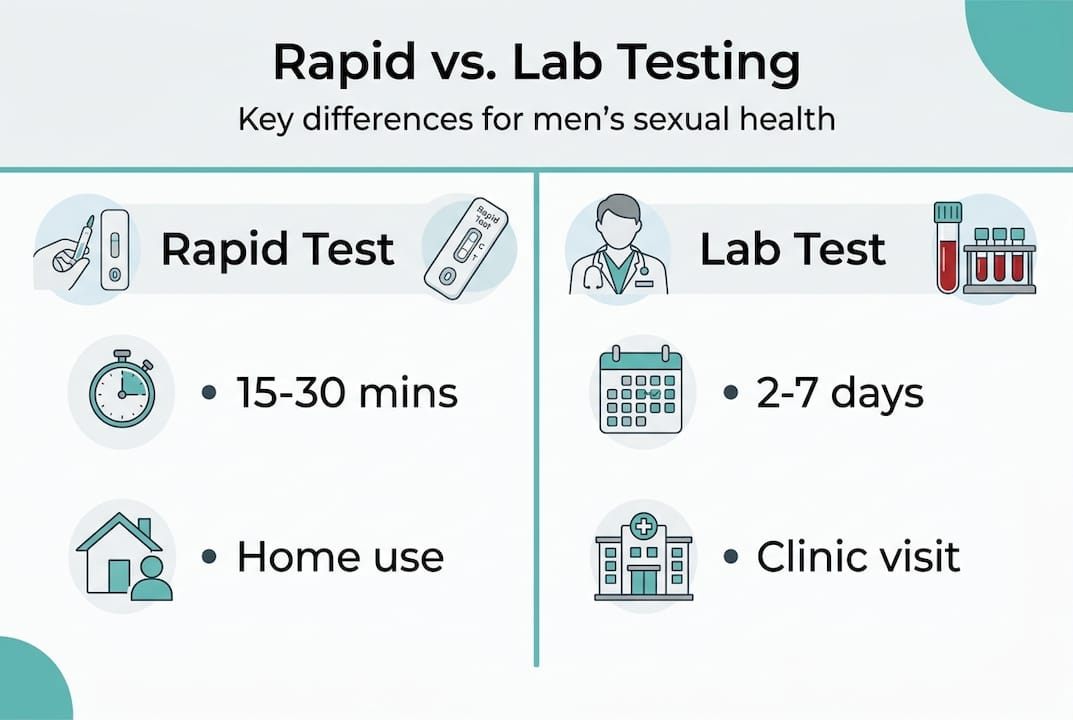
It’s worth knowing that rapid self-tests have moderate to high sensitivity and specificity, making them better suited for initial screening than for definitive diagnosis. They’re a powerful first step, not always the last word.
Pro Tip: If you’re using a rapid test for the first time, read the instructions fully before opening the kit. User error is one of the most common reasons for inaccurate results, and it’s easily avoided.
Key benefits of rapid testing for men’s health
Knowing how rapid testing works, let’s dig into why so many men are choosing it as their first step in managing sexual and general health.
Let’s be real: for men over 40, booking a sexual health appointment can feel like a logistical nightmare. You’ve got work, family, and about a thousand other things competing for your time. And if you’re honest, there’s probably a bit of awkwardness in there too.
Rapid testing cuts through all of that. Here’s why it works so well:
Speed matters. Most results arrive in 15 to 30 minutes. That’s less time than a GP waiting room. The anxiety of not knowing is one of the worst parts of health concerns, and rapid testing shortens that window considerably.
Convenience is real. You order online, test at home, and read your result without rearranging your day. No appointments, no travel, no sitting in a clinic.

Privacy is non-negotiable for many men. Sexual health is personal. Rapid testing gives you control over who knows you’re testing and when. That matters.
Faster decisions, better outcomes. When you know sooner, you act sooner. Whether that’s seeking treatment, telling a partner, or simply ruling something out, quicker answers support better choices.
Here’s how rapid testing compares to traditional clinic-based STI screening:
| Factor | Rapid home test | Clinic-based test |
|---|---|---|
| Time to result | 15-30 minutes | 2-7 days |
| Privacy | High | Moderate |
| Convenience | Very high | Low to moderate |
| Cost | Low | Variable |
| Diagnostic certainty | Screening level | Diagnostic level |
For those exploring options, best rapid test alternatives offer useful comparisons across different kits and providers.
That said, it’s important to remember that rapid testing is better suited for screening than diagnosis, particularly in early infection or low-prevalence situations where lab follow-up may still be needed. Our HIV at-home kit is a good example of a certified tool that works well as a first screening step.
Pro Tip: Build rapid testing into a regular routine rather than only using it after a scare. Routine screening every 3 to 6 months is one of the most effective ways to stay ahead of any issues.
Limits and accuracy: What rapid tests can—and cannot—tell you
While the advantages are clear, it’s equally important to understand the boundaries of what rapid testing can reliably reveal.
Here’s the part most people skip, and it’s the part that matters most.
Rapid tests are genuinely useful. But they have real limitations that you need to factor into how you interpret your results.
1. Window periods create blind spots. Every infection has a window period, which is the time between exposure and when the test can actually detect it. If you test too early, you might get a false negative even if you are infected.
2. False negatives happen in early infections. Your body needs time to produce the antibodies that rapid tests detect. A very recent infection may not trigger a readable response on the cassette yet.
3. Rapid tests can’t always differentiate between old and current infections. For syphilis in particular, antibodies can remain in your blood long after a treated infection, which may lead to a positive result that reflects past rather than active infection.
4. Drug resistance cannot be assessed. Rapid tests don’t tell you anything about whether an infection is resistant to antibiotics. That requires lab analysis.
As one key nuance makes clear:
Rapid tests have window periods (HIV 45 or more days), false negatives in early infection, and cannot distinguish active versus past syphilis.
This is especially relevant for timing of testing after exposure, where the gap between exposure and a reliable result can be several weeks. If you’re testing for syphilis, our syphilis at-home kit includes clear guidance on when to test for the most accurate reading.
For clinical guidance on confirmatory testing, always refer to official BASHH guidance alongside your home test result.
When to use rapid testing: Screening vs. diagnosis and follow-ups
To make the best use of rapid tests, men need to know exactly when and why to rely on them, or when it’s time to seek further support.
Thinking about screening vs. diagnostic uses helps you place rapid tests in the right role. Screening is about finding out whether something might be there. Diagnosis is about confirming it with clinical certainty. These are different jobs, and rapid tests excel at the first one.
Here’s when rapid testing is your best move:
- After unprotected sex, once you’re past the window period for the relevant infection
- As part of a regular sexual health routine, every 3 to 6 months if you have multiple partners
- When you want a quick, private first answer before deciding whether to seek clinical care
- For general wellness monitoring, like PSA or fertility markers, as part of proactive health management
And here’s when you should follow up with a lab or GP:
- You have symptoms (discharge, pain, sores) even if your rapid test is negative
- You had a high-risk exposure very recently and tested before the window period closed
- Your result is ambiguous or the test line is very faint
- You’ve had a positive result that needs treatment confirmation
Understanding the right timing for chlamydia testing is a good example of how timing decisions affect result quality. And for a deeper look at how home and lab options compare, rapid vs. lab gonorrhea testing breaks it down clearly.
Rapid tests are better positioned as initial screening tools; follow-up for diagnostic confirmation is often necessary, especially in edge cases.
Pro Tip: If your rapid test is positive, don’t panic and don’t delay. Contact a GP or sexual health clinic straight away. A positive screening result is the start of a process, not the end.
How to choose safe, reliable rapid tests and avoid common pitfalls
Once you’re ready to act, it’s vital to ensure the tests you’re using are not just fast, but also genuinely safe and reliable.
Not all rapid tests are created equal. There are kits out there with vague origins, unclear accuracy claims, and zero certification. Using one of those is worse than not testing at all, because a false sense of security can lead to real harm.
Here’s what to look for when choosing a kit:
- CE or UKCA certification. These marks mean the test has been through regulatory validation in Europe or the UK. No mark, no trust.
- Reputable suppliers. Stick with kits from established providers, including NHS-supplied options, Roche, Bosch, or certified brands like Rapidtest.
- Clear instructions and batch testing data. Reliable kits include sensitivity and specificity data in their packaging.
- Positive user reviews with specific feedback. Vague five-star reviews are a red flag. Look for detailed, honest accounts.
Always follow UK government test guidance when evaluating whether a kit meets current standards.
User error is also a significant factor in inaccurate results. Common mistakes include:
- Not reading the instructions before starting
- Collecting an insufficient sample
- Reading the result outside the stated time window
- Storing the kit in conditions that affect reagent quality (too hot, too cold, or damp)
CE-certified gonorrhea kit options show what a properly validated product looks like. For broader wellness screening, at-home health test options like FOB testing kits for bowel cancer follow the same standards.
Prioritize CE-certified, NHS-aligned tests over unvalidated kits, and you’ll get results you can actually trust.
Pro Tip: Check the expiry date on every kit before you use it. Expired reagents give unreliable results, and this is one of the easiest mistakes to make.
The bigger picture: Why rapid testing is a tool, not a replacement for medical care
Rapid testing has genuinely changed what’s possible for men managing their sexual health at home. It removes barriers. It gives you information faster. It puts you in control at a moment when that control feels important.
But here’s our honest take: the best outcomes happen when rapid testing is the beginning of your health response, not the whole of it. A negative result shouldn’t make you complacent. A positive result needs clinical follow-up. And even a series of routine negatives isn’t a substitute for an occasional conversation with a healthcare professional who knows your full picture.
As self-testing explained makes clear, these kits work best when they’re part of a broader, proactive approach to your wellbeing rather than a one-off response to anxiety.
For men over 40, the combination of speed, privacy, and access that rapid testing provides is genuinely valuable. Use it well, use it regularly, and use it as the first step in a process, not the last.
Get peace of mind with certified rapid testing kits
If you’re ready to choose a rapid testing kit with confidence, here’s where to start.
At Rapidtest, every kit we offer is CE-certified, ships discreetly, and delivers results in 15 minutes or less. No queues, no awkward conversations, no waiting days for answers.
Whether you’re looking for rapid STI and STD test kits, at-home PSA tests for prostate health monitoring, or at-home fertility tests to check where things stand, we’ve got straightforward options that put you in the driver’s seat. Browse our range and take the first step toward knowing more, sooner.
Frequently asked questions
How accurate are at-home rapid STI tests?
Most CE-certified tests show moderate to high accuracy, but early infections and user error can reduce reliability, so lab follow-up may be necessary in edge cases.
How soon after unprotected sex should I use a rapid test?
Most rapid STI tests are best used 2 to 6 weeks after potential exposure. Testing earlier may give false negatives because the HIV window period is 45+ days and early infections may not yet be detectable.
Can rapid tests replace going to a doctor?
No. Rapid testing is a helpful first step for screening, but rapid tests are for screening and professional follow-up is essential for accurate diagnosis and care.
What’s the difference between screening and diagnosis in STI testing?
Screening checks whether you might have an infection. Diagnosis confirms it with further testing and clinical evaluation. Rapid testing suits initial screening, not diagnosis.
Are all rapid tests the same?
No. Always choose CE-certified or NHS-recommended kits. Prioritize established sources like Rapidtest, NHS-aligned suppliers, or Roche and Bosch systems to ensure accuracy and safety.
Recommended
- Self-testing kits explained: Safe, simple health checks at home – RapidTest
- RapidTest - Syphilis at Home Testing Kit - Results in 15 mins - 99.8%
- Private At-Home Chlamydia & Gonorrhoea Test – Fast Results for £19.65 – RapidTest
- How to Use a Chlamydia Rapid Test at Home | Step-by-Step Guide – RapidTest