


Complexities of interpreting rapid tests: what you need to know
Rapid tests have become part of everyday life. Whether you’re testing for an STI, checking hormone levels, or screening for a health condition at home, millions of people now rely on these kits for fast answers. But the complexities of interpreting rapid tests catch a lot of people off guard. A faint line, an unexpected result, or a reading that doesn’t match how you feel can leave you more confused than when you started. This guide breaks down exactly what affects your results, why errors happen, and how to read your test with real confidence.
Table of Contents
- Key takeaways
- How rapid tests work and what results really mean
- Factors that affect rapid test accuracy
- Common challenges when reading results
- How to interpret your rapid test results with confidence
- My honest take on home testing
- Test at home with confidence
- FAQ
Key takeaways
| Point | Details |
|---|---|
| Rapid tests are screening tools | They detect markers, not symptom severity, so results always need context. |
| False results do happen | User technique, timing, and certain supplements are common causes of inaccurate readings. |
| Faint lines still count | Any visible positive line should be treated as a positive if you followed the instructions correctly. |
| Window periods matter | Testing too early can produce a false negative even when an infection is present. |
| CE-marked tests are more reliable | Clinically validated kits reduce the risk of errors caused by poor sensitivity or specificity. |
How rapid tests work and what results really mean
Rapid tests work through a process called an immunoassay. You apply a sample, typically saliva, urine, or blood, to the test strip. The strip contains antibodies designed to bind with a specific target, such as a virus antigen, a hormone, or an antibody your body has produced. When the target is present, you see a line appear. No target, no line. That’s the basic principle.
Here’s where it gets more nuanced. Rapid tests provide a binary result and lack the clinical depth of a laboratory test. They tell you whether a marker is present or absent. They do not tell you how serious an infection is, how long you’ve had it, or whether the detected bacteria or virus is actually causing your symptoms.
There’s also a meaningful difference between a screening test and a diagnostic test. Rapid tests are screening tools. A positive result signals that something may need further investigation. A negative result means the marker wasn’t detected at the time of testing. Neither result is a final diagnosis.
Timing matters more than most people realise. If you test too early after exposure, your body may not yet have produced the antibodies or antigens the test looks for. This is called the window period, and missing it is one of the most common reasons for false negatives.
Pro Tip: Always check the specific window period for your test type. For HIV tests, for example, this can be several weeks after exposure. Testing before the window closes can produce a misleading negative.
- Antigen tests detect viral or bacterial proteins directly and are most accurate close to the peak of infection
- Antibody tests detect your immune response, which takes time to develop after exposure
- Hormone and biomarker tests, like fertility or cancer screening kits, work differently and have their own timing considerations
- All rapid tests detect presence or absence of a marker, not the severity or stage of a condition
Factors that affect rapid test accuracy
This is where the complexities of rapid test interpretation really come into focus. The headline accuracy figures you see on packaging, sometimes 95 to 99 percent, often apply to ideal conditions. Real-world performance is frequently more variable.

Sensitivity can drop to 55% in asymptomatic individuals, while specificity remains consistently high at around 99.5%. What this means practically is that rapid tests are quite good at correctly identifying people who do not have a condition. They are less reliable at catching infections in people who have no symptoms at all.
Here are the key factors that influence accuracy:
-
Sample collection errors. Using too little or too much sample, swabbing the wrong area, or not following preparation steps are among the most common sources of error. Most testing errors stem from sample mishandling and user inexperience rather than a fault with the test itself.
-
Reading results outside the recommended time window. Every test has a result window, usually between 15 and 30 minutes. Reading before or after this window can produce misleading lines. Evaporation lines can appear as false positives if you read the test too late, and they do not indicate a true positive result.
-
Supplement and medication interference. This one surprises people. Biotin supplementation can interfere with immunoassays, causing false positive or false negative results, particularly in hormone and HIV tests. If you take high-dose biotin, stop for at least 48 hours before testing if possible.
-
Cross-reactive substances. Certain medications, other infections, or autoimmune conditions can trigger a positive signal even when the target pathogen is absent. This is known as cross-reactivity, and it’s one reason why a confirmed positive from a clinical lab sometimes differs from a rapid test result.
-
Brand sensitivity and specificity differences. Not all rapid tests are equal. A CE-marked test that has undergone clinical validation will generally outperform an unvalidated one. Sensitivity and specificity figures vary across brands, and this has a direct impact on testing errors and reliability.
Pro Tip: Always check whether your test carries a CE mark and has published clinical validation data. This is one of the clearest indicators of a reliable product. You can learn more about what affects test reliability on the Rapidtest blog.
Common challenges when reading results
Even when a test is performed perfectly, interpreting the result can be genuinely difficult. This is one of the most overlooked challenges in rapid test interpretation, and it catches people out far more often than manufacturers tend to acknowledge.
The most common point of confusion is the faint positive line. A very light line, barely visible, will cause many people to question whether it counts. Research shows this is a widespread problem. Only 25.2% of users correctly interpreted faint positive lines, and older adults and people with lower levels of education faced the greatest challenges. That’s a significant portion of users who are likely to dismiss a genuine positive result.
- Faint lines vs. evaporation lines. Faint lines that appear within the result window are positives. Lines that appear after the window has closed are evaporation lines and should be disregarded.
- Invalid results. If the control line does not appear, the test is invalid regardless of whether a test line is visible. You’ll need to retest with a new kit.
- Interpreting “no line” as “no problem”. A negative result means the marker wasn’t detected at this point in time. If you’re within the window period, a follow-up test is worth considering.
- Overconfidence in a single result. One test is a snapshot. Symptoms, exposure history, and context all matter when deciding what to do next.
The solution isn’t complicated, but it does require manufacturers and users to take instructions seriously. Clear diagrams, video walkthroughs, and simple written guidance all improve accuracy. If you’re unsure about reading your results, Rapidtest has a practical guide on how to read your results that walks you through it step by step.
How to interpret your rapid test results with confidence
The good news is that most errors in rapid testing are entirely avoidable. Here’s a straightforward approach to getting the most accurate result possible.
Before you test:
- Store your kit properly and check the expiry date before you open it
- Understand the window period for the specific condition you’re testing for
- Stop taking high-dose biotin supplements at least 48 hours before testing if applicable
- Read through the full instructions before touching any components
During the test:
- Collect your sample exactly as instructed, including volume and technique
- Start your timer immediately after applying the sample
- Do not move, tilt, or disturb the test while it’s processing
Reading your result:
- Read only within the time window stated in the instructions
- Treat any visible positive line as a true positive. Line intensity does not indicate severity, so a faint line is still a positive if the test was done correctly
- If no control line appears, the test is invalid and you must repeat it
What to do next:
| Result | What it means | Recommended action |
|---|---|---|
| Clear positive | Marker detected | Follow up with a healthcare professional |
| Faint positive | Marker likely detected | Treat as positive; confirm if needed |
| Negative | Marker not detected at this time | Retest if within window period or symptoms persist |
| Invalid | Test did not work correctly | Repeat with a new kit |
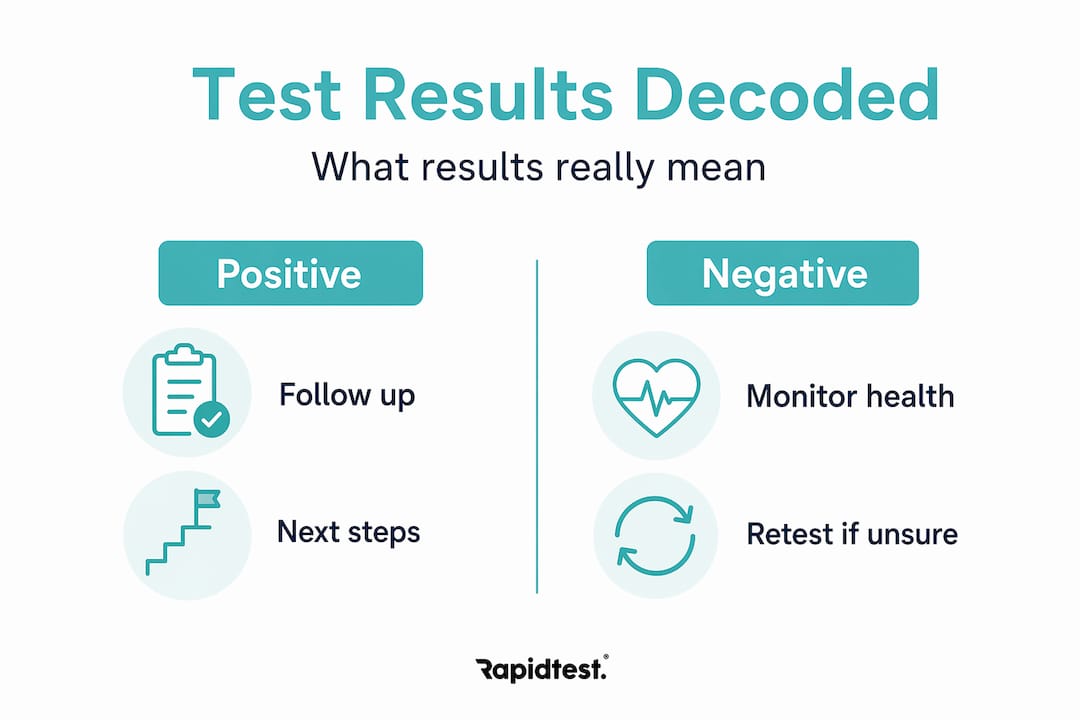
When your symptoms and your result don’t match, trust your symptoms. Conflicting results and symptoms should prompt follow-up testing with a laboratory or healthcare professional. Rapid tests are a first step, not a final word.
My honest take on home testing
I’ve watched home testing go from a niche product to something millions of people rely on, and I think that’s a genuinely good development. But I’ll be honest: the part that concerns me isn’t whether the tests work. It’s whether people trust themselves to read the results.
In my experience, the fear of a wrong result is what stops people from testing at all. And that fear is often rooted in not understanding how these tests actually function. When you know why a faint line still counts, why timing matters, and what a window period actually is, the whole process feels far less threatening.
What I’ve learned is that education doesn’t scare people away from testing. It does the opposite. Once someone understands that a CE-marked, clinically validated test is genuinely reliable when used correctly, their confidence goes up, and so does the quality of their results.
Rapid tests deserve to be seen as valuable tools. They’re not perfect, but neither is any screening method. The key is using them correctly, knowing their limits, and following up when the picture isn’t completely clear. That combination makes home testing genuinely powerful.
— Jack
Test at home with confidence
If you’ve read this far, you already know more about interpreting rapid test results than most people do. The next step is making sure the kit you’re using is worth trusting in the first place. Rapidtest’s range is CE-marked and clinically validated, with clear instructions designed to give you accurate results in 15 minutes at home.
Whether you’re looking for STI testing kits or want to screen for other health conditions, Rapidtest makes proactive health care straightforward and genuinely accessible. No queues, no appointments, no awkward conversations. Just fast, reliable answers when you need them. Explore the full range at rapidtest.co and test with real confidence.
FAQ
Can a faint line on a rapid test be a positive result?
Yes. Any visible positive line should be treated as a positive if you followed the instructions correctly and read the result within the stated time window. Line intensity does not reflect how severe an infection is.
What causes a false negative on a rapid test?
The most common causes are testing during the window period before markers are detectable, poor sample collection technique, or using a test with lower sensitivity. Retesting after the window period has passed often resolves an unexpected negative.
How do I know if my rapid test result is invalid?
An invalid result occurs when the control line does not appear. Without a control line, the test has not functioned correctly, and you should discard it and retest using a new kit.
Can supplements affect my rapid test result?
Yes. High biotin intake can interfere with immunoassays used in many rapid tests, potentially causing false results in hormone and HIV tests. If you take high-dose biotin, stop at least 48 hours before testing where possible.
When should I seek confirmatory testing after a rapid test?
Seek confirmatory testing if your symptoms conflict with your result, if you tested within the window period, or if you have any reason to doubt the test conditions. Discrepancies between symptoms and results are a clear signal to follow up with a laboratory or healthcare professional.