


Under 1%? Gonorrhoea Test False Positives in the UK, When to Retest
Yes, a gonorrhoea test can return a false positive, though it doesn’t happen often. Modern NAAT tests are highly accurate for genital samples, with false-positive rates typically under 1%. Throat swabs carry a noticeably higher risk because of a quirk of anatomy. If your result came back positive and you weren’t expecting it, the first thing to do is ask your clinic or lab for confirmatory testing before assuming anything.
TL;DR:
- False-positive gonorrhoea NAAT results are rare, typically under 1%, but are more common with throat swabs due to cross-reactivity with harmless Neisseria species.
- Confirmatory testing, especially on extragenital samples, is essential before treating or disclosing a positive result to avoid unnecessary treatment and stress.
- The accuracy of results varies by sample site and test platform, with genital samples being most reliable and throat tests requiring extra caution.
- Recent antibiotic use can cause false negatives, while a positive result from a single genetic target assay without confirmation increases the risk of false positives.
- Home testing is useful for initial screening but always requires follow-up clinic testing to confirm gonorrhoea infection, particularly after reactive results from extragenital sites.
Table of Contents
- Gonorrhoea test false positive rates: what the accuracy figures actually mean
- What causes a false positive gonorrhoea test result?
- Why the same result can mean different things depending on prevalence
- Which sample sites carry the highest false-positive risk?
- What to do if you get an unexpected positive gonorrhoea result
- How labs confirm a gonorrhoea positive
- RapidTest’s guidance on retesting windows and home kits
- Does recent antibiotic use or vaccination affect your result?
- The emotional weight of an unexpected positive result
- How clinicians should talk to patients about false positives
- Do all gonorrhoea test platforms have the same false-positive rate?
- A calm, evidence-led way to think about your result
- Where RapidTest fits into your testing pathway
- Sources
- FAQ
Gonorrhoea test false positive rates: what the accuracy figures actually mean
Two numbers decide how much you can trust a test result: sensitivity and specificity. Sensitivity is how well a test catches a true infection when it’s actually there. Specificity is how well it correctly says “no infection” when there genuinely isn’t one. A gonorrhoea test false positive happens when specificity fails, flagging someone as infected who isn’t.
Nucleic acid amplification tests, known as NAATs, are the standard method used across the UK and most developed healthcare systems. For urogenital samples (urine, vaginal or urethral swabs), NAAT specificity usually sits at 99% or higher, with false-positive rates for gonorrhoea consistently reported below 1% in clinical studies. That’s a strong track record. It’s one of the reasons NAATs replaced older culture based methods as the frontline test.
But that figure isn’t fixed across every context. It shifts depending on:
- Which assay the lab uses (different manufacturers target different genetic sequences)
- Which body site the sample came from (genital, rectal, or throat)
- How the sample was collected, stored and transported before testing
- Whether the lab runs a single-target test or a dual-target confirmation process
For a standard genital NAAT, you can treat a positive result as reliable in the vast majority of cases. Extragenital samples, particularly throat swabs, deserve more scepticism, and that’s where the rest of this explainer is going to focus your attention.
What causes a false positive gonorrhoea test result?
Most gonorrhoea test errors trace back to one of four mechanisms. Understanding which applies to your situation helps you judge how worried to be.
- Cross-reactivity with commensal Neisseria species. The throat naturally hosts several harmless Neisseria bacteria that share genetic sequences with Neisseria gonorrhoeae. A NAAT designed to detect gonorrhoea’s genetic markers can occasionally pick up these look-alike sequences instead. This is the single biggest reason pharyngeal (throat) tests carry more false-positive risk than genital ones.
- Laboratory or sample handling errors. Contamination during processing, mislabelled specimens, or clerical mix-ups happen in any lab system, however rare. These aren’t specific to gonorrhoea testing, but they’re a real and underappreciated contributor to unexpected results.
- Single-target assay limitations. Some testing platforms rely on just one genetic target to confirm gonorrhoea. If that target happens to appear in a related, non-pathogenic bacterium, the test has no second checkpoint to catch the error.
- Commensal strains acquiring diagnostic markers. This is rarer and more unusual: researchers have documented cases where a harmless Neisseria strain picked up the specific genetic marker a NAAT looks for, producing a persistent false positive on certain commercial platforms such as some Roche cobas assays. It sounds alarming, but it’s an edge case, not a common occurrence.
Pro Tip: If your positive result came from a throat swab, don’t panic and don’t assume it’s wrong either. Ask your provider directly: “was this confirmed with a second, different genetic target?” That single question tells you a lot about how much weight to put on the result.
Why the same result can mean different things depending on prevalence
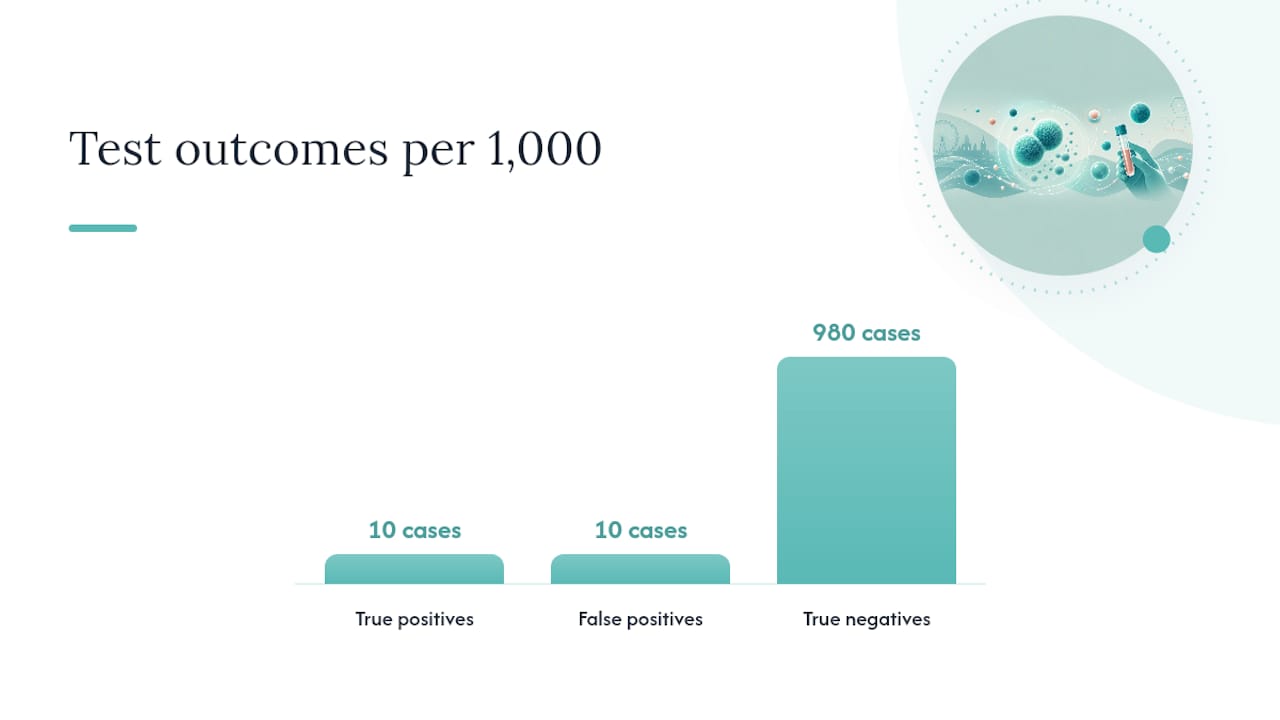
A positive test doesn’t mean the same thing for everyone. It depends heavily on how common gonorrhoea already is in the group you belong to, a concept called positive predictive value, or PPV. PPV answers the real question: given a positive result, what’s the actual probability you’re infected?
Here’s the maths, and it’s worth sitting with because it surprises most people. Imagine a population where 1% of people actually have gonorrhoea, and the test used has 99% specificity. Test 1,000 people from that group. Roughly 10 will truly be infected, and the test picks up most of them. But of the 990 uninfected people, 1% (specificity failing) means around 10 false positives too. Suddenly you’ve got roughly 10 true positives sitting alongside 10 false ones. Your test just told you “positive”, but the actual odds it’s real are closer to a coin flip.
- Low-prevalence setting + high specificity test = surprisingly weak PPV
- High-prevalence setting (e.g. symptomatic patients, known exposure) = much stronger PPV
- UK guidance states that below 1% prevalence, most initial positives are likely to be false, which is why supplementary testing is recommended in these settings
A key figure to remember: UK clinical guidance aims for a validated PPV of 90% or higher before a result is treated as confirmed, achieved largely through supplementary testing using an alternative NAAT target. That’s the whole point of confirmation testing: it corrects for exactly the scenario above.
Which sample sites carry the highest false-positive risk?
Not all swabs are equal when it comes to reliability. Where the sample came from changes how much you should trust the result.
- Pharyngeal (throat) samples carry the highest false-positive risk, because commensal Neisseria species live there naturally and can trigger cross-reactive results.
- Rectal samples generally show lower false-positive risk than throat swabs, though reliability still depends heavily on which assay the lab uses.
- Genital samples (urine, urethral, vaginal swabs) are where most NAATs were originally validated, and they carry the strongest accuracy track record of the three.
- Extragenital claims (throat and rectal) vary considerably by assay manufacturer, so a positive from one platform isn’t automatically comparable to a positive from another.
If your positive result came from a throat swab, it’s entirely reasonable to ask explicitly whether supplementary testing was carried out before you accept the diagnosis.
What to do if you get an unexpected positive gonorrhoea result
An unexpected positive is unsettling, but the right response is measured, not panicked. Follow this sequence.
- Contact the testing provider or clinic straight away and ask directly whether your positive was confirmed using a supplementary NAAT targeting a different gene sequence, or whether it was a single, unconfirmed result.
- Request confirmatory testing, either on the original specimen or a freshly collected one, particularly if your positive came from a throat or rectal swab rather than a genital sample.
- Mind your timing. NHS guidance notes it can take up to two weeks after exposure for gonorrhoea to be reliably detected, so a test taken too early can also produce a false negative gonorrhoea test result, which complicates the picture if you’re retesting after a recent exposure.
- Hold off on partner notification or starting antibiotics until the result is confirmed. Jumping straight to treatment or telling a partner based on an unconfirmed positive can cause real emotional fallout and unnecessary antibiotic use, without actually confirming anything.
Pro Tip: Keep a note of the exact test type, the sample site, and the date you were tested. When you call the clinic to ask about confirmation, having these details ready speeds up the conversation considerably and helps the clinician choose the right follow-up test.
How labs confirm a gonorrhoea positive
Good labs don’t stop at a single reactive result, particularly for extragenital specimens. Confirmation typically follows one of these routes:
- Supplementary NAATs that target a completely different gene sequence from the initial test, used to rule out the cross-reactivity issues covered earlier.
- Dual-target assays, which check for two separate gonococcal genetic sequences within a single test, cutting the odds that a commensal look-alike triggers a false result.
- Culture testing, used more selectively, especially where antimicrobial susceptibility needs checking. Culture remains less sensitive than NAATs for oropharyngeal specimens, so it’s a supporting tool rather than a first-line one.
- A properly run lab report should tell you whether your result is “reactive”, “confirmed”, or “inconclusive”, and whether supplementary testing was actually carried out.
If your lab report doesn’t specify this, it’s worth asking. You’re entitled to know exactly what level of confidence sits behind your result.
RapidTest’s guidance on retesting windows and home kits
We recommend waiting around 14 days after a potential exposure before testing, in line with NHS guidance, to give the infection time to become reliably detectable. An at-home rapid test gives you a private, fast first screen, which is genuinely useful for peace of mind. But a reactive result, especially from a throat sample, still needs clinic confirmation using supplementary NAATs. If you test at home and get a reactive result, bring the test type and exact timing with you to the clinic. That information helps the clinician pick the right confirmatory approach rather than starting from scratch.
Does recent antibiotic use or vaccination affect your result?
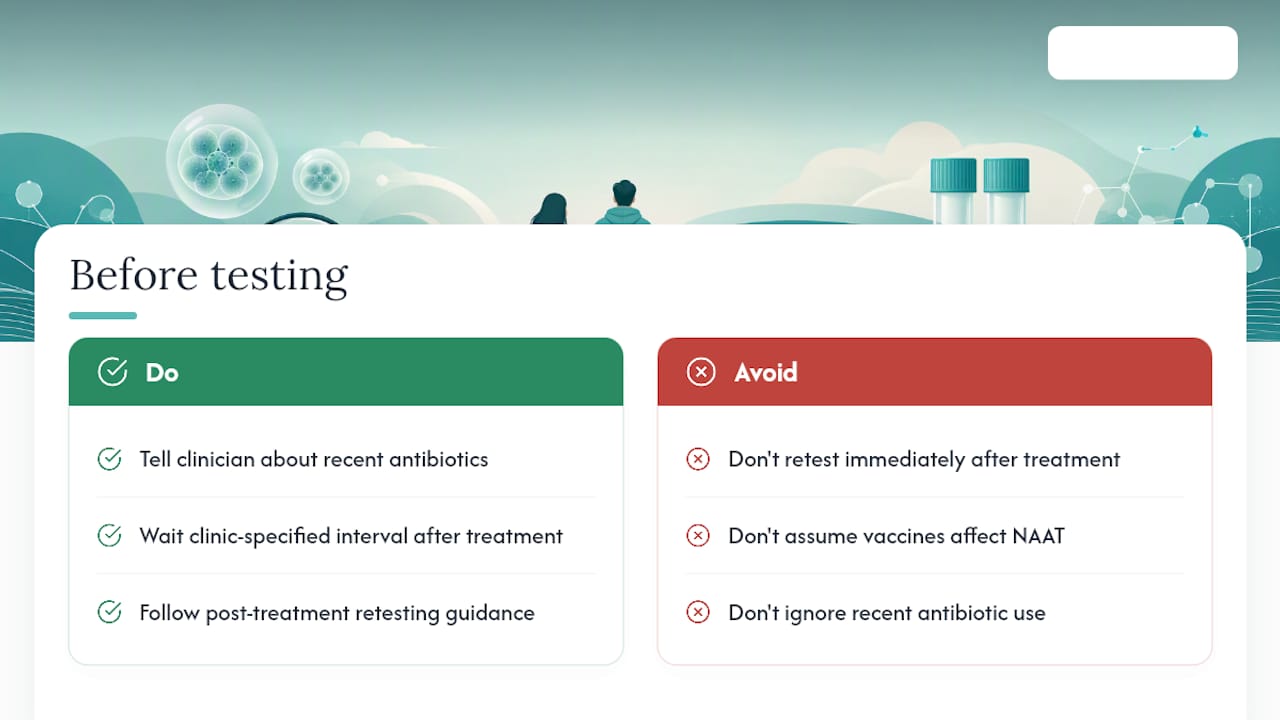
Recent antibiotic use is one of the more overlooked gonorrhoea testing mistakes people make when interpreting their own results. If you’ve taken antibiotics recently, whether for gonorrhoea itself, an unrelated infection, or as a precaution, this can suppress bacterial DNA levels enough to produce a false negative on a subsequent NAAT, even if the infection hasn’t fully cleared. This is a different problem from a false positive, but it matters just as much for interpreting your result correctly.
If you were treated for gonorrhoea and are retesting to confirm the infection has cleared, timing again becomes critical. Testing too soon after treatment can produce a misleading result in either direction, which is why clinic guidance around post-treatment retesting tends to specify a waiting period rather than an immediate recheck.
As for vaccination, there’s currently no gonorrhoea vaccine in routine UK clinical use that would interfere with NAAT results the way, say, a flu vaccine might interact with certain unrelated screening panels. If you’ve had a meningococcal vaccine, worth noting given some cross-protection research against gonorrhoea has circulated in scientific discussion, this doesn’t introduce genetic material that a gonorrhoea NAAT would detect. The practical takeaway is simpler than it sounds: tell your clinician about any recent antibiotics before you test, because that’s the variable that actually changes how your result should be read.
The emotional weight of an unexpected positive result
A false positive gonorrhoea test isn’t just a clinical inconvenience. It can trigger genuine distress, and that’s worth naming rather than glossing over. Finding out you’ve tested positive for an STI, particularly when it feels completely unexpected, can bring up anxiety, shame, or fear about what it means for a relationship.
There’s often a specific and painful question that follows: “why did I test positive and my partner didn’t?” It’s a fair question, and it doesn’t automatically mean infidelity or a testing error. Gonorrhoea doesn’t transmit with 100% efficiency every time, detection windows differ between partners depending on when each of you was exposed, and sample sites or test timing can differ too. A false positive on one partner’s test, or genuinely different exposure timing, are both plausible explanations that don’t point to anything sinister.
The social ripple effects can be just as heavy as the clinical ones. People sometimes rush into difficult conversations with partners, or feel pressure to disclose before they’ve actually confirmed anything. That’s understandable, but it’s also exactly why confirmatory testing matters so much before any of those conversations happen. A confirmed result gives you solid ground to stand on. An unconfirmed one just adds uncertainty to an already stressful moment.
How clinicians should talk to patients about false positives
Good counselling around an unexpected positive starts with one simple move: explaining that a single reactive NAAT result, particularly from a throat or rectal sample, is not automatically the final answer. Patients deserve to hear this plainly and early, rather than being left to interpret a lab printout alone.
Clear counselling should cover three things. First, whether the result was confirmed with a supplementary test or represents a single, unconfirmed reactive finding. Second, what sample site the test came from, since that materially changes how confident anyone should be in the result. Third, what the actual next steps are, whether that’s a repeat test, a different assay, or straightforward confirmation that treatment is genuinely needed.
Clinicians who skip this explanation risk leaving patients either falsely reassured or unnecessarily alarmed. Framing the conversation around “this needs confirmation” rather than “you have gonorrhoea” changes how a patient processes the news, and it’s a more accurate reflection of what an unconfirmed positive actually represents. Anyone reading a lab report on their own, without that conversation, should feel entitled to ask their provider the same questions a good clinician would raise unprompted: was this confirmed, from what site, and what happens next.
Do all gonorrhoea test platforms have the same false-positive rate?
No, and this is one of the more common gonorrhoea testing mistakes people overlook. Different NAAT platforms use different genetic targets, and some high-throughput commercial platforms have documented cross-reactivity issues with commensal Neisseria species on pharyngeal specimens specifically, while performing well on genital samples.
Laboratory algorithms vary by assay vendor too. Some platforms use a single genetic target for their pharyngeal testing claims, which offers less of a safety net than a dual-target design. This is precisely why local validation and supplementary testing agreements between labs and commissioners matter so much in UK testing guidance. It isn’t a fixed, one-size-fits-all number.
If you’re comparing results from two different testing episodes, perhaps a home kit followed by a clinic test, don’t assume they were measuring accuracy identically. Ask which assay was used each time, especially if the sample site was extragenital. It’s a small question that carries real diagnostic weight.
A calm, evidence-led way to think about your result
Getting an unexpected positive gonorrhoea result is genuinely stressful, and no amount of statistics fully removes that. But the evidence gives you something concrete to hold onto: confirmatory testing exists precisely because clinicians know single results, especially from throat swabs, need a second look. Use a provider that actually follows supplementary-testing protocols, ask direct questions about your sample site and confirmation status, and treat NHS and peer-reviewed guidance as your anchor rather than guesswork or forum speculation.
— Jack
Where RapidTest fits into your testing pathway
RapidTest gives you a private, discreet way to screen at home, with results in around 15 minutes and none of the waiting-room awkwardness that puts people off testing altogether. It’s not a replacement for clinical confirmation. It’s a genuinely useful first step, particularly for people who want quick reassurance before deciding whether a clinic visit is even necessary.
If your home test comes back reactive, that’s your cue to book a clinic appointment for confirmatory NAAT testing, not a diagnosis to act on alone. Bring your test type and the date you tested, since that context genuinely speeds up how quickly a clinician can confirm or rule out the result. Browse the At-Home STI/STD Rapid Test Kits range to start with a private screen today, and treat any unexpected result as the start of a conversation with a healthcare provider, not the end of one.
This article is general information, not a substitute for advice from a qualified doctor. Consult a qualified healthcare professional about your own circumstances before acting on anything here.
Sources
- Guidance for the detection of gonorrhoea in England: updated guidance 2021
- Performance characteristics of nucleic acid amplification tests for N. gonorrhoeae
- Neisseria gonorrhoeae false-positive result obtained from a pharyngeal swab by using the Roche cobas 4800 CT/NG assay
- Gonorrhoea - NHS
FAQ
Why did I test positive for gonorrhoea when my partner didn’t?
Detection windows and exposure timing often differ between partners, so one person can test positive before the other’s infection becomes detectable. A false positive on your result, or a false negative gonorrhoea test on theirs, is also possible, which is exactly why confirmatory testing matters before drawing conclusions.
Can a chlamydia test also give a false positive?
Yes, chlamydia NAATs can produce false positives through similar mechanisms to gonorrhoea tests, including assay-specific cross-reactivity and sample handling errors, and the same confirmatory testing principle applies. Read more in the chlamydia false positive explainer for the specifics of that test type.
How reliable is a gonorrhoea test overall?
For genital samples, modern NAATs are highly reliable, with specificity typically at 99% or above and false-positive rates under 1%. Reliability drops somewhat for throat swabs, where confirmatory testing is recommended before accepting a positive result.
Should I retest after a false negative gonorrhoea test?
If you tested within 14 days of a potential exposure, retesting after that window closes gives a more reliable result, since gonorrhoea may not yet be detectable in the early days after exposure. Follow your clinic’s specific retest timing if you’ve recently completed treatment.
Can RapidTest home kits confirm a positive result on their own?
No single test, home or clinical, should be treated as fully confirmed without follow-up, particularly for throat or rectal samples. A RapidTest at-home kit works well as a private first screen, but a reactive result should always be followed up with clinic-based confirmatory testing.