


Tested Early for Gonorrhea? How to Get a Reliable Result After 14 Days
Wait 14 days after potential exposure before you trust a gonorrhoea test result. NAATs, the standard nucleic acid amplification tests used across sexual health services, can sometimes pick up bacterial DNA sooner, but testing before day 14 raises your odds of a false negative. If you’ve already tested earlier than that, plan on repeating it once the full window has passed.
TL;DR:
- Testing too early, before 14 days post-exposure, risks false negatives because bacterial load may be insufficient for reliable detection.
- NAATs can sometimes detect gonorrhoea DNA within 1 to 5 days, but clinical guidance still recommends waiting full 14 days for trustworthiness.
- Symptoms often do not appear until several days after exposure, and many infections cause no symptoms at all, making exposure history essential for testing timing.
- Retesting after the initial negative test at day 14 is necessary if tested earlier, to confirm infection or rule it out definitively.
- At-home rapid tests are useful for quick screening around day 14 but should be followed by clinic-based testing if results are positive or symptoms develop.
Table of Contents
- Understanding the gonorrhoea window period and why timing matters
- How soon can gonorrhoea be detected? Evidence versus guidance
- Symptoms timeline: why you can’t wait to feel unwell
- Tested too early? Here’s what to do next
- Getting your sample right: what to know before you test
- After a positive result: treatment and retesting rules
- Where at-home rapid testing fits into the 14-day rule
- A note on getting the timing right
- Your next step: testing that fits your timeline
- Sources
- FAQ
Understanding the gonorrhoea window period and why timing matters
The window period is the stretch between catching an infection and the point where a test can reliably find it. For gonorrhoea, that gap exists because Neisseria gonorrhoeae needs time to multiply after exposure. Too few bacteria on board, and even a good test can miss them.
NAATs have become the clinical standard because they hunt for the bacteria’s genetic material rather than waiting for an antibody response or trying to grow a culture. That makes them far more sensitive than older methods, but sensitivity still depends on how much bacterial DNA is actually present in your sample. Early on, there simply isn’t much to detect.
This is where “earliest possible detection” and “recommended wait for accuracy” pull apart. A test might technically register a positive within days. Clinical guidance from the NHS still sets 14 days as the benchmark, because a technically-possible early positive doesn’t guarantee a reliable negative.
How soon can gonorrhoea be detected? Evidence versus guidance
Laboratory data shows modern NAATs can occasionally detect gonorrhoea DNA within 1 to 5 days of infection. That figure surprises a lot of people who assume testing has one fixed start date. It doesn’t. Detection speed depends on bacterial load, the site of infection, and the specific assay a lab uses.
Bacterial DNA can appear on a test within days, yet clinicians still recommend waiting up to 14 days for a result you can actually rely on.
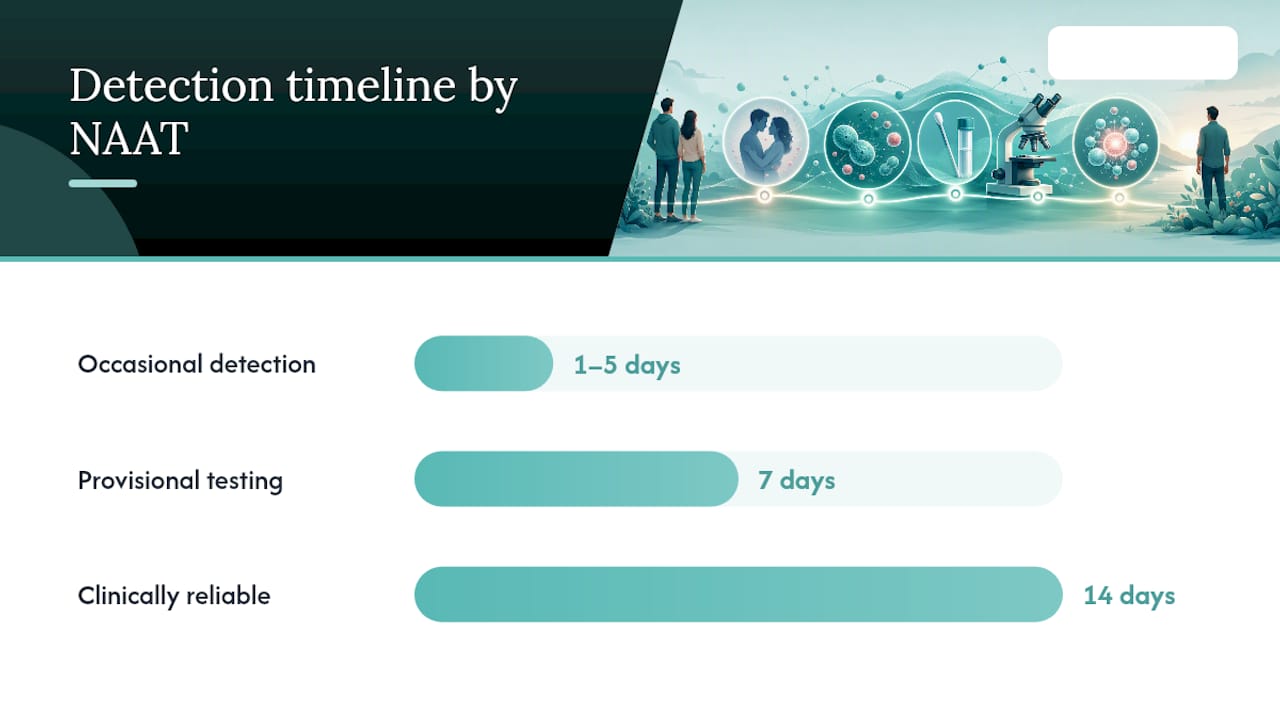
That gap between “can detect” and “should test” comes down to a trade-off between sensitivity and specificity. Test too early, and even a highly specific NAAT can return a false negative simply because bacterial load hasn’t reached a detectable threshold yet.
In practice, this plays out in a few common scenarios:
- Someone tests three days after a condom slips, gets a negative result, and assumes they’re clear.
- A clinic offers testing at seven days for a symptomatic contact, flags it as provisional, and books a follow-up.
- A person waits the full 14 days after a higher-risk encounter and treats that single result as conclusive.
Only the last scenario reflects genuine clinical confidence. The first two need a repeat test once the window has properly closed.
Symptoms timeline: why you can’t wait to feel unwell
When symptoms do appear, it’s typically within 1 to 14 days of exposure. But the site of infection changes what you’ll notice, if you notice anything at all:
- Urethral infection: burning when you urinate, unusual discharge.
- Cervical infection: increased discharge, bleeding between periods, or no symptoms whatsoever.
- Pharyngeal infection (from oral sex): often nothing at all, occasionally a mild sore throat.
- Rectal infection: discomfort, discharge, or again, frequently no symptoms.
Here’s the part that catches people out: a large share of infections, particularly in people assigned female at birth and in pharyngeal or rectal cases, cause no symptoms at all. Feeling fine tells you almost nothing about your infection status. Exposure history, not how you feel, should decide whether and when you test.
Tested too early? Here’s what to do next
Testing before day 14 doesn’t mean you’ve wasted your time, but it does mean you’re not finished. A negative result taken during the window period doesn’t rule gonorrhoea out. Bacterial load may simply be too low to register yet, and clinicians consistently recommend retesting once the full window has passed.
If you’ve tested early, here’s a sensible sequence to follow:
- Treat an early negative as provisional, not final.
- Avoid sexual contact, or use condoms consistently, until you’ve retested past day 14.
- Tell recent partners if you were exposed to a known case, so they can consider their own testing timeline.
- Book a clinic appointment promptly if any symptoms appear in the meantime, rather than waiting for your retest date.
Some clinics offer empirical treatment to contacts of a confirmed case even before a test result comes back, particularly when follow-up can’t be guaranteed. Contacts who aren’t treated this way should return for repeat testing after the window period closes, without exception.
Pro Tip: If you test early out of anxiety rather than necessity, put a reminder in your calendar for day 14. That single habit prevents more missed follow-up tests than anything else.
Getting your sample right: what to know before you test
Sample type depends entirely on where exposure happened. First-catch urine works for urethral or cervical checks. Genital swabs cover vaginal or urethral sampling directly. Oral sex means a throat swab; anal sex means a rectal swab. Testing only the site that matches your risk, and skipping the others, is how infections get missed.
A few practical steps improve accuracy on the day:
- Avoid urinating for at least two hours before collecting a first-catch urine sample, since this concentrates urethral bacterial DNA and meaningfully improves test sensitivity.
- Follow swab instructions precisely; rushing the collection reduces the sample quality.
- Write down every exposure site beforehand so nothing gets left untested, especially if you’ve had oral or anal contact as well as genital.
At-home rapid tests and clinic-based NAATs both have their place. Rapid tests offer speed and privacy from your own bathroom. Clinic NAATs generally offer marginally higher sensitivity and the option for a clinician to interpret an ambiguous result on the spot. Our gonorrhoea test guide breaks down the accuracy differences in more detail if you want to compare methods before deciding.
Pro Tip: If you’ve had oral or anal sex as well as genital contact, ask specifically for throat and rectal swabs. A urine test alone won’t catch an extragenital infection.
After a positive result: treatment and retesting rules
A positive result means antibiotic treatment, usually as a single dose, and no sexual contact until you and your partner have both completed treatment. Skipping this step is how reinfection cycles start within couples.
Follow-up depends on where the infection was found:
- Uncomplicated genital infections typically don’t need a routine test-of-cure if treated with the recommended regimen.
- Pharyngeal infections need closer follow-up, since treatment failure shows up more often at this site.
- A routine retest around three months after treatment catches reinfection, which is common if a partner wasn’t treated at the same time.
- Screening for chlamydia and other STIs alongside gonorrhoea makes sense given how often they occur together, a point echoed in gonorrhoea clinical guidance.
There’s a public-health angle too. Retesting after treatment feeds into antimicrobial-resistance monitoring, tracking how well current antibiotics are still working. Anyone curious about how resistance testing functions more broadly might find this explainer on antibiotic sensitivity useful background reading.
Where at-home rapid testing fits into the 14-day rule
An at-home gonorrhoea rapid test gives you a result in around 15 minutes, which makes it genuinely useful for quick screening once you’ve reached day 14 after exposure. It’s not a substitute for a laboratory NAAT when clinical certainty is essential, such as before a partner’s fertility treatment or when a clinician needs to confirm treatment failure. Use it as a first step, then follow up with clinic-based testing if your result is positive, if you’re symptomatic, or if you tested before the window closed.
A note on getting the timing right
Testing too soon out of anxiety, or too late out of avoidance, are both understandable. Neither serves you well. What actually helps is knowing the 14-day figure exists for a real biological reason, not as bureaucratic caution, and building your testing plan around it rather than around how you feel on any given day.
Confidentiality shouldn’t be a barrier to getting this right, and it isn’t one. Whether you use a clinic or an at-home kit, the honest advice stays the same: test at the right time, then retest if you tested early.
— Jack
Your next step: testing that fits your timeline
Waiting 14 days is the clinically sound approach, but you shouldn’t have to book time off work or sit in a waiting room to act on it. Rapidtest’s at-home gonorrhoea rapid test gives you a result in 15 minutes, from home, with none of the awkward conversations a clinic visit sometimes involves.
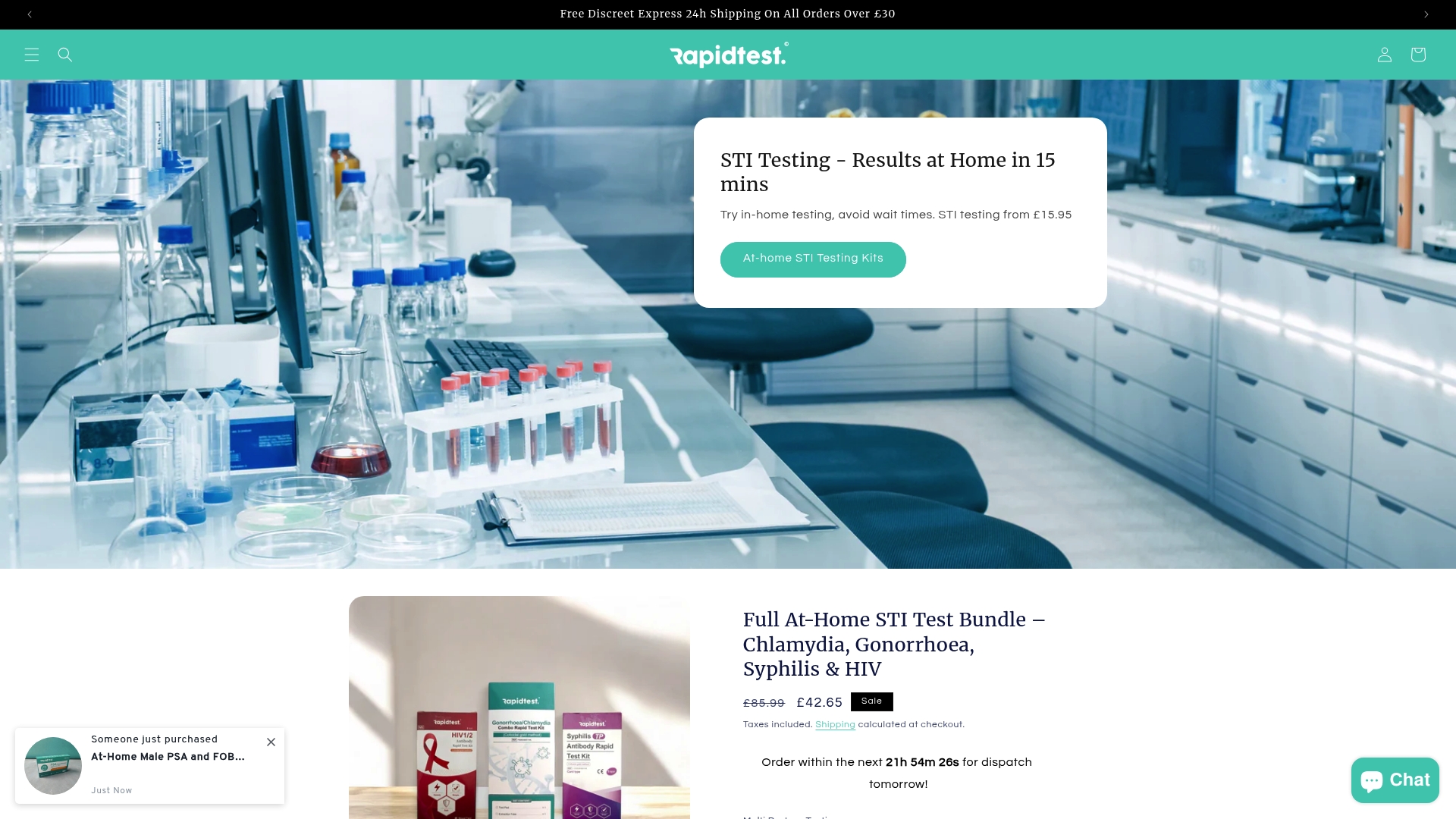
Be clear-eyed about what a rapid test can and can’t do: it’s a strong screening tool, not a replacement for laboratory NAAT testing when you need absolute clinical certainty, and a positive result should always be followed up with your GP or a sexual health clinic for treatment. If your exposure involved multiple sites, or you want broader coverage in one go, our at-home STI testing kits test for several infections at once, including chlamydia alongside gonorrhoea. Order one today, wait out your 14 days, and test on your own schedule.
Sources
FAQ
How soon will gonorrhoea show up on a test?
Modern NAATs can sometimes detect bacterial DNA within 1 to 5 days of exposure, but clinical guidance recommends waiting 14 days for a result you can trust.
What are common warning signs of gonorrhoea?
Signs include burning on urination, unusual discharge, bleeding between periods, sore throat, and rectal discomfort, though many infections cause no symptoms at all, especially in people assigned female at birth.
Is two weeks too early for an STI test?
No. Fourteen days is the recommended window for a reliable gonorrhoea result; testing earlier than that is what actually increases your risk of a false negative.
Can you have gonorrhoea for a long time without knowing?
Yes. A large proportion of gonorrhoea infections, particularly cervical, pharyngeal, and rectal cases, produce no noticeable symptoms, which is why testing based on exposure history matters more than waiting for symptoms to appear.