


3 Month Retest for Gonorrhea: When Clinic Care Beats Home Kits
If you’ve just finished antibiotics for gonorrhoea, here’s the short answer: you don’t usually need an immediate test-of-cure, but you do need a retest around three months later to check for reinfection. Immediate retesting matters far more in specific cases: pharyngeal infection, symptoms that haven’t cleared, pregnancy, or treatment that wasn’t the standard first-line antibiotic.
TL;DR:
- A gonorrhea test-of-cure is usually unnecessary after standard treatment unless treating pharyngeal infection, symptoms persist, or antimicrobial resistance is suspected.
- Testing too soon can produce false positives due to residual bacterial DNA, so wait at least 7 to 14 days for throat infections and several weeks for other sites.
- A routine retest at three months is essential to detect reinfection, which is much more common than antibiotic failure, especially if partners weren’t treated.
- At-home testing kits are reliable for three-month reinfection screening but are unsuitable for early detection, symptomatic cases, or suspected treatment failure.
- Always inform providers about antibiotics taken and exact timing to ensure proper interpretation of test results and follow-up.
Table of Contents
- Do you need a gonorrhea test after antibiotics for everyone?
- When is the right time to test after antibiotics?
- Which gonorrhea test after antibiotics is right, and where do you sample from?
- How do recent antibiotics affect your results?
- What happens if your gonorrhea test after antibiotics comes back positive?
- Where does at-home testing fit after treatment?
- What I’d want you to remember from all this
- Get your 3-month check sorted without the waiting room
- Sources
- FAQ
Do you need a gonorrhea test after antibiotics for everyone?
Not automatically. For most people with uncomplicated urogenital or rectal gonorrhoea who took the recommended antibiotic, a routine test-of-cure isn’t necessary. The treatment works well in the vast majority of straightforward cases, and testing too soon can actually produce misleading results.
That said, “routine” is the key word. Certain situations always warrant closer follow-up, and knowing which bucket you fall into saves you a lot of unnecessary worry.
You should arrange a test-of-cure (TOC) rather than wait three months if:
- You had a pharyngeal (throat) infection — these respond less predictably to treatment than genital or rectal infections.
- Symptoms are still present a few days after finishing your course.
- You’re pregnant.
- You were given a non-standard or alternative antibiotic rather than the first-line recommended treatment.
- Your clinician suspects antimicrobial resistance based on your case history or local resistance patterns.
Everyone else falls into the reinfection-screening pathway. This exists because gonorrhoea comes back through new exposure far more often than the antibiotics simply fail. Standard clinical guidance recommends a retest after a period of time sufficient to detect reinfection specifically because reinfection is the more likely culprit if a partner wasn’t treated or a new partner was exposed in the meantime.
When is the right time to test after antibiotics?
Timing isn’t arbitrary here. Test too early and the result can lie to you, either way. Gonococcal DNA can linger in tissue for a while after the bacteria are dead, and a nucleic acid amplification test (NAAT) doesn’t know the difference between a living infection and a bacterial corpse.
- Pharyngeal test-of-cure: 7 to 14 days. CDC guidance specifically recommends this window for anyone treated for a throat infection. Testing at exactly 7 days raises the odds of a false positive, so where possible, culture confirmation should back up a NAAT result that soon.
- Routine NAAT test-of-cure (when needed for other reasons): typically a few weeks to avoid false positives due to residual genetic material. Some clinics advise waiting this long after finishing treatment to let any residual, non-viable genetic material clear before testing.
- Reinfection screen: a few months after treatment. This is the default for everyone else, regardless of symptoms, and it stays fixed even if you feel completely fine.
A calendar reminder set the day you finish your antibiotics is genuinely one of the most useful things you can do. It’s easy to feel “sorted” once symptoms fade, and reinfection screening quietly falls off the radar. If you notice new symptoms, discharge, pain, or a partner tells you they’ve tested positive at any point before that three-month mark, don’t wait for the calendar. Book a review straight away.
Which gonorrhea test after antibiotics is right, and where do you sample from?
Two test types dominate follow-up testing, and they’re not interchangeable.
NAAT (nucleic acid amplification testing) is the workhorse. It’s highly sensitive and can pick up trace genetic material from the bacteria, which is exactly why timing matters so much. NAATs are excellent at detecting infection but can flag non-viable nucleic acid soon after treatment, producing a positive result even when the infection is genuinely gone.
Culture grows the actual bacteria in a lab. It’s slower and slightly less sensitive overall, but it does something NAAT can’t: it allows antimicrobial susceptibility testing, which tells clinicians which antibiotics will actually work if resistance is suspected.
Sample site depends on exposure, not guesswork:
- Urine or urethral swab for anyone with penetrative vaginal or anal sex involving the penis.
- Cervical/vaginal swab for people with a cervix.
- Rectal swab if there’s been receptive anal sex.
- Pharyngeal (throat) swab if there’s been oral sex, regardless of whether throat symptoms are present.
Because gonorrhoea and chlamydia often travel together, many follow-up visits test for both at once. Clinic-based testing becomes necessary rather than optional when culture and susceptibility testing are called for, since at-home kits aren’t built for growing bacteria in a lab.
How do recent antibiotics affect your results?
Antibiotics do their job by knocking bacterial load down, but that same process can hide an infection from a test if you check too soon. A NAAT run days after finishing treatment might come back negative simply because there isn’t enough genetic material left to detect yet, even in a case where the infection genuinely hasn’t cleared. This is precisely why the 2 to 4 week deferment window for routine NAAT retesting exists.
Preparation matters more than people expect:
- Tell your provider exactly what you took and when — the antibiotic name, dose, and finish date all affect how your result should be interpreted.
- Avoid douching or using vaginal products in the days before a swab, as these can wash away the cells the test needs.
- Hold off on sex until at least 7 days after completing treatment, and ideally until any partners have also been treated, to avoid muddying the picture with a genuine new exposure.
Pro Tip: Write the date you took your last dose somewhere you’ll actually see it, your phone notes app, a calendar entry, whatever sticks. When a clinician asks “when did you finish treatment?”, a vague answer like “a couple of weeks ago” makes your result far harder to interpret correctly.
What happens if your gonorrhea test after antibiotics comes back positive?
A positive result at this stage doesn’t automatically mean the antibiotics failed. Clinicians usually work through this in order:
- Review sexual history and timing. Because reinfection is more common than true treatment failure, a new or untreated partner is the first thing investigated, not the antibiotic itself.
- Order culture and susceptibility testing if failure is genuinely suspected, particularly when symptoms persisted beyond 3 to 5 days post-treatment with no plausible reinfection. This identifies whether a resistant strain is involved and which antibiotic will actually clear it.
- Retreat and notify partners. Depending on the cause, that might mean the same antibiotic again (reinfection) or a different regimen entirely (confirmed resistance), alongside partner notification so the cycle doesn’t repeat.
Persistent symptoms without a positive retest are also worth flagging. Sometimes another organism entirely is behind ongoing symptoms, which is another reason not to self-diagnose treatment failure from symptoms alone.
Where does at-home testing fit after treatment?
At-home rapid tests are genuinely useful for one specific job: routine reinfection screening once you’re past the window where residual nucleic acid could skew your result. If you’re asymptomatic, past the 3-month mark, and just want to confirm you’re clear, a discreet test at home ticks every box without needing an appointment.
Where at-home testing falls short is anywhere clinical nuance is required. Testing too soon after finishing antibiotics, checking a pharyngeal infection, or investigating suspected treatment failure all call for a clinic visit, because those situations may need culture and susceptibility testing that a rapid kit simply isn’t designed to provide. MedlinePlus is clear that persistent symptoms should prompt culture testing, not another round of home screening.
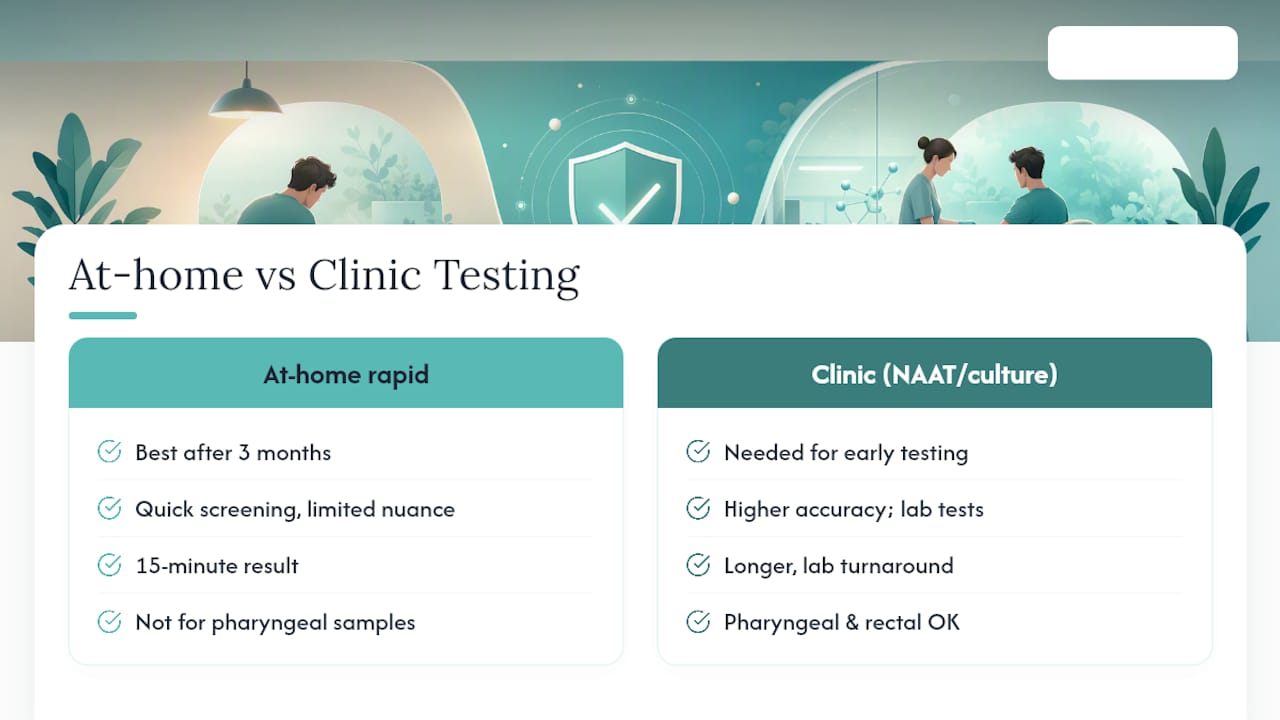
Rapidtest’s at-home gonorrhoea testing options are built for that 3-month reinfection check: a discreet kit, a result in around 15 minutes, no waiting room. If that result comes back positive, the next step is the same regardless of how you tested, book a clinical review for confirmation and, if needed, susceptibility testing.
What I’d want you to remember from all this
Three things matter more than anything else here. Get your timing right, tell whoever’s testing you exactly what antibiotics you took and when, and put a genuine reminder in your calendar for that 3-month reinfection screen, not just a vague mental note.
If anything feels off before then, persistent discharge, pain, symptoms that haven’t budged, don’t sit on it waiting for the three-month mark. Book a review sooner.
Reinfection is common, and that’s actually the reassuring part once you understand it. It’s rarely a sign the treatment failed you. It’s usually a sign the screening system is doing exactly what it’s meant to do: catching a new exposure before it causes real problems. Between sensible timing, honest disclosure to whoever’s testing you, and a follow-up you don’t forget about, this is one of the more manageable corners of sexual health to stay on top of.
— Jack
Get your 3-month check sorted without the waiting room
Rapidtest is the option for exactly the follow-up moment this article has been building towards: the routine 3-month reinfection screen, done privately at home, with a result in around 15 minutes instead of a clinic booking you have to find time for.
If you’re asymptomatic and simply working through the timeline your clinician gave you, the at-home STI testing kits cover gonorrhoea alongside the other infections worth checking at the same visit, since co-infections are common enough that testing for one alone rarely tells the full story. If you’d rather screen more broadly at the same time, the full STI testing bundle covers chlamydia, syphilis, and HIV in the same kit.
Where symptoms are ongoing, you’re inside the early testing window, or a throat infection is involved, book a clinic appointment instead; that’s genuinely the right call for those cases. For the straightforward 3-month check, order your kit, test on your own schedule, and book a clinical follow-up only if it comes back positive.
Sources
This article draws on NHS, CDC, and IUSTI European guidance on retesting intervals, sample types, and when test-of-cure applies.
This article is general information, not a substitute for advice from a qualified doctor. Consult a qualified healthcare professional about your own circumstances before acting on anything here.
- Gonorrhoea — Southwest Devon formulary guidance
- 2020 European guideline for the diagnosis and treatment of gonorrhoea in adults
- Gonococcal infections among adolescents and adults — CDC
- Gonorrhea test — MedlinePlus
FAQ
How long after antibiotics can you test for gonorrhoea?
For routine reinfection screening, wait around three months. If a test-of-cure is needed for pharyngeal infection, wait 7 to 14 days; for other TOC situations, many clinics recommend 2 to 4 weeks to avoid a false positive from residual genetic material.
Is it okay to get an STD test while you’re taking antibiotics?
Testing during treatment isn’t recommended, as the antibiotic may already be reducing bacterial load and skew the result. Wait until you’ve finished the course and reached the appropriate window for the test you need.
How quickly does gonorrhoea go away after antibiotics?
Recommended first-line antibiotics clear most uncomplicated infections effectively, and symptoms typically improve within a few days. Persistent symptoms beyond that point should prompt a clinical review rather than assuming it will resolve on its own.
Will I still test positive for chlamydia after antibiotics?
If you were treated correctly for chlamydia, you shouldn’t test positive again unless reinfected or tested too soon, when residual genetic material can still trigger a NAAT result. The same 3-month reinfection screening logic applies, and it’s often tested alongside gonorrhoea since co-infection is common.