


When to get a gonorrhoea retest after treatment
Book a retest for gonorrhoea about three months after treatment finishes, whether or not you have symptoms, because this catches reinfection rather than confirming the antibiotics worked. A “test of cure” (TOC) is different and only needed if you had a throat infection, symptoms haven’t cleared, or you were treated outside the standard antibiotic regimen. Abstain from sex for seven days after finishing treatment, and make sure any partner from the last 60 days gets tested too.
TL;DR:
- The routine three-month gonorrhoea test screens for reinfection, not treatment failure, and should be booked at treatment to ensure follow-up.
- A test of cure is only necessary if the infection was in the throat, symptoms persist, or a non-standard antibiotic regimen was used.
- NAAT tests may remain positive for weeks after treatment due to residual bacterial DNA, especially in the throat, requiring careful timing.
- Culture tests, which detect live bacteria, are preferred if symptoms persist or resistance testing is needed, typically done three days after treatment.
- Most positive retests reflect new infections from untreated or newly exposed partners, not failure of the original antibiotics.
Table of Contents
- Gonorrhoea test after therapy: the two retest timelines explained
- Why timing changes the result: NAAT, culture and residual DNA
- Reinfection or treatment failure: how clinicians tell them apart
- Practical steps after gonorrhoea treatment, before your retest
- What a positive retest usually means, and what happens next
- What to tell the clinic when booking your retest
- Why this guidance holds up
- Making follow-up testing a normal part of your routine
- How RapidTest fits into your follow-up plan
- Sources
- FAQ
Gonorrhoea test after therapy: the two retest timelines explained
There are two entirely different reasons you might be asked to come back for another test, and mixing them up is where most confusion starts.
The first is the routine three-month reinfection screen. This isn’t about whether your treatment worked. It exists because gonorrhoea often has no symptoms at all, so you could pick it up again from an untreated partner or a new one and not know it. The British Association of Sexual Health and HIV (BASHH) recommends this window specifically to detect reinfection, and clinics are encouraged to book it in at the point of treatment rather than leaving it to the patient to remember months later. The CDC backs the same three-month standard, which gives this recommendation genuine international weight.
The second is the test of cure, and this is not routine for most people. If you had an uncomplicated genital or rectal infection and took the recommended antibiotic course, BASHH does not advise a TOC at all. It becomes necessary in three specific situations:
- You had a pharyngeal (throat) infection, which responds less predictably to treatment than genital or rectal sites.
- Symptoms are still present after finishing the antibiotics.
- You were treated with a non-standard regimen, perhaps due to an allergy or a resistance concern.
Timing matters enormously here, and getting it wrong produces confusing results. For a pharyngeal TOC, BASHH specifies a NAAT (nucleic acid amplification test) should be done no sooner than two weeks after treatment. If you’re symptomatic and a culture is being used instead, the wait is shorter, at least 72 hours post-treatment. Test any earlier and you risk a result that reflects leftover genetic material rather than a live, active infection.
Pro Tip: If your clinic offers to book your three-month retest before you even leave the appointment, take them up on it. It’s the single easiest way to make sure follow-up testing actually happens instead of quietly slipping down your to-do list.
It helps to think of these as two separate jobs. The three-month test is a screen, done to catch something new. The TOC is a check, done to confirm something specific has actually cleared. Most people treated for standard genital gonorrhoea will only ever need the first one.
Why timing changes the result: NAAT, culture and residual DNA
The test used and the day you take it can change what the result actually tells you, and this is where a lot of avoidable anxiety comes from.
NAAT is the workhorse test for gonorrhoea because it’s highly sensitive, picking up tiny amounts of bacterial genetic material. That sensitivity is also its weak point when it comes to early retesting. After successful treatment, dead bacteria can leave behind residual nucleic acid that a NAAT swab may still detect, even though the infection itself is gone.
The core issue: NAAT can return a positive result from genetic fragments left behind by bacteria the antibiotics already killed, which is exactly why BASHH sets a minimum two-week wait before a pharyngeal NAAT test of cure.
That single fact explains most of the “why do I have to wait” frustration people feel after treatment. Test too early, and you risk a false alarm that sends you back into a cycle of retreatment and stress for an infection that’s already gone.
Clearance timelines aren’t uniform across the body, either. Anogenital infections tend to clear detectable genetic material faster than pharyngeal ones, which is part of the reason the throat gets its own, longer TOC window rather than being treated the same as a genital site. If you’re being tested at more than one site, don’t assume the timing rule for one applies to the other.
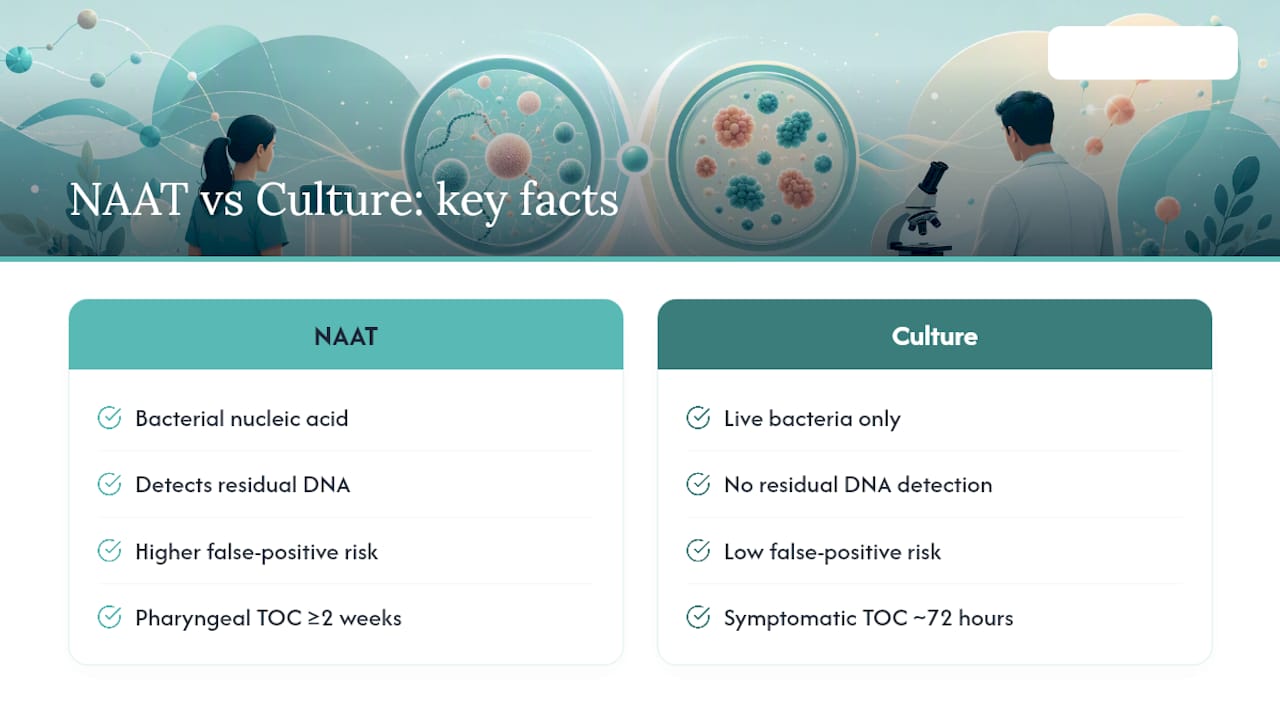
Culture, meanwhile, only detects live bacteria, so it doesn’t carry the same false-positive risk from residual DNA. That’s exactly why BASHH recommends culture, not NAAT, for symptomatic patients needing a quicker turnaround at 72 hours rather than two weeks. Culture also does something NAAT cannot: it allows antimicrobial susceptibility testing, which tells a clinician whether the strain is resistant to the antibiotic used. If treatment failure is genuinely suspected, culture stops being a nice-to-have and becomes essential. RapidTest’s overview of gonorrhoea test types and accuracy covers how NAAT and culture compare in more depth if you want the fuller picture.
Reinfection or treatment failure: how clinicians tell them apart
A positive retest almost never means the original treatment failed. It’s overwhelmingly more likely to mean you picked up a new infection, usually from a partner who wasn’t treated at the same time, or a new partner who was carrying it without symptoms. Genuine treatment failure with recommended ceftriaxone-based regimens is uncommon, which is part of why routine TOC isn’t required for standard genital infections in the first place.
When a clinician does suspect true failure, rather than reinfection, they typically work through a specific sequence:
- Take a culture sample to confirm live bacteria are actually present, not just residual genetic fragments.
- Run antimicrobial susceptibility testing on that culture to see whether the strain resists the antibiotic you were given.
- Report the case to national public health bodies where resistance is confirmed, since drug-resistant gonorrhoea is a surveillance priority.
Partner treatment does most of the heavy lifting in preventing that early recurrence. If your partner isn’t treated at the same time as you, having sex with them again, even once, before the seven-day abstinence window closes, can reintroduce the infection almost immediately. This is why abstinence and partner treatment aren’t optional extras tacked onto the advice. They’re the actual mechanism that stops a straightforward course of antibiotics turning into what looks like a treatment failure.
Pro Tip: If a partner tests positive after you’ve already been treated and abstained properly, that’s a strong sign of reinfection, not a failed course of antibiotics. Mention the timeline clearly to your clinician so they don’t default to assuming resistance.
Practical steps after gonorrhoea treatment, before your retest
Getting the sequence right between finishing your antibiotics and sitting down for a retest isn’t complicated, but it does need a bit of planning.
- Abstain from sex for at least seven days after completing your antibiotic course, and don’t resume until any partner has also finished treatment.
- Notify partners from the past 60 days. BASHH’s lookback window means anyone you’ve had sex with in that period should be tested and treated, even if they have no symptoms.
- Book your three-month retest at the same appointment where you’re treated, if your clinic offers this. It removes the risk of the date quietly disappearing from your calendar.
- Only book an earlier test of cure if you had a pharyngeal infection, still have symptoms, or were given a non-standard antibiotic regimen. Otherwise, wait for the three-month window.
- If you miss the exact three-month mark, retest at your next health visit, ideally within 12 months rather than letting it drift indefinitely.
None of these steps are about distrust in the treatment. They’re about closing the small gaps where reinfection actually happens; an untreated partner, an early return to sex, or a screening date that never gets rebooked. RapidTest’s guide to why gonorrhoea often has no symptoms is worth a look if you’re wondering why scheduled retesting matters even when you feel completely fine.
What a positive retest usually means, and what happens next
A positive result on your three-month screen is disappointing, but it’s rarely a sign anything went wrong with your original treatment. Statistically, reinfection is by far the more common explanation, particularly if a partner wasn’t treated alongside you or you had a new partner in the interim.
Your clinician’s response depends on the pattern:
- If it looks like straightforward reinfection, the response is usually a repeat course of antibiotics plus a fresh round of partner notification, exactly as before.
- If treatment failure is genuinely suspected, expect a confirmatory culture and susceptibility test before any retreatment decision, rather than an automatic repeat prescription.
- If resistance is confirmed, your case may be reported to public health bodies, since tracking resistant strains is a national surveillance priority, not just a local clinical decision.
A positive TOC result specifically (rather than the routine three-month screen) is taken more seriously by clinics, because TOC is only ever done where there’s already a reason for concern, a throat infection, lingering symptoms, or unusual treatment. If your TOC comes back positive, expect a fuller work-up rather than a simple repeat prescription.
Seek urgent care rather than waiting for a scheduled appointment if you develop new pelvic pain, fever, or joint pain and swelling after treatment, as these can signal the infection has spread beyond the original site.
What to tell the clinic when booking your retest
Clinics move faster and choose the right test when you arrive with the right information rather than a vague “I need a follow-up test.”
Have these details ready:
- Where the original infection was (genital, rectal, or pharyngeal), since this determines whether you need routine reinfection screening or a specific TOC.
- The date you finished treatment and which antibiotic you took, so the clinic can check you’re past the minimum wait time for an accurate result.
- Whether symptoms have fully resolved, which affects whether NAAT or culture is the right tool.
- Whether your partner(s) have been tested and treated, since untreated partners change how a positive result should be interpreted.
On the NAAT versus culture question: NAAT is appropriate for the routine three-month reinfection screen and for most TOC situations after the two-week wait. Culture becomes the better choice when you’re still symptomatic and need a faster turnaround, or when resistance is a genuine concern.
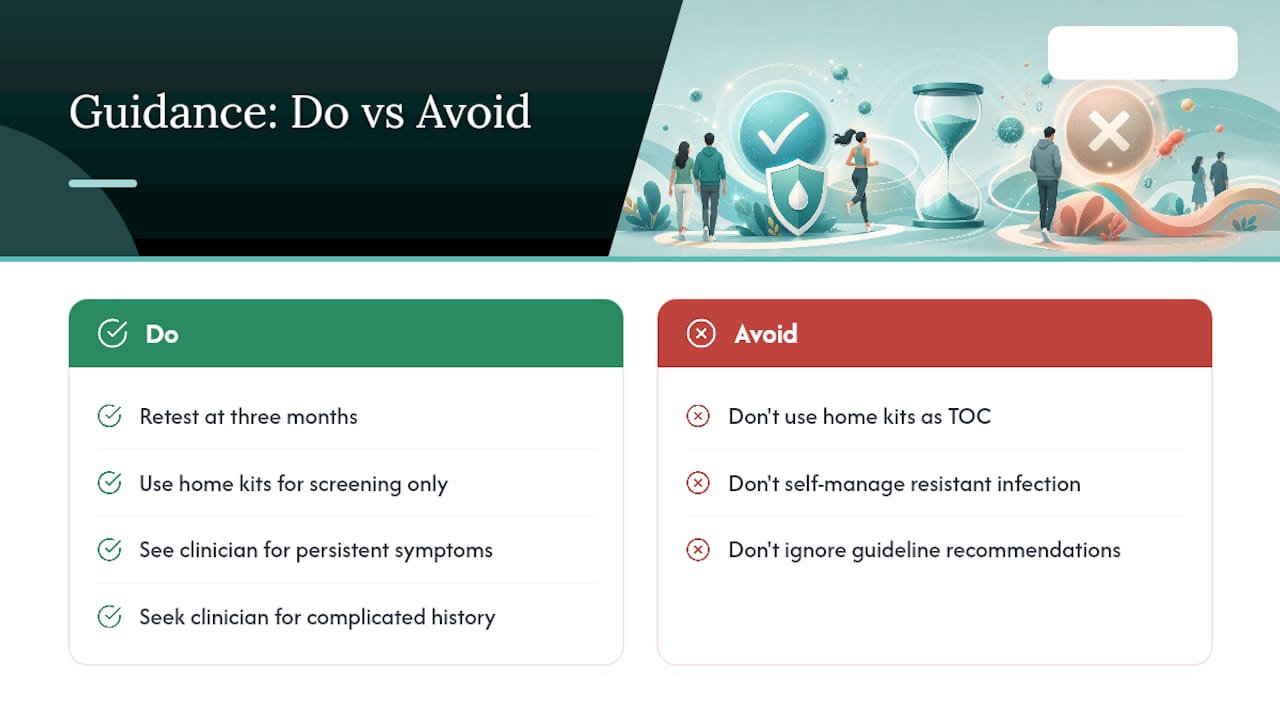
Pro Tip: An at-home rapid test, like RapidTest’s gonorrhoea rapid test, can be a useful prompt if you’re worried between appointments, but it isn’t a substitute for a clinical test of cure. Treat a positive at-home result as a reason to book a proper NAAT or culture, not as a diagnosis in itself.
At-home testing works well as interim reassurance, particularly around the three-month reinfection window, but the precise timing rules around NAAT and residual nucleic acid mean a formal TOC should always go through a clinic or lab setting.
Why this guidance holds up
The retest timings here come straight from the BASHH 2025 national guideline for Neisseria gonorrhoeae, cross-checked against NHS patient guidance and the CDC’s treatment guidelines. All three converge on the same three-month reinfection screen and the same narrow set of circumstances for a test of cure, which is a rare and useful level of agreement across national bodies.
This piece was written by Jack for RapidTest, drawing on that published guidance rather than personal clinical practice. At-home testing has real limits: it’s a screening tool, not a replacement for a clinical TOC, and anyone with persistent symptoms, a complicated treatment history, or a suspected resistant strain should speak to a clinician directly rather than relying on a home kit alone.
Making follow-up testing a normal part of your routine
Booking your three-month retest the same day you’re treated removes almost all the friction. It’s already awkward enough having the conversation once; you shouldn’t have to relive it because you forgot to rebook.
Telling a partner is simpler than it feels. Something like “I need to let you know I’ve tested positive for gonorrhoea, so you should get tested too,” said plainly and without drama, does the job. RapidTest’s guide on talking to a partner about STI testing has more phrasing if you want it. Retesting isn’t a sign anything went wrong. It’s just what taking your sexual health seriously actually looks like.
— Jack
How RapidTest fits into your follow-up plan
RapidTest is the option for checking in between clinic visits without waiting weeks for an appointment. Where a clinical NAAT or culture takes time to book and process, RapidTest’s at-home gonorrhoea rapid test gives you a result in around 15 minutes, from a discreetly packaged kit, with no queue and no awkward conversation at reception.
Be clear on what it’s for, though. An at-home result is a screening tool, useful if you’re anxious between your treatment date and your three-month reinfection screen, or if new symptoms appear and you want a quick prompt before booking a clinic visit. It cannot serve as a formal test of cure, and it doesn’t replace the NAAT or culture your clinician needs for a confirmed pharyngeal TOC or a suspected treatment failure. If your at-home result is positive, or symptoms persist, follow it up with a clinical test rather than treating it as the final word. For broader interim screening across multiple STIs, RapidTest’s at-home STI rapid test kits cover the same 15-minute, no-queue approach.
Sources
The recommendations in this article draw directly from the BASHH 2025 UK national guideline for Neisseria gonorrhoeae (DOI: 10.1177/09564624251345195), NHS patient guidance on gonorrhoea, and the CDC’s gonococcal infection treatment guidelines. Reading the primary guideline is worthwhile if you want the full clinical detail behind the retest windows summarised here.
This article is general information, not a substitute for advice from a qualified doctor. Consult a qualified healthcare professional about your own circumstances before acting on anything here.
FAQ
How often does gonorrhoea recur after treatment?
Recurrence usually reflects reinfection rather than the original treatment failing, most often from an untreated partner or a new one, which is exactly why the routine three-month retest exists.
How long will a gonorrhoea test stay positive after treatment?
NAAT can detect residual genetic material for some time after successful treatment, which is why BASHH advises waiting at least two weeks for a pharyngeal NAAT test of cure and at least 72 hours for culture in symptomatic cases.
How do you know gonorrhoea is gone after treatment?
For most uncomplicated genital or rectal infections treated with the recommended antibiotics, a routine test of cure isn’t needed at all. Confirmation comes from symptoms resolving and a clear three-month reinfection screen, unless you had a pharyngeal infection or ongoing symptoms.
Can you ever fully get rid of gonorrhoea?
Yes. Gonorrhoea responds well to recommended antibiotic regimens, and true treatment failure is uncommon. Most repeat positives come from a new exposure rather than the infection persisting.