


Three in Four Men: What Raises PSA Levels and How to Retest at Home
A raised PSA reading rarely means cancer. Age, an enlarged prostate, prostatitis, a urinary infection, recent ejaculation, vigorous exercise, certain procedures and even some medications can all push your number up. Cancer Research UK notes that a large proportion of men with an elevated PSA level don’t have prostate cancer at all, which is why the NHS, Prostate Cancer UK and clinicians never diagnose from one blood draw. They repeat the test, examine you, and look at the trend before deciding anything.
TL;DR:
- Most causes of elevated PSA are temporary, such as recent ejaculation, vigorous exercise, or urinary infections, and typically resolve within days.
- Prostate enlargement from aging or benign conditions like BPH can cause persistent PSA increases that are harmless and common in older men.
- Recent prostate procedures or catheter use can significantly raise PSA levels for weeks, requiring a waiting period before retesting.
- Medications like testosterone therapy and corticosteroids can artificially raise PSA, while 5-alpha reductase inhibitors often lower it, affecting interpretation.
Table of Contents
- What raises PSA levels: a quick checklist
- The causes behind a raised PSA, one by one
- How doctors read a raised PSA result
- Getting ready for a PSA test the right way
- Why one number shouldn’t define your week
- Screening from home with the Rapidtest PSA kit
- Where to read more
- Sources
- FAQ
What raises PSA levels: a quick checklist
Before you spiral into worry over one number, run through this list. Most of these causes are temporary, and knowing which applies to you can save you weeks of needless anxiety.
Transient causes (usually settle within days):
- Ejaculation or sexual activity in the 48 hours before your blood draw
- Vigorous exercise, especially cycling, which puts direct pressure on the prostate
- A urinary tract infection that hasn’t fully cleared
Longer-lasting or persistent causes (weeks to permanent):
- Age-related prostate growth, also known as BPH
- Prostatitis, which can take longer to settle than a simple UTI
- Recent prostate biopsy, cystoscopy or catheter use
- Certain medications, including testosterone therapy and corticosteroids like betamethasone
If you’ve had a biopsy or catheter recently, mention it to whoever’s requesting the test. Doctors will usually want to wait several weeks before drawing blood again, according to NHS guidance. And if you’re on a 5-alpha reductase inhibitor for BPH, flag that too. It works the other way, quietly lowering your PSA and masking what’s really going on underneath.
The causes behind a raised PSA, one by one
Age and an enlarging prostate
Your prostate grows slowly as you get older, and PSA tends to climb right alongside it. This is so well established that Prostate Cancer UK recommends screening from age 50 for most men, or from 45 if you’re at higher risk (a Black man or someone with a family history of prostate cancer). Benign prostatic hyperplasia, or BPH, is simply the medical name for this natural enlargement. It’s not cancer, and it’s arguably the single most common reason an older man’s PSA sits above the textbook “normal” range without anything sinister going on.
Prostatitis and urinary infections
Inflammation is the theme here. Prostatitis is inflammation of the prostate itself, often from a bacterial infection, and it can send PSA sharply upward because inflamed tissue leaks more of the protein into your bloodstream. A UTI does something similar by irritating the urinary tract and surrounding prostate tissue.
Both usually come with symptoms you’d notice: a burning sensation when you urinate, pelvic discomfort, feeling like you need to go more often, or in prostatitis’s case sometimes fever and general malaise. The good news is that once the infection clears, PSA typically drops back down over several weeks. If your GP suspects infection is behind a raised reading, they’ll often try a course of antibiotics and retest afterwards, rather than jumping straight to imaging.
Recent ejaculation and sexual activity
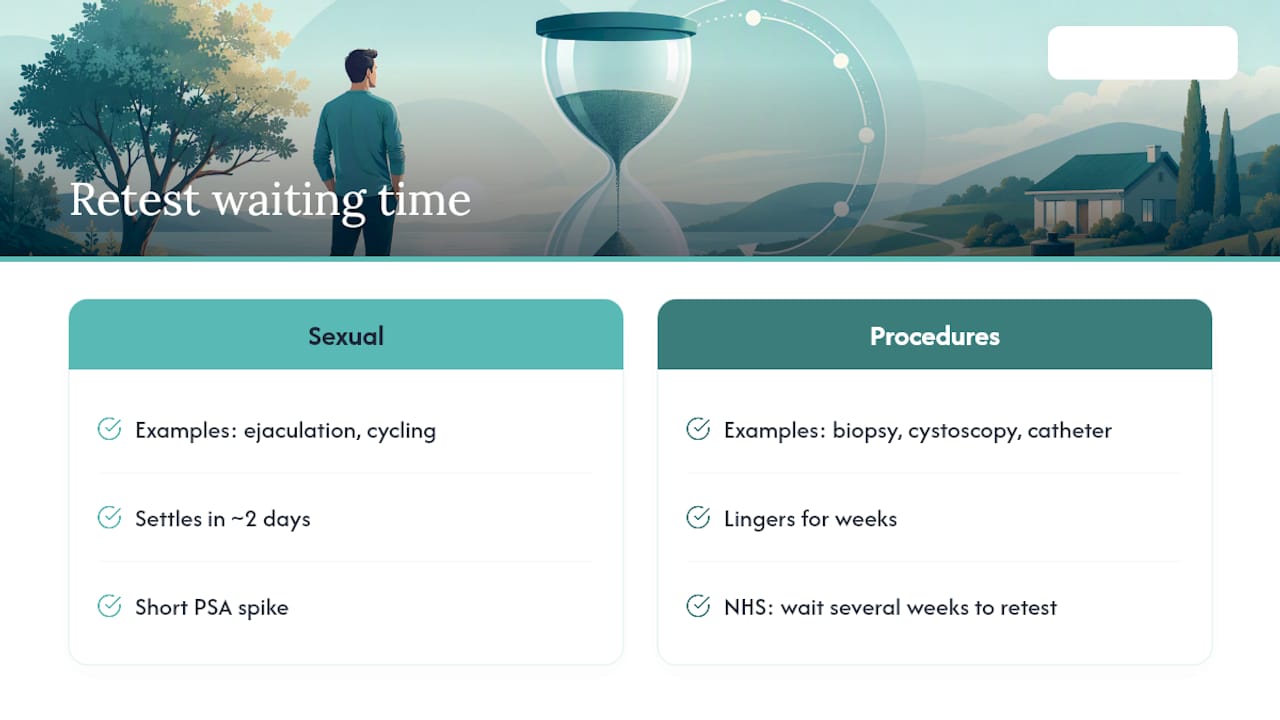
This one catches a lot of men out because it feels almost too mundane to matter, yet it genuinely does. Ejaculation causes a brief mechanical disturbance to the prostate, releasing extra PSA into circulation. Prostate Cancer UK and the National Cancer Institute both advise abstaining from sexual activity for at least two days before a test. The effect is genuinely transient. Give it two clear days and your PSA should settle back to your baseline.
Vigorous exercise, particularly cycling
Cycling gets singled out specifically because the saddle sits directly against the perineum, putting sustained pressure on the prostate for the whole ride. That pressure, combined with the general effect of raised heart rate and blood flow during any strenuous exertion, can nudge PSA upward for a few days afterwards. The same NCI guidance that covers ejaculation extends to vigorous exercise generally: give it two days’ rest before testing if you can.

Recent procedures and catheter use
Anything that physically disturbs the prostate, a biopsy, a cystoscopy, or having a catheter fitted, causes a much bigger and longer-lasting PSA spike than ejaculation or cycling ever will. Where sexual activity settles in two days, procedural effects can linger for weeks. This is why the NHS recommends waiting several weeks after a biopsy or cystoscopy before retesting. Test too soon and you’re measuring inflammation from the procedure itself, not your actual baseline.
Medications and hormones
This is where interpretation gets genuinely tricky, and where a chat with your GP matters more than any online checklist.
- Testosterone replacement therapy can raise PSA, since testosterone drives prostate tissue activity.
- Corticosteroids such as betamethasone have also been shown to push PSA upward.
- 5-alpha reductase inhibitors (finasteride and dutasteride, commonly prescribed for BPH or hair loss) do the opposite, typically cutting measured PSA by around half over several months. Clinicians often adjust a patient’s PSA reading to account for the lowering effect of these drugs before assessing risk.
- Obesity can also lower measured PSA, likely through dilution effects in a larger blood volume, which is worth mentioning if your GP is trying to make sense of a lower-than-expected number alongside other risk factors.
Finasteride is FDA-indicated for men only. Women who are or may become pregnant must not handle crushed or broken finasteride tablets, due to the risk of harm to a male fetus. It can also cause sexual side effects (reduced libido, erectile dysfunction) in a minority of men, which usually resolve after stopping treatment. Discuss these risks with a physician before starting.
Pro Tip: Always tell whoever orders your PSA test about any regular medication, especially finasteride or dutasteride. A GP who doesn’t know you’re on one could misread a “normal” PSA as reassuring when it’s actually been artificially suppressed.
Rarer confounders worth a mention
Recent instrumentation of the bowel or rectum, such as a colonoscopy involving pressure near the prostate, has occasionally been linked to short-lived PSA changes too. It’s not a major driver for most men, but if you’ve had bowel investigations shortly before a PSA test and the result looks odd, it’s a reasonable thing to raise with your doctor rather than assume the worst.
How doctors read a raised PSA result
A single high reading is a prompt to investigate, not a verdict. Clinicians lean heavily on repeat testing and trend analysis, known as PSA velocity, which tracks how fast your number is rising over months or years rather than reacting to one snapshot.
What typically happens next:
- Your GP repeats the PSA test, often after ruling out or treating a suspected infection first
- If infection was likely, a short course of antibiotics comes before the retest, since treating the underlying cause avoids a misleading result
- A digital rectal examination (DRE) checks for physical changes in the prostate
- A free-to-total PSA ratio can help distinguish benign causes from higher-risk patterns
Roughly three in four men with a raised PSA turn out not to have prostate cancer, according to Cancer Research UK. That statistic alone should take some of the heat out of a first alarming result.
Worth asking your GP directly: what was my exact number, how does it compare with any previous readings, could any of my medications or recent activity explain it, and what’s the plan if the repeat test comes back the same?
Getting ready for a PSA test the right way
Getting an accurate reading starts before you even walk into the clinic, or in the case of an at-home kit, before you open the packet.
- Avoid ejaculation and vigorous exercise such as cycling for at least two days beforehand
- Wait several weeks after any prostate biopsy, cystoscopy or catheter if applicable
- Mention any current infection symptoms rather than testing through them
At-home PSA testing, the kind Rapidtest provides, gives you a private result in around 10 to 15 minutes without a GP appointment or a lab queue. That’s genuinely useful as a first check, particularly if you’ve been putting off testing out of embarrassment or a busy schedule. What it can’t do is replace a DRE, a velocity trend, or a biopsy if your number stays stubbornly high. Treat a raised at-home result as your cue to book a GP follow-up, not as a final answer either way.
Pro Tip: If your at-home result comes back raised, wait out any recent transient triggers, retest, and if it’s still up, take both results to your GP rather than testing repeatedly on your own.
Why one number shouldn’t define your week
Men tend to treat a PSA result like a verdict, when really it’s a starting point for a conversation. Having spent time working through the evidence behind this piece, what strikes me most is how ordinary most of the causes actually are. A bike ride, a bout of cystitis, a birthday. None of that is the stuff of nightmares, yet a raised number on a screen can make it feel that way.
The sensible response is almost boring in its simplicity: rule out infection, remove the obvious transient triggers, retest, and talk to your GP about the trend rather than the single figure. That measured approach is exactly what keeps men out of unnecessary biopsies and out of needless worry. If you want to go deeper on what a specific PSA number actually means for prostate cancer risk, that’s worth your time before your next appointment, not instead of it.
— Jack
Screening from home with the Rapidtest PSA kit
If you’ve read this far wondering whether you actually need to book a GP appointment just to get a starting number, you don’t. Rapidtest’s at-home PSA kit gives you a private reading in around 10 minutes, with discreet delivery and no waiting room in sight.
It’s built as a starting point, not a diagnosis. A raised result on the kit means exactly what a raised result at the GP means: rule out the transient causes covered above, then get a clinical follow-up if the number stays high. If you’d rather look at your wider health picture in one go, the men’s health screening bundle covers PSA alongside other key markers. Order your kit today and get a private answer before you even think about booking an appointment.
Where to read more
For deeper detail beyond this guide, the NHS PSA test page covers testing procedure and timing. Prostate Cancer UK explains screening age recommendations and non-cancer causes in more depth. Cancer Research UK sets out how clinicians weigh PSA testing against its false-positive rate, while the National Cancer Institute’s PSA fact sheet and MedlinePlus both offer clear overviews of what an elevated result means and the follow-up steps typically involved.
This article is general information, not a substitute for advice from a qualified doctor. Consult a qualified healthcare professional about your own circumstances before acting on anything here.
Sources
- The PSA blood test - Prostate Cancer UK
- PSA test - NHS
- PSA testing - Cancer Research UK
- PSA fact sheet - National Cancer Institute (NCI)
- MedlinePlus overview of elevated PSA
FAQ
What should I avoid before a PSA test?
Avoid ejaculation and vigorous exercise, particularly cycling, for at least 48 hours before your test, since both can temporarily raise PSA. If you’ve recently had a prostate biopsy, cystoscopy or catheter, ask your doctor how long to wait, as this can be several weeks.
Can PSA be elevated without cancer?
Yes, and it’s common. Cancer Research UK notes that roughly three-quarters of men with a raised PSA don’t have prostate cancer, with BPH, prostatitis and UTIs among the most frequent explanations.
What medications can increase PSA levels?
Testosterone replacement therapy and corticosteroids such as betamethasone can raise measured PSA. By contrast, 5-alpha reductase inhibitors like finasteride typically lower it, which is why clinicians adjust their interpretation for men taking these drugs.
What is an average PSA score for a 70-year-old?
PSA naturally tends to increase with age, and clinicians expect older men to have higher levels than younger men without it necessarily signalling disease. Rather than relying on a single fixed “normal” figure, doctors look at your trend over time and your individual risk factors, which is why a repeat test and a conversation with your GP matter more than comparing your number against an average.