


Should men test PSA yearly? What you need to know
PSA testing, or prostate-specific antigen testing, is defined as a blood test that measures a protein produced by the prostate gland to screen for potential prostate problems, including cancer. The question of whether men should test PSA yearly does not have a single answer. Current clinical guidelines from organisations including the American Urological Association (AUA), Prostate Cancer UK, and the US Preventive Services Task Force (USPSTF) consistently recommend a personalised, risk-based approach rather than routine annual testing for all men. Your age, ethnicity, family history, and baseline PSA level all shape how often you should be tested.
Should men test PSA yearly, or is that too often?
The short answer is: for most men, yearly testing is more than necessary. Prostate cancer progresses slowly in the majority of cases, which means annual testing offers no proven survival advantage over testing every two years for men with no symptoms and average risk. Screening every two to four years is the standard recommendation for men aged 50–69 at average risk.
That said, “average risk” does not describe every man reading this. If you have a father or brother who had prostate cancer, or if you are of Black African or Black Caribbean ancestry, your risk is meaningfully higher. For men in those groups, earlier and more frequent screening is appropriate, sometimes starting from age 40–45. The key point is that PSA test frequency is not one-size-fits-all. It is personal.

What is PSA testing and what does your result actually mean?
PSA is a protein made by both normal and abnormal prostate cells. A PSA test measures how much of it is circulating in your blood. A raised result does not mean you have cancer.
Plenty of non-cancerous conditions can push PSA levels up, including:
- Benign prostatic hyperplasia (BPH): an enlarged prostate, common in men over 50
- Prostatitis: inflammation or infection of the prostate
- Recent physical activity: vigorous cycling or sexual activity in the 48 hours before a test can temporarily raise levels
- A urinary tract infection: can cause a temporary spike
False positives are common, and so are false negatives. Cancer Research UK notes that false negatives occur in roughly 15% of men with prostate cancer. That figure matters because it means a normal PSA result does not completely rule out disease. A raised PSA triggers further evaluation, not immediate treatment. Repeat PSA testing is typically recommended before any biopsy is considered, to confirm the elevation is real and not a temporary blip.
Pro Tip: Avoid vigorous exercise, cycling, and sexual activity for at least 48 hours before a PSA test. These can temporarily raise your levels and lead to unnecessary follow-up.
Understanding your PSA levels and what they mean in context is the first step to making sense of your result.
What do current guidelines say about PSA test frequency?
The table below summarises what major health organisations recommend for men at different risk levels.
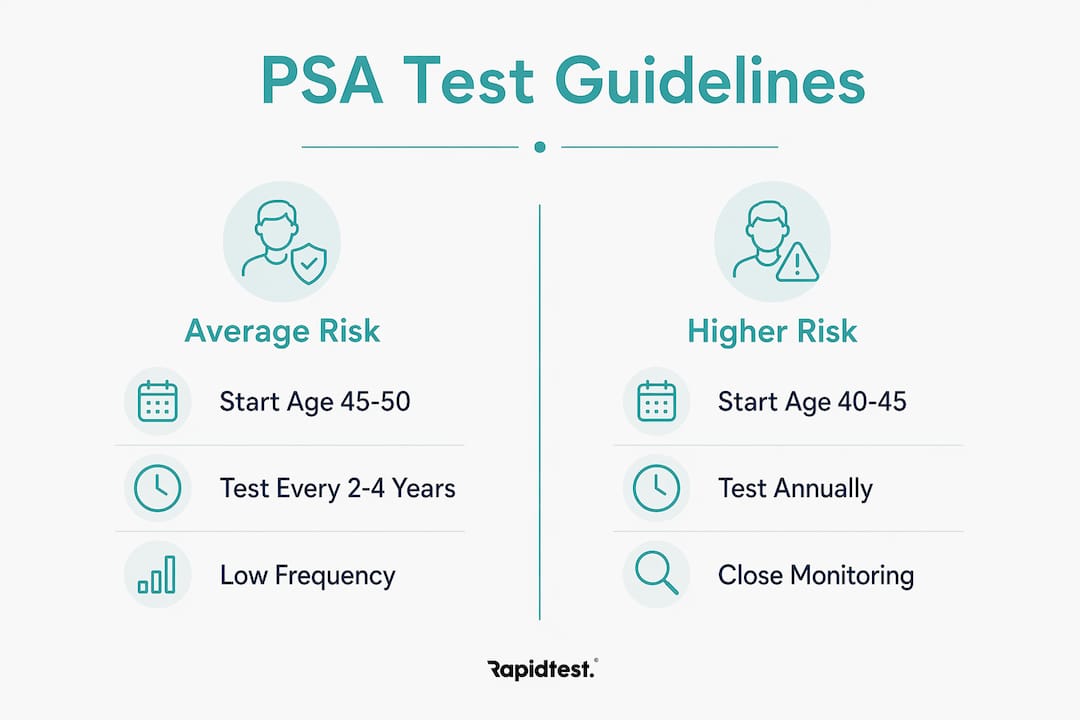
| Risk group | Recommended start age | Suggested interval |
|---|---|---|
| Average risk | 45–50 | Every 2–4 years |
| Increased risk (family history, Black ancestry) | 40–45 | Every 1–2 years |
| Men aged 70 and over | Not routinely recommended | Discuss with clinician |
Baseline PSA testing is advised from ages 45–50 for average-risk men, with earlier testing from 40–45 for those at higher risk. The USPSTF advises against routine PSA screening in men aged 70 and over, on the grounds that the risks of overdiagnosis and treatment side effects outweigh the likely benefits at that age.
The reason annual testing is not the standard recommendation comes down to biology. Prostate cancer typically grows slowly. A two-year interval gives clinicians enough time to detect meaningful changes without exposing men to the anxiety and potential harm of over-testing. PSA test frequency is increasingly individualised according to baseline levels, with low-risk men advised longer intervals and higher-risk men monitored more closely.
Pro Tip: If your baseline PSA at age 45 is very low, your clinician may suggest you do not need another test for four years or more. A low baseline is genuinely reassuring.
What are the benefits and risks of testing more or less often?
PSA testing has real benefits. Early detection of prostate cancer, when it is still confined to the gland, gives you far more treatment options and better outcomes. For men at elevated risk, regular monitoring can be the difference between catching something early and missing it entirely.
The risks of over-testing are just as real, though. They include:
- Overdiagnosis: detecting slow-growing cancers that would never have caused symptoms or shortened your life, but that trigger treatment anyway
- Unnecessary biopsies: an elevated PSA can lead to an invasive biopsy that turns out to be unnecessary, carrying its own risks of infection and discomfort
- Treatment side effects: prostate cancer treatment, including surgery and radiotherapy, can cause urinary incontinence and erectile dysfunction
- Anxiety: living with an uncertain result or waiting for biopsy outcomes takes a genuine toll on mental health
Overdiagnosis of indolent prostate cancers is one of the central controversies in prostate screening. The concern is not that testing is bad. The concern is that testing too often, without a clear clinical reason, can set off a chain of investigations that cause more harm than good. Evidence shows no clear survival benefit for annual testing over a two-year interval in asymptomatic men. That is why the conversation with your doctor matters so much.
How should you decide the right PSA testing frequency for you?
The right PSA test frequency is a decision you make with your doctor, not one you make alone. Here is a practical way to approach that conversation.
- Know your risk factors before the appointment. Write down any family history of prostate or breast cancer (BRCA gene mutations raise prostate cancer risk), your ethnicity, and any urinary symptoms you have noticed.
- Ask about a baseline test. If you are aged 40–50 and have not had a PSA test before, a baseline result gives your clinician a reference point for future comparisons.
- Discuss your result in context. A PSA number on its own means little. Your doctor will consider your age, prostate size, and rate of change over time.
- Ask about additional tools if your result is borderline. MRI, risk calculators, and biomarker tests such as the Prostate Health Index (PHI) are increasingly used to avoid unnecessary biopsies in men with ambiguous PSA results.
- Review your plan regularly. Your risk profile changes as you age. A testing interval that made sense at 50 may need revisiting at 60.
Shared decision-making is the clinical standard here. A raised PSA is not a diagnosis. It is a prompt for further evaluation, and understanding that distinction reduces unnecessary anxiety.
Pro Tip: Bring a list of any medications you take to your PSA consultation. Some drugs, including certain treatments for hair loss and an enlarged prostate, can artificially lower PSA levels and mask a problem.
What practical steps can men over 40 take for prostate health?
PSA testing is one part of a broader picture. Men over 40 can take several practical steps to support prostate health beyond the test itself.
- Diet: a diet rich in vegetables, particularly tomatoes (which contain lycopene), and low in processed red meat is associated with better prostate health outcomes
- Exercise: regular physical activity supports healthy weight, which in turn reduces prostate cancer risk
- Smoking cessation: smoking is linked to more aggressive prostate cancer in men who are diagnosed
- Symptom awareness: changes in urinary flow, increased frequency at night, blood in urine or semen, and pelvic discomfort are all worth reporting to your GP promptly
- Regular check-ups: prostate health sits within the wider context of men’s health screenings, including blood pressure, cholesterol, and bowel health
At-home PSA testing kits offer a practical way to keep an eye on your levels between clinical appointments. They are not a replacement for a GP consultation, but they give you a data point you can bring to that conversation. Home testing kits for men over 40 are particularly useful for men who find it hard to get a GP appointment or who simply want to stay on top of things without waiting for an annual check-up.
Lifestyle and early symptom recognition are not optional extras. They are part of an effective screening strategy.
Key takeaways
Annual PSA testing is not recommended for most men. A personalised, risk-based schedule guided by age, ethnicity, family history, and baseline PSA level delivers better outcomes with fewer harms.
| Point | Details |
|---|---|
| Annual testing is not standard | Evidence shows no survival benefit for yearly PSA testing over a two-year interval in asymptomatic men. |
| Start age depends on your risk | Average-risk men begin at 45–50; higher-risk men, including those of Black ancestry or with a family history, start at 40–45. |
| Raised PSA is not a diagnosis | Elevated levels can result from BPH, prostatitis, or recent activity. Confirmatory testing comes before any biopsy. |
| Shared decision-making is key | Discuss your age, ethnicity, family history, and symptoms with your clinician to set the right testing interval. |
| At-home testing supports monitoring | Home PSA kits give you a baseline or interim result to bring to your next clinical appointment. |
My honest view on PSA testing and the yearly question
I have spent years reading the research on PSA screening, and the thing that strikes me most is how much anxiety the yearly question creates, often unnecessarily. Men come to this topic either convinced they should be testing every twelve months or convinced that PSA testing is too unreliable to bother with at all. Both positions miss the point.
The shift away from routine annual testing is not a step backwards. It is a sign that medicine has got more precise. We now know that a man with a very low baseline PSA at 50 is at genuinely low risk for the next several years. Putting him through annual tests does not protect him. It exposes him to the psychological weight of borderline results and the downstream procedures that can follow.
What I find encouraging is the direction of travel. Tools like MRI and the PHI biomarker test are making it possible to distinguish between cancers that need treating and cancers that can be safely watched. That precision is what reduces harm. The 2026 early detection guidance reflects this shift clearly.
My advice is simple. Get a baseline PSA test if you are 45 or older and have not had one. If you are at higher risk, start at 40. Then have an honest conversation with your doctor about what your result means and how often you actually need to retest. Do not let the fear of a bad result stop you from getting the information you need. And do not let the idea that you should be testing every year make you feel like you are falling behind if you are not.
— Jack
Check your PSA level from home with Rapidtest
Waiting months for a GP appointment to check your PSA level is not the only option. Rapidtest offers an at-home PSA test kit that gives you a clear result in 15 minutes, with no queues, no lab, and no awkward conversations.

The kit is straightforward to use and gives you a result you can take to your next clinical appointment as a useful reference point. For men who want to stay on top of their prostate health between GP visits, it is a practical and private way to keep track. You can also explore Rapidtest’s full range of at-home PSA and FOB test bundles for broader men’s health monitoring. A result at home does not replace your doctor. It gives you something concrete to talk about when you see them.
FAQ
Should men over 40 get a PSA test every year?
Annual PSA testing is not recommended for most men over 40. Clinical guidelines suggest testing every two to four years for average-risk men, with more frequent monitoring for those at higher risk due to family history or ethnicity.
What age should men start PSA testing?
Average-risk men should consider a baseline PSA test between ages 45 and 50. Men at increased risk, including those of Black African or Black Caribbean ancestry or with a close family member who had prostate cancer, are advised to start between 40 and 45.
Can a high PSA result mean something other than cancer?
Yes. Elevated PSA levels are commonly caused by benign prostatic hyperplasia, prostatitis, or recent physical activity. A raised result prompts further evaluation, not an immediate cancer diagnosis.
Is PSA testing recommended for men over 70?
The USPSTF advises against routine PSA screening for men aged 70 and over, as the risks of overdiagnosis and treatment side effects generally outweigh the benefits at that age.
Can I test my PSA level at home?
Yes. At-home PSA test kits, such as those available from Rapidtest, provide results in around 15 minutes. They are a useful monitoring tool between clinical appointments but should be followed up with a GP if results are raised.