


Choosing safe home test kits: A guide for men over 40
More men over 40 are turning to home test kits to check their STI status, fertility, and cancer markers. It’s a shift that makes sense: quick results, no waiting rooms, no awkward conversations. But here’s what most people don’t mention. Not all home tests are created equal, and some give you information that can genuinely mislead you if you don’t understand what you’re looking at. This guide breaks down which home tests are worth trusting, where the real limitations are, and how to use them safely as part of your broader health routine.
Table of Contents
- How do home test kits work?
- Are home fertility tests for men accurate and safe?
- The reality of PSA and cancer marker home tests
- When are home test kits most useful, and when are they not?
- Why safety means more than kit accuracy: Our perspective
- Next steps: Choosing safe home test kits with confidence
- Frequently asked questions
Key Takeaways
| Point | Details |
|---|---|
| Home kits offer privacy | Home test kits provide men over 40 with a convenient and private way to start checking their health. |
| Fertility kits are a first step | At-home sperm tests are useful for initial screening but not a substitute for lab-based diagnosis. |
| Cancer markers need oversight | Rapid PSA and other cancer marker tests should always be confirmed with a medical professional. |
| Follow-up is crucial | Any abnormal or positive result from a home test must lead to a follow-up with your doctor. |
How do home test kits work?
Before you can decide whether to trust a home test, it helps to know what’s actually happening when you use one. There are three main categories of home test kits that men over 40 tend to reach for: STI tests, fertility tests, and cancer marker tests like PSA (prostate-specific antigen) and FOB (fecal occult blood for bowel cancer).
You can learn more about how at-home tests work to get a clearer picture before ordering.
STI kits typically come in two forms. Rapid lateral flow tests give you a result in 15 minutes from a urine sample or swab. Postal self-sampling kits let you collect your own sample at home and send it to a certified lab, where results come back within a few days. Fertility tests work similarly, asking you to produce a semen sample and test it against a strip or cartridge. PSA tests use a finger-prick blood sample that reacts with a test strip.
The home testing benefits for men over 40 are real and well-documented. Privacy is the biggest one. Many men would rather skip the doctor visit entirely, especially for anything involving sexual health or fertility. Speed matters too. Getting a result in 15 minutes at home beats waiting weeks for a GP appointment.
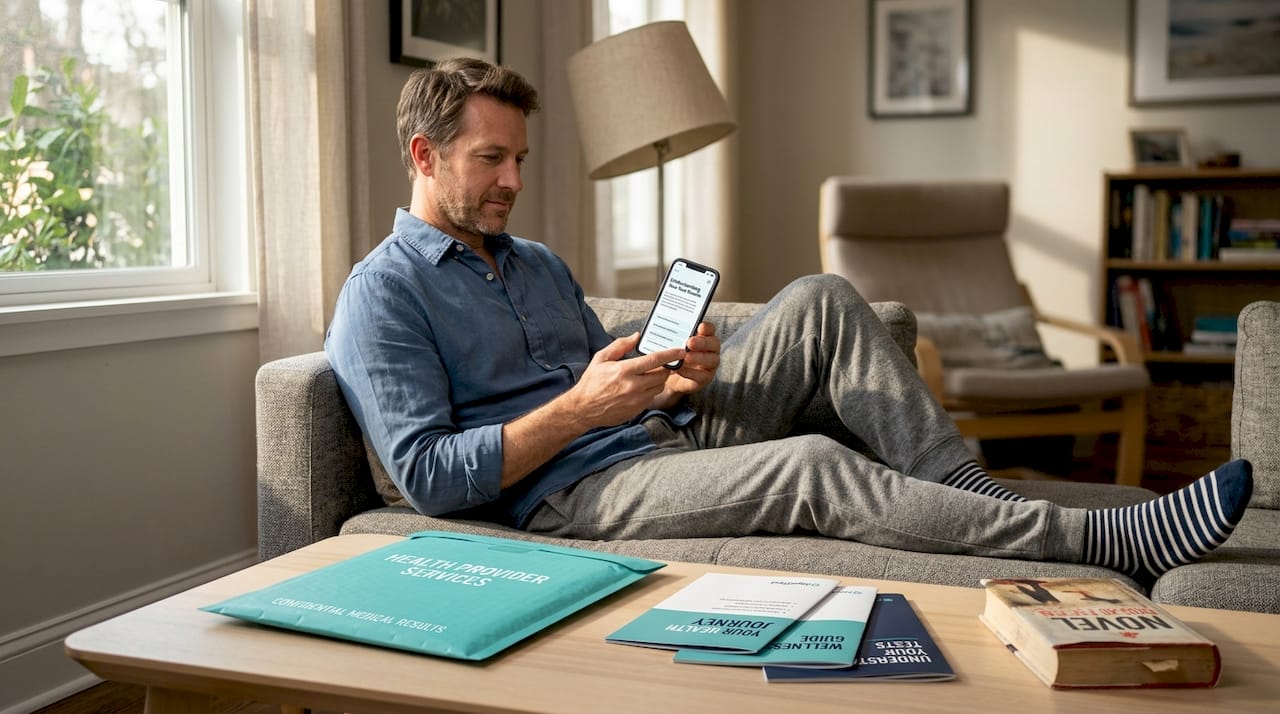
Here’s what the evidence shows, though. STI postal self-sampling increased testing access in England, with return rates ranging from 60 to 80 percent. But uptake was higher in less deprived areas, which shows an equity gap. There aren’t large-scale benchmarks for fertility or cancer home kits in UK men over 40, which is something worth noting.
Key takeaways before you test at home:
- Rapid tests give fast results but may sacrifice some accuracy
- Lab-based self-sampling is more reliable but takes longer
- Privacy motivates most men to test at home, and that’s a legitimate reason
- Equity in access is uneven across different communities
- Home tests are most useful when you know what they can and can’t tell you
Are home fertility tests for men accurate and safe?
This is a question worth taking seriously, especially if you and your partner are actively trying to conceive. Home sperm tests have improved a lot over the past decade. Brands like ExSeed and SpermCheck claim accuracy rates of 95 to 98 percent compared to lab results. That sounds impressive. But there’s a major catch.
Those accuracy figures apply only to the specific parameters the home test measures, usually sperm count and motility. What home kits don’t test for is equally important: sperm morphology (the shape of sperm), DNA fragmentation, and other clinical markers that can affect fertility outcomes significantly. A man could get a “normal” result at home and still have a serious underlying fertility issue that a clinic would catch immediately.
Check out the full fertility test guide for a deeper look at what’s involved.
| Feature | Home fertility test | Clinic semen analysis |
|---|---|---|
| Sperm count | Yes | Yes |
| Sperm motility | Yes (basic) | Yes (detailed) |
| Sperm morphology | No | Yes |
| DNA fragmentation | No | Yes |
| Professional counseling | No | Yes |
| Average cost | $30 to $80 | $150 to $400+ |
| Turnaround time | 10 to 30 minutes | 1 to 5 days |
| Lab certification | Varies | Accredited lab |
The NHS and health authorities like nidirect recommend full lab semen analysis over home kits precisely because of these limited parameters and the real risk of false reassurance. A man who gets a “pass” on a home sperm test may stop investigating, even when there’s still a problem worth addressing.
Pro Tip: Use a home fertility test as a starting point, not a final answer. If results are abnormal, or if you’ve been trying to conceive for 12 months or more without success, go straight to a clinic for a full semen analysis.
Here’s a simple way to think about when to use which:
Choose a home fertility test when:
- You want an initial check before booking a clinic appointment
- You’re curious but not yet actively trying to conceive
- You want to track changes over time between clinic visits
Trust the clinic when:
- You’re actively trying to conceive with a partner
- You’ve had an abnormal home result
- You’ve been trying for 12 months or longer
- You have a prior history of fertility concerns
Browse men’s fertility kit options if you want a reliable starting point before your clinic conversation.
The reality of PSA and cancer marker home tests
Let’s be real. This is where things get more serious, and where the stakes are highest. Men over 40 are understandably drawn to home PSA tests because prostate cancer is one of the most common cancers in men, and early detection genuinely matters. The appeal of testing quietly at home, without sitting in a GP’s waiting room, is completely understandable.
But the evidence here is uncomfortable. BBC testing of home PSA kits found that the same sample could produce very different results across different home kits, raising serious questions about consistency. Prostate Cancer UK has warned about questionable accuracy in these rapid home tests, the lack of professional interpretation, and the very real risk of either false positives (unnecessary panic) or false negatives (missed cancers).
| Feature | Rapid home PSA kit | NHS GP or lab PSA test |
|---|---|---|
| Test method | Finger-prick strip | Venous blood draw |
| Lab processing | No | Yes |
| Professional interpretation | No | Yes |
| Risk of inconsistent result | High | Low |
| Counseling included | No | Yes |
| Follow-up guidance | Limited | Structured |
“We always recommend professional testing and interpretation. A PSA test result only makes sense in context, alongside your age, family history, symptoms, and other factors.” — Prostate Cancer UK
That context piece is everything. A PSA number on its own doesn’t tell the full story. An elevated PSA could mean prostate cancer, or it could mean a benign enlarged prostate, a urine infection, or even recent physical activity. Without a doctor walking you through what that number means for you specifically, you’re flying blind.
If you’re still considering a rapid PSA kit at home, here’s what to do:
- Read the detailed PSA test analysis to understand what 98.79% accuracy actually means in practice
- Collect your sample exactly as instructed, following the timing guidance carefully
- Record your result but do not make any health decisions based on it alone
- Book a GP appointment and share your result as a conversation starter, not a diagnosis
- Ask your GP for an NHS lab test to confirm or rule out any concerns
The risks of acting on a home PSA result without professional guidance are real. False reassurance can delay diagnosis when it matters most. And a false alarm without a doctor to contextualize it can cause weeks of unnecessary anxiety.
When are home test kits most useful, and when are they not?
Having walked through the specifics, it’s worth stepping back to look at the bigger picture. Home test kits are a genuinely useful tool when used in the right situation. The problem isn’t the kits themselves, it’s misunderstanding their role.
For STI testing, postal self-sampling is one of the most genuinely useful innovations in men’s health in recent years. If you’ve had a new partner, want a routine check, or simply value privacy, an at-home STI test is a completely appropriate first step. What matters is that a positive result always requires follow-up with a clinic for confirmatory testing and treatment.
For fertility, home kits are a smart first move to start the conversation, whether with yourself or with a partner. They give you a rough sense of where things stand before committing to a full clinic workup.
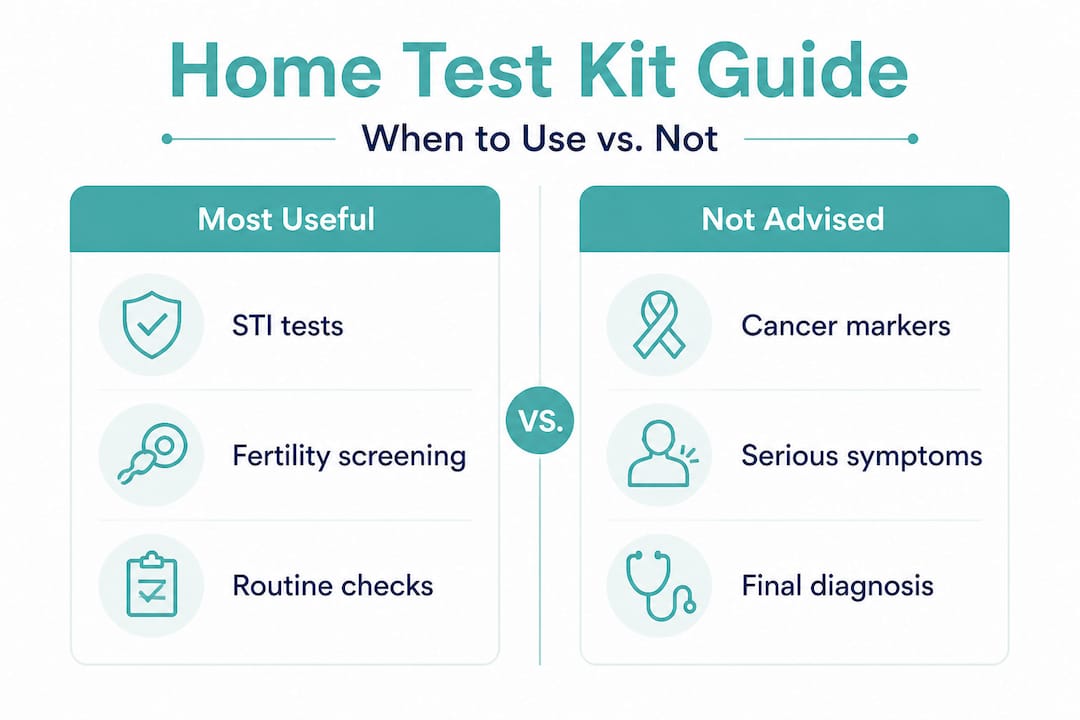
For cancer markers, lab-processed samples with professional oversight aren’t optional. They’re the minimum standard. Home kits can prompt important conversations with your GP, but they must never be the final word.
Also worth noting: the equity gap in STI self-sampling uptake in England means that men in more deprived areas are less likely to use these tools. If access has been a barrier for you, it’s worth knowing that many NHS services now offer free postal STI testing, so cost doesn’t have to stop you from getting checked.
Pro Tip: Never rely on a single home test for any cancer marker. Always confirm with a professional. Think of a home test as the first chapter, not the whole story.
Home tests are a safe first step when:
- You need a private STI check and have no symptoms
- You want a baseline fertility snapshot before clinic involvement
- You’re using the result to prompt a GP conversation
See a doctor without delay when:
- Any result is positive or borderline
- You have symptoms alongside the test result
- You’re using the test for cancer marker screening
- You’ve had abnormal results before
Read more about privacy risks and tips and the common test examples worth considering for men over 40.
Why safety means more than kit accuracy: Our perspective
Here’s something most guides get wrong. They treat “accurate” as a synonym for “safe.” They’re not the same thing at all.
A kit can perform at 98% accuracy in controlled lab conditions and still put you at risk, if you don’t know what to do with the result. The real danger isn’t a faulty strip. It’s the absence of a plan for what comes next.
Think about it this way. A man gets a negative PSA result at home, feels relieved, and puts his health concerns aside for another year. Meanwhile, he has early-stage prostate cancer that a GP-ordered test and conversation would have caught. That’s not a kit failure. That’s a guidance failure.
The most responsible home test is one that comes with a built-in next step. A clear instruction: if positive, contact your GP within 48 hours. If negative but symptomatic, still get a check. If unsure, repeat and confirm. Without those guardrails, even a highly accurate test can lead someone in the wrong direction.
We believe the smartest men use home tests as a gateway to better conversations with their doctors, not as a replacement for those conversations. Check out our step-by-step health checks guide to see what a responsible testing routine actually looks like.
A safe test is one that comes with a safe next step. That’s our measure of a good home test kit. Not just the accuracy figure on the box.
Next steps: Choosing safe home test kits with confidence
You’ve done the hard part. You now understand where home tests work brilliantly and where they need backup from a professional. The next move is to choose kits from a regulated, trustworthy source that gives you clear guidance on what to do with your results.
At Rapidtest, all our kits are sourced with privacy, reliability, and clear instructions in mind. Whether you’re checking for STIs, looking at your fertility picture, or starting a prostate health conversation with your GP, we have options built for men over 40 who want to take control without wading through confusing clinical processes.
Order at-home STI tests for results in 15 minutes with no appointment needed. Explore our men’s fertility test kits for a smart first step before a clinic visit. Or check out our PSA prostate health kit if you want to start that conversation with your GP from an informed position. No queues, no awkward conversations. Just clarity, on your terms.
Frequently asked questions
Are home test kits approved by the NHS or other UK authorities?
The NHS generally recommends lab-based testing and does not officially endorse most rapid home test kits for fertility or cancer markers. For STI self-sampling, some NHS services do offer or support postal kits, but always through accredited labs.
What should I do if I get a positive result from an at-home test?
Follow up immediately with your GP or local clinic for confirmatory testing and personalized advice. Prostate Cancer UK advises GP testing for any prostate-related concerns, and the same principle applies across all test types.
Are rapid home PSA tests as reliable as tests from my GP?
No. Research and expert consensus show rapid PSA kits are less reliable than GP or NHS lab analysis. BBC testing found inconsistent results from the same sample across different home kits, and the lack of professional interpretation makes self-diagnosis genuinely risky.
Who benefits most from STI self-sampling kits?
Men over 40 who value privacy and want easier access to regular STI checks benefit most from self-sampling kits. However, postal STI self-sampling should always be followed up with clinic care if any result comes back positive.