


Prostatitis and PSA: what men should do next
Yes, prostatitis commonly raises PSA, and an active infection makes your PSA result unreliable for cancer screening. The right move is to treat the infection first, then retest once you have recovered. Here is what that looks like in practice:
- If you have symptoms (fever, pain when urinating, pelvic discomfort), see a clinician before any PSA test. Treating suspected bacterial prostatitis with antibiotics comes first.
- Avoid PSA testing during acute infection. A result taken during active inflammation can be misleading and may trigger unnecessary investigations.
- Plan a timed repeat. Most clinicians retest PSA roughly 4–8 weeks after symptoms resolve, once pre-analytic conditions are standardised.
- Do not self-manage severe symptoms. A very high PSA during active infection still needs urgent clinical assessment. Case reports document PSA values far above the usual cancer-concern threshold in men with acute bacterial prostatitis, so extreme readings should never be dismissed as “just infection” without proper evaluation.
Pro Tip: Tell your clinician about any recent urinary symptoms, fever, or antibiotic use before your PSA test. That single piece of information can completely change how your result is interpreted.
Key takeaways
Prostatitis commonly raises PSA, making an infection-period result unreliable for cancer screening; treat first, retest after recovery, and escalate if PSA stays elevated.
| Point | Details |
|---|---|
| Treat before testing | Avoid PSA testing during active prostatitis; treat infection first and retest after recovery. |
| Retest timing | Most clinicians repeat PSA 4–8 weeks after symptom resolution under standardised conditions. |
| PSA normalisation rates | Roughly 20–30% of men in older cohorts showed PSA normalisation after 2–4 weeks of antibiotics. |
| Persistent elevation | If PSA stays high after treatment, mpMRI and PSA density assessment are the next steps before biopsy. |
| Rapidtest at-home kit | Rapidtest’s at-home PSA test supports discreet trend monitoring between clinic appointments, in agreement with your clinician. |
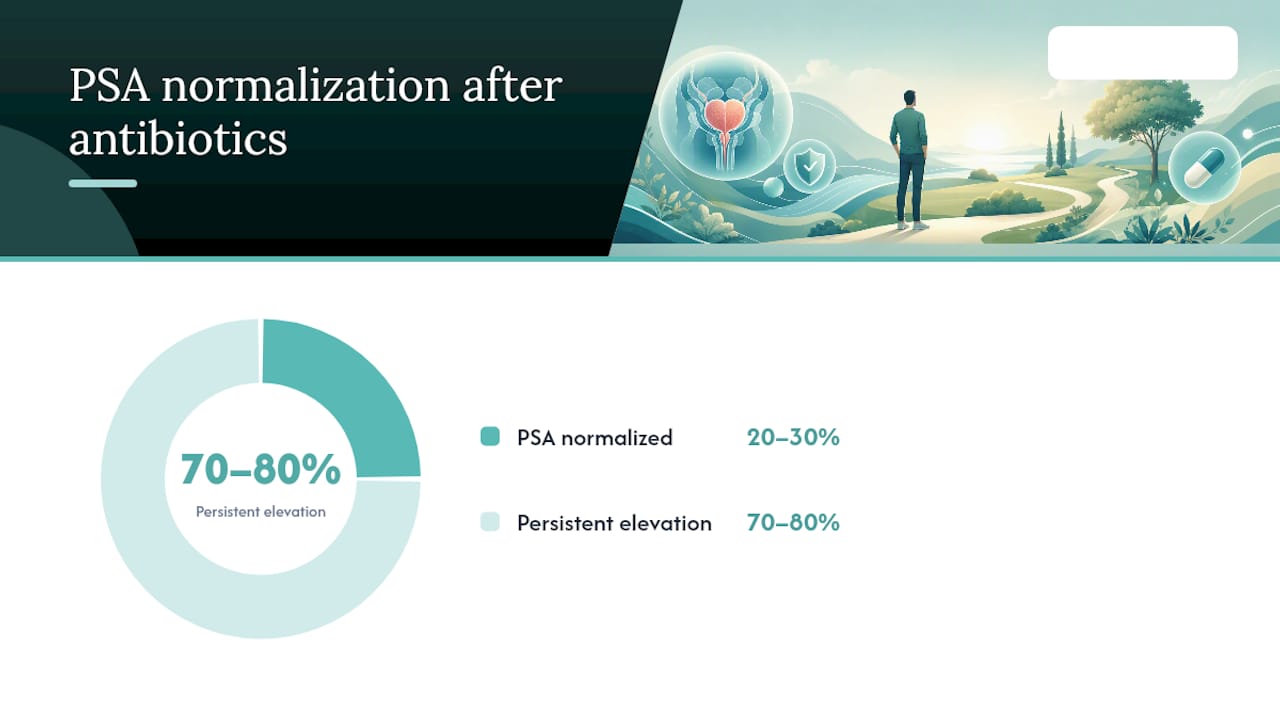
Table of Contents
- How does prostatitis raise PSA?
- How clinicians manage a raised PSA when prostatitis is suspected
- How long does PSA take to return to normal after prostatitis?
- When does a persistent high PSA after prostatitis need further investigation?
- Other reasons your PSA might be high
- What to expect at your GP or urology appointment
- What major health bodies say about PSA testing and prostatitis
- What research says about antibiotics and PSA reduction
- An editorial perspective on prostatitis-related PSA anxiety
- At-home PSA monitoring: what it can and cannot do for you
- Sources
- FAQ
How does prostatitis raise PSA?
PSA (prostate-specific antigen) is a protein produced by prostate cells. Normally, tight junctions between those cells keep most PSA inside the gland. When infection or inflammation disrupts that barrier, PSA leaks into the bloodstream at a much higher rate. Three overlapping mechanisms drive this:
- Increased epithelial permeability. Inflamed tissue loses its structural integrity, allowing PSA to pass into surrounding blood vessels more freely.
- Hypervascularity. Infection triggers new blood vessel growth and dilates existing ones, giving PSA more routes into circulation.
- Direct cellular damage. Bacterial toxins and immune-cell activity can destroy prostate cells outright, releasing their PSA content directly.
The clinical pattern depends on the type of prostatitis. Acute bacterial prostatitis tends to cause large, rapid PSA spikes. Chronic prostatitis or asymptomatic histologic prostatitis (where inflammation is found incidentally, without obvious symptoms) tends to produce smaller, slower rises that are harder to distinguish from early cancer or benign prostatic hyperplasia (BPH).
The key clinical insight: PSA values that would normally prompt urgent cancer investigation can, in some men, be entirely explained by acute infection. Published case reports confirm that acute prostatitis can produce extremely elevated PSA — including values far above the threshold typically associated with malignancy — and that these values can fall dramatically after antibiotic treatment alone.
This is precisely why testing PSA during active symptomatic prostatitis creates avoidable management dilemmas. The number on the report looks alarming, but it may tell you more about the state of your prostate’s defences than about cancer risk.
How clinicians manage a raised PSA when prostatitis is suspected
If you arrive at a GP or urology appointment with a raised PSA and symptoms that suggest prostatitis, the clinical pathway usually follows a clear sequence.
- Symptom review. Your clinician will ask about fever, pain on urination (dysuria), pelvic or perineal discomfort, urinary frequency, and how long symptoms have been present.
- Digital rectal examination (DRE). A tender, boggy prostate on DRE strongly supports prostatitis. A hard, irregular nodule raises concern for cancer and changes the urgency of the pathway.
- Urine dip and culture. A mid-stream urine sample checks for bacteria and white cells. A positive culture confirms bacterial prostatitis and guides antibiotic choice.
- Blood tests. Full blood count and C-reactive protein (CRP) help gauge the severity of infection. In acute cases, these are often markedly raised.
- Antibiotic treatment. For confirmed or strongly suspected bacterial prostatitis, a fluoroquinolone (such as ciprofloxacin) or trimethoprim is typically prescribed for 2–4 weeks in uncomplicated cases, and up to 4–6 weeks for more established infection. Research on antibiotic use as both a therapeutic and diagnostic manoeuvre in men with mildly elevated PSA and suspected inflammation has informed this approach in clinical practice.
- Timed PSA repeat. Once symptoms have resolved and a standardised pre-test interval has passed, PSA is retested. Most clinicians use a window of 4–8 weeks, though some allow longer.
Red flags that may bypass the “treat and retest” approach entirely:
- Signs of sepsis (high fever, rigors, confusion, rapid heart rate)
- A palpable suspicious mass on DRE
- Very high or rapidly rising PSA in a man with other cancer risk factors (strong family history, prior abnormal biopsy)
- Failure of PSA to fall after adequate antibiotic treatment
In any of these situations, urgent referral rather than watchful waiting is the appropriate step.
How long does PSA take to return to normal after prostatitis?
The honest answer is: it varies. Most clinicians expect meaningful PSA reduction within 4–8 weeks of successful treatment, but full normalisation can take considerably longer in some men.
Contemporary reviews recommend a conservative retest interval of several weeks after symptom resolution, with some specialists allowing 6–8 weeks or more before making definitive imaging or biopsy decisions. The reasoning is straightforward: retesting too early risks catching PSA on its way down rather than at its true post-infection baseline.
Older cohort data suggest that roughly 20–30% of men with elevated PSA attributed to prostatic inflammation show PSA normalisation after a 2–4 week antibiotic course. That figure comes with important caveats: cohorts were heterogeneous, prostatitis subtypes were not always clearly defined, and “normalisation” was measured against different thresholds across studies. The proportion who see a significant fall (even if not full normalisation) is likely higher.
Factors that slow PSA recovery include:
- Larger prostate volume. More tissue means more potential PSA production, even after infection clears.
- Underlying BPH. Pre-existing benign enlargement keeps baseline PSA elevated independently of infection.
- Incomplete antibiotic courses. Undertreated infection leaves residual inflammation.
- Chronic or asymptomatic prostatitis. Without clear symptom resolution as a marker, it is harder to know when the inflammatory process has truly settled.
If PSA remains elevated after an appropriate wait, that is not automatically a cancer diagnosis. It is a signal that further investigation is warranted.
When does a persistent high PSA after prostatitis need further investigation?
Not every PSA that stays elevated after treatment means cancer. But some patterns do warrant a closer look, and knowing what clinicians watch for helps you have a more informed conversation.
- Persistent elevation after an appropriate interval. If PSA has not fallen meaningfully after 6–8 weeks of completed antibiotic treatment and symptom resolution, most clinicians will not simply wait longer without additional assessment.
- Abnormal DRE findings. A hard or irregular prostate on examination changes the risk calculation regardless of PSA trajectory.
- Very high absolute values or concerning PSA kinetics. A rapidly rising PSA (PSA velocity) or a PSA density (PSAD) above a certain threshold adds weight to the case for imaging.
Multiparametric MRI (mpMRI) has become a key tool in this situation. It can identify suspicious lesions within the prostate that warrant targeted biopsy, while also reassuring clinicians when the gland looks structurally normal. Diagnostic pathways now favour repeat PSA under standardised conditions, followed by mpMRI and PSAD assessment to reduce unnecessary biopsies in men where inflammation may be the explanation.
PSA density (PSAD) is calculated by dividing the PSA value by the prostate volume measured on ultrasound or MRI. A higher PSAD suggests the PSA is disproportionate to prostate size, which raises cancer suspicion even when the absolute PSA is only modestly elevated.
Free versus total PSA adds another layer. PSA circulates in two forms: free (unbound) and complexed (bound to proteins). A lower free-to-total PSA ratio tends to be associated with a higher cancer probability. In the diagnostic grey zone, this ratio can help clinicians decide whether to proceed to biopsy or continue monitoring. Background on interpreting PSA values and the free/total ratio is worth reading before your next clinic appointment.
Worth knowing: Even when PSA falls after antibiotic treatment, clinicians remain alert. A normalised PSA does not automatically exclude cancer if other risk features or concerning signs are present. The StatPearls clinical review emphasises shared decision-making and the use of additional biomarkers alongside PSA to reduce unnecessary biopsies.
Other reasons your PSA might be high
Prostatitis is one of several non-cancer causes of a raised PSA. Telling your clinician about any of the following can prevent unnecessary alarm and guide better test interpretation.
- Benign prostatic hyperplasia (BPH). An enlarged prostate produces more PSA simply because there is more tissue. The NCI notes that BPH, infection, inflammation, recent ejaculation, and instrumentation can all raise PSA independently of cancer.
- Recent ejaculation. PSA can be temporarily elevated for up to 48 hours after ejaculation. Abstaining for 48 hours before testing is standard pre-test advice.
- Urinary retention. Pressure within the gland from retained urine can push PSA into the bloodstream.
- Recent instrumentation. A catheter, cystoscopy, or prostate biopsy can cause significant PSA spikes that persist for several weeks.
- DRE timing. A DRE immediately before a PSA blood draw can slightly raise the result. Ideally, blood is taken before the examination.
- Vigorous cycling or perineal trauma. Sustained pressure on the perineum from cycling can temporarily elevate PSA. Avoid vigorous cycling for 48 hours before testing.
Medications matter too. 5-alpha reductase inhibitors (such as finasteride or dutasteride, used for BPH or hair loss) typically halve PSA values after 6–12 months of use. If you take one of these, your clinician needs to know, because your “true” PSA may be roughly double the measured value. Statins and obesity can also affect PSA readings. Bring a full medication list to every appointment. For broader context on how men’s health medications can affect PSA and related testing, it is worth reviewing current guidance before your appointment.
Finasteride is FDA-indicated for men only. Women who are or may become pregnant must not handle crushed or broken finasteride tablets, due to the risk of harm to a male fetus. It can also cause sexual side effects (reduced libido, erectile dysfunction) in a minority of men, which usually resolve after stopping treatment. Discuss these risks with a physician before starting.
What to expect at your GP or urology appointment
Walking into a clinic with a raised PSA and a history of prostatitis can feel unsettling. Knowing what is coming makes it easier.
- Urine dip and culture. Almost always the first step. Confirms or rules out active infection.
- Blood tests. CRP, full blood count, and a repeat PSA under standardised conditions.
- DRE. Your clinician will examine the prostate for tenderness, size, and any suspicious texture.
- Symptom and history review. Expect questions about how long symptoms have been present, any antibiotics you have already taken, sexual activity, prior PSA values, and family history of prostate cancer.
- Possible referral for mpMRI. If PSA remains elevated after treatment, imaging is the next step before any biopsy decision.
Questions worth asking your clinician:
- “Given my prostatitis history, when should we recheck PSA?”
- “What PSA level or pattern would prompt you to refer me for MRI?”
- “Does my family history change the threshold for further investigation?”
- “Would at-home PSA monitoring between appointments be useful for tracking trends?” The prostate cancer testing checklist for men over 40 is a practical resource to bring to that conversation.
What major health bodies say about PSA testing and prostatitis
The consensus across major guideline bodies is consistent on the core point: do not test PSA during active infection, and retest under standardised conditions after recovery.
- NHS / NICE: Recommend deferring PSA testing in men with active urinary tract infection or prostatitis, and retesting after a suitable interval once symptoms have resolved.
- Prostate Cancer UK: Advises men to tell their GP about any recent infection or urinary symptoms before a PSA test, and supports shared decision-making about when to retest.
- National Cancer Institute (NCI): States clearly that PSA is sensitive but not cancer-specific, and that infection, inflammation, BPH, and recent procedures can all raise PSA, making an isolated elevated result a prompt for repeat testing rather than immediate biopsy.
- StatPearls / NCBI: The clinical review on prostate cancer screening recommends repeat PSA under standardised conditions, shared decision-making, and the use of imaging and additional biomarkers to reduce unnecessary biopsies.
- Contemporary urology reviews: The Beyond the Number review recommends a confirm-then-image-then-refine approach: repeat PSA, mpMRI, PSAD, and selective biomarkers before committing to biopsy when inflammation is suspected.
Where guidelines diverge is mainly on timing. Some recommend a minimum of 4 weeks after symptom resolution; others prefer 6–8 weeks or longer. The shared principle is that a single elevated PSA during or shortly after infection is not a reliable basis for cancer decisions.
What research says about antibiotics and PSA reduction
The evidence base here is real but limited. Several cohort studies and institutional series have examined whether antibiotic treatment lowers PSA in men with suspected prostatic inflammation, and the results are broadly encouraging, with important caveats.
Older cohort data report PSA normalisation in roughly 20–30% of men with elevated PSA attributed to prostatic inflammation after a 2–4 week antibiotic course. Other series report a significant fall (though not necessarily full normalisation) in a larger proportion. The variation reflects differences in how prostatitis subtypes were classified, what “normalisation” meant in each study, and how long follow-up lasted.
The limitation that matters most: Most studies in this area are small, retrospective, and heterogeneous. There are no large, high-quality randomised controlled trials specifically designed to test whether antibiotic treatment reduces unnecessary biopsies by lowering PSA in men with suspected inflammation. The evidence supports antibiotics as a reasonable first step, not as a definitive cancer-exclusion strategy.
This is why clinicians use a multimodal approach. Antibiotics may lower PSA and reduce the probability of a positive biopsy in some men, but they do not replace mpMRI, PSAD assessment, or validated biomarkers when cancer risk remains uncertain after treatment. Relying on PSA normalisation alone to rule out cancer would be clinically inappropriate.
An editorial perspective on prostatitis-related PSA anxiety
The most underappreciated problem in this whole area is not the biology. It is the timing.
Men often get a PSA test during or shortly after a symptomatic urinary infection, see an alarming number, and spend weeks convinced they have cancer before anyone explains that the infection itself was almost certainly responsible. That anxiety is real, and it is largely avoidable.
The clinical logic is not complicated: inflamed tissue leaks PSA. Treat the inflammation, wait for it to settle, then retest under controlled conditions. If the number falls, you have your answer. If it does not, you investigate further. The problem is that this sequence requires patience and clear communication, two things that are in short supply when a man is staring at a PSA result that looks frightening.
What I think gets missed is that a raised PSA during prostatitis is not a failed test. It is the test doing exactly what it is supposed to do: detecting something abnormal in the prostate. The clinical skill lies in interpreting what that abnormality means, and that interpretation almost always requires context, time, and a second data point.
If your PSA came back high and you have had prostatitis, the most useful thing you can do right now is not to catastrophise. It is to ask your clinician one clear question: “Given my infection history, when should we recheck this under proper conditions?” That question alone will move you from anxiety to a plan.

At-home PSA monitoring: what it can and cannot do for you
Once your clinician has agreed on a retest plan, keeping track of your PSA between appointments is where an at-home kit can genuinely help. Rapidtest’s at-home PSA test gives you a result in 15 minutes, with no queue, no appointment, and no awkward waiting room. That makes it a practical option for men who want to monitor trends discreetly while following a clinician-agreed schedule.
What it cannot do is replace clinical assessment. An at-home PSA result does not tell you whether a rise is due to residual inflammation, BPH, or something that needs imaging. It is a number, and numbers need context. Use it as a tracking tool alongside your clinical pathway, not instead of it. If your result is unexpectedly high or you develop new symptoms, seek clinical advice promptly rather than waiting for your next scheduled appointment.
Ready to start monitoring? Check out the Rapidtest at-home PSA kit and discuss with your GP whether home monitoring fits your retest plan.
Sources
- Extremely Elevated Prostate-Specific Antigen in Acute Prostatitis: A Case Report - PMC
- Asymptomatic prostatitis: a frequent cause of raising PSA
- Prostate-Specific Antigen (PSA) Test - NCI
- Prostate cancer screening (StatPearls/NCBI book chapter)
- Beyond the Number: Interpreting Prostate-Specific Antigen Elevation in the Context of Prostate Inflammation
This article is general information, not a substitute for advice from a qualified doctor. Consult a qualified healthcare professional about your own circumstances before acting on anything here.
FAQ
Does prostatitis always raise PSA?
Not always, but it often does. Acute bacterial prostatitis tends to cause the largest rises, sometimes to levels associated with cancer; chronic prostatitis produces smaller, more variable changes.
Is a PSA of 9 ng/mL high if I have prostatitis?
A PSA above the traditional 4.0 ng/mL threshold for further evaluation, but in the context of active or recent prostatitis it may reflect inflammation rather than cancer. Treat the infection first and retest after 4–8 weeks before drawing conclusions.
Can prostatitis be caused by not ejaculating?
Infrequent ejaculation is not a confirmed cause of prostatitis. Bacterial prostatitis is caused by infection; chronic pelvic pain syndrome has multiple proposed mechanisms, but abstinence alone is not established as a direct cause.
What else can raise PSA besides cancer?
BPH, prostatitis, recent ejaculation, urinary retention, catheterisation, cystoscopy, vigorous cycling, and DRE immediately before blood draw can all raise PSA, as the NCI confirms. Medications such as 5-alpha reductase inhibitors can lower it, so always share your full medication list with your clinician.
Can I use an at-home PSA test to monitor after prostatitis?
Yes, as an adjunct to clinical follow-up. Rapidtest’s at-home PSA kit gives results in 15 minutes and can help you track trends between appointments, but it does not replace clinical assessment, imaging, or biopsy decisions.