


PSA levels by age in the UK: your quick-reference guide
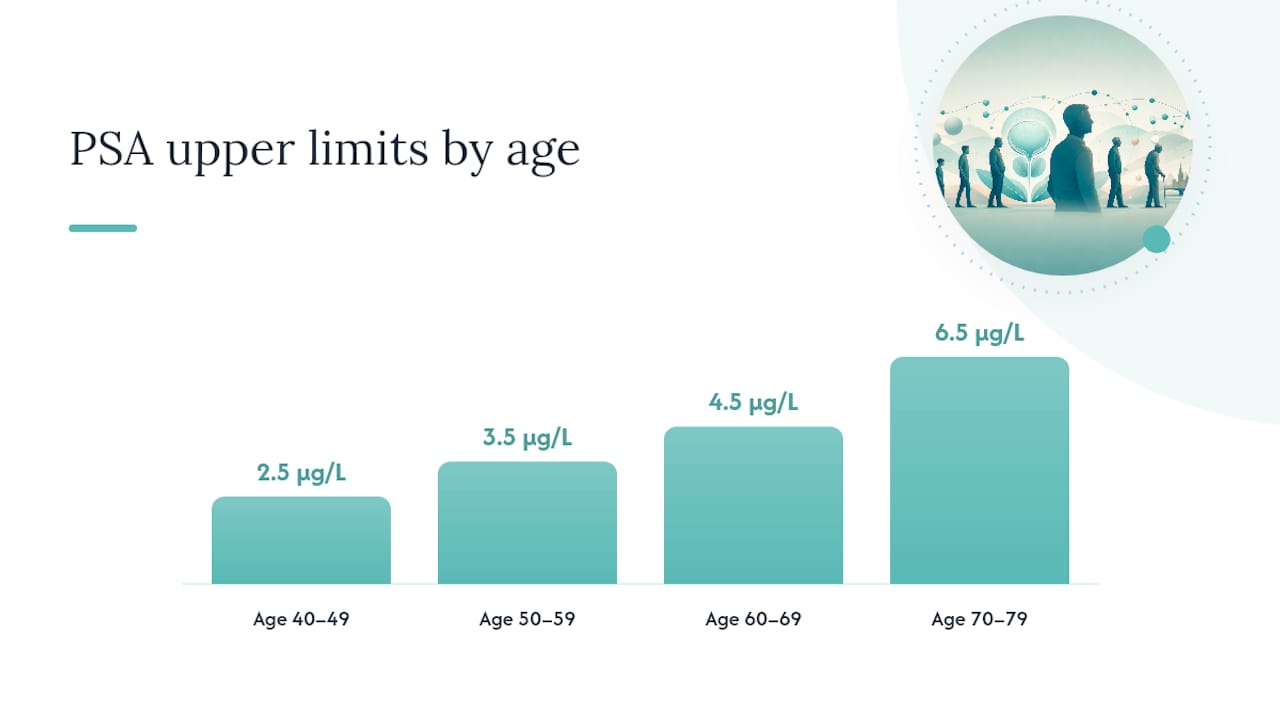
PSA levels by age in the UK follow specific referral thresholds set by NICE: above 2.5 µg/L for men aged 40–49, above 3.5 µg/L for men aged 50–59, above 4.5 µg/L for men aged 60–69, and above 6.5 µg/L for men aged 70–79. If your result sits above the threshold for your age group, that typically prompts a conversation with your GP, a repeat test, or an urgent suspected-cancer referral — not an automatic diagnosis.
PSA stands for prostate-specific antigen, a protein produced by the prostate gland. Its level rises naturally as you get older, which is exactly why a flat “normal” cut-off for all ages would miss cancers in younger men and over-refer older men. The NHS is clear that a raised PSA can have several non-cancer causes, including a benign enlarged prostate, infection, or recent ejaculation.
A raised PSA result does not mean you have prostate cancer. It means further investigation is needed — and in most cases, that investigation will start with a repeat blood test and a conversation with your GP, not an immediate biopsy.
The diagnostic pathway in the UK now routinely includes MRI triage before biopsy, which Cancer Research UK confirms helps reduce unnecessary invasive procedures. So if your number is raised, the process is more measured than many men fear.
Key takeaways
Age-specific PSA thresholds are the standard in UK practice, and a raised result above your age group’s cut-off means further investigation, not a diagnosis.
| Point | Details |
|---|---|
| Age-specific thresholds | NICE sets referral cut-offs at 2.5, 3.5, 4.5, and 6.5 µg/L for decades 40–49 through 70–79. |
| Higher-risk groups | Black men and those with a first-degree relative with prostate cancer should discuss testing from age 45. |
| Non-cancer causes matter | BPH, prostatitis, recent ejaculation, and certain medications can all raise PSA temporarily. |
| MRI before biopsy | UK pathways now use MRI triage after a raised PSA to reduce unnecessary invasive procedures. |
| Rapidtest at home | Rapidtest’s at-home PSA kit gives a result in 10–15 minutes; a raised result needs GP confirmation. |
Table of Contents
- What do PSA reference ranges look like across each age group?
- Who should consider getting a PSA test in the UK?
- What can raise or lower your PSA before you test?
- How do clinicians interpret a raised PSA in the UK?
- How often should you repeat a PSA test?
- How does an at-home PSA test fit into the UK pathway?
- The case for checking without catastrophising
- Check your PSA level at home with Rapidtest
- Sources
- FAQ
What do PSA reference ranges look like across each age group?
The thresholds below reflect both the NICE referral guidance and the decade-specific upper limits used in UK hospital laboratory reference ranges, such as those published by Manchester University NHS Foundation Trust.
| Age group | Upper reference limit (µg/L) | Typical clinical interpretation |
|---|---|---|
| Under 40 | No fixed threshold | Clinical judgement; PSA testing rarely routine at this age |
| 40–49 | 2.5 | Above this: GP discussion and likely repeat test |
| 50–59 | 3.5 | Above this: GP discussion; possible urgent referral |
| 60–69 | 4.5 | Above this: urgent suspected-cancer referral likely |
| 70–79 | 6.5 | Above this: urgent referral, balanced against comorbidities |
| 80 and over | No fixed threshold | Clinical judgement; invasive treatment less likely to benefit |
PSA is measured in micrograms per litre (µg/L), which is numerically identical to nanograms per millilitre (ng/mL). If your lab report uses ng/mL, the numbers are the same — no conversion needed.
A few things worth knowing about how these numbers are used in practice:
- Results just above a threshold are not treated the same as results significantly above it. A 50-year-old with a PSA of 3.6 µg/L is in a different clinical position from one with a PSA of 8 µg/L.
- Scotland uses the same age-specific thresholds in practice, though local NHS board guidance may vary slightly in wording.
- Men under 40 and over 79 are assessed on clinical judgement rather than a fixed cut-off. For older men, life expectancy and fitness for treatment are weighed carefully alongside the PSA result.
- NICE advises that patient preferences and comorbidities should always factor into referral decisions, not the number alone.
Who should consider getting a PSA test in the UK?
The NHS does not run a national prostate cancer screening programme, so PSA testing in the UK is largely request-based or prompted by symptoms. Here is how the guidance breaks down.
Prostate Cancer UK advises that any man aged 50 or over can request a PSA test from their GP. Men at higher risk should be offered a discussion about testing from around age 45:
- Black men and men of mixed Black ethnicity, who have a higher lifetime risk of prostate cancer
- Men with a first-degree relative (father or brother) diagnosed with prostate cancer
- Men carrying a known pathogenic BRCA2 variant, which is associated with more aggressive disease
- Men with urinary symptoms (difficulty urinating, urgency, frequency) at any age
If you fall into one of those groups and haven’t yet spoken to your GP about testing, a prostate cancer testing checklist for men over 40 can help you prepare for that conversation.
When a man requests a PSA test, Gov is clear that GPs must provide balanced information about both the potential benefits and the limitations of the test before it is taken. That includes explaining the risk of false positives, the possibility of overdiagnosis, and what the diagnostic pathway looks like if the result is raised.
Knowing your personal cancer risk before approaching your GP can make that conversation more productive.
What can raise or lower your PSA before you test?
PSA is not a stable number. Several temporary or reversible factors can push it up or pull it down, which is why a single reading taken at the wrong moment can mislead both you and your GP.
Common causes of a temporarily raised PSA:
- Recent ejaculation (within 48 hours)
- Vigorous exercise, particularly cycling, in the days before testing
- Urinary tract infection or prostatitis (inflammation of the prostate)
- Urinary retention
- Recent urological procedures such as catheterisation, TURP (transurethral resection of the prostate), or prostate biopsy
- Prostate massage or digital rectal examination performed shortly before the blood draw
Factors that may lower or mask PSA:
- 5-alpha reductase inhibitors (finasteride, dutasteride), commonly prescribed for BPH or hair loss, can roughly halve PSA levels. If you take either of these, tell your GP before testing — the result needs to be interpreted with that in mind.
- Obesity is associated with lower measured PSA due to haemodilution, which can mask a clinically significant level.
Finasteride is FDA-indicated for men only. Women who are or may become pregnant must not handle crushed or broken finasteride tablets, due to the risk of harm to a male fetus. It can also cause sexual side effects (reduced libido, erectile dysfunction) in a minority of men, which usually resolve after stopping treatment. Discuss these risks with a physician before starting.
Pre-test practical advice:
- Avoid ejaculation for at least 48 hours before a PSA blood draw
- Avoid vigorous exercise, especially cycling, for at least 48 hours beforehand
- If you have had a recent urinary infection or prostatitis, wait at least four to six weeks after symptoms resolve before testing
- Tell your GP about any medications, recent procedures, or symptoms before the test
Pro Tip: If you are taking finasteride or dutasteride, your GP may double your PSA result to estimate your “true” level. Always mention this before any PSA test, whether at a clinic or at home.
How do clinicians interpret a raised PSA in the UK?
PSA is a triage tool, not a diagnostic test. A raised result opens a conversation; it does not close one. Clinicians in the UK use several additional measures to decide what to do next.
The typical pathway after a raised PSA:
- Repeat PSA test: A single raised result is usually confirmed with a second test two to four weeks later, unless the level is very high or symptoms are urgent.
- Digital rectal examination (DRE): Your GP may examine the prostate to check for irregularities in size or texture.
- Percentage free PSA (%fPSA): When total PSA falls in the 4–10 µg/L range, North West London Pathology reports that a %fPSA of 10% or below substantially raises the probability of biopsy-positive cancer, helping distinguish cancer from benign enlargement.
- PSA density: Calculated by dividing PSA by prostate volume (measured on ultrasound or MRI), this helps account for the fact that a large benign prostate naturally produces more PSA.
- MRI triage: Before biopsy is recommended, most UK urology pathways now use multiparametric MRI (mpMRI) to assess whether a biopsy is likely to be informative. Cancer Research UK confirms this approach reduces unnecessary invasive procedures.
- Biopsy: If MRI suggests a suspicious area, a targeted biopsy follows. If MRI is reassuring, active surveillance or a repeat PSA may be recommended instead.
The urgency of referral depends on the magnitude of the PSA rise, your age, your symptoms, and your DRE findings. A PSA of 4.6 µg/L in a 60-year-old with no symptoms and a normal DRE is handled differently from a PSA of 15 µg/L with urinary symptoms and a hard, irregular prostate.
Pro Tip: Ask your GP specifically about %fPSA if your total PSA is between 4 and 10 µg/L. This single additional calculation can meaningfully change the clinical picture and may prevent an unnecessary biopsy.
For a deeper look at how results are read in context, the Rapidtest guide on PSA levels in prostate cancer covers the interpretation process in plain language.
How often should you repeat a PSA test?
Repeat testing intervals are not one-size-fits-all. Prostate Cancer UK notes that trial data suggests a range from every two years for higher-risk men to up to eight years for low-risk men with a very low baseline PSA.
Practical guidance on intervals:
- Suspected infection or prostatitis: Repeat after four to six weeks once symptoms have resolved, not before.
- Borderline result, no symptoms: Repeat in two to four weeks to confirm the level before any referral decision.
- Low PSA, low risk: Longer intervals (every two to four years) are reasonable for men with a PSA well below the age-specific threshold and no risk factors.
- Active monitoring after a raised result: Your GP or urologist will set the interval, often every three to six months initially.
Two concepts your GP may mention during monitoring:
- PSA doubling time: How quickly the PSA level doubles. A rapid doubling time (under twelve months) is a stronger signal for concern than a slow, gradual rise.
- Rise above baseline: A consistent upward trend across multiple readings carries more weight than a single elevated result.
Keep a personal record of your PSA results with the date, the laboratory used, and any relevant notes (recent illness, medications). This makes it much easier for your GP to spot a meaningful trend. A practical guide on whether men should test PSA yearly covers the monitoring question in more detail.
How does an at-home PSA test fit into the UK pathway?
An at-home PSA test, like the one offered by Rapidtest, gives you a result in your own time without a GP appointment or a wait for lab results. That has real value, particularly if you want a baseline reading before a GP conversation, or if you are monitoring a known borderline level between clinic appointments.
After your home test result, here is what to do:
- Normal result (below your age-specific threshold): Keep a note of the date and result. If you are in a higher-risk group, repeat testing every one to two years is sensible. No urgent action needed, but do discuss it with your GP at your next routine appointment.
- Borderline result (at or just above your threshold): Do not panic. Avoid ejaculation and vigorous exercise for 48 hours, then arrange a confirmatory blood test through your GP or a private laboratory. A single borderline home result is not a diagnosis.
- Clearly raised result (significantly above your threshold): Book a GP appointment promptly. Bring your printed or photographed result, note the date and time of the test, and mention any recent illness, medications, or relevant symptoms.
Home tests do not replace NHS laboratory testing for clinical decision-making. Lab assays use calibrated equipment and standardised methods; a home lateral-flow test gives a useful directional indicator, not a precise quantitative figure. Any result that prompts clinical action needs confirmation through a GP or accredited laboratory.
Pro Tip: When you see your GP after a raised home result, bring a written note of: the test date, the time of your last ejaculation, any recent urinary symptoms or infections, and any medications you take. This turns a five-minute appointment into a genuinely productive one.
The case for checking without catastrophising
There is a tension at the heart of PSA testing that most articles gloss over: the test saves lives, and it also leads to overdiagnosis and unnecessary treatment. Both things are true.
The Wessex Cancer Alliance position statement is frank about the fact that older men, particularly those over 70–80, may be less likely to benefit from invasive treatment even if a cancer is found. That is not a reason to avoid testing; it is a reason to have an honest conversation about what you would do with the result before you take the test.
MRI triage has genuinely changed the risk calculus. The shift away from immediate biopsy after a raised PSA means fewer men face the complications of an unnecessary procedure. That is a meaningful clinical advance, and it makes the case for proactive checking stronger than it was a decade ago.
My view: use the age-specific thresholds as your reference point, not a single “normal” number. Get a baseline in your late forties if you are in a higher-risk group. And if your result is raised, ask about MRI before agreeing to a biopsy. Shared decision-making with your GP is not a bureaucratic nicety — it is the part of the process most likely to result in the right outcome for you specifically.
Check your PSA level at home with Rapidtest
Waiting for a GP appointment to get a baseline PSA reading is one of those things that keeps getting pushed back. Rapidtest’s at-home PSA test kit gives you a result in 10–15 minutes, with no queues, no awkward conversations, and full instructions included. Discreet packaging, straight to your door.
It is designed for proactive screening and early indication, not clinical diagnosis. If your result is raised, the next step is a confirmatory test through your GP or a private lab, and a conversation about the diagnostic pathway. Think of it as the prompt that gets you through the door, rather than the final word.
Order your PSA rapid test kit today, follow the instructions, and if the result is above your age-specific threshold, book that GP appointment.
Sources
These are the primary sources referenced throughout this article. Worth bookmarking before your next GP appointment.
- Tests for prostate cancer | Cancer Research UK
- PSA test | NHS
- Prostate specific antigen (PSA), percentage free - North West London Pathology
This article is general information, not a substitute for advice from a qualified doctor. Consult a qualified healthcare professional about your own circumstances before acting on anything here.
FAQ
What is a normal PSA level by age in the UK?
NICE guidance sets the referral thresholds at 2.5 µg/L for men aged 40–49, 3.5 µg/L for 50–59, 4.5 µg/L for 60–69, and 6.5 µg/L for 70–79. A result below your age-specific threshold is generally considered within the expected range, though clinical context always applies.
What is an average PSA score for a 70-year-old?
For men aged 70–79, the UK referral threshold is 6.5 µg/L; a result below this is typically within the expected range for that age group. PSA rises naturally with age, so a level that would prompt referral in a 50-year-old may be unremarkable in an older man in this group.
What is a worrying PSA level?
Any result above the threshold for your age group warrants a GP discussion, but a significantly elevated result — for example, above 10 µg/L in any age group — or a rapidly rising level over time is more concerning. The NHS advises against interpreting the number alone without clinical context.
What PSA level is associated with stage 1 prostate cancer?
PSA alone cannot determine cancer stage. Early-stage prostate cancer can occur with PSA levels only slightly above the age-specific threshold, while some men with advanced disease have lower PSA levels. Staging requires MRI, biopsy, and clinical assessment, not a PSA figure in isolation.
Can I use a home PSA test instead of an NHS test?
A home PSA test, such as Rapidtest’s at-home kit, is useful for proactive screening and getting a baseline reading quickly. Any raised result still needs confirmation through a GP or accredited laboratory before clinical decisions are made.