


What is a positive result in health testing?
A positive result is defined as a test finding that confirms the detection of a specific target substance, marker, or condition in your sample. According to MedlinePlus, a positive test means the condition or substance is likely present. That word “likely” matters more than most people realise. Positive does not automatically mean bad news, and it does not mean you have a confirmed diagnosis. It means the test found what it was looking for. Whether that is cause for concern, cause for celebration, or simply a prompt for further investigation depends entirely on what the test was designed to detect.
What is a positive result and why does it matter?
A positive result tells you one specific thing: the target the test was designed to find appears to be present in your sample. Nothing more, nothing less. Patients often misunderstand “positive” as good news or bad news, but it simply means the test found what it was looking for. The emotional weight of that finding depends on context.
Think about the difference between a positive pregnancy test and a positive chlamydia test. Both are technically the same type of result. Both confirm detection. But one might be the best news you have heard all year, and the other might prompt a visit to your GP. The test itself is neutral. What changes is the substance being detected and what that means for your health.

This is why understanding the definition of a positive result matters before you even open the packet. When you know what “positive” actually means in clinical terms, you are far less likely to spiral into panic or false reassurance. You are better placed to take the right next step.
How reliable is a positive result?
Not all positive results carry the same weight, and this is where things get genuinely interesting. Two key concepts govern how trustworthy any result is: sensitivity and specificity. Sensitivity measures how good a test is at catching true cases. Specificity measures how good it is at ruling out people who do not have the condition.
Here is where it gets surprising. A test with 80% sensitivity and 95% specificity may still produce more false positives than true positives in a low-prevalence population. In a sample of 1,000 people, that same test might identify 8 true positives and 48 false positives. That means roughly 6 out of every 7 positive results in that scenario are incorrect. This is not a flaw in the test design. It is a mathematical reality of how prevalence affects predictive accuracy.
The concept that ties this together is positive predictive value, or PPV. PPV defines the probability that a positive result is a true positive. A 90% PPV means 9 out of 10 positive results are accurate. A lower PPV means more of those positives are likely to be false alarms.
| Metric | What it measures | Example value | What it means in practice |
|---|---|---|---|
| Sensitivity | Ability to detect true cases | 80% | 20% of true cases may be missed |
| Specificity | Ability to rule out non-cases | 95% | 5% of healthy people may test positive |
| Positive predictive value | Probability a positive is real | 90% | 9 in 10 positives are accurate |
| False positive rate | Positives that are incorrect | 5–15% | Depends heavily on population prevalence |
Pro Tip: If you receive a positive result on a rapid home test, the PPV of that result is higher if you already have symptoms or known risk factors. Context genuinely changes the maths.
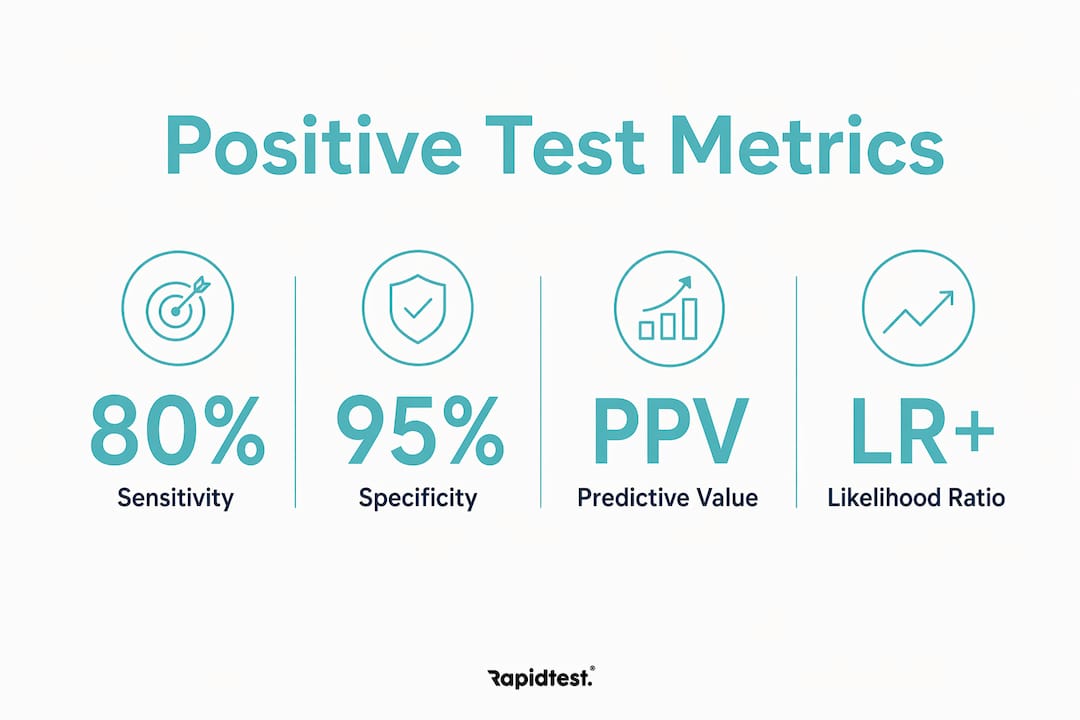
Clinicians also use the likelihood ratio for positive results, written as LR+. An LR+ greater than 10 is considered strong evidence supporting a diagnosis after a positive result. This figure quantifies how much a positive result shifts the probability that you actually have the condition. It is one of the most useful numbers in clinical decision-making, and most patients never hear about it.
What do positive results mean across different test types?
The positive result significance changes dramatically depending on what kind of test you are taking. Here is a breakdown of the most common categories you are likely to encounter.
- Infection tests (STIs, bacterial, viral): A positive result indicates the pathogen or its antibody is present. For STIs like chlamydia or gonorrhoea, this typically means treatment is needed. You can read more about next steps after a positive STI test to understand what happens from there.
- Pregnancy tests (hCG detection): A positive result means the hormone human chorionic gonadotropin has been detected, indicating pregnancy. This is one of the clearest examples of a positive result being welcome news.
- Hormone level tests (LH, FSH, testosterone): These use cutoff thresholds rather than binary detection. A positive result means your level has exceeded or fallen below a clinically defined point. For LH surge tests used in fertility tracking, a positive signals the optimal window for conception.
- Antibody tests: A positive antibody test means high antibody levels have been detected, but this does not necessarily indicate current infection. It may reflect past exposure or vaccination response.
- Cancer marker tests (PSA, FOB): A positive result here means a marker associated with potential disease has been detected above a threshold. It is not a cancer diagnosis. It is a prompt for further investigation.
| Test type | What “positive” means | Typical next step |
|---|---|---|
| STI test | Pathogen or antibody detected | Treatment or confirmatory test |
| Pregnancy test (hCG) | Pregnancy hormone detected | Confirm with GP or midwife |
| LH surge test | Ovulation window identified | Time intercourse or insemination |
| PSA / FOB test | Elevated cancer marker detected | GP referral for further testing |
| Antibody test | Immune response detected | Clinical review of context |
Positive results from binary tests like infection or pregnancy tests differ from semi-quantitative tests using cutoffs like hormone levels. Both are valid, but they require different interpretive frameworks.
Why can positive results be tricky to interpret?
Positive results are not always as clear-cut as they appear, and this is where many people get caught off guard. The first complication is timing. Testing too early in a pregnancy, for example, may produce a false negative because hCG levels have not yet risen above the detection threshold. The same principle applies in reverse: testing too early in an infection cycle may miss the pathogen entirely, giving false reassurance.
Borderline results add another layer of complexity. Results near the cutoff threshold often require further investigation rather than immediate action. A PSA level that sits just above the reference range, for instance, does not confirm prostate cancer. It confirms that the number exceeded a line drawn on a chart, and that line was chosen to balance sensitivity against false positives.
Cross-reactivity is another factor worth knowing about. Some tests can react to substances similar to the target, producing a positive result that does not reflect the actual condition. This is why initial positive results are often presumptive and trigger more specific confirmatory investigations rather than immediate treatment.
Pro Tip: If your result feels unexpected or does not match your symptoms, ask specifically about the test’s PPV and whether a confirmatory test is recommended. This is a completely reasonable question to ask any healthcare professional.
Not all positives mean you need treatment right away. Some are monitoring signals. Some are prompts to retest. Understanding how to read at-home test results with confidence makes a real difference to how calmly and effectively you respond.
What to do after you get a positive result
Getting a positive result can feel like a lot to process. Here is a clear sequence to follow.
- Do not panic. A positive result is information, not a verdict. It means the test detected something. It does not mean you have a confirmed diagnosis or that the situation is beyond management.
- Read the test instructions again. Confirm you followed the procedure correctly, including timing and sample collection. User error is a genuine source of false positives in home testing.
- Note the context. Were you testing early? Do you have symptoms? Have you had recent exposure? These factors all affect how seriously to weight the result.
- Book a follow-up with a healthcare professional. For any positive result involving infection, cancer markers, or unexpected hormone levels, a GP appointment is the right next step. They can order confirmatory tests and provide clinical context.
- Protect your privacy. If you are concerned about confidentiality, at-home testing with Rapidtest means your results stay with you. No GP record is created unless you choose to share the information.
- Seek support if needed. A positive result can trigger anxiety, particularly if you are waiting on confirmatory tests. Talking to someone you trust or a mental health professional is a legitimate and sensible response.
Positive results should be viewed as indicators that require confirmation, not standalone diagnoses. That framing alone removes a significant amount of unnecessary stress.
Key takeaways
A positive result confirms detection of a target substance or marker, but it requires context, confirmation, and calm interpretation before any conclusions are drawn.
| Point | Details |
|---|---|
| Definition of positive result | A positive result means the test detected the target it was designed to find, not that a diagnosis is confirmed. |
| Reliability varies by test | Sensitivity, specificity, and PPV all affect how trustworthy a positive result actually is. |
| Context changes meaning | A positive pregnancy test and a positive STI test are structurally identical but carry completely different implications. |
| Timing affects accuracy | Testing too early can produce false negatives or borderline results, particularly in pregnancy and infection testing. |
| Confirmatory testing matters | Most initial positives are presumptive and should be followed up with a healthcare professional or additional testing. |
Let’s be real about positive results
I have seen a lot of people tie themselves in knots over a single line on a test strip. The anxiety is completely understandable. But the most common mistake I see is treating a positive result as the end of the story, when it is actually the beginning of a much shorter and more manageable one.
The clinical reality is that most positive results from home tests are starting points. They are designed to be sensitive, which means they catch more cases but also produce more false alarms. That is a deliberate design choice, not a flaw. The system is built so that nothing falls through the cracks, and confirmatory testing exists precisely to sort the real positives from the noise.
What I find genuinely reassuring is how much power you have in this process. Testing at home means you find out on your own terms, in your own time, without a waiting room full of strangers. And knowing what a positive result actually means, rather than what you fear it might mean, puts you in a completely different headspace when you go to that follow-up appointment.
The people who handle positive results best are the ones who treat them as data. Not as doom, not as nothing. Just data that needs one more step.
— Jack
Test at home with Rapidtest
Rapidtest offers at-home rapid testing kits that give you clear results in 15 minutes, no queues, no GP appointment, and no awkward conversations. Whether you are checking for an STI, tracking your fertility, or screening for health markers like PSA or FOB levels, Rapidtest has a kit designed for exactly that. The at-home STI test kits deliver fast, private results you can act on straight away. If fertility is your focus, the fertility testing range covers LH, hCG, and SP-10 testing for both men and women. For broader health screening, explore the full health marker test kit range and take control of your health on your own schedule.
FAQ
What does a positive result mean in medical testing?
A positive result means the test has detected the specific substance, marker, or condition it was designed to find. It indicates likely presence but is not a confirmed diagnosis on its own.
Can a positive result be wrong?
Yes. False positives occur when a test detects something that is not actually present, often due to cross-reactivity, low population prevalence, or testing errors. Confirmatory testing is recommended for any unexpected positive result.
What is the difference between a positive and a negative result?
A positive result confirms detection of the target substance. A negative result means the target was not found at a detectable level, though this does not always rule out the condition entirely, particularly if testing was done too early.
How do I interpret a positive result on a home fertility test?
A positive LH test indicates an ovulation surge, signalling the most fertile window. A positive hCG test indicates pregnancy hormone has been detected. Both are reliable indicators but should be confirmed with a healthcare professional for clinical context.
Should I see a doctor after a positive home test result?
For any positive result involving infection, cancer markers, or unexpected hormone levels, a GP appointment is the right next step. They can arrange confirmatory tests and advise on treatment or monitoring as appropriate.