


Test kit expiry dates: when it's safe to use an expired kit
Using an expired at-home COVID-19 test kit is generally not recommended, unless that specific kit has an official extension on record. Before you bin it or use it, do this: check the FDA’s list of authorised at-home tests for an extended expiry, look the kit over for obvious damage, and treat any negative result from an expired test with a healthy dose of scepticism.
Here’s your quick action list:
- Check first. Search the manufacturer and lot number against the FDA’s authorised list (UK readers should also check MHRA guidance for the same product).
- Inspect it. Look for a damaged pouch, discoloured strip, or a control line that doesn’t show up.
- Read cautiously. A positive is usually still meaningful. A negative from an expired kit needs backup, ideally symptom monitoring or a repeat test.
Peer-reviewed work, including studies indexed on PMC, confirms this isn’t a black-and-white situation: some expired kits keep working, others don’t, and there’s no way to tell just by looking at the calendar.
Key Takeaways
Expired at-home COVID-19 test kits should not be used unless the FDA or manufacturer has authorised a specific extension for that batch.
| Point | Details |
|---|---|
| Check the FDA list first | Search the authorised extension database by brand and lot before using or discarding any expired kit. |
| Inspect before testing | A missing control line, discoloured buffer, or damaged pouch means the kit is unusable regardless of date. |
| Trust positives, doubt negatives | Peer-reviewed data suggests expired kits rarely give false positives but are more prone to false negatives. |
| Storage changes everything | Heat and humidity accelerate reagent breakdown faster than the printed date alone suggests. |
| Choose fresh where accuracy matters | For sexual health, fertility, or cancer-marker screening, Rapidtest’s in-date kits remove the uncertainty expired stock carries. |
Table of Contents
- How lateral-flow rapid tests actually detect infection
- Why manufacturers print expiry dates at all
- What the research says about expired kits
- How to check if your expired kit has an official extension
- Checking a single kit for obvious problems
- What to do if expired tests are all you’ve got
- Storage rules that genuinely extend shelf life
- Disposing of expired kits and finding replacements
- Why the expiry date isn’t the whole story
- Reliable testing without the guesswork
- Where to check the official guidance
- Sources
- FAQ
How lateral-flow rapid tests actually detect infection
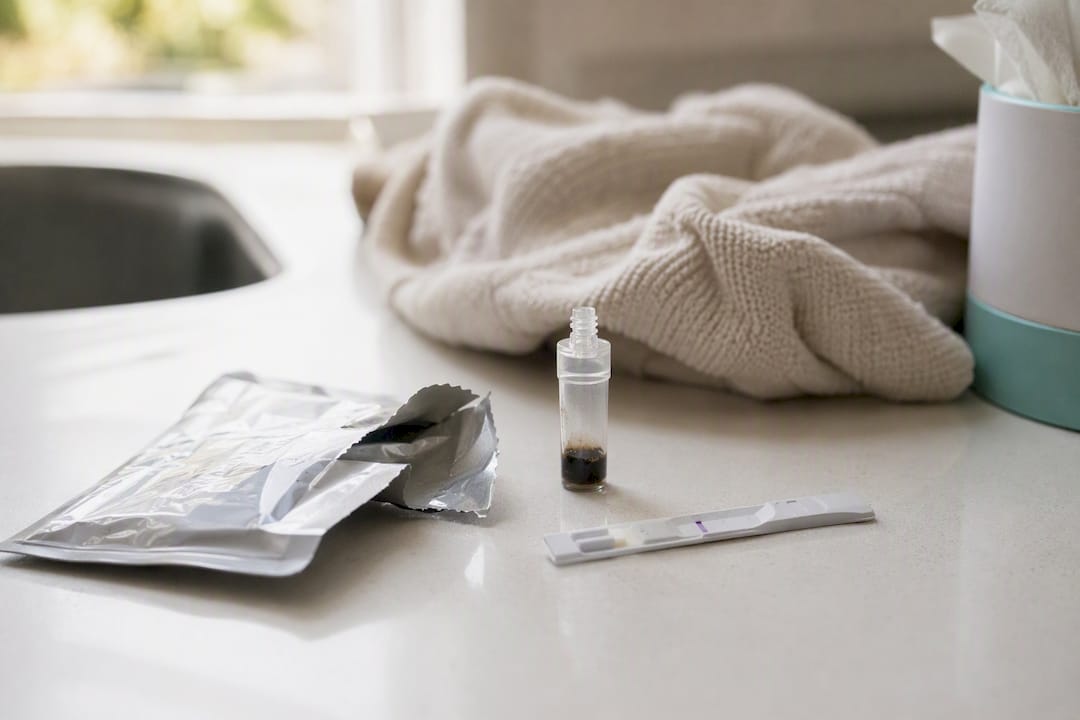
A lateral-flow test is a small chemistry experiment you run in fifteen minutes. Inside the strip, antibodies are printed onto a membrane, waiting to grab hold of viral proteins (antigens) if they’re present in your sample. The extraction buffer, that liquid you drip onto the swab or into the tube, carries the sample along the strip so it reaches those antibodies.
Two things happen as the liquid travels:
- The control line appears if the test has run correctly, regardless of your result. No control line means the test is invalid, full stop.
- The test line appears only if antigen has bound to the antibodies, which is what signals a positive result.
Think of the control line as your quality check and the test line as your actual answer. If the control line hasn’t shown up by the time you read the result, nothing else on that strip means anything, as NHS England explains in its lateral-flow FAQs.
Why manufacturers print expiry dates at all
Those antibodies printed on the strip are proteins, and proteins degrade. Over time they lose their shape and their ability to grab onto antigen, while the chemical stabilisers that keep the whole system stable slowly break down too. This isn’t a design flaw. It’s basic biochemistry, and every manufacturer runs stability testing to work out how long a kit can sit on a shelf before that degradation becomes a real accuracy risk.
Heat and damp air speed the whole process up.
- Storing a kit somewhere too hot, in a car glovebox in summer, for instance, or somewhere damp, like a steamy bathroom cabinet, pushes it outside the tested range faster than the printed date assumes.
- Improper storage that exceeds recommended temperatures can measurably shorten a kit’s effective shelf life, even before the printed expiry arrives.
There’s no home fix for this. Warming a kit up, refrigerating it, or letting it “rest” won’t restore antibody function once it’s gone. Degradation only runs one direction.
What the research says about expired kits
The most useful data point here comes from a peer-reviewed study that tested expired BinaxNOW kits, some up to 27 months past their manufacture date, against fresh, unexpired stock. The results were genuinely mixed. Some expired kits performed close to their original specification. Others clearly hadn’t held up. The researchers were careful to flag that you can’t generalise from one product line to every kit on the market, because storage history and manufacturing batch both play a role in how gracefully a kit ages.
That variability is the headline finding, and it’s worth sitting with. Two boxes of the same test, made months apart, stored slightly differently, can age at different rates. A kit that spent its life in a cool, dark cupboard is a different proposition to one that rattled around in a car boot through a heatwave.
There are limits to what this evidence can tell you, too:
- Sample sizes in these lab evaluations tend to be small.
- Most testing has focused on a handful of specific antigen tests, not the whole market.
- Lab conditions, controlled temperature, careful handling, don’t map perfectly onto how a kit actually lives in someone’s bathroom cabinet for a year.
None of that means expired kits are automatically useless. It means you can’t assume performance either way without checking the specific kit in front of you.
How to check if your expired kit has an official extension
This is the single most useful thing you can do before deciding whether to use or discard a kit. The FDA maintains an updatable list of authorised at-home OTC COVID-19 tests, and it flags which products have had their expiry extended after the manufacturer submitted extra stability data to support it. An “extended expiration date” simply means the maker proved, to the regulator’s satisfaction, that the kit still performs well beyond the date printed on the box.
To check a specific kit:
- Search the FDA’s list by brand name and, where listed, lot number.
- Cross-reference the manufacturer’s own instructions for use, which are sometimes updated separately.
- Note that the FDA has repeatedly reminded consumers to check this list before throwing tests away, because several popular brands have had extensions granted.
If you search and find nothing, that’s your answer. No listed extension means the regulator’s and manufacturer’s position is to discard the kit rather than rely on it.
Checking a single kit for obvious problems
Before you even swab, give the kit a quick visual once-over.
- A missing or noticeably faint control line is the clearest sign something’s wrong.
- Discoloured extraction buffer, or a strip with visible staining or dark patches, points to reagent breakdown.
- A punctured foil pouch or damaged outer packaging means the strip may have been exposed to air and moisture it wasn’t designed for.
- Liquid that pools instead of wicking smoothly along the strip, or a result that hasn’t appeared by the recommended read time, both suggest the test has failed rather than given you a true negative.
Pro Tip: If you’ve got a second kit from a different box or batch, run it alongside the questionable one. Two working control lines from two different lots is a much stronger signal than trusting a single test that’s behaving oddly.
What to do if expired tests are all you’ve got
Sometimes an expired kit is genuinely the only one in the house. Here’s how to approach that sensibly.
- Check for an extension first. Search the FDA’s authorised list before assuming the worst.
- Inspect the physical kit. Apply the checks above, damaged pouch, discoloured strip, obvious wear.
- Only proceed if the control line appears. No control line means stop, the result is meaningless.
- Weigh a positive as likely genuine. Consumer guidance generally treats a positive from an expired kit as trustworthy, since false positives are rare even in degraded kits.
- Treat a negative with more caution. Expired kits are more prone to false negatives than false positives, so pair a negative result with symptom monitoring and, ideally, a repeat test 24 to 48 hours later.
If you’re symptomatic or have been exposed, government guidance on managing possible infection still applies regardless of what your test says. Don’t let a shaky negative override common sense.
If you’re a healthcare worker, travelling under testing requirements, or being screened before a medical procedure, don’t rely on an expired kit at all. The margin for error in those contexts is too thin, and a fresh, verified test is worth the small extra cost.
Storage rules that genuinely extend shelf life
Most kits are designed to be stored at normal room temperature, broadly between 2°C and 30°C, though you should always check the specific range printed on your box. Extremes in either direction accelerate the reagent breakdown covered earlier.
- Never leave kits in a hot car, a sun-facing windowsill, or a bathroom that regularly steams up.
- An unopened box generally holds its printed shelf life better than one that’s been opened and left with loose components rattling around.
- Extraction buffer sometimes outlasts the antibody strip itself. NHS England notes some extraction solutions carry a shelf life of around two years, which is longer than most people expect.
Pro Tip: Buy smaller packs more often rather than one big box you’ll forget about. Jot the expiry date on your calendar or phone the day you buy them, so nothing quietly goes out of date in the back of a drawer.
Disposing of expired kits and finding replacements
Used test components and packaging can go in normal household waste in most cases, though check local guidance if you’re disposing of anything from a household with confirmed infection. When it’s time to restock, check the FDA’s authorised list for the current status of any brand you’re considering, and buy from a retailer you trust rather than an unsealed or second-hand kit from an unverified source. Provenance matters here just as much as the printed date.
Why the expiry date isn’t the whole story
Most guidance on this topic treats the printed date as a hard wall. It isn’t. It’s a manufacturer’s conservative estimate, backed by stability testing, of the point beyond which they can’t confidently guarantee performance. Some kits sail past that point in fine condition. Others fail well before it if they’ve had a rough life in storage.
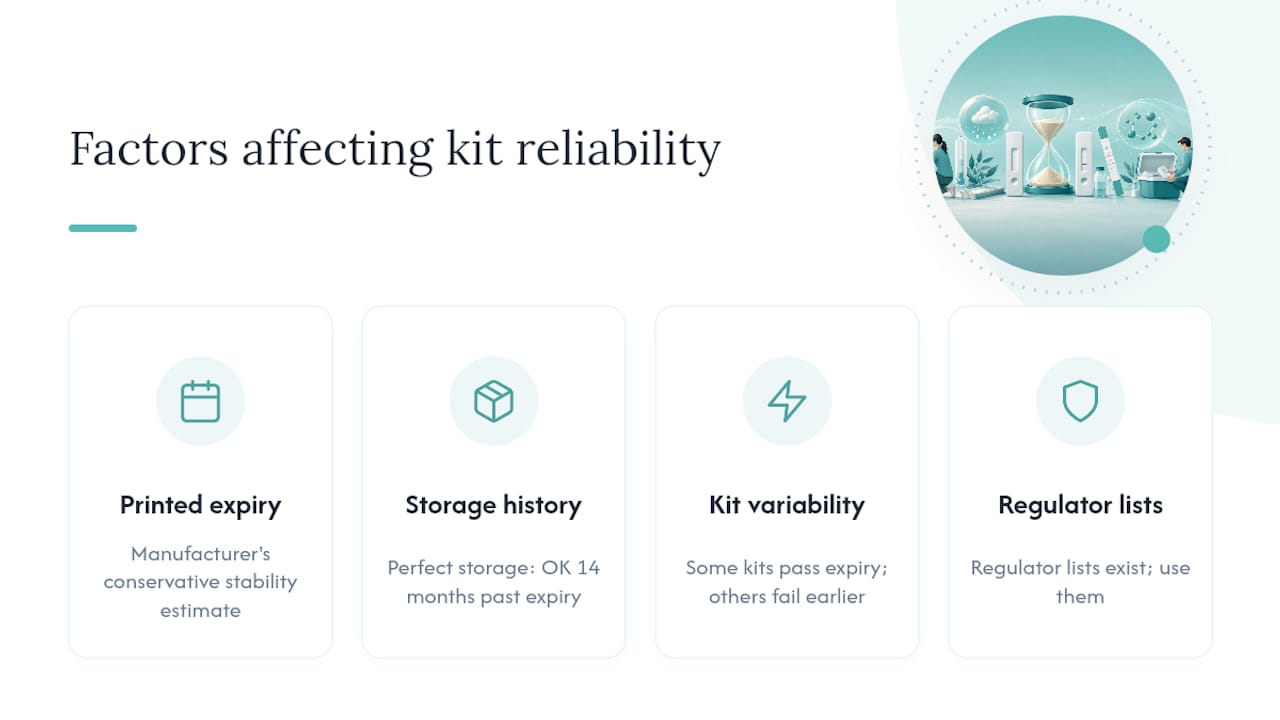
What people underestimate is how much storage history matters compared with the date itself. A kit stored perfectly for fourteen months past its printed expiry is arguably a better bet than one stored badly for two weeks before its official date. That’s not permission to ignore expiry dates. It’s a reason to stop treating the date as the only variable worth checking.
The honest position, and the one backed by the evidence in the BinaxNOW research, is that expired kits are a genuine grey area, not a flat no and not a free pass. Regulator lists exist precisely because blanket rules don’t capture that nuance. Use them.
Reliable testing without the guesswork
Rather than gambling on a kit that’s sat in a cupboard past its date, Rapidtest gives you a straightforward alternative: order a fresh kit, get results at home in 10 to 15 minutes, with no lab returns and no awkward GP conversation.
That matters most for the tests where a false negative has real consequences, sexual health screening, fertility tracking, or PSA and FOB checks for prostate and bowel health. Rapidtest’s at-home STI testing kits cover chlamydia, gonorrhoea, syphilis, HIV, and more, all delivered discreetly with full instructions included. If your concerns run to reproductive health, the fertility and hormone testing range covers FSH, LH and HCG. Whatever you’re checking, start with a kit you know is within date, and let the result tell you something you can actually trust.
Where to check the official guidance
- The FDA’s authorised at-home test list is the definitive source for checking whether your kit’s expiry has been extended.
- The FDA’s bulletin on extended expirations explains why the agency recommends checking before discarding tests.
- NHS England’s lateral-flow FAQs cover how the tests work and practical storage detail.
- The PMC study on expired BinaxNOW kits is the primary peer-reviewed evidence behind this article’s caution around variability.
- CNET’s consumer walkthrough translates the regulator steps into a simple checklist if you want a plain-English version.
This article is general information, not a substitute for advice from a qualified doctor. Consult a qualified healthcare professional about your own circumstances before acting on anything here.
Sources
- Accuracy of Expired BinaxNOW Rapid Antigen Tests - PMC
- At-Home OTC COVID-19 Diagnostic Tests | FDA
- Coronavirus » Lateral flow antigen test FAQs
- How to Check if Your Expired At-Home COVID Test Is Still Good to Use - CNET
FAQ
Is a COVID test kit still good after the expiration date?
Sometimes, but only if the FDA or manufacturer has issued an official extension for that specific product and lot. Without one, the safe assumption is that accuracy can’t be guaranteed.
Is my pregnancy test still reliable if it expired two years ago?
A pregnancy test that expired two years ago has a high chance of reduced accuracy, since the antibodies involved degrade steadily over time regardless of storage. Replacing it with a fresh kit is the safer choice, especially given how time-sensitive a pregnancy result usually is.
What are the signs a COVID test is no longer valid?
A missing or very faint control line, discoloured extraction buffer, a damaged foil pouch, or liquid that fails to flow properly along the strip are all signs the kit has degraded and shouldn’t be trusted.
Will old COVID tests still work for new variants?
Rapid antigen tests detect a viral protein rather than a specific variant’s genetic sequence, so most lateral-flow tests continue working across variants regardless of age. Whether an old kit still works comes down to reagent degradation, not variant mismatch.
What should I do if a negative result comes from an expired kit?
Treat it cautiously rather than as conclusive, particularly if you have symptoms or a known exposure, and follow up with a repeat test or a fresh, in-date kit from a source like Rapidtest where accuracy matters most.