


Syphilis self-tests explained: accuracy, results & next steps
Most people assume a syphilis test gives you a straight answer. You test positive, you have syphilis. You test negative, you don’t. Simple, right? Not quite. At-home syphilis self-tests detect antibodies your immune system makes in response to the infection and here’s the catch: those antibodies can stay in your blood for life, even after successful treatment. That means a positive result doesn’t always mean you have an active infection right now. Understanding what your result actually tells you is just as important as taking the test in the first place.
Table of Contents
- Understanding syphilis and why testing matters
- Types of syphilis tests explained: treponemal, non-treponemal, and self-tests
- How at-home syphilis self-testing works
- The clinical pathway: what to do with your syphilis self-test result
- A reality check: at-home syphilis self-tests are screening, not diagnosis
- Explore your at-home STI testing options
- Frequently asked questions
Key Takeaways
| Point | Details |
|---|---|
| At-home tests are screening tools | A positive test should always be confirmed with clinical follow-up and further testing. |
| Treponemal self-tests detect antibodies | These tests cannot distinguish between past and current infection on their own. |
| Accuracy meets high standards | Most commercial kits deliver high sensitivity and specificity, but certain groups need extra caution. |
| Early repeat testing is critical | After recent exposure or symptoms, repeat testing increases chances of accurate detection. |
| Follow UK/EU clinical pathways | Self-test users should follow up with recommended clinical algorithms for diagnosis and care. |
Understanding syphilis and why testing matters
Syphilis is a bacterial sexually transmitted infection (STI) caused by Treponema pallidum. It’s completely curable with antibiotics, but left untreated it can progress through four stages, causing serious damage to the heart, brain, and nervous system. The tricky part is that many people don’t realize they have it.
Symptoms can be easy to miss or dismiss entirely. A painless sore that disappears on its own, a faint rash that looks like a skin irritation, or no symptoms at all. Lots of people carry syphilis for months or even years without knowing. That’s exactly how it keeps spreading.
Here’s why regular testing matters:
- Syphilis is at a decades-long high across Europe and the UK. Rates have been climbing steadily, affecting all genders and sexual orientations.
- Early detection means simple, effective treatment. One course of antibiotics in the early stages is usually all it takes.
- Untreated syphilis is dangerous. Late-stage syphilis can affect your brain, heart, bones, and eyes.
- You can pass it on without knowing. Testing is how you protect yourself and your partners.
“Testing is the most powerful tool we have against syphilis. You can’t treat what you don’t know about.”
The UKHSA syphilis response plan confirms the UK testing landscape has expanded to include convenient online postal kits, making testing more accessible and private than ever before. If you’re unsure about what to look for before you test, our syphilis symptoms guide covers the full picture.
With the importance of timely and discreet testing established, let’s explore how syphilis tests actually work.
Types of syphilis tests explained: treponemal, non-treponemal, and self-tests
Now that you know why testing is so important, here’s a deep dive into what kinds of tests are available and what they actually tell you.
There are two main categories of syphilis tests used in clinical and home settings. Each plays a different role, and knowing the difference is key to understanding your result.
Treponemal tests detect antibodies specifically targeting Treponema pallidum, the bacteria that causes syphilis. At-home syphilis self-tests are typically treponemal antibody lateral-flow rapid tests, using a finger-prick whole blood sample to detect these antibodies. They’re fast, simple, and accurate for initial screening. The problem is that treponemal antibodies persist lifelong, meaning a reactive result may reflect a past, treated infection rather than an active one. Confirmatory testing is always needed.
Non-treponemal tests (like VDRL and RPR) measure your body’s general inflammatory response to the infection. They’re excellent for detecting active disease and monitoring whether treatment is working, because the levels rise with active infection and fall after successful treatment. These are not available as at-home self-tests. They require a lab.
Combining treponemal and non-treponemal tests is the gold standard for full diagnosis and monitoring treatment response. One without the other gives you only part of the story.
| Test type | What it detects | Available at home? | Tells you if infection is active? |
|---|---|---|---|
| Treponemal (self-test) | Syphilis-specific antibodies | Yes | No |
| Treponemal (lab) | Syphilis-specific antibodies | No | No |
| Non-treponemal (lab) | General inflammation/RPR | No | Yes |
| Combined (clinical) | Full picture | No | Yes |
Pro Tip: Think of an at-home syphilis self-test as a smoke detector. It tells you something may be wrong. It doesn’t tell you where the fire is or how big it is. A clinician does that part.
You can learn more about exactly how self-testing kits work and what makes them clinically valid screening tools before you buy.
How at-home syphilis self-testing works
With test types clarified, let’s focus specifically on the experience and limitations of at-home syphilis screening so you know exactly what to expect.
Using an at-home syphilis test is genuinely straightforward. Most kits involve the same basic process:
- Wash and dry your hands. A clean finger-prick gives a better sample.
- Use the lancet (tiny needle) to prick your fingertip. A small dot of blood is all you need.
- Apply the blood to the test cassette using the dropper or collection tube provided.
- Add the buffer solution as directed in the instructions.
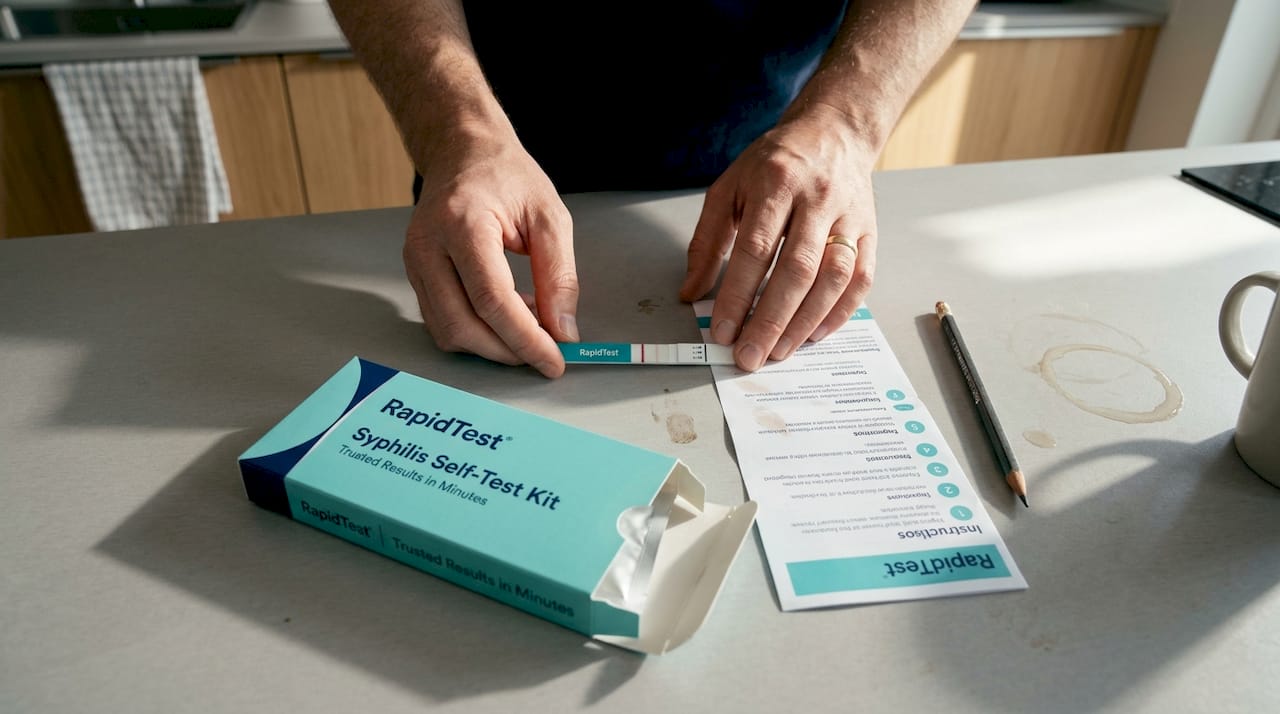
- Wait 15 to 20 minutes and read your result in good lighting.
At-home syphilis self-tests use this finger-prick blood sample to screen for treponemal antibodies and give a positive or negative result. It’s genuinely that simple, and results come in under 20 minutes for most kits.
Reading your result:
A single line (control line only) = negative. Syphilis antibodies were not detected. Two lines (control line + test line) = positive. Antibodies to Treponema pallidum were detected.
Here’s the critical nuance. A positive result means your body has produced antibodies to syphilis at some point. It does not confirm whether you have an active infection right now, or whether a past infection was successfully treated. That distinction requires clinical follow-up.
How accurate are these kits?
Very accurate, for most people. A commercial treponemal self-test demonstrated sensitivity of 93.4% and specificity of 99.5% overall. In plain terms: it correctly identifies over 93 in 100 people who have syphilis antibodies, and correctly returns a negative for over 99 in 100 people who don’t. That’s strong performance.
However, sensitivity dropped to 75% in pregnant individuals in the same study. So if you’re pregnant, a negative self-test alone is not sufficient reassurance. Please seek clinical testing regardless.
What about window periods? Syphilis antibodies typically develop within 2 to 4 weeks of infection, but can take up to 90 days. If you’ve had a recent possible exposure, a negative result today doesn’t fully rule it out. Retest at 6 weeks and again at 3 months.
Pro Tip: Check the expiry date on your kit before you use it. An expired test strip can affect accuracy. Store kits at room temperature, away from direct sunlight.
Our guide on the safe use of at-home tests walks you through common mistakes to avoid so your result is as reliable as possible.
The clinical pathway: what to do with your syphilis self-test result
Knowing how to use and interpret a self-test is only part of the picture. Understanding clinical next steps ensures you manage your health responsibly, whatever result you get.
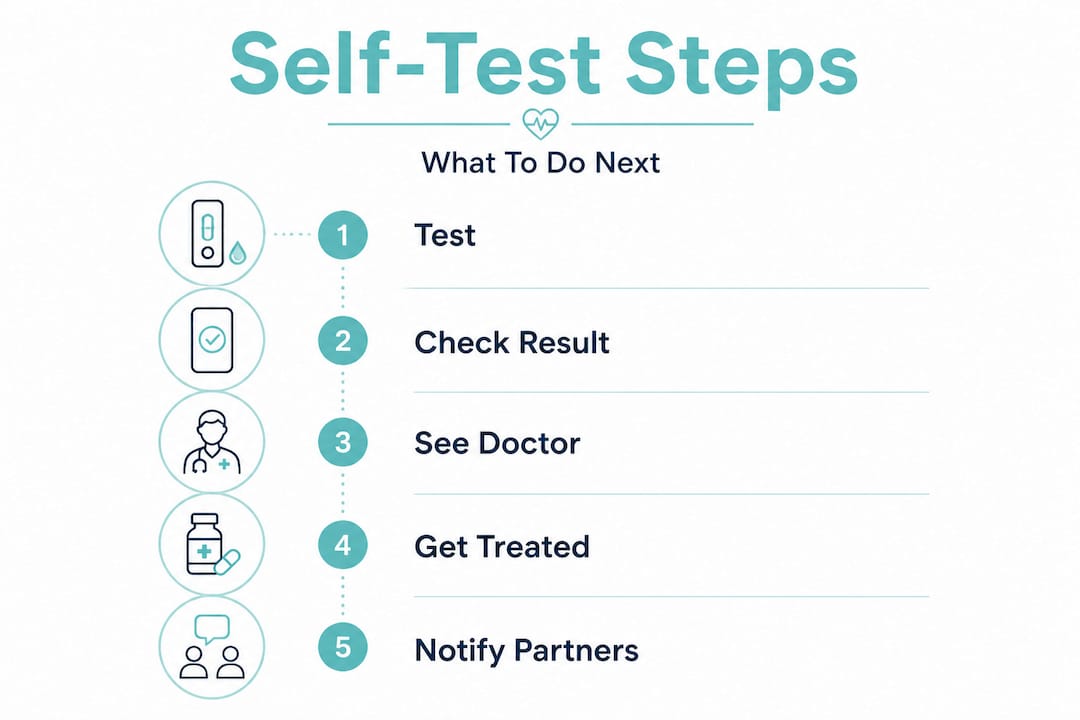
If your result is positive:
Don’t panic, but do act quickly. A positive self-test means syphilis antibodies are present. You need clinical confirmation to find out whether you have an active infection requiring treatment.
- Book an appointment at a sexual health clinic, GUM clinic, or your GP.
- Tell them you’ve had a reactive at-home syphilis test.
- They’ll run a full laboratory workup, including both treponemal and non-treponemal tests.
- If infection is confirmed, treatment with penicillin is fast and highly effective.
- Partner notification is also important. Your clinic can help with this sensitively.
If your result is negative:
A negative result is reassuring, but there are situations where you should still follow up.
- If you’ve had a potential exposure in the last 90 days, retest at 6 weeks and 3 months.
- If you have symptoms like a painless sore, rash, or swollen glands, see a clinician even if your test is negative.
- If you’re pregnant or planning to become pregnant, request clinical testing regardless.
| Scenario | Recommended action |
|---|---|
| Positive self-test, no symptoms | Seek clinical confirmation within 1 week |
| Positive self-test, symptoms present | Seek same-day or next-day care |
| Negative self-test, recent exposure | Retest at 6 weeks and 3 months |
| Negative self-test, ongoing risk | Regular screening every 3 to 6 months |
| Pregnant, any result | Clinical testing required |
What about discordant results?
Sometimes you might get mixed signals during follow-up testing. Discordant results, where a treponemal test is positive but a non-treponemal test is negative, are more common than you’d expect. This can mean a past, treated infection, or a very early current infection. Clinicians handle this by running a second treponemal test from a different manufacturer and scheduling a retest in a few weeks.
“If you’ve had syphilis before and been treated, a reactive treponemal test can look identical to a new infection. That’s why lab follow-up isn’t optional, it’s necessary.”
The UK clinical algorithm for syphilis diagnosis (2025) includes repeat testing when early infection is suspected and uses paired results across multiple test types to reach a confident diagnosis. It’s a layered process, and that’s a good thing. It means fewer misdiagnoses and better outcomes.
For a broader look at home-based STI screening options, our guide on screening for STIs at home gives you a step-by-step overview, and our piece on the accuracy of STI self-tests gets into the numbers in more detail.
A reality check: at-home syphilis self-tests are screening, not diagnosis
Having covered what to do after you test, here’s a frank perspective on where self-tests fit, and where they don’t, in managing syphilis risk.
We’re big believers in at-home testing. No queues, no awkward conversations, results in 15 minutes. That convenience genuinely changes behavior for the better. People test more often when it’s private and easy. And testing more often means catching infections earlier, which means fewer complications and less transmission.
But we’d be doing you a disservice if we didn’t say this clearly: at-home syphilis self-tests are screening tools. A reactive result tells you that syphilis antibodies are present in your blood. It does not tell you whether you have an active infection, whether a previous infection was treated, or what stage of disease you might be in. Those questions require a clinician and a lab.
This matters a lot in practice. We’ve seen the confusion it causes. Someone tests positive at home, feels terrified, assumes the worst. Or someone tests negative after a risky encounter and assumes they’re in the clear, even though they’re still within the window period. Both situations can lead to poor decisions, either unnecessary panic or dangerous complacency.
The healthy middle ground is this: treat your self-test result as the starting point of a process, not the end of it. A positive means “get checked.” A negative with ongoing risk means “stay on top of it.” There’s real value in understanding why self-tests aren’t final diagnosis tools, and knowing that upfront makes you a smarter, more confident tester.
Self-testing empowers you to act. But the system works best when you follow through with clinical care when the situation calls for it. That’s not a criticism of at-home tests. It’s just how responsible sexual health management works.
Explore your at-home STI testing options
Ready to take control of your sexual health from home? At-home testing makes it genuinely easy to stay on top of your STI status without waiting rooms, awkward conversations, or delays.
At RapidTest, we offer trusted, clinically validated kits that give you results in just 15 minutes. Our at-home syphilis test is accurate, private, and simple to use, whether you’re testing for the first time or keeping up with regular screening. Looking for wider coverage? Browse our full range of at-home STI/STD test kits to find the right option for your needs. We also have rapid home STI tests covering multiple infections in one kit, giving you a more complete picture of your sexual health in one go.
Frequently asked questions
Can I rely on an at-home syphilis self-test as the only test I need?
No. At-home syphilis tests are screening tools only, and a positive or unclear result always requires clinical follow-up with laboratory confirmation before any treatment decisions are made.
How accurate are at-home syphilis self-tests?
Leading commercial self-tests show 93.4% sensitivity and 99.5% specificity overall, making them reliable screening tools, though accuracy may be lower during pregnancy where sensitivity can drop to around 75%.
What should I do if my self-test is positive or unclear?
Seek medical attention promptly for laboratory-based confirmatory testing and to get advice on treatment and notifying any recent partners.
If my self-test is negative, can I be sure I don’t have syphilis?
Not completely. A negative result is reassuring, but retesting is advised if you have symptoms, recent exposure, or ongoing risk, since very early or latent infections can produce a false negative.
Are private, postal STI self-sampling kits in the UK as reliable as clinic tests?
They use the same proven technology, but follow-up is still required after any positive or unclear result, since lab-based confirmation is needed before a definitive diagnosis can be made.