


Stomach bacteria test: what you need to know
A stomach bacteria test identifies the presence of Helicobacter pylori, the bacterial cause of peptic ulcers, gastritis, and persistent stomach discomfort. If you have been dealing with bloating, burning pain, or nausea that just will not shift, this is the test your GP is most likely to recommend. H. pylori is carried by roughly two thirds of the world’s population, making it one of the most common bacterial infections on earth. Testing is typically triggered by stomach symptoms lasting more than a month, and the results directly shape whether you need antibiotic treatment.
What are the different types of stomach bacteria tests?
Four main test types exist for detecting H. pylori: the urea breath test, stool antigen test, blood antibody test, and endoscopic biopsy. Each works differently, and choosing the right one depends on your symptoms, your history, and what your doctor needs to know.
Urea breath test
The urea breath test is the most widely used non-invasive option. You swallow a capsule or drink containing urea labelled with a carbon tracer. If H. pylori is present in your stomach, its urease enzyme breaks down the urea and releases carbon dioxide, which shows up in your breath sample. The test detects active infection only, making it reliable for both initial diagnosis and confirming that treatment has worked.
Stool antigen test
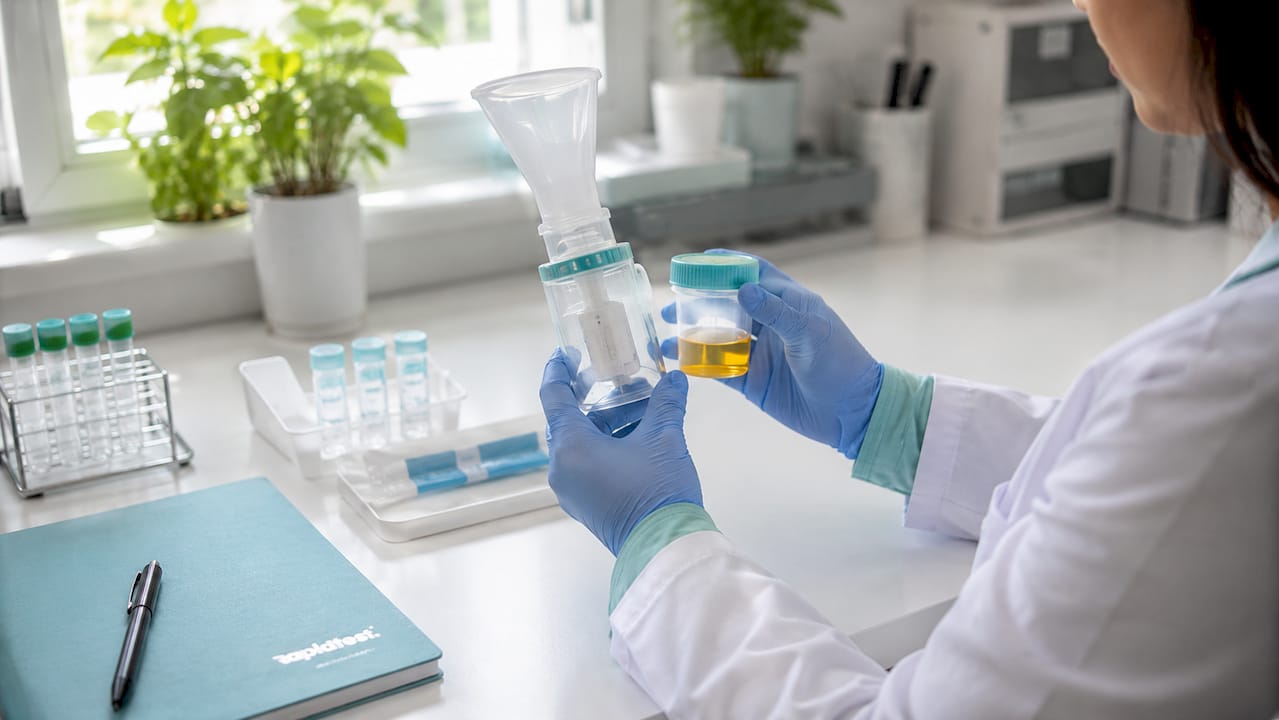
The stool antigen test detects H. pylori proteins directly in a stool sample. It is accurate, non-invasive, and used to monitor treatment success as well as diagnose active infection. Like the breath test, it reflects what is happening in your gut right now, not what happened months ago.
Blood antibody test
The blood test checks for antibodies your immune system produced in response to H. pylori. The problem is that antibodies persist for years after eradication, so a positive result cannot confirm whether you have an active infection or simply had one in the past. Blood tests are the least reliable option for current infection and should not be used to confirm that treatment has cleared the bacteria.
Endoscopic biopsy
An endoscopic biopsy involves passing a thin camera through your mouth into your stomach to collect a small tissue sample from the stomach lining. It is the most invasive option, but it provides the most information. When alarm symptoms are present, such as unexplained weight loss, difficulty swallowing, or blood in the stool, a biopsy goes beyond detecting H. pylori to assess the condition of the stomach lining itself.
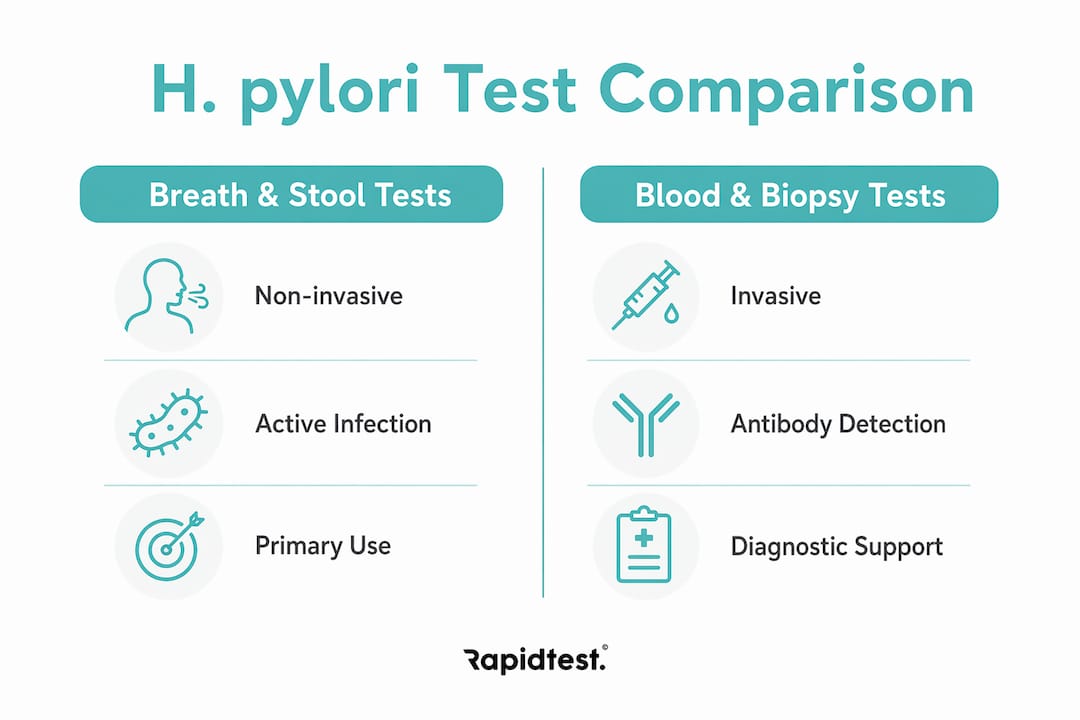
Comparison of H. pylori test types
| Test | Invasiveness | Detects active infection | Typical use |
|---|---|---|---|
| Urea breath test | Non-invasive | Yes | Diagnosis and post-treatment check |
| Stool antigen test | Non-invasive | Yes | Diagnosis and eradication confirmation |
| Blood antibody test | Minimal (blood draw) | No (past exposure only) | Limited; not for confirming cure |
| Endoscopic biopsy | Invasive | Yes | Alarm symptoms or inconclusive results |
How to prepare for a stomach bacteria test
Preparation makes a real difference to the accuracy of your results. Get it wrong and you risk a false negative, which means the test misses an active infection and you go without treatment.
The key rules before a urea breath test are:
- Fast for at least one hour before the test, though some clinics ask for a longer fast. Check with your provider.
- Stop antibiotics at least four weeks before testing. Antibiotics suppress H. pylori without fully clearing it, which can mask a positive result.
- Stop proton pump inhibitors (PPIs) such as omeprazole or lansoprazole for one to two weeks before the test. PPIs and bismuth compounds must be stopped to avoid false negatives.
- Stop H2 blockers such as ranitidine for 24–48 hours before testing.
- Tell your doctor about every medication you are taking, including over-the-counter acid reducers. Even short-term use of antacids can affect results.
The same preparation rules apply to the stool antigen test. Both tests measure active bacterial activity, so anything that suppresses the bacteria will interfere with the reading.
Pro Tip: If you are testing after a course of antibiotics to confirm eradication, wait at least four weeks after finishing the antibiotics and one to two weeks after stopping PPIs before you test. Testing too soon is the most common reason for a misleading negative result.
Timing matters just as much as preparation. Testing too early after antibiotic therapy risks false negatives because suppressed bacteria fall below the detection threshold. A negative result at two weeks does not mean the infection is gone.
What do your test results mean?
A positive result on a breath or stool antigen test confirms active H. pylori infection. Your doctor will typically prescribe a course of combination antibiotics, often alongside a PPI, to eradicate the bacteria. Most people complete treatment within one to two weeks.
A negative result on a breath or stool test is reliable, provided you followed the preparation guidelines. It means H. pylori is not currently active in your stomach. If your symptoms persist despite a negative result, further investigation is needed to rule out other causes.
Blood test results require more careful interpretation:
- A positive blood test does not confirm active infection. Antibodies remain in the bloodstream for years after the bacteria have gone. A positive blood result alone is not enough to start antibiotic treatment.
- A negative blood test is more useful. It makes current infection unlikely, though it cannot rule it out entirely in people who have never been exposed before.
- Post-treatment confirmation should always use a breath or stool test, not a blood test. Breath and stool tests detect active infection far more reliably than blood antibody tests for this purpose.
- Biopsy results provide the most complete picture. Beyond confirming H. pylori, a biopsy can identify gastritis, ulcers, or early signs of more serious conditions. Upper endoscopy with biopsy is appropriate when initial non-invasive testing is inconclusive or when alarm symptoms are present.
If your treatment course is complete, your doctor will arrange a test of cure. This is a repeat breath or stool test, performed at least four weeks after finishing antibiotics. It confirms the bacteria have been fully cleared.
How does a stomach bacteria test differ from gut microbiome testing?
This is where a lot of people get confused. A stomach bacteria test, specifically an H. pylori test, is a clinically validated diagnostic tool. A gut microbiome test, sold directly to consumers, is something quite different.
H. pylori tests detect one specific pathogen with established clinical thresholds. The result is binary: the infection is either present or it is not. Treatment protocols are clear and well evidenced.
Direct-to-consumer gut microbiome tests profile the broader community of bacteria in your stool. They look at hundreds of species and generate reports about your intestinal flora. The problem is that 2026 research shows large inconsistencies within and across providers, and no reliable pattern for a “healthy microbiome” has been established. The analytical variability is significant enough to undermine any clinical conclusions.
“No current clinical guideline supports using direct-to-consumer gut microbiome tests for diagnosis or treatment decisions due to lack of clinical validity and consistency.” — Henry Ford Health, 2026
Stool microbiome tests profile bacterial communities but lack clinically validated markers or thresholds. They cannot diagnose H. pylori or any other specific stomach infection. If you are experiencing digestive symptoms, a targeted H. pylori test gives you answers you can act on. A microbiome report gives you a list of bacteria with no clear clinical meaning attached.
Practical points to bear in mind if you are considering gut health testing:
- An H. pylori breath or stool test is the right starting point for unexplained stomach symptoms.
- Gut microbiome tests are not endorsed by clinical guidelines for diagnosing or treating digestive conditions.
- If you want professional guidance on gut health beyond H. pylori, a gut health specialist can help you interpret symptoms in a clinical context.
- At-home H. pylori tests are a practical, evidence-based option for initial screening.
Key takeaways
A stomach bacteria test is the most direct and clinically reliable way to identify H. pylori infection, and choosing the right test type determines whether your result is actually trustworthy.
| Point | Details |
|---|---|
| Breath and stool tests are most reliable | Both detect active infection and are suitable for diagnosis and post-treatment confirmation. |
| Blood tests have a key limitation | Antibodies persist for years, so a positive blood result cannot confirm current infection. |
| Preparation affects accuracy | Stop PPIs for 1–2 weeks and antibiotics for 4 weeks before testing to avoid false negatives. |
| Timing post-treatment matters | Wait at least 4 weeks after antibiotics before a test of cure to get an accurate result. |
| Microbiome tests are not a substitute | Direct-to-consumer gut tests lack clinical validation and cannot diagnose H. pylori. |
What I have learned about getting stomach bacteria testing right
I have read a lot of clinical guidance on H. pylori testing, and the single most consistent finding is this: people get false negatives because they test too soon or forget to stop their medication. It sounds simple, but it catches people out constantly. Someone finishes a course of antibiotics, feels a bit better, and tests after two weeks. The result comes back negative. They assume they are clear. They are not necessarily.
The blood test misconception is the other big one. A positive blood test does not mean you have an active infection right now. It means your immune system responded to H. pylori at some point. That could have been five years ago. Doctors know this, but patients often do not, and it leads to unnecessary anxiety or, worse, unnecessary antibiotic courses.
My honest view is that the breath test or stool antigen test should be the default for anyone with persistent stomach symptoms. They are non-invasive, accurate, and give you a result you can actually use. The at-home H. pylori test guide from Rapidtest is worth reading if you want a clear breakdown of how at-home options compare to clinical testing.
The gut microbiome space is genuinely interesting, but it is not ready for clinical use. If someone is selling you a detailed health plan based on a stool microbiome report, be sceptical. The science does not yet support that level of interpretation. Stick with validated tests for specific concerns, and speak to a doctor if your symptoms are persistent or worsening.
— Jack
At-home H. pylori testing with Rapidtest
If you have been putting off getting checked because the idea of a GP appointment feels like too much hassle, you are not alone.
Rapidtest offers an at-home H. pylori rapid test kit that gives you results in 15 minutes, with no queues, no appointment, and no awkward conversations. It is a practical first step if you are experiencing persistent stomach discomfort and want to know whether H. pylori could be the cause. Rapidtest also offers a full range of health screening test kits covering digestive health, prostate health, and more. Private, fast, and straightforward.
FAQ
What is a stomach bacteria test?
A stomach bacteria test is a diagnostic test used to detect Helicobacter pylori, the bacterium responsible for most peptic ulcers and chronic gastritis. The most common types are the urea breath test, stool antigen test, blood antibody test, and endoscopic biopsy.
Which stomach bacteria test is the most accurate?
The urea breath test and stool antigen test are the most accurate for detecting active H. pylori infection. Blood antibody tests are unreliable for confirming current infection because antibodies persist for years after the bacteria have cleared.
How long before a stomach bacteria test should I stop taking PPIs?
Stop proton pump inhibitors such as omeprazole for one to two weeks before a urea breath test or stool antigen test. Taking PPIs before testing suppresses bacterial activity and can produce a false negative result.
Can a gut microbiome test replace an H. pylori test?
No. Direct-to-consumer gut microbiome tests cannot detect H. pylori and lack the clinical validation needed for diagnosing digestive infections. A targeted H. pylori breath or stool test is the appropriate tool for investigating stomach symptoms.
When should I test after H. pylori treatment?
Wait at least four weeks after completing antibiotic therapy, and one to two weeks after stopping PPIs, before taking a test of cure. Testing earlier risks a false negative because residual medication can suppress bacterial activity below the detection threshold.