


H pylori test at home: your complete 2026 guide
An H pylori test at home is a fast, private way to screen for Helicobacter pylori infection by detecting antibodies or antigens in a finger-prick blood or stool sample, with results ready in as little as 10 to 15 minutes. H pylori is not a minor inconvenience. It causes up to 80% of gastric ulcers and roughly 90% of duodenal ulcers. If you have been dealing with persistent bloating, burning stomach pain, or unexplained nausea, a home H pylori kit from brands like Rapidtest or Dr. Manya gives you a clear starting point before you speak to your GP. These tests are screening tools, not diagnoses. A positive result means you need a GP appointment for confirmation and prescription treatment, not a trip to the pharmacy.
What types of H pylori home tests are available?
Three main test types exist for home H pylori testing: blood antibody tests, stool antigen tests, and breath tests. Each works differently and suits different situations.
Blood antibody tests
Blood antibody tests use a finger-prick sample and deliver results in 10–15 minutes. They detect whether your immune system has produced antibodies in response to H pylori. The critical limitation is that antibody tests detect past or current exposure but cannot confirm whether the infection is still active. Someone who cleared the infection months ago may still test positive. These are the most widely available at-home option and the easiest to use.
Stool antigen tests
Stool antigen tests detect actual bacterial proteins in a stool sample. This makes them more reliable for confirming an active infection. Most require you to post the sample to a lab, so results take longer. They are the preferred method for checking whether treatment has worked after a course of antibiotics.
Breath tests
The H pylori breath test kit is the gold standard in clinical settings. You swallow a urea solution, and if H pylori is present, it breaks down the urea and releases carbon dioxide that shows up in your breath sample. Some home sample collection kits exist, but the sample is processed in a lab rather than at home. For most people doing an at home H pylori check, the blood antibody test is the most practical starting point.
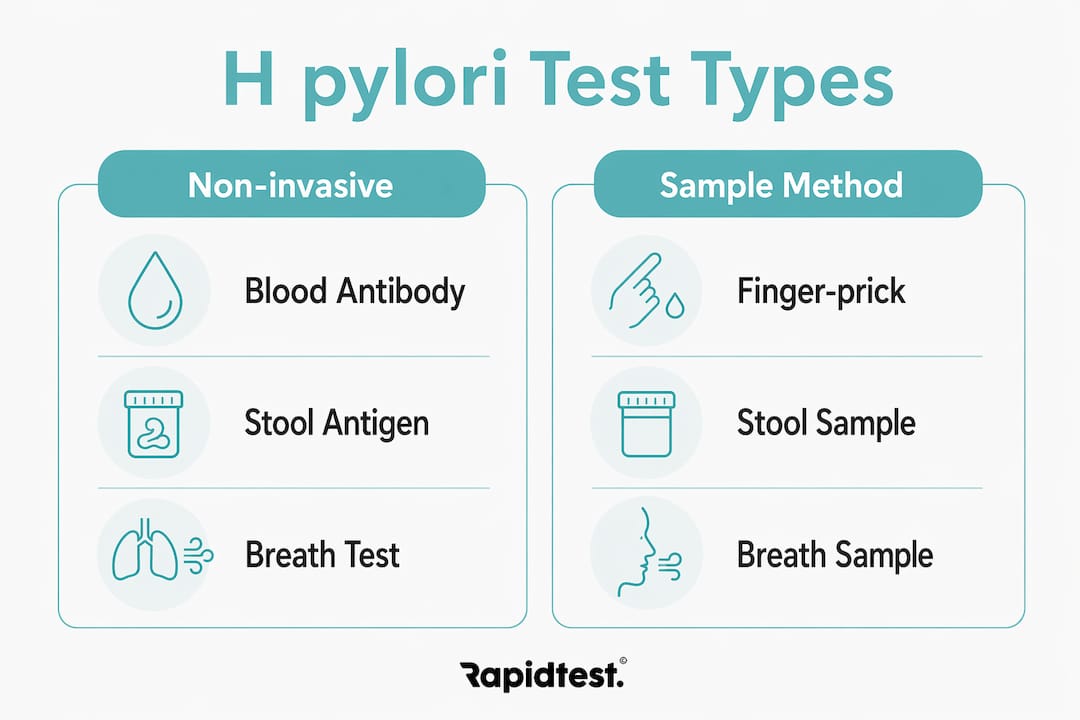
| Test type | Sample method | Time to result | Best used for |
|---|---|---|---|
| Blood antibody | Finger-prick | 10–15 minutes | Initial screening |
| Stool antigen | Stool sample (posted) | 1–3 days | Confirming active infection |
| Breath test | Breath sample (posted) | 1–3 days | Diagnosis and post-treatment check |
How to perform an H pylori test at home correctly
Getting an accurate result depends almost entirely on preparation. Rushing the process or ignoring the instructions is the most common reason for invalid results.
What you will typically find in a home H pylori kit:
- A lancet for finger-prick blood collection
- A collection tube or capillary pipette
- A test cassette or strip
- A buffer solution bottle
- An instruction leaflet with a result guide
Step-by-step process for a blood antibody test:
- Do not eat, drink (except water), or take antacids for at least two hours before testing.
- Wash your hands thoroughly with soap and warm water, then dry them completely.
- Use the lancet to prick the side of your fingertip. Wipe away the first drop of blood.
- Collect the required amount of blood using the pipette or collection tube provided.
- Add the blood sample to the test cassette, then apply the buffer solution as directed.
- Set a timer for the time stated in your kit instructions, usually 10–15 minutes.
- Read the result within the specified window. Results read after this window may be unreliable.
Pro Tip: Warm your hands before the finger-prick by rubbing them together or running them under warm water. Cold hands restrict blood flow and make sample collection much harder.
Timing matters more than most people realise. Antibiotics, proton pump inhibitors like omeprazole, and bismuth-based medicines can all suppress H pylori activity and produce false negative results. Stop these medications at least two weeks before testing if your GP agrees it is safe to do so.
| Preparation step | Why it matters |
|---|---|
| Fast for 2 hours | Reduces interference with the sample |
| Avoid antibiotics for 2 weeks | Prevents false negative results |
| Avoid acid suppressants for 2 weeks | H pylori activity must be detectable |
| Read result in time window | Results outside the window are unreliable |
How to interpret your H pylori home test results
Reading the result correctly is where many people go wrong. Understanding what each line means prevents unnecessary panic or false reassurance.
- Two lines (C and T): Negative result. The control line © confirms the test worked. The test line (T) appearing means no significant antibody level was detected.
- One line (C only): Positive result. Antibodies to H pylori were detected in your sample.
- One line (T only) or no lines: Invalid result. The test did not work correctly. Repeat with a new kit.
A positive result does not mean you need antibiotics today. A positive home test requires GP follow-up for confirmation, because antibiotic treatment for H pylori is only available on prescription. Your GP will likely arrange a stool antigen test or breath test to confirm active infection before prescribing.
A negative result is reassuring but not absolute. A negative result does not definitively rule out infection if you were exposed recently, as antibodies may not yet be detectable. If your symptoms continue, see your GP regardless of the result.
If your symptoms include unexplained weight loss, difficulty swallowing, vomiting blood, or black tarry stools, do not wait for a home test result. Seek urgent medical attention immediately.
Pro Tip: Take a photo of your test result before the reading window closes. This gives you a clear record to show your GP and removes any uncertainty about what you saw.
H pylori spreads through saliva, contaminated water, and close household contact, which is why testing other household members makes sense if you test positive. Kits like the Dr. Manya three-pack are designed with this in mind.
What are the benefits and limitations of testing for H pylori at home?
Home testing gives you real information quickly, without a GP appointment or a wait at a clinic. That matters when you are trying to work out whether your symptoms are worth worrying about. Early-stage H pylori infection is often asymptomatic, so routine screening for people with recurring digestive discomfort is genuinely useful. Knowing your status before you see a GP also means the appointment is more focused and productive.
CE-certified home tests match clinical rapid test accuracy when used correctly. That is a meaningful level of reliability for a screening tool you can use at your kitchen table.
The limitations are real too. A blood antibody test cannot tell you whether the infection is currently active. You cannot treat yourself at home. And a negative result does not close the case if your symptoms persist. Home testing works best as the first step in a process, not the final word.
| Benefit | Limitation |
|---|---|
| Results in 10–15 minutes at home | Cannot confirm active infection (antibody tests) |
| No GP appointment needed to screen | Treatment requires a prescription from a GP |
| Private and convenient | False negatives possible with recent exposure |
| Affordable and widely available | Invalid results possible if instructions not followed |
| Supports household screening | Does not replace clinical diagnosis |
For personalised context on what your results might mean in a broader health picture, resources like health diagnostics personalisation are worth exploring alongside your GP conversation.
Common questions and troubleshooting for H pylori home testing
Even when you follow the instructions carefully, questions come up. Here are the most common ones.
What should I do if my result is invalid? An invalid result means the test did not function correctly. This is usually caused by insufficient blood volume, using an expired kit, or not following the timing instructions. Repeat the test with a fresh kit and read the instructions again before starting.
Can I buy antibiotics over the counter if I test positive? No. Antibiotics for H pylori are not available without a prescription in the UK. Self-medicating is not an option and could cause antibiotic resistance. Book a GP appointment and bring your test result.
How long should I wait before retesting? If you have recently completed a course of H pylori treatment, wait at least four weeks before retesting. Testing too soon can produce a false negative because bacterial levels may still be suppressed.
What about test storage? Store your kit at room temperature, away from direct sunlight and moisture. Check the expiry date before use. An expired kit may still produce a result, but its reliability cannot be guaranteed.
When should I skip the home test and go straight to my GP? If you have severe or worsening symptoms, blood in your stool or vomit, significant unintentional weight loss, or difficulty swallowing, contact your GP or NHS 111 without delay. These symptoms need clinical assessment, not a home screening kit.
For guidance on reading rapid test results correctly and avoiding common interpretation errors, Rapidtest has a dedicated resource that walks you through the process clearly.
Key takeaways
An H pylori test at home is a reliable first step for screening, but a positive result always requires GP confirmation and prescription treatment before any action is taken.
| Point | Details |
|---|---|
| Test types differ significantly | Blood antibody tests screen; stool antigen and breath tests confirm active infection. |
| Preparation affects accuracy | Avoid antibiotics and acid suppressants for two weeks before testing for reliable results. |
| Positive results need follow-up | A GP appointment is required for confirmation; antibiotics are prescription-only in the UK. |
| Negative results are not final | Symptoms that persist after a negative result still warrant a GP visit. |
| Household testing is recommended | H pylori spreads through close contact, so testing family members makes practical sense. |
Let’s be real about what home testing actually does
I have spoken to a lot of people who test positive on a home kit and immediately assume the worst, or worse, start searching for antibiotics online. I understand the impulse. You get a result in 15 minutes, it says positive, and your mind races. But here is what I have come to believe after years of writing about health testing: the real value of a home test is not the result itself. It is the conversation it starts.
Walking into a GP appointment with a positive antibody test result changes the dynamic entirely. You are not describing vague symptoms and hoping to be taken seriously. You have data. That shifts the consultation in your favour and often speeds up the path to a proper diagnosis.
What I would caution against is treating the antibody test as the final word. Antibody presence does not necessarily indicate active infection. I have seen people convince themselves they need urgent treatment based on a result that simply reflects a past exposure their immune system dealt with years ago. The test is a signal, not a sentence.
The other thing worth saying: if someone in your household tests positive, test everyone. H pylori is a household infection as much as a personal one. Treating one person while others carry the bacteria is a reliable way to end up back at square one.
Home testing done right is genuinely empowering. Done carelessly, it creates anxiety without direction. Use it as a tool within a wider process, take the result to your GP, and let the professionals confirm what it means.
— Jack
Test for H pylori at home with Rapidtest
Rapidtest makes it straightforward to screen for H pylori from home, with no queues, no appointments, and no awkward conversations. The H pylori rapid test kit delivers a clear result in 15 minutes using a simple finger-prick sample. Every kit is CE-certified and designed to be used without any medical training. If you are dealing with recurring digestive symptoms and want a clear starting point before speaking to your GP, this is it. Rapidtest also offers a full range of health screening kits covering gut health, men’s health, fertility, and more, all with the same fast, private results you can trust.
FAQ
What does an H pylori home test actually detect?
Most home H pylori kits detect antibodies in your blood, which indicates exposure to the bacteria. Stool antigen tests detect the bacteria itself and are more reliable for confirming an active infection.
How accurate are at-home H pylori tests?
CE-certified home tests match the accuracy of clinical rapid tests when used correctly. Accuracy depends heavily on following preparation instructions, particularly avoiding antibiotics and acid suppressants beforehand.
Can I treat H pylori without seeing a GP?
No. Antibiotic treatment for H pylori requires a prescription and is not available over the counter in the UK. A positive home test result is the start of the process, not the end.
How soon can I test after finishing H pylori treatment?
Wait at least four weeks after completing a course of antibiotics before retesting. Testing too early risks a false negative because bacterial activity may still be suppressed by the medication.
Should I test other people in my household?
Yes. H pylori spreads through saliva and close contact, so experts recommend testing household members if one person tests positive. Multi-pack kits make this straightforward and cost-effective.