


PSA Velocity: What 0.35–0.75 ng/mL/year Means for Your Prostate
PSA velocity is simply how fast your PSA level is climbing over time, measured in nanograms per millilitre per year (ng/mL/year). A steep rise can be a red flag, but it’s never read on its own. Doctors weigh it against your PSA level, age, and other findings before deciding what happens next. If your last two readings show a sharp jump, the sensible move is a repeat test and a conversation with your GP.
TL;DR:
- PSA velocity measurement requires at least three tests spread over 18 months to reliably identify significant trends.
- Thresholds around 0.27 to 0.35 ng/mL/year suggest increased risk but do not automatically trigger a biopsy.
- PSA levels can temporarily rise due to infections, recent procedures, ejaculation, or medication, influencing velocity calculations.
- In active surveillance or post-treatment monitoring, velocity provides valuable early warning signals, but it should always be interpreted alongside other tests.
- Home PSA testing can help track levels over time but must be consistently timed and followed by professional consultation to be meaningful.
Table of Contents
- What is PSA velocity, and how does it differ from a single PSA reading?
- What PSA velocity thresholds are considered concerning?
- When do doctors actually use PSA velocity?
- Why is PSA velocity considered a controversial measure?
- What else can make your PSA levels rise?
- What should you do if your PSA is rising?
- Can at-home PSA testing help you track your levels?
- A measured view on rising PSA numbers
- Track your PSA between check-ups with Rapidtest
- Sources
- FAQ
What is PSA velocity, and how does it differ from a single PSA reading?
A single PSA test tells you where your levels sit right now. PSA velocity tells you the direction and speed of travel. Think of PSA level as a photograph and PSA velocity as the film reel: it’s the trend that often matters more than any one snapshot.
The measurement is reported in ng/mL/year, and it’s distinct from a related concept called PSA doubling time, which estimates how quickly PSA would double if it kept rising at its current rate. Velocity works in straightforward units of change per year. Doubling time works in exponential terms, borrowed from how oncologists track tumour growth. Both aim to capture the same underlying worry, that a rising PSA might signal something more aggressive than a stable one, but they calculate it differently and tend to be used in slightly different clinical situations.
How the calculation actually works:
- You need at least two PSA readings taken months apart, though three readings spread over a longer window give a far more reliable picture.
- Clinical guidance generally recommends at least three measurements collected over a minimum of 18 months before drawing any firm conclusion.
- The basic formula subtracts the earlier PSA value from the later one, then divides by the time between tests in years.
- A single comparison between two tests taken weeks apart is almost meaningless, because PSA naturally wobbles from one week to the next.
Here’s a simple worked example. Say your PSA was 2.0 ng/mL two years ago, and it’s now 3.2 ng/mL. That’s a rise of 1.2 ng/mL over two years, giving a velocity of 0.6 ng/mL/year. On its own, that number sounds alarming. But without a third data point confirming the trend, and without knowing your age, prostate size, or whether anything else was going on at the time of testing, it’s not enough to act on.
Methods vary between studies too. Some researchers calculate velocity using a simple linear slope across all available readings; others use only the two most recent values. This inconsistency is one reason PSA velocity numbers reported in different papers don’t always compare neatly, and it’s worth remembering next time you see a headline threshold quoted as if it’s universal.
What PSA velocity thresholds are considered concerning?
Three figures come up again and again in the research: 0.35 ng/mL/year, 0.27 ng/mL/year, and 0.75 ng/mL/year. None of them function as an automatic trigger for a biopsy.
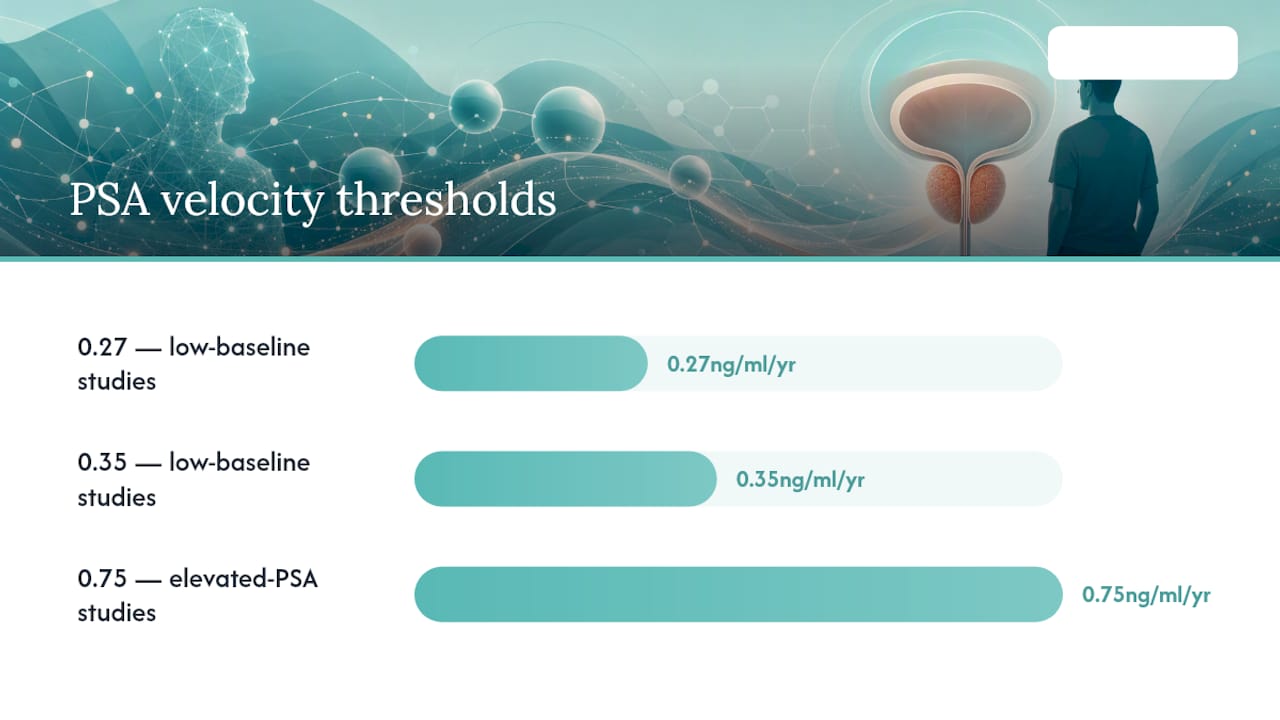
The 0.75 ng/mL/year figure emerged from early studies in men with already elevated PSA, largely used to help decide whether monitoring should intensify. The lower thresholds, around 0.27 to 0.35, appeared in research looking at men with lower baseline PSA, where even a modest absolute rise can represent a meaningful proportional change.
None of these numbers exist to hand a clinician an automatic decision. They exist as prompts for discussion.
- A velocity above a commonly cited threshold usually means “look closer,” not “biopsy immediately.”
- Your age changes the picture. A rise that’s unremarkable at 70 can carry more weight at 50.
- Your baseline PSA matters. A jump from 1.0 to 1.5 ng/mL is proportionally huge; a jump from 8.0 to 8.5 ng/mL is comparatively small.
- Prostate volume, recent procedures, and infection history can all shift the number without cancer being involved at all.
When do doctors actually use PSA velocity?
Its usefulness changes enormously depending on why you’re being tested in the first place.
- General screening. For men having routine PSA checks with no prior diagnosis, the evidence for PSA velocity adding real value is genuinely mixed. The National Cancer Institute’s analysis found that adding velocity to standard risk models only slightly improved predictive accuracy, and suggested that simply lowering the PSA threshold for further testing might do more good than tracking velocity at all.
- Active surveillance. This is where PSA velocity tends to earn its keep. Men already diagnosed with low-risk prostate cancer and being monitored rather than treated immediately often have PSA tracked closely precisely because a sudden acceleration can prompt a shift from watching to acting, alongside MRI and repeat biopsy findings.
- Post-treatment monitoring. After surgery or radiotherapy, PSA should drop to a very low level and stay there. A rising velocity here is one of the earliest signals of recurrence, and a systematic review found PSA velocity may carry more genuine predictive weight in this post-treatment setting than as a general screening tool.
In every one of these contexts, PSA velocity works alongside other tools, never instead of them. A digital rectal exam, an MRI scan, imaging findings, and biopsy results all carry weight that a velocity number alone can’t replace. If your surveillance team notices your PSA climbing faster than expected, that’s usually the cue to bring in imaging or a repeat biopsy, not to act on the velocity figure in isolation.
Why is PSA velocity considered a controversial measure?
The honest answer is that the research doesn’t speak with one voice, and understanding why helps you interpret your own results more sensibly.
A broad synthesis of PSAV research found genuinely conflicting evidence about the metric’s added value, concluding it may help more in men already being monitored after treatment than in general screening decisions. Around the same time, the National Cancer Institute’s own analysis concluded that folding PSA velocity into standard risk calculations produced only a slight improvement in accuracy, and suggested that a simpler PSA threshold adjustment might achieve more.
That’s roughly the position taken by Mayo Clinic’s own patient guidance on PSA testing, and it reflects a genuine shift in clinical thinking over the past decade.
Part of the disagreement comes down to definitions. Different studies calculate velocity over different time windows, use different numbers of readings, and sometimes use different PSA assay technologies that don’t produce perfectly matching results. Add in the fact that PSA fluctuates naturally from week to week for reasons that have nothing to do with cancer, and you get a metric that’s genuinely useful in aggregate but noisy in any individual case. The sensible reading of all this evidence is that PSA velocity works best as one contextual factor sitting alongside PSA level, age, family history, and imaging, rather than as a standalone decision-maker.
What else can make your PSA levels rise?
Before anyone gets too worried about a rising number, it’s worth ruling out the ordinary, non-cancerous reasons PSA can climb.
- A urinary tract infection or prostatitis can push PSA up sharply, sometimes for weeks.
- Ejaculation in the 24 to 48 hours before a test can nudge readings higher.
- Recent catheterisation, a prostate biopsy, or even a vigorous digital rectal exam can temporarily raise PSA.
- Certain medications and supplements can shift readings in either direction, so it’s worth mentioning everything you’re taking.
- A benign enlarged prostate, common with age, can produce a steadily rising PSA with no cancer involved at all.
Pro Tip: Book your PSA retest at roughly the same time of day, avoid ejaculation for two days beforehand, and mention any recent infections or procedures to whoever’s taking the sample. Small inconsistencies between tests are exactly what make velocity calculations unreliable.
Using the same lab, and ideally the same assay method, each time also matters more than people realise. Switching between different testing providers can introduce enough variation to distort a velocity calculation that would otherwise look perfectly stable. Keep a simple record of the date, the result, and the testing method for every reading, because that record is what your clinician will actually use to judge the trend.
What should you do if your PSA is rising?
A rising number isn’t a diagnosis. It’s a prompt to gather better information before drawing any conclusion.
- Repeat the test. A single rise, especially a small one, often settles down or reverses on its own. Most guidance points toward retesting within a few weeks to a few months rather than reacting to one result. Regular annual testing gives you the baseline history that makes any future velocity calculation meaningful.
- Ask about further tests. A free-to-total PSA ratio, an MRI scan, or in some cases a biopsy might be appropriate depending on your age, family history, and how consistent the rise has been.
- Talk through your personal risk factors. Ask your clinician directly how your age, ethnicity, and any family history of prostate cancer should shape the plan, since these all change how a given velocity is interpreted.
- Watch for symptoms that need faster attention. New urinary difficulties, blood in urine or semen, or a very rapid doubling time (PSA visibly climbing within weeks rather than months) warrant a quicker appointment rather than waiting for a scheduled retest.
Can at-home PSA testing help you track your levels?
An at-home PSA test gives you one reading at one moment, useful for keeping an eye on things between GP visits, but it can’t establish a clinically validated velocity trend on its own. A genuine velocity calculation needs multiple, consistently timed readings, ideally cross-checked against your GP’s own testing history.
Rapidtest’s PSA RapidTest delivers a result in 10 to 15 minutes from a small blood sample, according to Rapidtest’s own product claims. That speed makes it a reasonable tool for staying aware of where your levels sit, particularly if you’re waiting between annual checks.
- Write down the date and result of every home test, exactly as you would a lab result.
- Bring that log to your GP rather than acting on a single home reading alone.
- Treat a raised home result as a reason to book a proper clinical follow-up, not as a final answer.
- Use consistent timing (avoid testing right after ejaculation or during an active infection) to keep readings comparable.
A measured view on rising PSA numbers
Rising PSA numbers unsettle people more than they should, and I understand why. It’s your body sending an ambiguous signal, and ambiguity is uncomfortable. But the evidence genuinely supports patience here. A modest rise, viewed in isolation, tells you almost nothing reliable.
What actually helps is repetition: a second test, then a third, discussed openly with your GP against your age, your history, and your baseline. Shared decision-making beats panic every time. If your numbers are climbing, that’s a conversation to start, not a verdict to fear.
— Jack
Track your PSA between check-ups with Rapidtest
Rapidtest gives you a faster, more private way to keep tabs on your PSA than waiting months between GP appointments. The PSA RapidTest delivers a result from home in 10 to 15 minutes, with no clinic queue and no awkward conversation needed to get started.

That said, one home reading is a data point, not a diagnosis. It works best as part of a pattern you build over time, logged alongside your GP’s own results, so any genuine velocity trend can be spotted properly rather than guessed at. A rising result at home should always lead you back to your doctor for proper follow-up, not away from it.
If you’re weighing up broader men’s health screening alongside PSA tracking, Rapidtest’s Mens Health Screening range covers other markers worth keeping an eye on too. Order a kit, test at home whenever suits you, and take your results to your next GP visit as a useful starting point for the conversation.
This article is general information, not a substitute for advice from a qualified doctor. Consult a qualified healthcare professional about your own circumstances before acting on anything here.
Sources
- Systematic review synthesising studies on PSAV’s diagnostic and prognostic role
- PSA velocity does not improve prostate cancer detection — National Cancer Institute (summary)
- Prostate-specific antigen — StatPearls (NCBI Bookshelf)
FAQ
What is a concerning PSA velocity?
A velocity above roughly 0.35 to 0.75 ng/mL/year, depending on which study you look at, is often flagged as worth discussing further, though it’s never treated as an automatic biopsy trigger on its own.
What is an average PSA score for a 70-year-old?
PSA tends to rise gradually with age and prostate size, so reference ranges by age generally sit higher for men in their seventies than for younger men; your GP can tell you where your specific result falls against that range.
How fast does PSA rise with aggressive cancer?
Aggressive prostate cancer can sometimes produce a very short PSA doubling time, with levels climbing markedly within weeks or months rather than years, though a slow rise doesn’t rule out significant disease either.
What is the fastest way to lower your PSA?
Treating an underlying cause such as an infection or prostatitis can bring PSA back down quickly, and avoiding ejaculation or vigorous prostate stimulation before retesting can prevent a temporary spike, but there’s no reliable shortcut for lowering PSA caused by cancer itself; that requires proper clinical assessment.