


Avoid ejaculation 24–48 hours before a PSA test: evidence, home testing
Yes, ejaculation can raise your PSA reading, and it usually settles back down within a day or two. The practical rule is simple: avoid ejaculation for 24 to 48 hours before a PSA blood test. This matters most if your PSA already sits close to a clinical cutoff, or if you’re older. Cycling, recent urinary procedures, and other physical stresses on the prostate can nudge PSA up too, so ejaculation isn’t the only thing worth thinking about before you book that test.
TL;DR:
- PSA levels can increase by approximately one point within 24 to 48 hours after ejaculation, especially in men with borderline baseline readings.
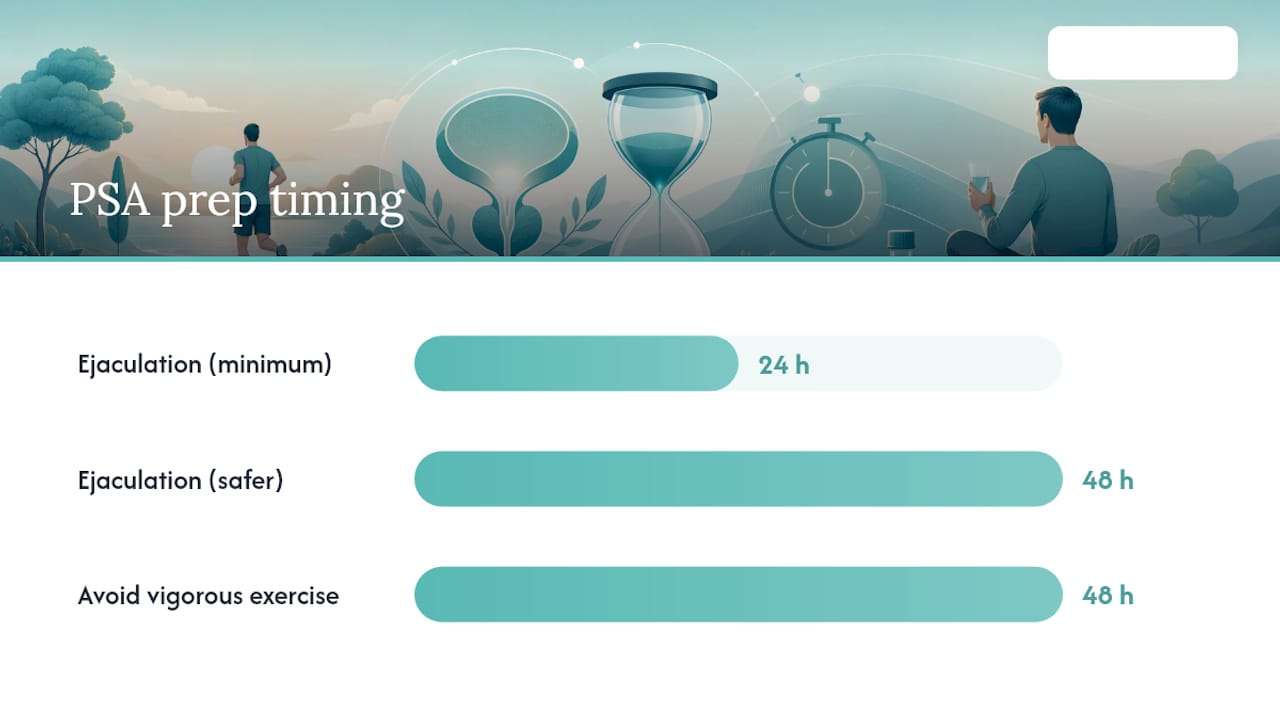
- Abstaining from ejaculation for at least 24 hours is recommended before testing, with 48 hours being safer if results are near biopsy thresholds.
- Other factors like vigorous exercise, urinary procedures, or prostate infections can also raise PSA temporarily, requiring longer delays before retesting.
- At-home PSA tests provide quick monitoring but must be followed by professional confirmation if results are high or unexpected.
- Repeating the test after proper abstinence helps distinguish between temporary fluctuations and potentially concerning sustained elevations.
Table of Contents
- What the research shows about PSA after ejaculation
- How to prepare for a PSA test the right way
- When a raised PSA might just be ejaculation, and what to do next
- Other things that can quietly push PSA up
- At-home PSA testing and how it fits with clinical monitoring
- A candid word on PSA anxiety
- Monitor your PSA at home, without the guesswork of “was it just Tuesday night?”
- Sources
- FAQ
What the research shows about PSA after ejaculation
You don’t need to take our word for it. Several studies have actually measured what happens to PSA in the hours and days after ejaculation, and the picture is consistent enough to build real guidance around.
One of the most cited studies, looking at men aged 49 to 79, found that ejaculation increased serum PSA in 87% of subjects. The rise wasn’t trivial either. That’s a big swing for something that has nothing to do with cancer.
Other controlled studies back this up, showing statistically significant increases in total and free PSA shortly after ejaculation, with values generally returning toward baseline somewhere between 24 and 72 hours. The timing varies a little between studies, which is one reason clinicians tend to favour the safer end of the window when giving advice.
Here’s where it gets genuinely interesting for anyone trying to interpret their own numbers:
- Total PSA (tPSA) and free PSA (fPSA) both tend to rise noticeably after ejaculation.
- Complexed PSA (cPSA) often shows a smaller, less consistent change.
A study measuring all three found that tPSA and fPSA rose significantly while cPSA changes were not statistically significant. Assay type genuinely affects what you see on the report, which is part of why comparing results across different labs or different tests can be misleading.
The evidence in one line: most men see PSA rise sharply within an hour of ejaculation, then drift back to normal within a day or two, with total and free PSA affected more than complexed PSA.
It’s worth flagging the limits of this evidence too. These studies tend to involve modest numbers of participants, and methods vary (blood draw timing, assay brand, how strictly abstinence was controlled beforehand). None of that undermines the core finding, but it does mean the exact percentages shouldn’t be treated as gospel for every man in every situation.
How to prepare for a PSA test the right way
Getting a clean PSA reading isn’t complicated, but it does take a bit of forward planning. Here’s what actually matters:
- Abstain from ejaculation for 24 to 48 hours beforehand. Twenty four hours is often enough, since most men return close to baseline by then, but 48 hours is the safer choice if your PSA has previously come back borderline or you’re due a result that really matters.
- Skip vigorous cycling or intense lower-body exercise in the day or two before your appointment. The prostate sits close enough to take a physical knock from a saddle or a hard squat session.
- Avoid booking a test soon after a urinary procedure, a catheter, or anything involving trauma to the perineal area. These can distort results far more than ejaculation ever does.
- Book your test for the morning where possible, and try to keep conditions consistent if you’re tracking PSA over time (same time of day, same general activity levels beforehand).
- If a result comes back unexpectedly high, ask for a repeat test after a proper abstinence window rather than jumping straight to alarm.
Pro Tip: Tell your GP or the blood test provider about anything relevant when you book, including recent ejaculation, cycling, or any urinary symptoms. It takes ten seconds and can save you a false alarm.
None of this is about being paranoid over a number. It’s about giving yourself an accurate baseline so that if something does need investigating, you’re not chasing a phantom caused by Tuesday night rather than anything in your prostate.
When a raised PSA might just be ejaculation, and what to do next
A “borderline” PSA result means your number sits close enough to a clinical decision point that small changes can tip it over. Because ejaculation can add up to roughly a point in some men, even a change under 1 ng/mL can be clinically relevant if your baseline was already hovering near a biopsy threshold, according to UCLA Health’s clinical guidance.
The sensible sequence, and the one most clinicians actually follow, looks like this:
- Confirm whether ejaculation, cycling, or a recent procedure happened in the 48 hours before the blood draw.
- If so, repeat the test after a proper abstinence period rather than acting on the first number.
- If the repeat result normalises, that’s your answer.
- If it stays elevated, your GP will look at other causes, from infection to age-related enlargement to, less commonly, cancer.
Individual case reports exist of men whose PSA rose from within normal range to above 4 ng/mL purely from recent ejaculation, which is exactly the kind of scenario a simple repeat test resolves without anyone reaching for a biopsy needle. Clinicians only tend to move toward imaging or biopsy when a properly repeated, well timed test still comes back high, or when other symptoms point toward something that needs a closer look.
Other things that can quietly push PSA up
Ejaculation gets most of the attention, but it’s far from the only thing that can skew a PSA reading. It’s worth keeping an eye on:
- Vigorous exercise and prolonged cycling can raise PSA temporarily, and Prostate Cancer UK specifically advises avoiding these before a test.
- Recent catheterisation, cystoscopy, or a prostate biopsy can affect PSA far more dramatically than ejaculation, often requiring a much longer delay before retesting.
- Urinary tract infections or prostatitis inflame the prostate directly and can push PSA well above baseline, sometimes for weeks rather than days.
- Certain medications can shift PSA in either direction, so it’s worth a quick conversation with your GP if you’re on anything new before comparing results over time.
The common thread is anything that physically irritates or stimulates the prostate. Ejaculation is simply the most frequent and most avoidable of the group.
At-home PSA testing and how it fits with clinical monitoring
An at-home PSA rapid test measures the same protein your GP’s blood test does, just from a finger-prick sample, with a readable result in around 10 to 15 minutes rather than a days-long wait for lab processing.
- Good for: convenient monitoring between clinical check-ups, tracking trends over time, and getting a quick read without booking an appointment.
- Not a substitute for: lab confirmation if your result comes back high. A single elevated reading, at home or in clinic, always deserves a formal follow-up test and a chat with your GP.
- If your home result is high: repeat it after a proper abstinence window, then book a professional blood test to confirm before drawing any conclusions.
Used this way, an at-home kit adds visibility between appointments rather than replacing the judgement of a clinician.
A candid word on PSA anxiety
Worrying about a single number is natural, but a small, temporary rise after ejaculation is common and rarely means anything sinister. If your result looks off, mention recent ejaculation to whoever’s reading it. It genuinely changes how the number should be interpreted, and it’s the first question most clinicians ask anyway.
— Jack
Monitor your PSA at home, without the guesswork of “was it just Tuesday night?”
Rapidtest’s PSA Rapid Test gives you a result in around 10 minutes, from a small finger-prick sample, delivered in discreet packaging with full instructions so there’s no guessing about method or timing.
It’s built for the exact situation this article covers: checking your PSA between GP visits, or getting a same-day read before deciding whether that “high” number from last week deserves a proper look. Full instructions walk you through timing your test correctly, including steering clear of ejaculation and vigorous exercise in the 24 to 48 hours beforehand.
Be clear about what it is and isn’t. A high at-home reading should always be followed by a professional lab test and a conversation with your GP, never treated as a diagnosis on its own. If you want more background before testing, the PSA rapid test kit page covers exactly how the kit works and what your result actually means. When you’re ready, the kit itself is a straightforward way to start monitoring your baseline today.
Sources
- Ejaculation increases the serum prostate-specific antigen concentration
- Effects of ejaculation on serum prostate-specific antigen levels
- PSA test results can be affected by different factors | UCLA Health
FAQ
How long should you abstain from ejaculation before a PSA test?
Abstain for 24 to 48 hours. Most men return close to baseline PSA within 24 hours, but 48 hours is safer if your PSA has previously come back borderline, per NHS guidance.
Is ejaculating every day bad for the prostate?
There’s no strong evidence that frequent ejaculation harms the prostate long term. It simply needs to be avoided in the 24 to 48 hours right before a PSA test, since that’s when it temporarily raises your reading.
How many times should a man ejaculate per week for prostate health?
There’s no single figure supported by strong evidence for an ideal weekly frequency. What matters for testing accuracy is timing around your PSA test, not the frequency itself.
What does ejaculation feel like with prostate cancer?
Prostate cancer doesn’t typically cause a distinctive sensation during ejaculation on its own, though some men report discomfort or blood in semen alongside other urinary symptoms. Any unusual pain or bleeding warrants a GP visit rather than self-diagnosis.
Can an at-home PSA test replace a clinical blood test?
No. An at-home kit like Rapidtest’s PSA Rapid Test is useful for monitoring between appointments, but a high result should always be confirmed with a professional lab test and a GP conversation.