


Sore Throat 1–3 Weeks? Oral Chlamydia Symptoms, Ask for a NAAT Swab
Most oral chlamydia causes no symptoms at all, which is exactly why it goes undiagnosed for so long. When symptoms do show up, they usually appear one to three weeks after exposure as a sore throat, swollen glands, or pain swallowing. The only way to know for certain is a throat swab tested by NAAT, since a urine test cannot pick up an infection sitting in your throat.
TL;DR:
- Most oral chlamydia infections are asymptomatic and go unnoticed, but persistent sore throats and symptoms after unprotected oral sex should prompt testing.
- Accurate diagnosis requires an oropharyngeal swab tested by NAAT, not a urine test, and testing too early or relying on at-home kits not validated for throat samples can lead to false negatives.
- Doxycycline is generally more effective than azithromycin for treating throat chlamydia, so patients should ask their clinicians which antibiotic they prescribe.
- Risk factors include unprotected oral sex with new or multiple partners and co-infection with gonorrhea, which is why comprehensive testing is recommended.
- Avoid sex during treatment and notify recent partners to prevent reinfection, and barrier methods like condoms or dental dams significantly reduce transmission risk.
Table of Contents
- What are the real oral chlamydia symptoms?
- How does oral chlamydia spread?
- How do you actually test for oral chlamydia?
- Treatment: what clears oral chlamydia and how fast
- When should you see a clinician?
- Cutting your risk of oral chlamydia
- Where at-home testing fits, and where it doesn’t
- Why the conventional advice on oral chlamydia falls short
- Sources
- FAQ
What are the real oral chlamydia symptoms?
Here’s the uncomfortable truth: the vast majority of oropharyngeal chlamydia infections produce nothing you’d notice. No pain, no visible change, nothing that would send you to a pharmacy for lozenges. That’s precisely why it spreads quietly between partners who both assume they’re clear.
When oral chlamydia signs do appear, they tend to mimic a fairly ordinary throat bug, which makes them easy to write off. Watch for:
- A sore throat that doesn’t ease up after a few days
- Pain or discomfort when swallowing
- Swollen lymph nodes in the neck
- White spots or patches on the tonsils
- Mouth sores or ulcers
- A low-grade fever or persistent dry cough
Statistic: Clinical guidance from the CDC notes that while oropharyngeal chlamydia occurs among sexually active adults, routine screening is debated due to unclear clinical significance and the fact that most people show no symptoms.
Symptom onset, when it happens, generally falls within one to three weeks of exposure, according to NHS guidance. The tricky part is telling this apart from a garden-variety viral sore throat. Two clues help: your symptoms hang around well past the point a normal throat infection would clear, and you’ve had unprotected oral sex recently. That combination is your cue to get tested, not to wait it out.
Pro Tip: If a sore throat lingers more than a week and over-the-counter remedies aren’t touching it, don’t assume it’s just a stubborn cold, especially if you’ve had a new or unprotected sexual partner recently.
How does oral chlamydia spread?
Oral chlamydia is transmitted through oral-genital or oral-anal contact, and the bacteria can move between the throat and genitals during the same sexual encounter, according to NHS information on chlamydia transmission. Throat infections are less common than genital ones because Chlamydia trachomatis has more difficulty establishing itself in oral tissue than in genital or rectal mucosa.
Certain behaviours raise your risk meaningfully:
- Unprotected oral sex with a new or casual partner
- Multiple sexual partners without barrier protection
- A partner who has recently tested positive for chlamydia or another STI
- Oral contact combined with vaginal, anal, or shared sex toys without cleaning between acts
Co-infection is a real consideration here too. Gonorrhoea often travels alongside chlamydia in the throat, which is why testing for both organisms from a single sample, rather than chasing one diagnosis at a time, makes practical sense. If you’re weighing up a persistent sore throat against recent exposure, it’s worth reading about throat gonorrhoea symptoms as well, since the two can look almost identical.
How do you actually test for oral chlamydia?
Getting this right matters more than most people realise, because the wrong test gives you a false sense of security. Here’s what actually works:
- Request an oropharyngeal swab, not a urine sample. Diagnosis of oral chlamydia depends on a throat swab tested by NAAT, the nucleic acid amplification test that’s now the diagnostic standard. Urine tests only detect genital infection and will miss a throat infection entirely.
- Time your test to the window period. Since symptoms, when present, typically surface within one to three weeks of exposure, testing too early can produce a false negative. If you’ve had a specific high-risk contact, our guide on how soon after exposure you should test for chlamydia walks through sensible timing.
- Ask whether the swab is clinician-collected or self-collected. Self-collected swabs perform comparably to clinician-collected ones when processed by NAAT, and some clinics now offer this as standard practice.
- Confirm the sample covers gonorrhoea too. Several NAAT platforms detect both chlamydia and gonorrhoea from one throat swab, sparing you a second appointment or a second swab altogether.
Pro Tip: When you book a sexual health appointment, say the words “oropharyngeal NAAT” explicitly. Reception staff and even some clinicians default to urine testing unless you specify the throat.
Treatment: what clears oral chlamydia and how fast
Antibiotics clear oral chlamydia effectively, but which one matters more here than with genital infections. Observational data suggests doxycycline may work better than azithromycin against oropharyngeal chlamydia, and clinicians increasingly favour it for that reason, per CDC treatment guidance.
Statistic: That same guidance flags oropharyngeal infection as an area where treatment choice genuinely shifts outcomes, unlike straightforward genital cases where either antibiotic tends to perform well.
Whichever course you’re prescribed, finish it completely, even once symptoms fade. You’re generally advised to avoid all sexual contact, oral included, until you’ve finished treatment and enough time has passed for the antibiotics to clear the infection. Your clinician will confirm the exact interval for your regimen.
- Complete the full antibiotic course, don’t stop early
- Avoid sex (oral, vaginal, and anal) during treatment
- Notify recent partners so they can test and treat too
- Retest only if symptoms persist or your clinician advises it
Partner notification isn’t just courtesy, it’s how reinfection gets prevented, and NHS guidance treats it as a standard part of care.
When should you see a clinician?
Book an appointment promptly if you’ve had a persistent sore throat following recent unprotected oral sex, or if a partner has tested positive for chlamydia. Don’t wait for symptoms to worsen.
Severe complications like pelvic inflammatory disease and infertility are linked overwhelmingly to genital infection, not throat infection, so oral chlamydia on its own rarely causes lasting harm. The real concern is co-infection: gonorrhoea can sit alongside chlamydia in the throat and produces near-identical symptoms, which is why testing usually covers both organisms from the same swab.
When you contact a clinic or triage line, be specific:
- Mention the type of sexual contact (oral, vaginal, anal) and roughly when it happened
- Say if a partner has a confirmed STI diagnosis
- Ask directly for an oropharyngeal swab, not just a urine sample
Cutting your risk of oral chlamydia
Barrier methods work here just as they do elsewhere. Condoms and dental dams during oral sex meaningfully reduce transmission risk, even though many people skip them for oral contact specifically.
- Use a condom or dental dam for oral sex with new or casual partners.
- Avoid all sexual contact while you’re waiting for results or completing treatment.
- Test again if you’ve had unprotected exposure since your last screen, particularly if a new partner is involved.
- Talk openly with partners about testing history before oral sex becomes part of the equation.
Pro Tip: Dental dams are cheap, widely available online, and often overlooked entirely, most people think of condoms only for penetrative sex.
Where at-home testing fits, and where it doesn’t
At-home STI testing kits with results in 10 to 15 minutes, discreet delivery, and no lab returns suit routine screening when you’re not dealing with specific throat symptoms. But here’s the honest caveat: the diagnostic standard for oropharyngeal chlamydia is a clinician-processed throat swab tested by NAAT, so always check whether a rapid kit is validated for throat specimens before relying on it for that purpose.
- Use at-home kits for routine, general STI screening as part of regular sexual health upkeep
- Seek a clinic NAAT swab specifically if you suspect throat infection or have had recent high-risk oral exposure
- Browse available chlamydia rapid test kit options, or read the guide on testing for chlamydia at home to see what’s covered
If your main concern is a persistent sore throat rather than routine screening, our full chlamydia resource hub covers testing pathways in more depth, and our range of STI test kits is there when you’re ready to screen for the wider picture, including partners.
Why the conventional advice on oral chlamydia falls short
Most public health messaging treats chlamydia as a genital condition with a footnote about the throat. That gets the emphasis backwards for anyone who’s actually had recent oral exposure. The real issue isn’t awareness of oral chlamydia existing, it’s that people who do suspect something wrong default to a urine test because that’s what they’ve always been offered, and it tells them nothing about their throat.
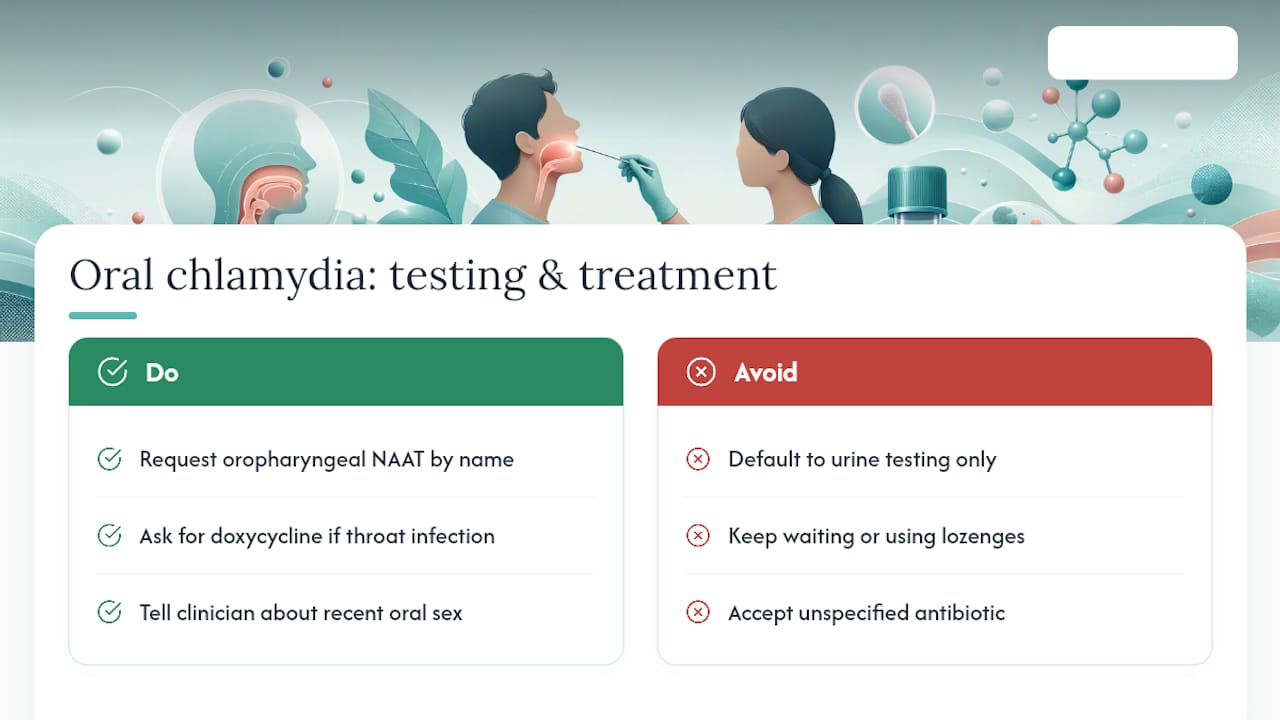
What the evidence here actually supports is a shift in what you ask for, not just what you worry about. If you’ve had unprotected oral sex and develop a throat that won’t settle, the priority isn’t more waiting or more lozenges, it’s requesting the specific test, oropharyngeal NAAT, by name. Clinicians won’t always volunteer it unless prompted.
The other overlooked piece is treatment nuance. Doxycycline’s edge over azithromycin for throat infections isn’t widely publicised outside clinical circles, yet it’s exactly the kind of detail that changes whether treatment actually works the first time. Ask your clinician which antibiotic they’re prescribing and why, particularly if it’s a throat infection.
— Jack
This article is general information, not a substitute for advice from a qualified doctor. Consult a qualified healthcare professional about your own circumstances before acting on anything here.
Sources
- Chlamydia - NHS
- STI NAAT testing (Leeds Teaching Hospitals NHS Trust)
- STD treatment guidelines: chlamydia — CDC
FAQ
How can you tell if you have oral chlamydia?
Most people can’t tell just from symptoms, because oral chlamydia is usually silent. When signs do appear, they include a sore throat lasting longer than a typical cold, pain swallowing, swollen neck glands, or white spots on the tonsils, but a throat swab tested by NAAT is the only reliable way to confirm it.
Can oral chlamydia go away on its own?
No, chlamydia does not clear up without antibiotics, regardless of whether it’s in the throat or genitals. Left untreated, it can persist and continue to be passed to partners, so testing and a prescribed antibiotic course remain necessary.
How long will I test positive for chlamydia after treatment?
This varies by test type and individual response, and your clinician can advise on retesting timing based on your specific antibiotic course. As a general rule, avoid sex until you’ve completed treatment and enough time has passed for the antibiotics to clear the infection fully.
What are the first signs of an STD caught through oral sex?
The earliest signs, when they appear at all, tend to be a sore throat, pain swallowing, or swollen glands within one to three weeks of exposure, closely resembling a viral throat infection. Because oral STDs frequently cause no symptoms whatsoever, a recent high-risk contact is often a stronger reason to test than symptoms alone.