


Chlamydia Window Period Explained: 14 Days, NAAT and At Home Tests
Test for chlamydia from about two weeks after exposure. Testing earlier risks a false negative, because the infection often hasn’t built up enough bacterial material for a test to pick it up. NAAT (nucleic acid amplification testing) is the diagnostic standard behind this advice. If you’ve had a recent exposure, book a NAAT at 14 days, or speak to a clinic sooner if you’re symptomatic or seriously worried.
TL;DR:
- Testing before 14 days after exposure can lead to false negative results due to low bacterial levels, even with sensitive NAAT tests.
- Symptoms usually appear between 7 and 21 days, but many infected individuals remain asymptomatic, making symptom monitoring unreliable.
- Retesting around three months post-treatment is essential to detect reinfection, especially if symptoms reoccur or if partners were not treated.
- At-home rapid tests can give quick results from 14 days after exposure but are less sensitive than lab NAATs and should be confirmed if necessary.
- Early testing after exposure is mainly for reassurance; the safest approach is to wait until day 14 for an accurate diagnosis unless symptoms or urgent concerns arise.
Table of Contents
- What does the chlamydia window period actually mean?
- Why does waiting 14 days matter for accurate detection?
- Can you test sooner than 2 weeks if you’re worried?
- How is chlamydia testing actually done?
- What happens after a positive or negative result?
- Where do at-home rapid tests fit into this timeline?
- Why the “just test now” instinct is the wrong instinct
- Sources
- FAQ
What does the chlamydia window period actually mean?
The chlamydia window period is the gap between catching the infection and the point a test can reliably detect it. It’s easy to muddle this with the incubation period, which is the time between exposure and symptoms showing up, if they show up at all.
That distinction matters more than most people realise. Symptoms, when they appear, usually start somewhere between 7 and 21 days after exposure, according to NHS guidance. But a huge proportion of chlamydia cases never produce noticeable symptoms at all. You could feel completely fine and still be carrying it.
This is why waiting for symptoms is a poor strategy, and why the 2 week rule exists as your dependable benchmark instead of guesswork.
A few things worth holding onto:
- Incubation period: how long before symptoms might appear (often 1 to 3 weeks, sometimes longer)
- Window period: how long before a test can reliably confirm infection
- Asymptomatic cases are common, meaning symptom-watching alone leaves you exposed
- The 2 week mark applies whether or not you feel anything unusual
If you’ve had a recent exposure and you’re unsure when to test, the safest move is circling day 14 on the calendar and working from there.
Why does waiting 14 days matter for accurate detection?
NAAT works by detecting the genetic material of Chlamydia trachomatis, and it’s considered the gold standard for a reason: it’s far more sensitive than older culture-based methods, picking up infections that other tests miss entirely, according to StatPearls’ clinical overview.
Here’s the catch. Sensitivity depends on bacterial load, the amount of the organism present in your sample. Straight after exposure, that load is often too low to register, even with a highly sensitive test. Give it time, and the bacteria multiply to detectable levels.
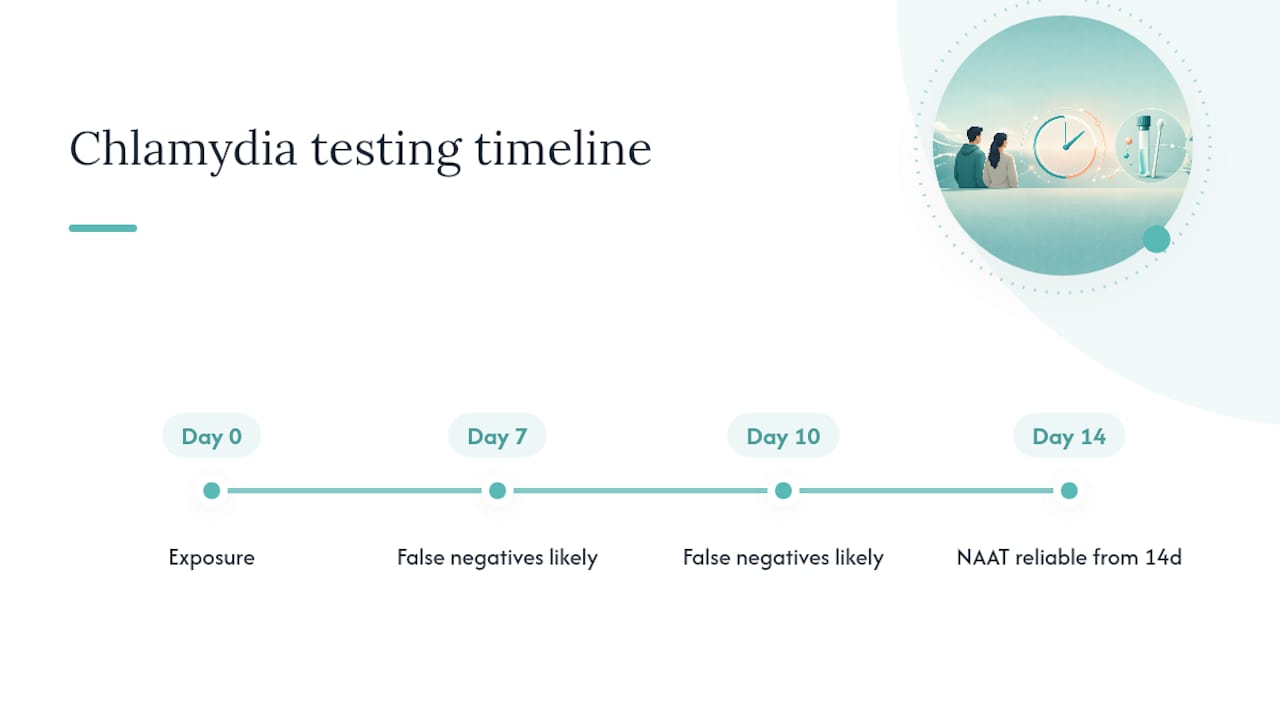
Clinical guidance recommends testing for chlamydia from two weeks after exposure and, if tested earlier, returning for a repeat NAAT at 14 days.
That’s the core recommendation from the British Association for Sexual Health and HIV (BASHH), and it carries a GRADE 1D rating, meaning it’s a strong recommendation even though the underlying evidence base is limited by study design constraints rather than weak results.
The number that matters here is 14. Not 7, not 10. Fourteen days is the point at which most infections have accumulated enough detectable material for NAAT to work as intended. Test before that, and you risk a false negative that tells you nothing useful, and BASHH’s clinical guidance explicitly flags premature testing as a common source of false reassurance.
Can you test sooner than 2 weeks if you’re worried?
Anxiety doesn’t wait 14 days, and neither does the temptation to test early. But an early negative result can be genuinely misleading.
If you’ve had a recent exposure and you’re anxious about it, here’s a sensible sequence to follow:
- Watch for symptoms like unusual discharge, pain when urinating, or pelvic discomfort, without relying on their absence as proof you’re clear
- Use condoms with any partners until you’ve been tested and cleared
- Tell your partner(s) about the exposure so they can consider testing too
- Book a NAAT at 14 days as your primary test, rather than testing repeatedly before then
- Go straight to a clinic if symptoms appear before day 14, rather than waiting out the window
Pro Tip: If your exposure involved a potential HIV risk too, don’t confuse the timelines. HIV post-exposure prophylaxis (PEP) has its own emergency window of within 72 hours, which is a completely separate pathway from chlamydia testing and needs urgent action, not a wait-and-see approach.
An early test isn’t wasted if you understand its limits, but treat it as a starting point, not a verdict.
How is chlamydia testing actually done?
NAAT sample collection is straightforward, and which sample you give depends on where the exposure happened. Genital urine or vaginal swabs won’t catch an infection sitting in your throat or rectum, so telling your clinician (or reading your at-home kit instructions carefully) about the type of contact you’ve had genuinely changes what gets tested, per StatPearls.
Typical sample types include:
- First-catch urine, the standard sample for most genital chlamydia testing in men and often used for women too
- Self-taken vaginal swab, frequently preferred for women and just as accurate as a clinician-taken one
- Throat swab, needed after oral exposure
- Rectal swab, needed after anal exposure, since genital samples alone will miss infections at this site
Lab-based NAATs remain the most sensitive option available. Rapid point-of-care tests can offer faster answers, but sensitivity varies by product, which is part of why confirmatory lab testing still has a role when accuracy is critical. You can access testing through a sexual health clinic, a postal NAAT kit, or an at-home rapid testing kit for a faster first read.
What happens after a positive or negative result?
A positive result is treated with antibiotics, and your clinician or pharmacist will advise on the exact regimen for your situation, so this isn’t something to self-manage from an internet search.
Partner notification matters just as much as your own treatment. Reinfection is common if a partner remains untreated, so sexual partners should be offered testing and treatment too, according to MedlinePlus.
Retesting is where a lot of people drop the ball, assuming one clear result means the story’s over.
- Retest around 3 months after treatment to catch reinfection, even if you feel fine and haven’t had new partners
- If you’re pregnant, follow your clinic’s specific advice, which often means retesting 4 weeks after treatment rather than waiting the full 3 months, per NHS guidance
- A negative result within the window period should still be treated cautiously if your exposure was recent, and a repeat NAAT at 14 days is the way to be sure
If something about your result doesn’t add up, our guide on understanding a chlamydia false positive covers the nuances worth knowing.
Where do at-home rapid tests fit into this timeline?
Rapidtest’s at-home kits deliver results in around 15 minutes, no clinic visit, no waiting on a lab. That speed is genuinely useful for people who want privacy or simply can’t get to a clinic easily. But speed and lab-grade NAAT sensitivity aren’t the same thing, and being upfront about that difference is what actually helps you test smart.
- Results in roughly 15 minutes from home, with full instructions included
- Best used from 14 days after exposure, matching the same window period guidance clinics follow
- If your result matters for peace of mind after a specific exposure, a confirmatory NAAT adds certainty a rapid test alone can’t fully match
| Testing approach | Typical timing | Best used for |
|---|---|---|
| At-home rapid test | From 14 days after exposure | Quick, private first check |
| Lab NAAT (clinic or postal) | From 14 days after exposure | Confirmatory, highest sensitivity |
If you’re weighing up options, our chlamydia rapid test kit gives you a fast starting point, ideally timed alongside the same 2 week guidance clinics rely on.
Why the “just test now” instinct is the wrong instinct
The biggest mistake people make with chlamydia testing isn’t ignoring it. It’s testing too early and then relaxing because the result came back clean. That’s backwards. A negative result inside the window period tells you almost nothing if your exposure happened three days ago.
Where conventional advice falls short is treating “get tested” as a single instruction rather than a timed one. Clinics know the 14 day rule inside out. The public, understandably, wants an answer today. That gap between clinical patience and personal anxiety is where false reassurance breeds, and BASHH’s own guideline calls this out directly as a recurring problem.
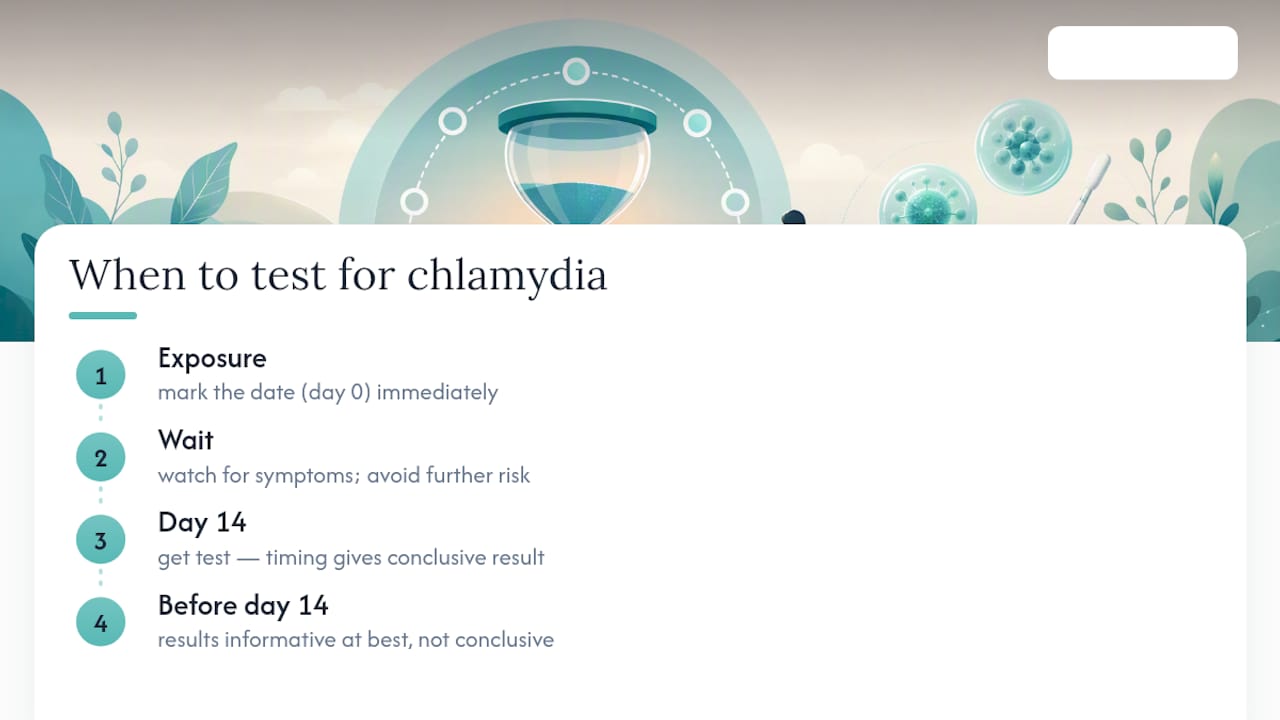
If there’s one thing to prioritise, it’s this: pick your test date based on your exposure date, not your anxiety level. Mark day 14 on your calendar the moment you’re worried, use that fortnight to watch for symptoms and avoid further risk, and treat any test taken before then as informative at best, not conclusive. Rapid kits are a genuinely useful part of that pathway when the timing lines up. They’re not a shortcut around it.
— Jack
This article is general information, not a substitute for advice from a qualified doctor. Consult a qualified healthcare professional about your own circumstances before acting on anything here.
Sources
- Chlamydia trachomatis Infection - StatPearls - NCBI Bookshelf
- Chlamydia - NHS
- Chlamydia test: MedlinePlus
FAQ
Can chlamydia show symptoms in 3 days?
It’s unlikely but not impossible. Most symptoms, when they occur, appear between 7 and 21 days after exposure, and many people never develop symptoms at all, so their absence at day 3 tells you nothing either way.
Can you have chlamydia for 2 years without knowing?
Yes. Chlamydia is frequently asymptomatic, which is exactly why routine screening for sexually active people matters more than waiting for warning signs to appear.
How soon after unprotected sex can I test for chlamydia?
Test from 2 weeks after the exposure for a reliable result. Testing earlier risks a false negative because bacterial levels may still be too low for even a sensitive NAAT to detect.
Does chlamydia always clear up completely with treatment?
Antibiotic treatment clears chlamydia in the vast majority of cases when taken as prescribed, but reinfection from an untreated partner is common. That’s why retesting around 3 months after treatment, and getting partners tested too, is part of the standard advice.