


48–72 Hours Before an FOB Test: Foods and Drugs to Skip
Yes, most guaiac FOB tests (gFOBT) need diet and medicine changes beforehand, and the golden rule is simple: avoid certain foods for about 2 to 3 days before you collect a sample, with some medicines needing up to a week’s notice. If you have a FIT test, you can usually skip all of this, but check the box first. If you take aspirin for your heart or an anticoagulant, never stop it without talking to your clinician.
TL;DR:
- Foods high in haem, such as red meat, and high-peroxidase raw produce like melons and radishes, must be avoided for 48 to 72 hours before gFOBT testing.
- Certain medications, including NSAIDs, aspirin, blood thinners, iron supplements, and high-dose vitamin C, require a full week of discontinuation or consultation with a clinician to avoid false results.
- Testing should be postponed if there is active bleeding, a recent colonoscopy, menstrual period, or contamination from urine, to prevent inaccurate outcomes.
- FIT tests, which target human haemoglobin with antibodies, usually do not need diet or medicine restrictions, simplifying pre-test preparation considerably.
- Using Rapidtest’s at-home FOB kit simplifies the process with clear instructions and quick results, but always verify if your specific kit requires any dietary or medication adjustments.
Table of Contents
- Fob test diet restrictions: which foods to avoid
- Medications and supplements that can skew your result
- When to postpone testing altogether
- gFOBT versus FIT: which one actually needs these restrictions?
- Your practical checklist: seven days to test day
- Myths about diet interference, and the real science
- How Rapidtest’s at-home FOB kit fits into this guidance
- Washing fruit and vegetables during your restriction window
- Does alcohol affect your FOB test result?
- Preparing your diet with allergies or existing restrictions
- Does cooking method change the risk from these foods?
- Do you need to change how much water you drink?
- A final word on getting this right
- Ready for a straightforward at-home FOB test?
- Sources
- FAQ
Fob test diet restrictions: which foods to avoid
Let’s be real: nobody wants to overthink a sandwich three days before a bowel screening test. But a handful of foods genuinely can throw off a guaiac-based result, and it’s worth knowing why.
Red meat is the big one. Beef, lamb, and liver all contain haem, a compound your body absorbs partially but not completely, and any that reaches your stool can trigger a false positive on a guaiac test. This isn’t a rumour, it’s basic chemistry: the test strip reacts to the same peroxidase activity whether the blood came from a tumour or last night’s steak.
Then there’s the raw produce list, which surprises most people. Melons, radishes, horseradish, and turnips contain plant peroxidases that mimic the reaction the test is looking for. A systematic review of dietary interventions for FOBT screening backs the standard advice: a short few-day break from these foods is enough for most gFOBT kits, and the risk scales with quantity, not with a single stray bite.
Pro Tip: A small garnish of radish on a salad three days ago is unlikely to wreck your result. A big bowl of melon or a horseradish sauce the night before collection is the scenario worth avoiding.
So what should be on your plate instead? Plenty of options stay safe:
- Cooked vegetables (steamed, boiled, or roasted), since cooking doesn’t remove the enzyme entirely but sharply reduces the practical risk in most guidance
- Poultry and fish, which don’t carry the same haem load as red meat
- Grains, pasta, rice, and bread
- Cooked fruit and most low-peroxidase salad items in modest portions
Once your sample is collected and safely away, there’s no need to keep avoiding these foods. Go back to your normal diet the same day, unless your clinician has told you otherwise for an unrelated reason. The MedlinePlus guide to fecal occult blood testing lists this exact combination of foods and timing as the standard preparation for guaiac-based kits, so it’s a good one to bookmark if you’re testing more than once.
Medications and supplements that can skew your result
This is the part people miss most often, and it’s usually not the steak that trips them up. It’s the medicine cabinet.
- NSAIDs and aspirin. Ibuprofen, naproxen, and aspirin can cause small amounts of gastrointestinal bleeding on their own, which shows up as a false positive that has nothing to do with bowel cancer. Many guidelines recommend stopping these for about a week before testing when it is medically safe to do so.
- Anticoagulants and antiplatelet drugs. Warfarin and clopidogrel fall into a different category entirely. These aren’t drugs you pause for convenience. If you’re on one of these for a heart condition or stroke prevention, speak to your clinician first; some cancer centres explicitly warn against stopping prophylactic aspirin without medical approval, and the same caution applies here.
- Iron supplements. Iron can interfere with some test chemistries and is commonly paused during the collection window, again only where it’s safe to skip a few doses.
- High-dose vitamin C. This one catches people out because it sounds harmless, even healthy. Doses above roughly 250mg a day, whether from supplements or concentrated juice, can mask blood in the sample and produce a false negative, according to guidance from Harvard Health.
- Hidden combination products. Cold and flu remedies, period pain tablets, and some multivitamins quietly contain aspirin, ibuprofen, or vitamin C. Check the label of anything you take regularly, not just your obvious prescriptions.
The seven-day rule in numbers: clinical guidance summarised in the StatPearls entry on FOBT puts the diet window at 48 to 72 hours, but extends the medicine window to a full week for certain drugs, because some of these substances take longer to clear your system than food does.
If stopping a medicine isn’t safe for you, that’s genuinely fine. Clinicians can sometimes switch you to a FIT test instead, which sidesteps the whole problem rather than asking you to risk your health for the sake of screening convenience.
When to postpone testing altogether
Some situations call for a delay, not a diet change. Testing through these events almost guarantees a confusing result.
- Active rectal bleeding, a flared haemorrhoid, or an anal fissure. Any of these can bleed independently of anything happening higher up in the bowel, and the test can’t tell the difference.
- Blood in your urine. Contamination from urine can affect the sample even when the bleeding has nothing to do with your bowel.
- Your period. Wait until your period finishes, then allow a further three days before collecting, since menstrual blood can contaminate the sample just as easily.
- Recent endoscopy or a known gastrointestinal bleed. Follow whatever timing your clinician gives you here rather than the general 48 to 72 hour rule, since procedures can leave minor bleeding that clears on its own.
If you’re not sure whether something counts, the safer move is always to wait. Note down why you delayed, whether that’s a fissure, a period, or a recent colonoscopy, so you can mention it if a later result comes back abnormal. That one line of context can save you an unnecessary round of follow-up investigations.
gFOBT versus FIT: which one actually needs these restrictions?
Here’s the distinction that makes half of this article irrelevant to some readers: not every fecal occult blood test works the same way.
gFOBT (guaiac-based) detects peroxidase activity in general terms. It can’t distinguish human blood from the plant enzymes in a radish or the haem in a steak, which is precisely why diet and medicine restrictions exist for this test type.
FIT (faecal immunochemical test) works differently. It targets human haemoglobin specifically using antibodies, so plant peroxidases and most food-related interference simply don’t register. According to Mayo Clinic, FIT usually requires no dietary preparation at all, and the Cleveland Clinic confirms the same for FIT-DNA tests.
- Check the kit box or insert for the words “guaiac” or “immunochemical”
- If you were sent the kit by a screening programme or GP, the accompanying letter usually states the type
- When in doubt, treat it as gFOBT and follow the full restrictions, since over-preparing carries no risk
Pro Tip: Most at-home kits sold today, including modern FIT kits, lean toward the antibody-based method precisely because it cuts out the guesswork around food and medicine. If you’re unsure which one is in your hands, our guide to FIT accuracy explains what sets it apart from older guaiac methods.
Your practical checklist: seven days to test day
Rather than trying to remember every rule in isolation, work backwards from your collection date.
- Day −7 to −4: review your medicines. List anything you take regularly. If aspirin or an anticoagulant is on that list, call your GP or pharmacist now, not the night before, so there’s time to get advice or an alternative plan in place.
- Day −3 to 0 (the 48 to 72 hour window): follow the diet restrictions. Cut red meat and the high-peroxidase raw produce, stop non-essential iron and high-dose vitamin C where it’s safe, and keep a simple note of anything you couldn’t avoid, along with any bleeding you notice.
- Collection day: follow the kit instructions to the letter. Timing and handling vary between kits, so don’t improvise based on a different test you used previously. Avoid letting urine touch the sample, and wash your hands before and after.
- After collection: return to normal. Resume your usual diet and any paused medicines the same day, unless told otherwise. Keep your prep notes handy in case your clinician wants to discuss a positive result.
Improper preparation is a genuinely common driver of false positives, according to clinical commentary in the StatPearls review, which is exactly why a rushed final-night approach causes more repeat tests than the restrictions themselves. Our step-by-step FIT collection guide covers the handling details in more depth if you want a walk-through before test day.
Myths about diet interference, and the real science
Myth: one bite of steak the night before ruins everything. Not quite. Interference scales with quantity and timing. A small portion three days out is a very different scenario from a large steak the evening before collection.
Myth: “natural” supplements are automatically safe. High-dose vitamin C is about as natural as it gets, and it’s one of the more reliable ways to produce a false negative, masking blood that’s actually there rather than creating blood that isn’t.
The plain-English chemistry: gFOBT reacts to peroxidase activity, a chemical signature shared by human blood and several plant enzymes. FIT instead looks for a specific antibody match to human haemoglobin, which is why it largely ignores what you ate. This difference in mechanism, not marketing, is why FIT has become the preferred screening tool in much of modern practice.
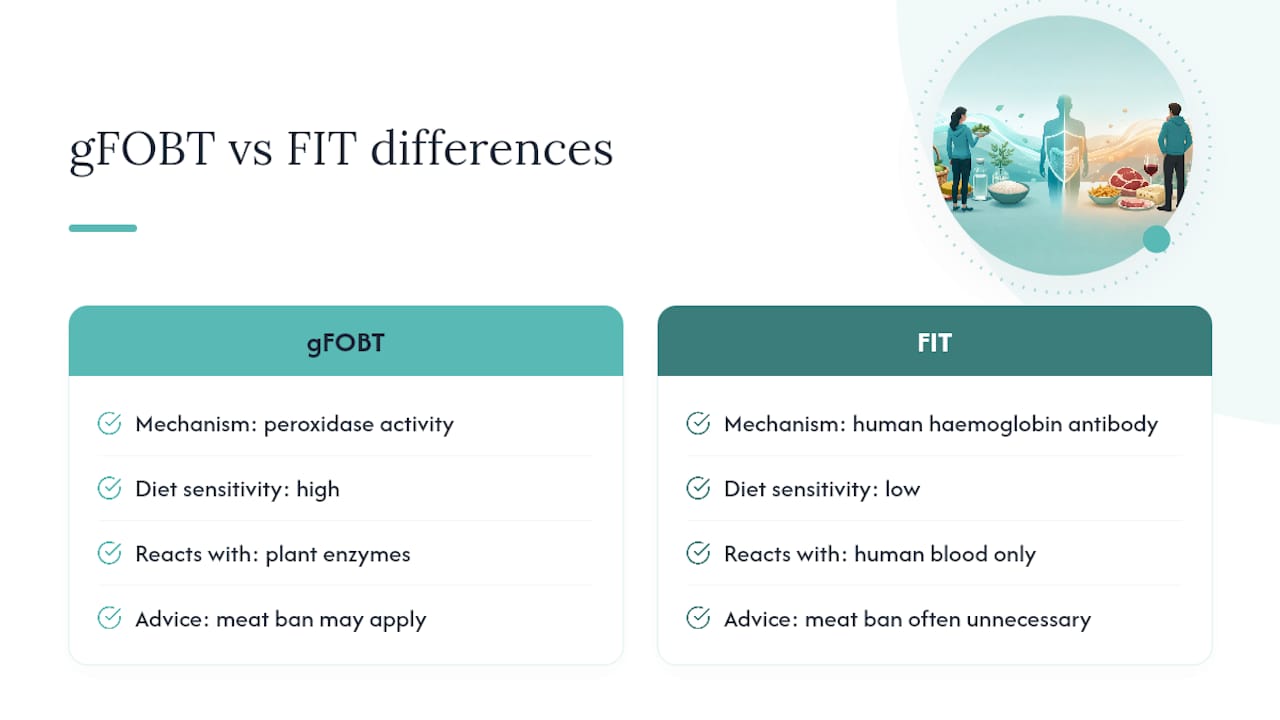
The practical takeaway: follow the instructions that came with your specific kit rather than a rule you saw shared online. A three-day red meat ban that applies to one test type can be entirely unnecessary for another.
How Rapidtest’s at-home FOB kit fits into this guidance
Every point above still comes back to one simple step: check your kit’s own instructions before you assume anything. Rapidtest’s at-home FOB testing kit states clearly on the product page and in the insert whether preparation is needed, so you’re never guessing which rules apply to you.
Inside the box, you’ll find clear step-by-step guidance and collection aids designed to make the process straightforward the first time. Results come back quickly, without a lab return or a wait for a letter through the post. If your result raises questions, customer support and online resources may be available to help you understand what happens next, and how to discuss it with your GP if needed.
Washing fruit and vegetables during your restriction window
If you’re eating fresh produce during the 48 to 72 hour window rather than cutting it out entirely, how you wash it matters more than most people assume. Thorough rinsing under running water removes surface residue and some of the milder peroxidase-rich juices that can cling to skins, particularly on melons, turnips, and radishes.

That said, washing doesn’t eliminate the enzyme activity inside the flesh of high-risk produce, so rinsing a radish doesn’t make it safe to eat in quantity during your prep window. It simply reduces surface contamination, which matters more for hygiene than for test accuracy.
For anything on the avoid list, the safer approach is straightforward: skip it for the 48 to 72 hours rather than trying to wash your way around the restriction. For lower-risk fruit and vegetables you’re keeping in your diet, wash them as you normally would under cold running water, scrubbing firm-skinned items like carrots or cucumbers rather than just rinsing them. Peeling can also help with produce where the skin carries most of the peroxidase activity, though this isn’t a substitute for avoiding the highest-risk items altogether.
Does alcohol affect your FOB test result?
Alcohol itself isn’t on the standard list of foods and drinks to avoid before a fecal occult blood test, and there’s no strong evidence it directly triggers a false positive or negative in the way red meat or high-dose vitamin C can. The more relevant concern is indirect.
Heavy or regular alcohol use is a known irritant to the stomach and bowel lining, and it can contribute to gastrointestinal bleeding in some people, particularly when combined with NSAIDs or on an empty stomach. That’s the pathway worth thinking about: not alcohol as a chemical interferent with the test strip, but alcohol as a possible source of the very bleeding the test is designed to detect.
If you drink moderately and don’t have any history of stomach irritation, there’s no specific reason to stop before a FOB test. If you’ve had recent stomach discomfort, reflux, or you regularly combine drinking with painkillers, it’s worth mentioning to your clinician alongside your medicine review, since that combination is a more plausible explanation for an unexpected result than the alcohol on its own.
Preparing your diet with allergies or existing restrictions
If you’re vegetarian, vegan, gluten-free, or managing a food allergy, the standard FOB test diet advice still applies, just with different substitutions. The core restriction list, red meat and specific high-peroxidase raw produce, is short enough that most existing diets can accommodate it without much disruption.
If you’re vegetarian or vegan, red meat was never on your plate anyway, so your main task is simply avoiding the specific raw fruits and vegetables on the list (melons, radishes, horseradish, turnips) for the 48 to 72 hour window. Plenty of other cooked vegetables, grains, and legumes remain completely fine to eat.
If you have coeliac disease or another condition requiring careful ingredient checking, focus your label reading on medicines and supplements rather than food, since combination cold remedies and multivitamins are where hidden aspirin, NSAIDs, or high-dose vitamin C most often turn up unexpectedly. Your existing gluten-free staples, grains, breads, and pastas made from safe flours, sit comfortably within the safe-food list already covered earlier in this guide.
Anyone managing a chronic condition that requires regular iron or vitamin supplementation should raise this with their clinician during the medicine review stage, rather than stopping supplements independently, since some conditions make even a short pause medically significant.
Does cooking method change the risk from these foods?
Cooking helps, but it’s not an automatic green light for foods on the avoid list. Peroxidase enzymes are broken down by heat, and boiling, steaming, and frying all reduce enzyme activity to varying degrees, with prolonged high heat generally doing more than a light steam.
The catch is that “reduces” isn’t the same as “removes completely.” A cooked portion of a high-peroxidase vegetable carries meaningfully less risk than eating it raw, but guidance still generally recommends avoiding the specific problem foods altogether during the 48 to 72 hour window rather than assuming cooking has neutralised them. This is particularly true for large portions, where even a partially reduced enzyme level might still be enough to trigger a reaction on a sensitive gFOBT strip.
Red meat follows a different logic entirely. Cooking a steak doesn’t remove the haem content that causes the concern with gFOBT, since haem isn’t a heat-sensitive enzyme in the same way plant peroxidases are. Whether it’s rare, well-done, or minced into a bolognese, red meat stays on the avoid list for the full window regardless of preparation method.
The practical rule: cooking lowers risk for the plant-based peroxidase foods but doesn’t eliminate it, and does essentially nothing for red meat. Stick to the avoid list as written rather than assuming a particular cooking method earns you an exception.
Do you need to change how much water you drink?
There’s good news here: hydration isn’t part of the restriction list for any FOB test type, guaiac or FIT. You don’t need to drink more water than usual, and you don’t need to cut back either.
Staying reasonably hydrated in the days before your test is sensible for general bowel health and comfort, particularly if you’re already changing your diet slightly to avoid certain foods. A well-hydrated bowel tends to produce a more typical, easier-to-collect stool sample, which is more a matter of practical convenience on collection day than test accuracy.
The one area where fluid matters is avoiding contamination. Whatever you drink, make sure urine doesn’t come into contact with your sample during collection, since that can interfere with results regardless of your hydration levels. Follow your kit’s specific collection instructions for keeping the sample separate and clean, and treat normal water, tea, or coffee intake as entirely unrestricted territory.
A final word on getting this right
The mistake I see most often isn’t people ignoring the red meat advice. It’s people missing hidden aspirin in a combination cold remedy, or assuming their test is a FIT when it’s actually a guaiac kit. Both slip past the obvious rules entirely.
If you’re on anything for your heart, talk to your clinician before changing a single dose. Everything else in this guide is designed to make the boring part, the 48 to 72 hours before you collect, straightforward enough that you get a result you can actually trust the first time.
— Jack
Ready for a straightforward at-home FOB test?
Rapidtest’s at-home FOB kit gives you results in around 15 minutes, without a GP visit, a lab return, or an awkward conversation in a waiting room.
Every kit ships in discreet packaging with clear instructions inside the box, so you can check straight away whether your specific kit needs dietary preparation rather than relying on generic advice from a search result. If bowel health screening is part of a wider check-up on your mind, our men’s health bundle also covers PSA testing alongside FOB, letting you screen for more than one thing in a single order. Order your kit, read the insert on arrival, and follow the timing that applies to your test type.
Sources
For readers who want the primary references behind this guide: the StatPearls FOBT entry on NCBI Bookshelf covers clinical timing guidance in detail, the PMC review of dietary interventions examines restriction evidence across kit types, and patient pages from Mayo Clinic, MedlinePlus, and Harvard Health offer accessible summaries of food and medicine guidance.
This article is general information, not a substitute for advice from a qualified doctor. Consult a qualified healthcare professional about your own circumstances before acting on anything here.
- Fecal Occult Blood Test - StatPearls - NCBI Bookshelf
- Dietary interventions for fecal occult blood test screening - PMC
- Fecal occult blood test (FOBT) - MedlinePlus
- Fecal occult blood test - Mayo Clinic
- Fecal-occult-blood test: A to Z - Harvard Health
FAQ
What should I not eat before a FOB test?
Avoid red meat and high-peroxidase raw produce such as melons, radishes, horseradish, and turnips for 48 to 72 hours before collecting your sample, as advised by MedlinePlus.
What not to eat before a stool test more generally?
The same rules apply to most stool occult blood tests as to FOB testing specifically: cut red meat and the listed raw fruit and vegetables, and check whether your test is FIT, which typically needs no dietary changes at all.
Which foods cause false positive results on a stool occult blood test?
Red meat (through haem) and raw high-peroxidase produce like melons and radishes are the main culprits for false positives on guaiac-based tests, while high-dose vitamin C tends to cause false negatives instead.
How do I prepare for a FOB test?
Review your medicines seven days out, follow diet restrictions for the 48 to 72 hours before collection if your test is gFOBT, confirm your test type on the kit’s own instructions, and follow the collection steps in Rapidtest’s at-home FOB kit exactly as written.
Do I need to follow diet restrictions before a FIT test?
Usually not. FIT detects human haemoglobin specifically, so it generally requires no dietary preparation, according to Mayo Clinic, though you should still confirm this on your specific kit’s instructions.