


FIT test sample collection: your step-by-step guide
To collect a FIT sample, unscrew the tube from your kit, use the grooved collection stick to scrape a small amount of stool until the grooves are coated, reseal the tube, write the collection date on the label, and return it to your GP practice or drop-off point within a week. That is genuinely all there is to it.
Before you start, make sure you have:
- Your FIT kit (tube, collection stick, bag or envelope, and request form)
- A pen (black or blue)
- A clean, dry surface to work on
- A disposable catch method (layered toilet paper, a disposable container, or a small paper plate)
If you have symptoms such as blood in your stool or a change in bowel habits, contact your GP rather than waiting for a routine screening invitation.
Key takeaways
Collecting a FIT sample correctly comes down to four things: label the tube first, keep the stool away from water, coat the grooved tip lightly, and return the sample within 7 days.
| Point | Details |
|---|---|
| Label before you collect | Write your name, date of birth, NHS number, and collection date on the tube using a black or blue pen. |
| Avoid contamination | Use layered toilet paper or a disposable container so stool does not touch toilet water or urine. |
| Scrape lightly | A thin, even coating on the grooved tip is all that is needed; over-collecting can affect the result. |
| Return within 7 days | NHS kits must be returned within 7 days; private labs may ask for same-day or 24-hour posting. |
| Positive result needs follow-up | A positive FIT is not a diagnosis; it prompts further investigation, usually a colonoscopy. |
Table of Contents
- What is a FIT test and who is it for in the UK?
- What to prepare before you collect your sample
- How to collect your FIT sample at home, step by step
- Why do samples get rejected, and how do you avoid it?
- How to return your sample and what to expect next
- Practical tips to make collection easier
- What do your FIT results actually mean?
- Prefer a private at-home FOB test?
- Sources
- FAQ
What is a FIT test and who is it for in the UK?
FIT stands for faecal immunochemical test. It detects tiny, invisible traces of blood in your stool, blood that you would never spot yourself. The test is quick, painless, and done entirely at home.
Routine NHS bowel cancer screening invites people aged 50–74 every two years. You may also receive a FIT kit from your GP outside that age range if you have symptoms that warrant investigation.
Who typically receives a FIT kit:
- Adults aged 50–74 invited through the NHS Bowel Cancer Screening Programme
- People of any age referred by their GP due to symptoms (change in bowel habits, unexplained bleeding, abdominal pain)
- Patients being monitored after previous bowel conditions
One thing worth saying clearly: a positive FIT result is not a cancer diagnosis. It means blood was detected and further investigation is needed, usually a colonoscopy. Cancer Research UK explains that the process is straightforward and the test itself takes only a few minutes.
What to prepare before you collect your sample
Good news: you do not need to change your diet, stop any medication, or fast beforehand. NHS guidance confirms no special preparation is required for a FIT test, which removes one of the biggest barriers people worry about.
What to have ready:
- Your complete kit (check the tube contains buffer solution and is undamaged)
- A black or blue pen for labelling
- Your NHS number, date of birth, and full name
- A disposable catch container or layered toilet paper
- The request form that came with your kit
Label the tube before you collect. Write your full name, date of birth, NHS or hospital number, and the date of collection on the tube itself, not just the bag. Unlabelled or undated tubes are among the most common reasons samples get rejected.
Return your sample within 7 days of collection. After that, the sample may degrade and the result could be unreliable.
How to collect your FIT sample at home, step by step
Following the kit instructions closely is the single best way to avoid a rejected sample. Here is the full sequence:
- Prepare your catch. Before you use the toilet, place several sheets of layered toilet paper across the bowl, or position a disposable container or paper plate to catch the stool before it touches the water.
- Urinate first, then flush. This keeps urine out of the collection area entirely.
- Have a bowel movement and catch the stool on your paper or container so it does not touch the toilet water.
- Remove the collection stick from the tube by unscrewing the cap. Do not touch the grooved tip with your fingers.
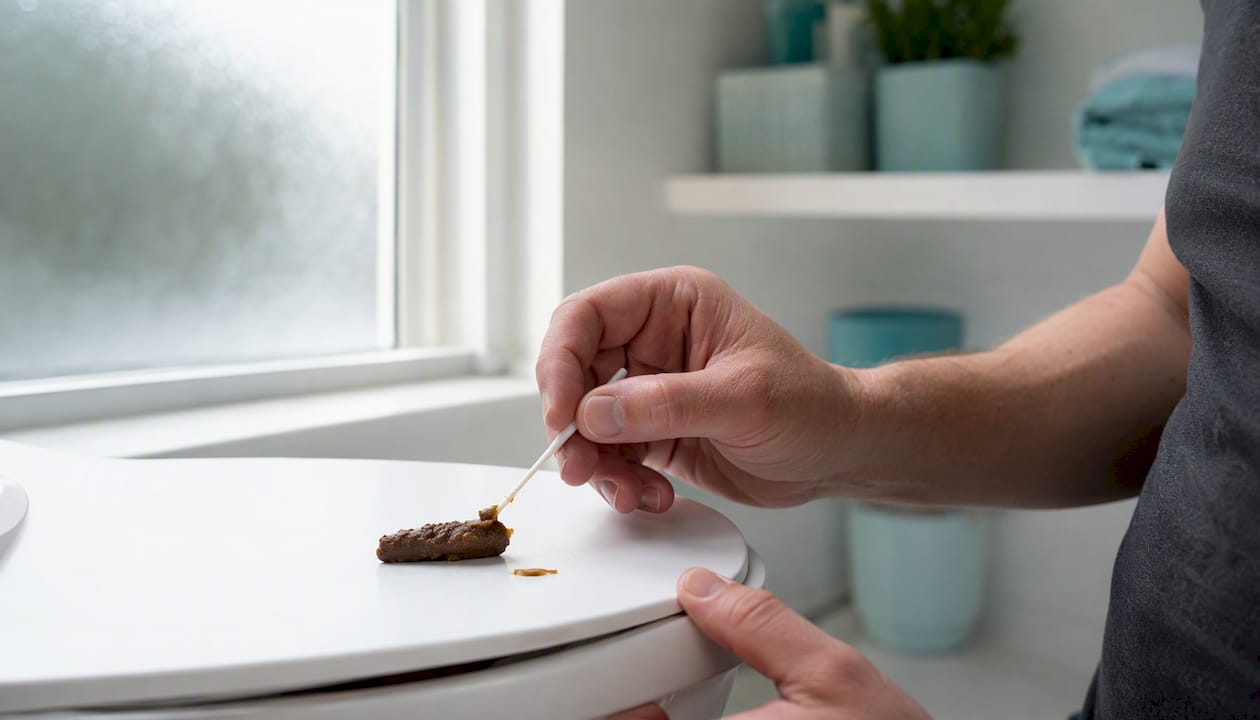
- Scrape the stick across the surface of the stool in several places until the grooved tip is lightly and evenly coated. You only need a small amount.
- Replace the stick in the tube and screw the cap closed firmly until it clicks. Do not press the stick down into the tube.
- Check the label on the tube shows your name, date of birth, NHS or hospital number, and today’s date.
- Place the sealed tube and your request form into the provided bag or envelope and seal it.
- Wash your hands thoroughly with soap and water.
- Dispose of the catch paper or container in your household waste, not the toilet.
Pro Tip: Write the collection date on the tube before you sit down, not after. It is easy to forget once you are washing your hands.
Do not insert the collection stick into your body. You are only scraping the surface of the stool.
Why do samples get rejected, and how do you avoid it?
Most rejections come down to a handful of simple, avoidable errors. Contamination and incorrect labelling are the top two causes.
Common reasons for rejection:
- Stool contaminated with toilet water or urine
- Tube not labelled, or missing the collection date
- Too much stool collected (a thick glob rather than a thin coating on the grooves)
- Sample returned after the 7-day window
- Tube damaged, leaking, or missing its buffer solution
What to do if your stool touches the water: Do not use that sample. Discard the catch material, wait for your next bowel movement, and try again with a fresh catch method. If your kit only came with one tube, contact your GP practice or the screening programme for a replacement.
A damaged tube or one that has lost its buffer solution should also not be used. The buffer solution inside the tube protects the sample; without it, the test chemistry cannot work correctly.
How to return your sample and what to expect next
Once the tube is sealed and labelled, place it in the provided bag along with your completed request form. Seal the bag securely.
Where to return it:
- Your GP practice (hand it in at reception)
- A designated NHS drop-off point specified in your kit instructions
- By post, if a pre-paid envelope is included with your kit
Timeline rules:
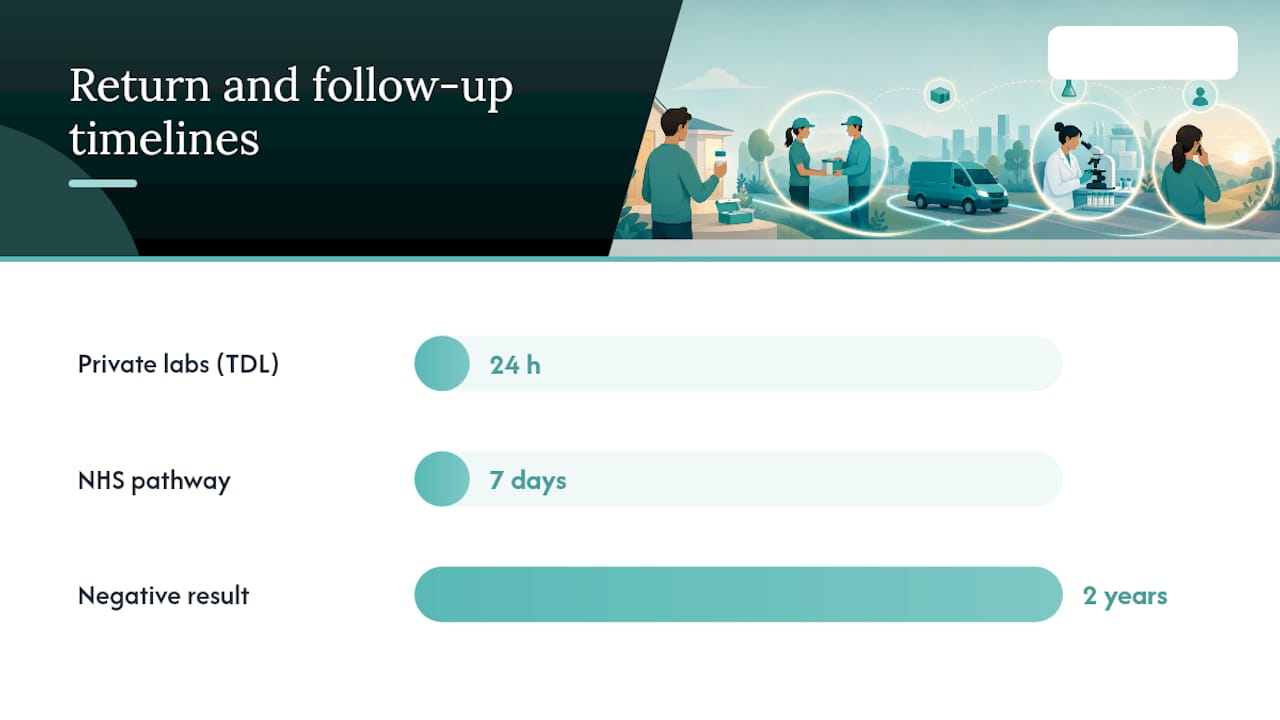
- NHS pathway: return within 7 days of collection
- Private labs such as TDL advise posting the same day or within 24 hours for best results
- Always follow the specific instructions supplied with your kit, as timelines vary by provider
After you return the sample:
- The lab analyses the sample for traces of blood
- Results are usually sent by letter or communicated via your GP
- If your result is negative, you will typically be invited again in two years (routine screening)
- If your result is positive, you will be contacted to discuss next steps, usually a referral for colonoscopy
| Stage | What happens |
|---|---|
| Sample received by lab | Analysed for blood using immunochemical method |
| Negative result | Letter sent; routine re-invitation in two years |
| Positive result | GP or screening team contacts you for further investigation |
| Further investigation | Usually colonoscopy or specialist referral |
Practical tips to make collection easier
The process feels less daunting once you have a clear plan. These are the tips that actually help.
Pro Tip: Use a disposable plastic cup or a clean paper plate as your catch container. It sits neatly under the toilet seat and keeps the stool completely clear of the water.
Dos:
- Urinate and flush before collecting
- Use layered toilet paper or a disposable container as your catch
- Write the date on the tube before you sit down
- Use a black or blue pen so the label is legible
- Collect in the morning if possible, so you can return the sample the same day
Don’ts:
- Do not let the stool touch toilet water or urine
- Do not collect more than a thin coating on the grooved tip
- Do not store the sample in direct sunlight or near heat
- Do not use a tube that is past its expiry date or visibly damaged
- Do not delay returning the sample beyond the timeframe in your instructions
A small, even coating on the grooves is all the lab needs. More is not better here.
What do your FIT results actually mean?
Negative result: No blood was detected at a level that requires further investigation. For routine screening, you will usually be invited again in two years. A negative result is reassuring, though it does not guarantee there are no bowel problems, which is why regular screening matters.
Positive result: Blood was detected. This does not mean you have cancer. A positive FIT signals that further investigation is needed, most commonly a colonoscopy, which allows doctors to look directly at the bowel lining. Many positive FIT results turn out to have benign causes such as haemorrhoids or small polyps.
What happens next:
- The screening programme or your GP will contact you, usually by letter or phone
- You will be offered a referral to a specialist or a colonoscopy appointment
- Timescales vary, but urgent referrals are typically seen within two weeks
- If you have not heard back within a few weeks of returning your sample, contact your GP practice
The key message: a positive result is a prompt to investigate, not a verdict. Acting on it quickly gives you the best possible outcome.
A word from the editor
The FIT test is one of the simplest, most effective things you can do for your long-term health, and yet a surprising number of people put it off because the idea feels awkward or confusing. Having read through the NHS guidance and patient leaflets carefully, what strikes me is just how straightforward the process actually is once it is laid out clearly. The steps take less than five minutes. The kit does most of the work.
If you have received a kit through the post and it is sitting on your kitchen counter, do it today. If you have symptoms and have not yet spoken to your GP, do that today too. For official guidance, GOV.UK and NHS England are the authoritative sources, and your GP practice can answer any questions specific to your situation.
Prefer a private at-home FOB test?
If you would rather not wait for an NHS invitation, or you simply want the reassurance of screening on your own terms, Rapidtest’s at-home FOB testing kit gives you a private, rapid alternative with results in 15 minutes, no lab, no appointment, and no queue.
It is worth being clear: a Rapidtest FOB kit is a private screening option, not a replacement for NHS clinical pathways. If your result is positive, or if you have symptoms, the right next step is always your GP or the NHS screening programme. But for proactive, private peace of mind, it is a straightforward option you can order today. You can also explore the PSA and FOB bundle if you want broader men’s health screening in one go.
Sources
These are the authoritative UK sources used in this guide. If your kit instructions differ from anything here, follow your kit.
- Patient instructions for using FIT (Queens English) — NHS England
- Gov
- Patient information leaflet for FIT for symptomatic patients — Transformation Partners (NHS)
- FIT test (QFIT) sample collection — The Doctors Laboratory (TDL)
- Testing for blood in your poo using FIT — Cancer Research UK
For general home sample collection advice, the Rapidtest blog covers the broader principles clearly.
This article is general information, not a substitute for advice from a qualified doctor. Consult a qualified healthcare professional about your own circumstances before acting on anything here.
FAQ
How do you collect a sample for a FIT test?
Use the grooved collection stick from your kit to scrape a small amount of stool, coat the tip lightly, reseal the tube, label it with your name, date of birth, NHS number, and collection date, then return it within 7 days. Full step-by-step instructions are available from NHS England.
How much stool do I need to collect for a FIT sample?
You only need a thin, even coating on the grooved tip of the collection stick. Over-collecting can interfere with the test chemistry, so less is genuinely better here.
How likely is bowel cancer if my FIT result is positive?
A positive FIT result does not mean you have cancer. It means blood was detected and further investigation is needed, usually a colonoscopy. Many positive results have benign causes such as haemorrhoids or polyps.
What is the best time of day to collect a stool sample?
There is no medically required time, but collecting in the morning works well practically. It gives you the whole day to return the sample to your GP or drop-off point, keeping it well within the 7-day window.
Can I use a private FOB test instead of the NHS FIT kit?
A private at-home FOB test, such as the one from Rapidtest, can offer rapid results for personal peace of mind, but it is a private screening option rather than a substitute for NHS clinical follow-up. If you have symptoms or a positive result from any test, contact your GP.