


When does bowel cancer screening start in the UK?
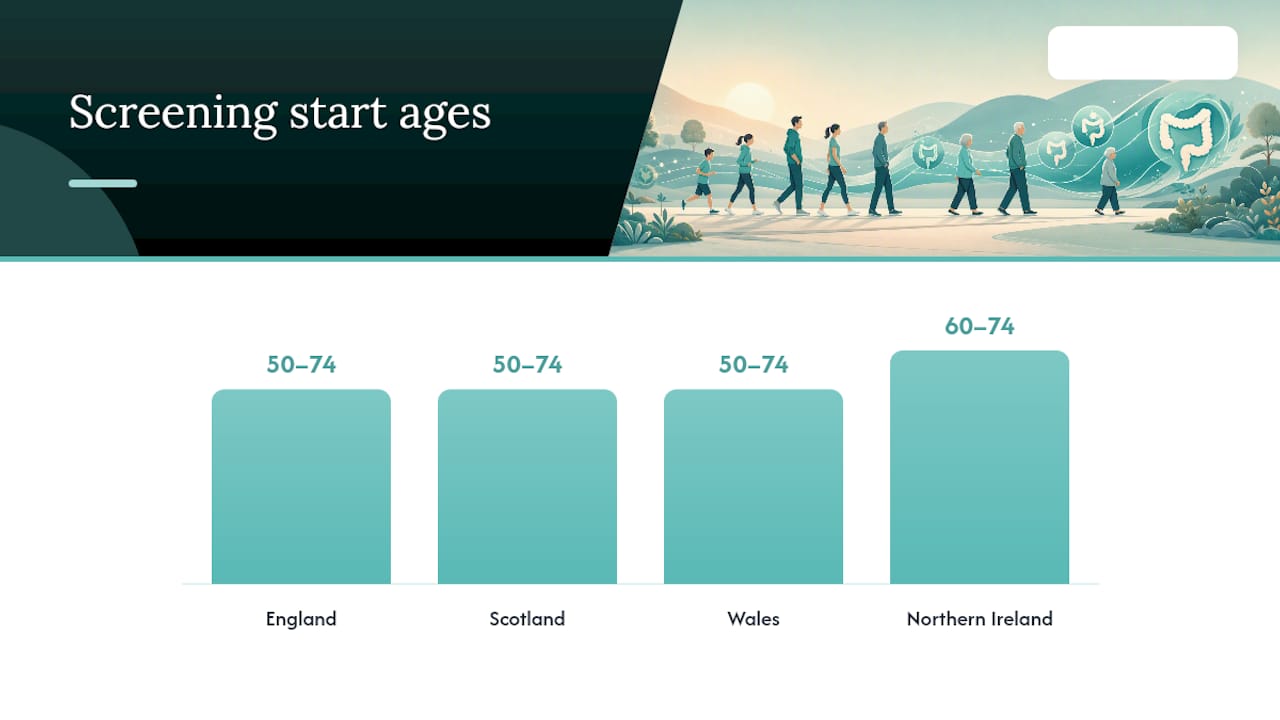
If you’re aged 50 to 74 in England, Scotland or Wales, you’ll be invited for NHS bowel cancer screening every two years. In Northern Ireland, that invitation currently starts at 60. You do not need to do anything to opt in. The NHS sends a home testing kit to whatever address your GP has on file, so keeping your details up to date matters more than most people realise.
Here’s what you need to know right now:
- Ages 50 to 74 (50 to 74 in England, Scotland and Wales; 60 to 74 in Northern Ireland) get invited automatically every two years.
- Kits arrive by post, sent to the address registered with your GP.
- Aged 75 or over? You won’t get an automatic invite, but you can request a kit yourself by calling the free NHS bowel cancer screening helpline on 0800 707 6060.
TL;DR:
- People aged 50 to 74 in the UK are invited for bowel cancer screening every two years, but Northern Ireland starts at age 60 and the invite timing varies by birth cohort.
- The FIT home test detects tiny blood traces in stool samples, with results arriving within two weeks, and positive results lead to further investigation rather than diagnosis.
- Moving residence or updating GP details is crucial, as inaccurate records can cause missed screening invitations, especially around the age of a person’s eligibility window.
- Individuals over 75 can request screening kits every two years by phone, but high-risk groups should consult their GP for tailored surveillance options.
- Private at-home FOB tests like Rapidtest provide quick, interim checks but are not substitutes for NHS diagnostics or necessary follow-up procedures.
Table of Contents
- Bowel cancer screening age UK: who’s invited and why the rules differ
- How does the FIT home test work?
- When will I get my next screening invitation?
- What do FIT results actually mean?
- Screening after 75 and what higher-risk groups should do instead
- Why does screening start at 50, not sooner?
- Where private at-home FOB testing fits alongside NHS screening
- The eligibility rules matter more than the marketing around them
- Want a bowel health check without waiting for your next invitation?
- Key Takeaways
- Sources
- FAQ
Bowel cancer screening age UK: who’s invited and why the rules differ
The screening ages aren’t arbitrary. England, Scotland and Wales all invite adults aged 50 to 74, while Northern Ireland’s programme currently begins at 60 and runs to 74. That gap catches people out, particularly those who’ve moved between UK nations and assume the rules are identical everywhere.
Not everyone gets their first kit on their 50th birthday. Because the rollout to younger age groups happened in phases, some people received their first invitation at 50, others at 52 or 54, depending on when their birth cohort was brought into the programme. It’s confusing if you’re comparing notes with a friend who started two years before you did, but it’s not an error.
The whole system runs on GP records. Screening invitations depend on accurate demographic data held by GP surgeries, so if you’ve recently moved house or switched GP, do these two things:
- Confirm you’re still registered with a GP at your current address.
- Update your contact details directly with the surgery, not just with your council or bank.
How does the FIT home test work?
The test itself is refreshingly undramatic. Since the programme moved to the faecal immunochemical test, or FIT, screening no longer involves the older guaiac-based kits that many people remember as fiddly and unpleasant. FIT checks for tiny traces of blood in a stool sample that aren’t visible to the naked eye, which can sometimes be an early sign of bowel cancer or polyps.
Using the kit takes a few minutes, not because it’s complicated but because the instructions are precise:
- Collect a small stool sample using the probe provided in the kit.
- Seal it into the sample bottle exactly as shown in the leaflet.
- Post it back in the pre-paid envelope, ideally the same day.
- Wait for your result letter, which normally arrives within a couple of weeks.
Worth repeating: this is a screening test for people with no symptoms. If you’re already experiencing bleeding, persistent changes in bowel habit, or unexplained weight loss, screening isn’t the right route. Speak to your GP directly instead, because those symptoms need proper investigation regardless of when your next screening invite is due.
Pro Tip: Do the test as soon as the kit arrives rather than leaving it in a drawer. Samples degrade over time, and a fresher sample gives a more reliable result. Our step-by-step FIT collection guide walks through the process if you want a visual run-through first.
When will I get my next screening invitation?
Invitations go out on a two-year cycle, so once you’re in the system, you can roughly predict when the next envelope will land. That said, a few things affect the timing.
- The recent expansion means people turning 50 or 52 only started receiving kits automatically from 2025, as NHS England widened the programme to cover the full 50 to 74 range.
- If your birthday falls near a screening round, your first kit might arrive slightly later than expected. That’s phasing, not an oversight.
- If it’s been more than two years since your last kit and nothing has turned up, contact your GP surgery or call the helpline rather than assuming you’ve simply been missed.
Moving house, changing surname, or switching GP surgeries around the time you’re due are the three most common reasons people fall through the gaps.
What do FIT results actually mean?
Most people who take the test get good news, and it’s worth understanding the numbers before assuming a positive result means the worst.
- Negative result: No blood was detected above the threshold. You’ll be invited again in two years and should carry on watching for any bowel symptoms in the meantime.
- Positive result: Blood was detected, which triggers a referral, usually for a colonoscopy. This is not a cancer diagnosis. It simply means further investigation is needed to find out why.
A positive FIT sets off a diagnostic pathway rather than a verdict, and colonoscopy waiting times can vary regionally, which is why the programme includes quality assurance steps to prioritise people flagged as higher risk.
Results letters typically arrive within two weeks of the sample being received. If you’re referred on, expect a follow-up appointment to be arranged fairly quickly given the prioritisation built into the system, though exact timescales depend on local capacity.
Screening after 75 and what higher-risk groups should do instead
Turning 75 doesn’t mean the door closes. You simply move from automatic invitation to opt-in.
- Call the free NHS bowel cancer screening helpline on 0800 707 6060 and ask for a kit.
- Repeat this every two years for as long as you want to continue, since screening for the 75+ group is available on request rather than by automatic invite.
- If you have a strong family history, Lynch syndrome, or a history of multiple polyps, don’t rely on population screening at all. Speak to your GP or specialist team about tailored surveillance, which usually means more frequent colonoscopies rather than a two-yearly FIT kit.
Higher-risk surveillance exists precisely because the standard 50 to 74 programme is calibrated for average risk, not for people whose genetics or medical history put them well outside that curve.
Why does screening start at 50, not sooner?
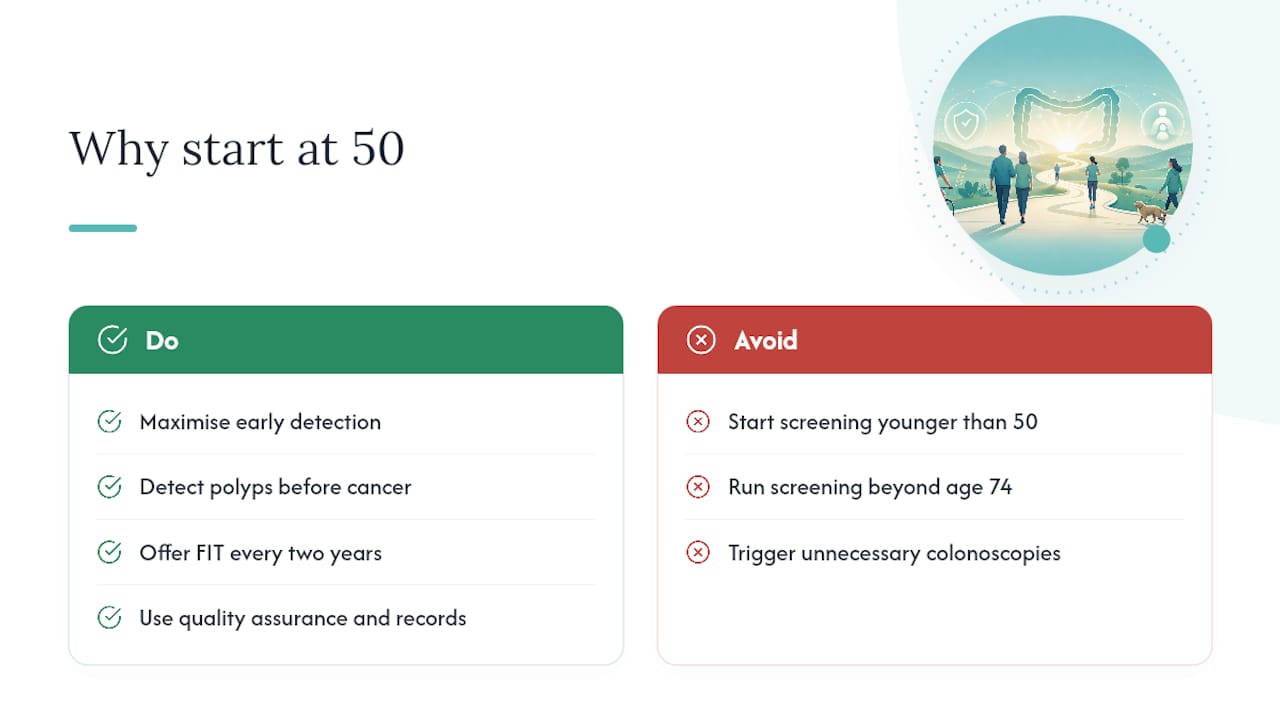
The starting age isn’t guesswork. The UK National Screening Committee recommends offering FIT screening every two years to people aged 50 to 74 because the evidence shows it reduces deaths from bowel cancer and can help prevent it altogether by catching polyps before they turn cancerous.
Every screening programme is a trade-off, and bowel screening is no exception. FIT will occasionally flag a positive result that turns out, after investigation, to be nothing sinister. Those false positives lead to colonoscopies that weren’t strictly necessary, which is a real cost to the person and the NHS.
Sound population screening isn’t about catching every possible case. It’s about maximising early detection while keeping unnecessary investigations to a minimum, backed by quality assurance and accurate invitation records.
That balance is exactly why the age range sits at 50 to 74 rather than starting earlier or running indefinitely.
Where private at-home FOB testing fits alongside NHS screening
If you’re outside the 50 to 74 window, waiting for your next invitation, or simply want a private check between NHS rounds, Rapidtest’s at-home FOB testing kit gives you a result in around 15 minutes without waiting for a postal lab. It works on the same principle as FIT, checking for hidden blood in a stool sample, though private kits vary from NHS laboratory testing in method and validation, so treat a positive private result as a prompt to see your GP, not a diagnosis in itself.
A private kit suits someone who wants an interim check or extra reassurance, not someone replacing NHS diagnostic follow-up.
- Use it as a convenience check, not a substitute for colonoscopy if you’re symptomatic.
- Keep a copy of your result and share it with your GP if it’s abnormal.
- Read our complete guide to at-home FOB testing before you buy, so you know exactly what the kit can and can’t tell you.
Pro Tip: Private testing works best as a bridge between NHS screening rounds, not a replacement for them. If your NHS invite is due within a few months, it’s usually simpler to just wait.
The eligibility rules matter more than the marketing around them
The conventional advice on bowel screening tends to focus on encouraging people to “just do the test,” which is fine as far as it goes but skips over the part that actually causes missed screenings: administrative drift. People move house, switch GPs, or fall between screening rounds during a life change, and nobody chases them because the system assumes their records are current.
I’d argue the single most useful thing anyone aged 45 to 75 can do this year isn’t researching symptoms or reading about colonoscopy prep. It’s ringing their GP surgery to confirm their address and registration status. That five-minute call solves more missed-screening cases than any amount of health literacy content ever will.
The other underrated point is what happens outside the 50 to 74 window. Too many people either assume nothing is available to them until 50, or that everything stops dead at 75. Neither is true, and the gap in public understanding here is wider than it should be given how simple the helpline route actually is.
Private testing has a place, but only a specific one: as a convenience layer, not a clinical substitute. Anyone treating an at-home FOB kit as equivalent to NHS diagnostic pathways has misunderstood what it’s for.
— Jack
Want a bowel health check without waiting for your next invitation?
Rapidtest gives you a private option for the gaps NHS screening doesn’t cover: if you’re under 50, between screening rounds, or simply want a quicker read on your bowel health while you wait for your next kit. Unlike the two-year NHS cycle, our at-home FOB testing kit gives you a result in around 15 minutes, with no GP appointment and no waiting for a postal lab.
It’s not a replacement for NHS diagnostic colonoscopy if you’re symptomatic or have received a positive screening result, but it’s a straightforward way to check in on your bowel health on your own schedule. If you’re also due a broader men’s health check, our 35+ health MOT bundle covers prostate and bowel markers together. Order your kit today and get your result within 15 minutes, at home.
Key Takeaways
Bowel cancer screening in the UK is offered every two years to adults aged 50 to 74 (60 to 74 in Northern Ireland), with people aged 75 and over able to request a kit by phone.
| Point | Details |
|---|---|
| Check your eligibility | Ages 50 to 74 apply in England, Scotland and Wales; Northern Ireland starts at 60. |
| Confirm GP registration | Kits are posted using GP records, so an out-of-date address can mean a missed invite. |
| Call if you’re 75+ | Ring the free NHS helpline on 0800 707 6060 to request a kit every two years. |
| A positive result isn’t a diagnosis | It leads to a referral, usually for colonoscopy, for further investigation. |
| Consider private testing between rounds | Rapidtest’s at-home FOB kit gives a result in around 15 minutes for interim checks, not as a replacement for NHS diagnostic follow-up. |
Sources
- Bowel cancer screening — NHS
- Gov
- Bowel cancer — UK National Screening Committee
- NHS rolls out lifesaving home testing for bowel cancer to over 50s — NHS England
FAQ
What age group is eligible for bowel cancer screening in the UK?
Adults aged 50 to 74 in England, Scotland and Wales are invited automatically every two years; in Northern Ireland, invitations currently start at 60.
Can you request bowel screening after 74?
Yes. People aged 75 and over don’t get an automatic invite but can request a free kit every two years by calling 0800 707 6060.
Is 40 too early for a colonoscopy?
Colonoscopy before the screening age isn’t part of routine NHS screening unless you have symptoms or a known higher-risk factor like Lynch syndrome or a strong family history, in which case your GP can refer you for tailored surveillance rather than population screening.
Why is there no automatic bowel cancer screening after 75?
The 50 to 74 range reflects where the UK NSC’s evidence shows the clearest balance of benefit against risk; screening remains available after 75, but only on request via the helpline rather than by automatic invite.
What’s the difference between NHS FIT screening and a private FOB test?
NHS FIT kits are processed through an accredited laboratory as part of a structured screening programme, while private kits like Rapidtest’s at-home FOB test give a faster result for personal use but should prompt a GP visit if the result is abnormal.